Plant Growth and Development – Class 11 Biology Notes
Chapter – 13
Plant Growth and Development
1. Growth
Growth is an irreversible, permanent increase in the size of an organ, its parts or even an individual cell. It is one of the most fundamental and conspicuous characteristics of a living being and is accompanied by metabolic processes (both anabolic and catabolic) that occur at the expense of energy.
Example: Expansion of a leaf is growth; swelling of a piece of wood placed in water is not, because it is not irreversible and is not a property of a living cell.
Plant growth is generally indeterminate: Plants retain the capacity for unlimited growth throughout their life because they have meristems at certain locations in their body. This form of growth, where new cells are always being added by the meristem, is called the open form of growth.
- Apical meristems (root and shoot) cause primary growth, mainly elongation along the axis.
- Lateral meristems (vascular cambium and cork cambium) appear later in dicots and gymnosperms and cause secondary growth, an increase in girth.
Measuring growth: Growth at the cellular level is mainly the result of increase in the amount of protoplasm. It can be measured as increase in fresh weight, dry weight, length, area, volume or cell number.
Example: One single maize root apical meristem can give rise to more than 17,500 new cells per hour. Cells in a watermelon may increase in size by up to 3,50,000 times.
2. Phases of Growth
The period of growth is generally divided into three phases, best seen in a root tip:
- Meristematic phase: Constantly dividing cells at the root apex and shoot apex. Cells are rich in protoplasm, have large conspicuous nuclei and thin, cellulosic primary walls with abundant plasmodesmata.
- Phase of elongation: Cells just behind the meristematic zone show increased vacuolation, cell enlargement and new cell wall deposition.
- Phase of maturation: Further away from the apex, cells attain their maximal size in terms of wall thickening and protoplasmic modifications.
3. Growth Rates
The increased growth per unit time is called the growth rate. It may be arithmetic or geometric.
Feature | Arithmetic growth | Geometric growth |
|---|---|---|
Pattern | Only one daughter cell continues to divide; the other differentiates and matures | Both daughter cells continue to divide |
Example | Root elongating at a constant rate | Early growth of the embryo, cells in culture |
Graph | Straight line (linear curve) | Sigmoid (S-shaped) curve |
Equation | Lt = L0 + rt | W1 = W0 ert |
Where Lt = length at time t, L0 = length at time zero, r = growth rate (elongation per unit time); W1 = final size, W0 = initial size, r = relative growth rate (efficiency index), t = time and e = base of natural logarithms.
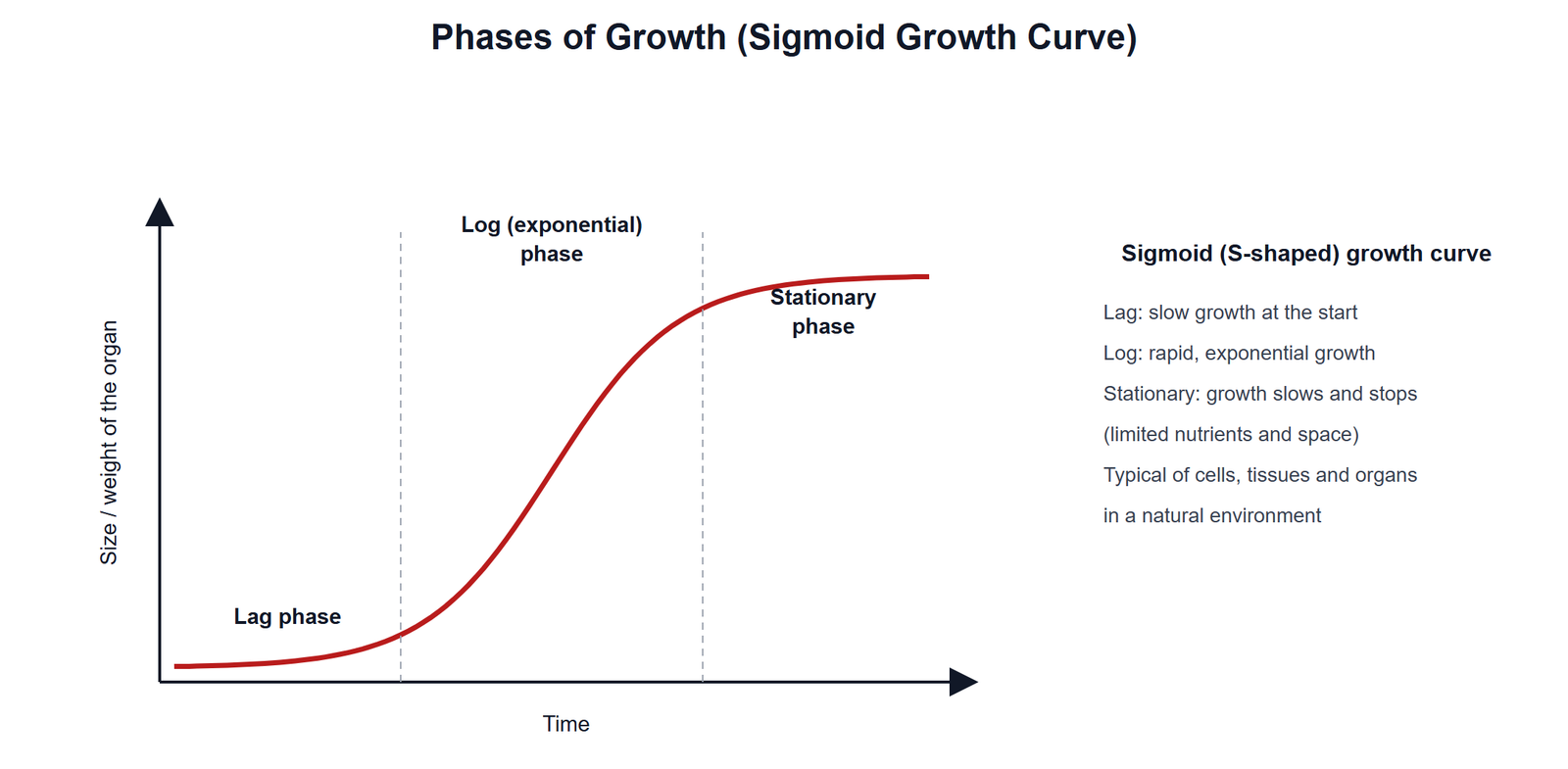
Sigmoid growth curve: In geometric growth, the initial growth is slow (lag phase), then rapid at an exponential rate (log or exponential phase). With limited nutrient supply, growth slows down and reaches a stationary phase. The S-shaped curve is characteristic of living organisms growing in a natural environment.
- Absolute growth rate: Measurement and comparison of total growth per unit time.
- Relative growth rate: Growth of the given system per unit time expressed on a common basis, e.g. per unit initial parameter.
Exam point: Two leaves may show the same absolute increase in area (5 cm2), but the smaller leaf has a much higher relative growth rate.
4. Conditions for Growth
- Water: Cell enlargement needs water; turgidity of cells helps extension growth. Water also provides the medium for enzymatic activities.
- Oxygen: Releases metabolic energy needed for growth.
- Nutrients: Macro- and micro-elements are needed for the synthesis of protoplasm and as an energy source.
- Temperature: Every plant has an optimum temperature range; deviations can be harmful.
- Light and gravity: Environmental signals that affect certain phases and stages of growth.
5. Differentiation, Dedifferentiation and Redifferentiation
- Differentiation: Cells derived from root and shoot apical meristems and cambium differentiate and mature to perform specific functions. Example: To form a tracheary element, cells lose their protoplasm and develop very strong, elastic lignocellulosic secondary cell walls.
- Dedifferentiation: Living differentiated cells that had lost the capacity to divide regain it under certain conditions. Example: Formation of interfascicular cambium and cork cambium from fully differentiated parenchyma cells.
- Redifferentiation: Cells produced by dedifferentiated meristems lose the capacity to divide again and mature to perform specific functions. Example: Secondary xylem and secondary phloem formed by the cambium.
Remember: Growth in plants is open, and differentiation is also open, because cells from the same meristem can give rise to different structures at maturity depending on their location. Example: Cells pushed away from the root apical meristem differentiate as root cap cells, while those pushed to the periphery mature as epidermis.
6. Development and Plasticity
Development is the sum of all changes an organism goes through during its life cycle, from germination of the seed to senescence (cell division → plasmatic growth → expansion → differentiation → maturation → senescence → death).
Plants follow different pathways in response to the environment or phases of life to form different kinds of structures. This ability is called plasticity.
- Heterophylly is an example of plasticity. In cotton, coriander and larkspur, leaves of the juvenile plant differ in shape from those of mature plants.
- In buttercup, the leaves produced in air differ from those produced in water. This heterophyllous development is due to the environment.
Development is the sum of growth and differentiation and is under the control of intrinsic factors (intracellular genetic factors and intercellular chemical factors such as plant growth regulators) and extrinsic factors (light, temperature, water, oxygen, nutrition).
7. Plant Growth Regulators (PGRs)
PGRs are small, simple molecules of diverse chemical composition, also called plant growth substances, plant hormones or phytohormones.
Chemical nature | PGR |
|---|---|
Indole compounds | Indole-3-acetic acid (IAA, an auxin) |
Adenine derivatives | N6-furfurylamino purine (kinetin, a cytokinin) |
Derivatives of carotenoids | Abscisic acid (ABA) |
Terpenes | Gibberellic acid (GA3) |
Gases | Ethylene (C2H4) |
PGRs can be broadly divided into two groups:
- Plant growth promoters: Involved in growth-promoting activities such as cell division, cell enlargement, pattern formation, tropic growth, flowering, fruiting and seed formation. Examples: auxins, gibberellins and cytokinins.
- Plant growth inhibitors: Involved in responses to wounds and stresses and in growth-inhibiting activities such as dormancy and abscission. Example: abscisic acid. Ethylene can be in either group but is largely an inhibitor.
Discovery:
- Auxin: Charles Darwin and his son Francis Darwin observed that coleoptiles of canary grass responded to unilateral light by growing towards the light source (phototropism). They concluded the tip was the site of a transmittable influence. Auxin was isolated by F.W. Went from tips of oat coleoptiles.
- Gibberellin: The “bakane” (foolish seedling) disease of rice was caused by the fungal pathogen Gibberella fujikuroi. E. Kurosawa reported the appearance of symptoms in uninfected rice seedlings treated with sterile filtrates of the fungus. The active substance was later identified as gibberellic acid.
- Cytokinin: F. Skoog and his co-workers observed that tobacco stem callus proliferated only if the medium contained extracts of vascular tissues, yeast extract, coconut milk or DNA. Skoog and Miller later crystallised the cytokinesis-promoting substance and named it kinetin.
- Abscisic acid: During the mid-1960s, three independent researchers reported purification of inhibitor-B, abscission II and dormin. They were proved to be chemically identical and named abscisic acid (ABA).
- Ethylene: Cousins confirmed the release of a volatile substance from ripened oranges that hastened the ripening of stored unripe bananas. It was later identified as ethylene, a gaseous PGR.
8. Physiological Effects of Plant Growth Regulators
(a) Auxins (Greek auxein = to grow). Natural: IAA and IBA. Synthetic: NAA (naphthalene acetic acid) and 2,4-D.
- Help to initiate rooting in stem cuttings, widely used for plant propagation.
- Promote flowering (e.g. in pineapples).
- Prevent fruit and leaf drop at early stages but promote abscission of older, mature leaves and fruits.
- Cause apical dominance: in most higher plants, the growing apical bud inhibits the growth of lateral (axillary) buds. Removal of the shoot tip (decapitation) usually results in growth of lateral buds. This is widely applied in tea plantations and hedge-making.
- Induce parthenocarpy (e.g. in tomatoes).
- Widely used as herbicides. 2,4-D is used to kill dicotyledonous weeds without affecting mature monocotyledonous plants, and is used to prepare weed-free lawns.
- Control xylem differentiation and help in cell division.
(b) Gibberellins (more than 100 known, GA1, GA2, GA3 … GA3 was the first discovered and is the most intensively studied). All GAs are acidic.
- Increase the length of the axis; used to increase the length of grape stalks.
- Cause fruits like apple to elongate and improve their shape.
- Delay senescence, so fruits can be left on the tree longer to extend the market period.
- Used in the brewing industry to speed up the malting process.
- Spraying sugarcane with gibberellins increases the length of the stem, raising the yield by as much as 20 tonnes per acre.
- Spraying juvenile conifers with GAs hastens maturity, leading to early seed production.
- Promote bolting (internode elongation just before flowering) in beet, cabbage and many plants with rosette habit.
(c) Cytokinins: Have specific effects on cytokinesis. Natural cytokinins are synthesised in regions of rapid cell division, such as root apices, developing shoot buds and young fruits. Examples: kinetin (a modified form of adenine), zeatin (from corn kernels and coconut milk).
- Help to produce new leaves, chloroplasts in leaves, lateral shoot growth and adventitious shoot formation.
- Help to overcome apical dominance.
- Promote nutrient mobilisation, which helps in delaying leaf senescence.
(d) Ethylene: A simple gaseous PGR synthesised in large amounts by tissues undergoing senescence and by ripening fruits.
- Causes horizontal growth of seedlings, swelling of the axis and apical hook formation in dicot seedlings.
- Promotes senescence and abscission of plant organs, especially leaves and flowers.
- Highly effective in fruit ripening; it enhances the respiration rate during ripening. This rise in respiration is called the respiratory climacteric.
- Breaks seed and bud dormancy, initiates germination in peanut seeds and sprouting of potato tubers.
- Promotes rapid internode/petiole elongation in deep-water rice plants, helping leaves and upper parts of the shoot remain above water.
- Promotes root growth and root hair formation, helping plants increase their absorption surface.
- Used to initiate flowering and synchronise fruit-set in pineapples; induces flowering in mango.
- The most widely used compound as a source of ethylene is ethephon. It is absorbed by the plant in aqueous solution and slowly releases ethylene. It hastens fruit ripening in tomatoes and apples, accelerates abscission in flowers and fruits (thinning of cotton, cherry, walnut) and promotes female flowers in cucumbers, increasing yield.
(e) Abscisic acid (ABA): Regulates abscission and dormancy, and acts as a general plant growth inhibitor and an inhibitor of plant metabolism.
- Inhibits seed germination.
- Stimulates the closure of stomata and increases tolerance of plants to various kinds of stress. It is therefore also called the stress hormone.
- Plays an important role in seed development, maturation and dormancy. By inducing dormancy, ABA helps seeds withstand desiccation and other unfavourable factors.
- In most situations, ABA acts as an antagonist to GAs.
PGR | Key function to remember |
|---|---|
Auxin | Apical dominance, rooting of cuttings, 2,4-D weedicide |
Gibberellin | Stem elongation, bolting, malting, sugarcane yield |
Cytokinin | Cell division, delays leaf senescence, overcomes apical dominance |
Ethylene | Fruit ripening, abscission, respiratory climacteric |
Abscisic acid | Stomatal closure, dormancy, stress hormone |
Important: No single PGR acts alone. In most situations, PGRs interact (synergistically or antagonistically) to affect a given phase of growth. Examples: dormancy in seeds and buds, abscission, senescence and apical dominance.
Easy Memory Trick: “All Good Cats Eat Apples” for Auxin, Gibberellin, Cytokinin, Ethylene, Abscisic acid — the first three promote growth, the last two mostly inhibit it.
Conclusion: Plant growth is irreversible, indeterminate and open, and can be arithmetic or geometric (sigmoid). Cells differentiate, dedifferentiate and redifferentiate, and plants show plasticity during development. Growth and development are controlled by intrinsic factors such as the five plant growth regulators (auxins, gibberellins, cytokinins, ethylene and abscisic acid) and by extrinsic factors such as light, temperature and water.