Morphology of Flowering Plants – Class 11 Biology Notes
Chapter – 5
Morphology of Flowering Plants
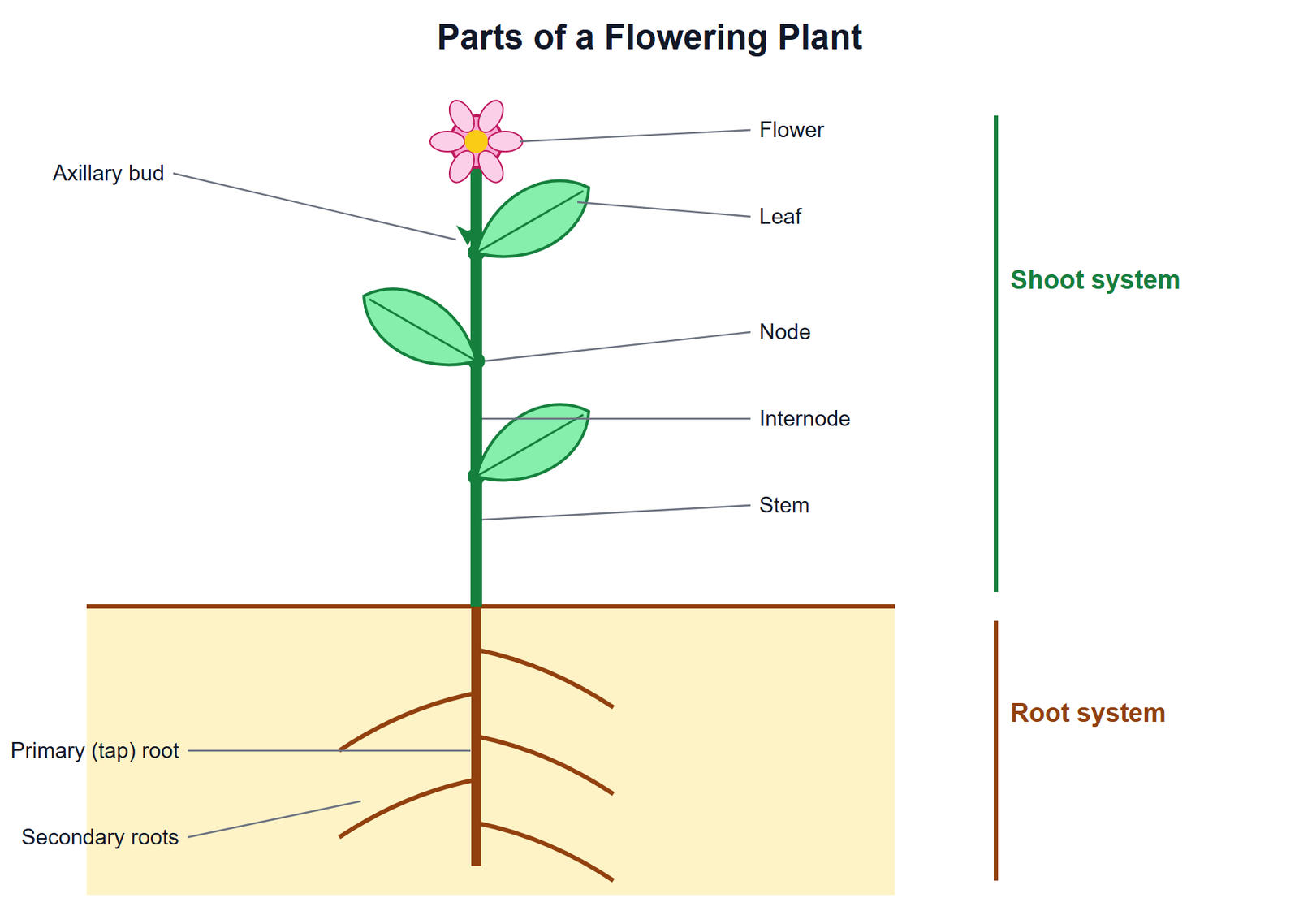
Morphology is the study of the external form and features of organisms. A typical flowering plant has a root system (below the ground) and a shoot system (above the ground, with stem, leaves, flowers and fruits).
1. The Root
- Tap root system: In most dicots, the radicle elongates to form the primary root, which bears lateral roots (secondary, tertiary roots). Example: mustard.
- Fibrous root system: In monocots, the primary root is short-lived and is replaced by many roots arising from the base of the stem. Example: wheat.
- Adventitious roots: Roots that arise from parts of the plant other than the radicle. Example: grass, Monstera, banyan tree.
Functions: absorption of water and minerals, anchorage, storage of food, and synthesis of plant growth regulators.
Regions of the root tip:
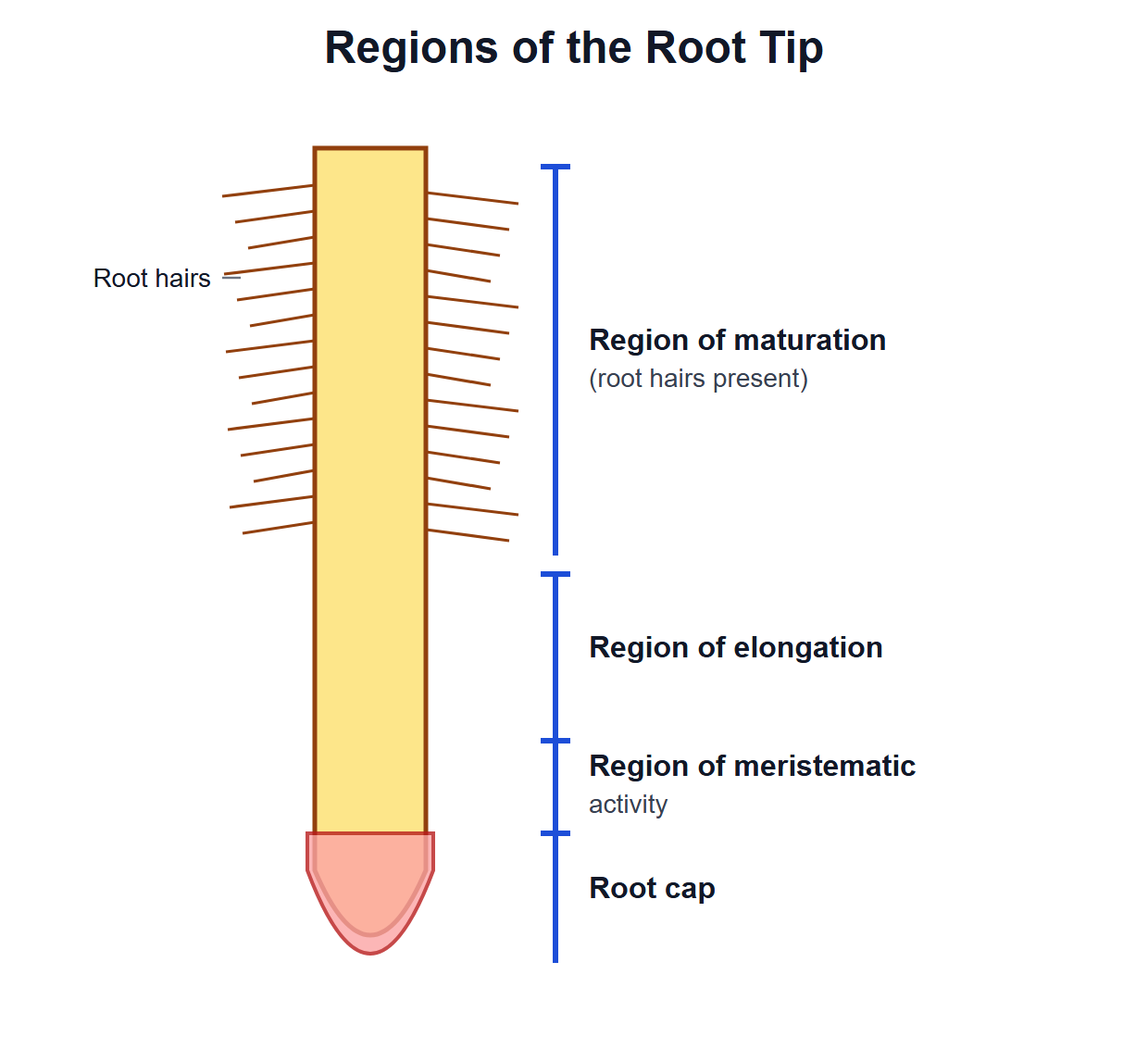
- Root cap: A thimble-like structure that protects the tender apex.
- Region of meristematic activity: Small cells with dense protoplasm that divide repeatedly.
- Region of elongation: Cells elongate rapidly and increase the length of the root.
- Region of maturation: Cells differentiate and mature. Some epidermal cells form root hairs, which absorb water and minerals.
Modifications of roots:
Modification | Function | Examples |
|---|---|---|
Storage roots | Store food | Carrot, turnip (tap roots); sweet potato (adventitious) |
Prop roots | Support (hanging roots from branches) | Banyan tree |
Stilt roots | Support (from lower nodes of stem) | Maize, sugarcane |
Pneumatophores | Respiration (roots grow vertically upwards to get oxygen) in swampy areas | Rhizophora (mangrove) |
2. The Stem
The stem is the ascending part of the plant axis that develops from the plumule of the embryo. It bears nodes (where leaves arise) and internodes (portions between nodes). It bears buds, which may be terminal or axillary.
Functions: spreading out branches bearing leaves, flowers and fruits; conducting water, minerals and food; storage of food; support; protection; and vegetative propagation.
Modifications of stem:
Modification | Function | Examples |
|---|---|---|
Underground stems | Storage of food; perennation | Potato (tuber), ginger, turmeric (rhizome), zaminkand, Colocasia (corm) |
Stem tendrils (from axillary buds) | Climbing | Cucumber, pumpkin, watermelon, grapevine |
Thorns (from axillary buds) | Protection from grazing animals | Citrus, Bougainvillea |
Flattened / fleshy green stems | Photosynthesis in arid regions | Opuntia (flattened), Euphorbia (fleshy cylindrical) |
Sub-aerial stems | Vegetative propagation | Runner: grass, strawberry; stolon: mint, jasmine; offset: Pistia, Eichhornia; sucker: banana, pineapple, Chrysanthemum |
3. The Leaf
The leaf is a lateral, generally flattened structure borne on the stem. It develops at the node and bears a bud in its axil. Leaves originate from shoot apical meristems and are arranged in an acropetal order. They are the most important vegetative organs for photosynthesis.
A typical leaf has three main parts: leaf base, petiole and lamina. In some leguminous plants, the leaf base may become swollen; this is called the pulvinus.
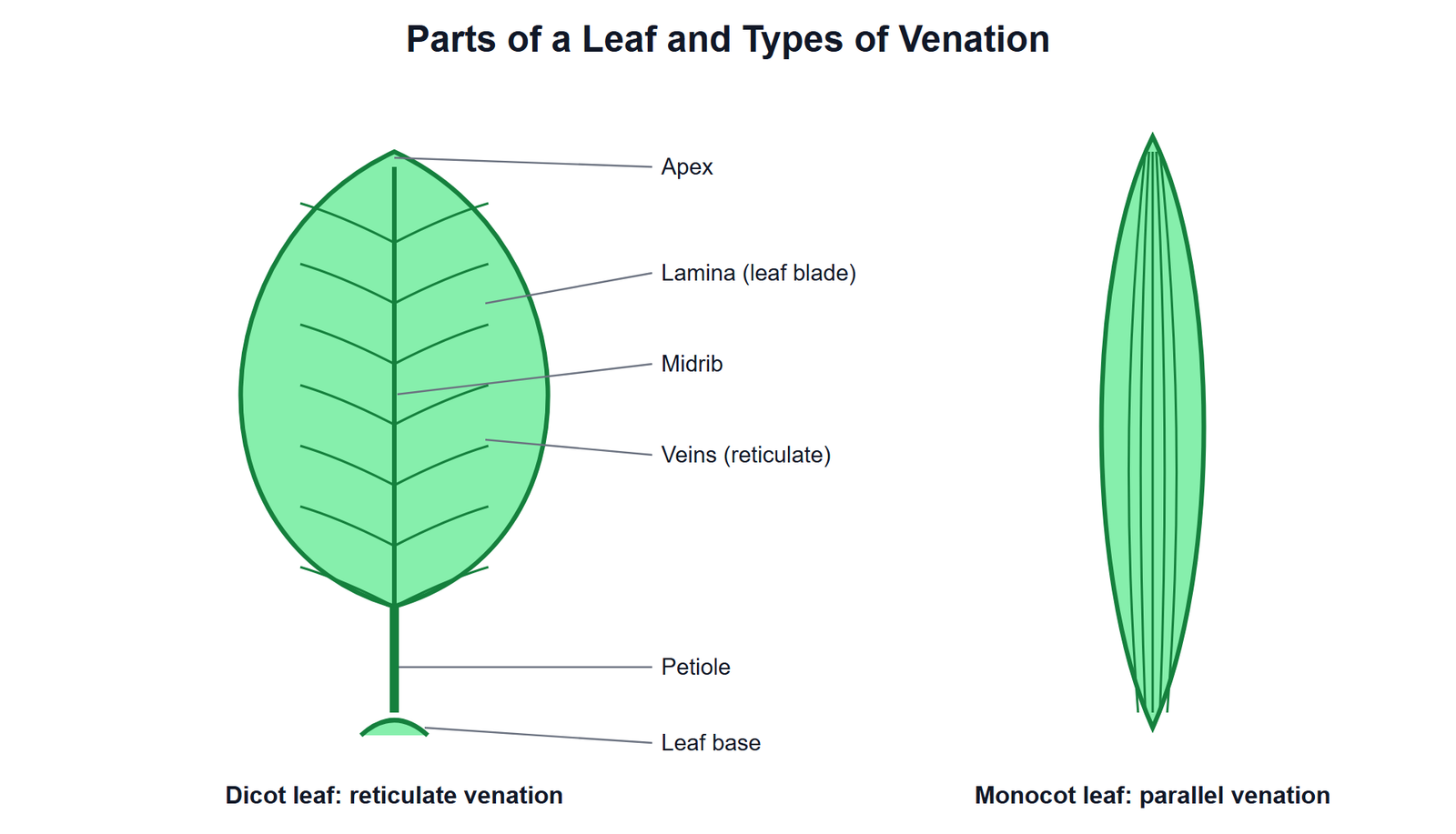
- Venation: The arrangement of veins and veinlets in the lamina. Reticulate venation (network of veinlets) is found in dicots; parallel venation (veins run parallel) is found in most monocots.
- Types of leaves: A leaf is simple when its lamina is entire or, if incised, the incisions do not touch the midrib. It is compound when the incisions reach the midrib, breaking it into leaflets.
- Pinnately compound: leaflets on a common axis, the rachis (e.g. neem).
- Palmately compound: leaflets attached at a common point, the tip of the petiole (e.g. silk cotton).
- Phyllotaxy: The pattern of arrangement of leaves on the stem.
- Alternate: a single leaf at each node in alternate manner (China rose, mustard, sunflower).
- Opposite: a pair of leaves at each node, opposite to each other (Calotropis, guava).
- Whorled: more than two leaves at a node, forming a whorl (Alstonia).
Modifications of leaves: tendrils for climbing (peas); spines for defence (cacti); fleshy leaves for storing food (onion, garlic); phyllode, a flattened green petiole that does the work of the lamina (Australian acacia); leaves modified to trap insects (pitcher plant, Venus fly trap).
4. The Inflorescence
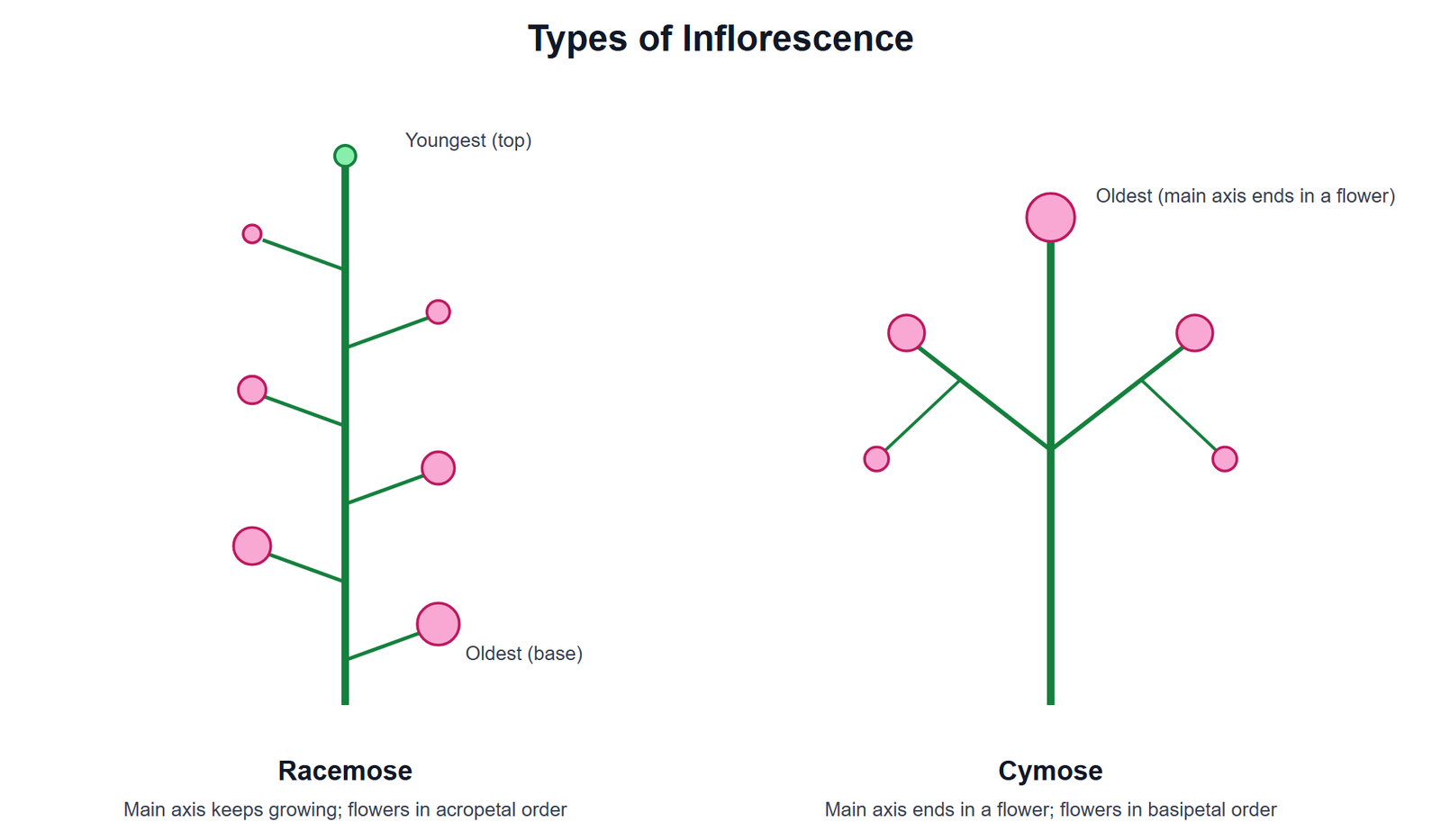
The arrangement of flowers on the floral axis is called inflorescence. A flower is a modified shoot in which the shoot apical meristem changes into a floral meristem.
Racemose | Cymose |
|---|---|
Main axis continues to grow | Main axis terminates in a flower |
Flowers borne laterally in acropetal succession (older below, younger above) | Flowers borne in basipetal order (older at the top) |
Growth of the axis is unlimited | Growth of the axis is limited |
5. The Flower
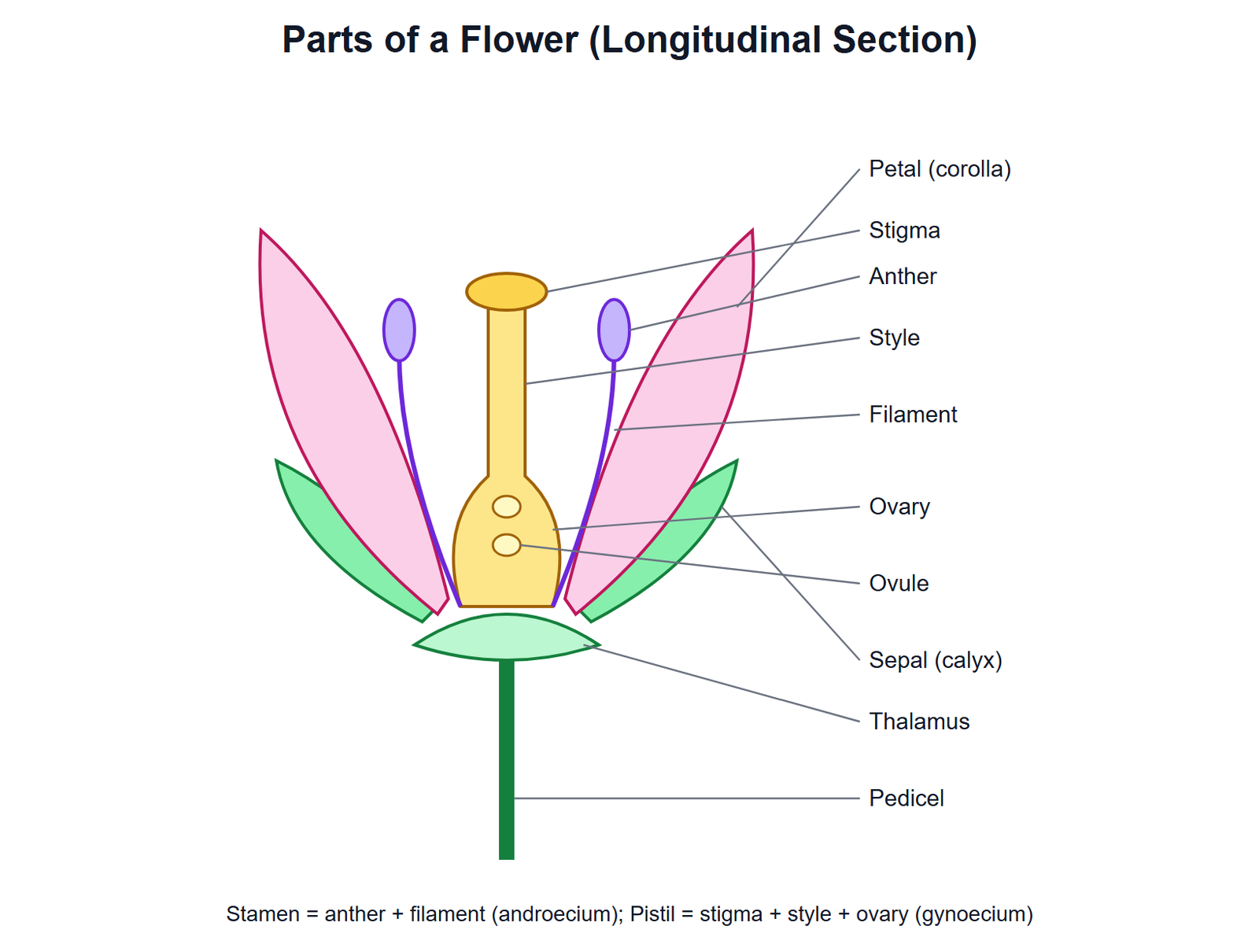
The flower is the reproductive unit in angiosperms. A typical flower has four whorls on a swollen end of the stalk (pedicel) called the thalamus or receptacle: calyx, corolla, androecium and gynoecium. Calyx and corolla are accessory organs; androecium and gynoecium are reproductive organs.
- When calyx and corolla are not distinct, they are called perianth (e.g. lily).
- A flower with both androecium and gynoecium is bisexual; with only one of them it is unisexual.
- Symmetry: Actinomorphic (radial; can be divided into two equal halves in any radial plane, e.g. mustard, datura, chilli); zygomorphic (can be divided into two similar halves in only one vertical plane, e.g. pea, gulmohur, bean, Cassia); asymmetric (cannot be divided into similar halves, e.g. canna).
- Flowers may be trimerous, tetramerous or pentamerous when the floral appendages are in multiples of 3, 4 or 5.
- Flowers with bracts (reduced leaves at the base of the pedicel) are bracteate; those without bracts are ebracteate.
Position of floral parts on the thalamus:
Type | Description | Ovary | Examples |
|---|---|---|---|
Hypogynous | Gynoecium at the highest position; other parts below it | Superior | Mustard, China rose, brinjal |
Perigynous | Gynoecium in the centre; other parts on the rim of the thalamus at almost the same level | Half-inferior | Plum, rose, peach |
Epigynous | Thalamus grows up enclosing the ovary; other parts arise above the ovary | Inferior | Guava, cucumber, ray florets of sunflower |
6. Parts of a Flower
- Calyx: The outermost whorl of sepals. Sepals are green and leaf-like and protect the flower in the bud stage. Calyx may be gamosepalous (sepals united) or polysepalous (sepals free).
- Corolla: Composed of petals, usually brightly coloured to attract insects for pollination. It may be gamopetalous (united) or polypetalous (free).
- Androecium: Composed of stamens (male reproductive organs). Each stamen has a filament and an anther; each anther is usually bilobed with two chambers (pollen sacs) producing pollen grains. A sterile stamen is a staminode.
- Epipetalous: stamens attached to petals (brinjal). Epiphyllous: attached to perianth (lily).
- Monoadelphous: stamens united in one bunch (China rose). Diadelphous: two bundles (pea). Polyadelphous: more than two bundles (citrus).
- Gynoecium: The female reproductive part, made of one or more carpels. A carpel has stigma (receptive surface for pollen), style (elongated tube) and ovary (enlarged basal part with ovules attached to the placenta). Carpels may be free (apocarpous, e.g. lotus, rose) or fused (syncarpous, e.g. mustard, tomato). After fertilisation, ovules become seeds and the ovary matures into a fruit.
Aestivation: The mode of arrangement of sepals or petals in the floral bud with respect to other members of the same whorl.
- Valvate: sepals or petals just touch one another at the margin without overlapping (Calotropis).
- Twisted: one margin of each appendage overlaps the next one, and so on (China rose, lady’s finger, cotton).
- Imbricate: margins overlap one another but not in any particular direction (Cassia, gulmohur).
- Vexillary (papilionaceous): five petals; the largest (standard) overlaps two lateral petals (wings), which in turn overlap the two smallest anterior petals (keel) (pea, bean).
Placentation: The arrangement of ovules within the ovary.
Type | Description | Examples |
|---|---|---|
Marginal | Placenta forms a ridge along the ventral suture of a monocarpellary ovary | Pea |
Axile | Placenta is axial in a multilocular ovary | China rose, tomato, lemon |
Parietal | Ovules on the inner wall of the ovary; one-chambered but may become two-chambered by a false septum | Mustard, Argemone |
Free central | Ovules on a central axis; septa absent | Dianthus, Primrose |
Basal | Placenta at the base of the ovary with a single ovule | Sunflower, marigold |
7. The Fruit and the Seed
Fruit: The mature or ripened ovary developed after fertilisation. A fruit formed without fertilisation of the ovary is called a parthenocarpic fruit. The fruit has a wall (pericarp) and seeds. The pericarp may be differentiated into epicarp, mesocarp and endocarp.
Example: In mango and coconut, the fruit is a drupe developing from a monocarpellary superior ovary with one seed. In mango, the pericarp has a thin epicarp, fleshy edible mesocarp and stony hard endocarp. In coconut, the mesocarp is fibrous.
Seed: The fertilised ovule. It has a seed coat and an embryo (radicle, embryonal axis and one or two cotyledons).
Dicot seed (e.g. gram, pea) | Monocot seed (e.g. maize) |
|---|---|
Two cotyledons, often fleshy and full of reserve food | One large shield-shaped cotyledon called scutellum |
Seed coat has two layers: outer testa and inner tegmen; hilum (scar) and micropyle present | Seed coat membranous and fused with the fruit wall |
Usually non-endospermic (e.g. bean, gram, pea); castor is endospermic | Endospermic; endosperm bulky; outer aleurone layer (proteinaceous) separates it from the embryo |
Plumule and radicle at the ends of the embryonal axis | Plumule enclosed in coleoptile; radicle enclosed in coleorhiza |
8. Semi-technical Description of a Flowering Plant
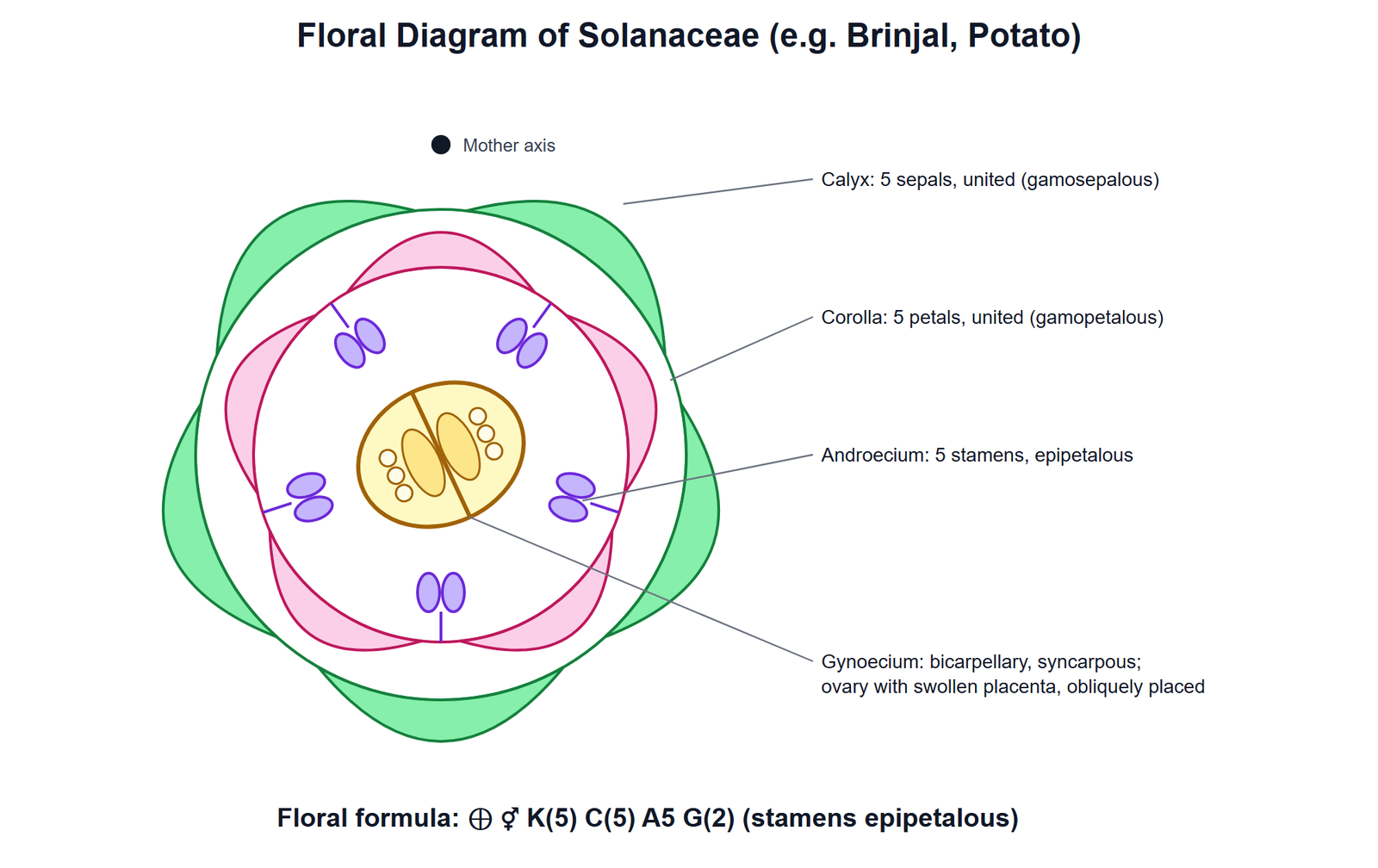
A flowering plant is described in a sequence, beginning with habit, vegetative characters (roots, stem and leaves) and then floral characters (inflorescence and flower parts). The flower is represented by a floral formula and a floral diagram.
Symbols used in a floral formula: Br = bracteate; K = calyx; C = corolla; P = perianth; A = androecium; G = gynoecium; G with a line above = inferior ovary; G with a line below = superior ovary; ⚥ = bisexual; ⊕ = actinomorphic; % = zygomorphic. Fusion is shown by enclosing the figure in brackets.
Family Solanaceae (potato family): A large family, commonly called the potato family. It is widely distributed in tropics, subtropics and even temperate zones.
- Vegetative characters: Plants mostly herbs, shrubs and rarely small trees. Stem herbaceous, rarely woody, aerial, erect, cylindrical, branched, solid or hollow, hairy or glabrous; underground stem in potato (Solanum tuberosum). Leaves alternate, simple, rarely pinnately compound, exstipulate; venation reticulate.
- Floral characters: Inflorescence solitary, axillary or cymose as in Solanum. Flower bisexual, actinomorphic.
- Calyx: sepals five, united, persistent, valvate aestivation.
- Corolla: petals five, united, valvate aestivation.
- Androecium: stamens five, epipetalous.
- Gynoecium: bicarpellary, obliquely placed, syncarpous; ovary superior, bilocular, placenta swollen with many ovules, axile placentation.
- Fruit: berry or capsule. Seeds: many, endospermous.
Economic importance of Solanaceae: Sources of food (tomato, brinjal, potato), spice (chilli), medicine (belladonna, ashwagandha), fumigatory (tobacco) and ornamentals (petunia).
Exam point: Floral formula of Solanaceae: ⊕ ⚥ K(5) C(5) A5 G(2), with the ovary superior and the stamens epipetalous (shown by an arc joining C and A).
Conclusion: Flowering plants show great variety in the form of roots, stems, leaves, inflorescences, flowers, fruits and seeds. These morphological features, many of them modified for special functions, are used to identify and classify plants, and are summarised for each family by a floral formula and a floral diagram.