The Living World – Class 11 Biology Notes
Chapter – 1
The Living World
1. What is “Living”?
Living organisms show certain characteristic features that distinguish them from non-living things.
- Growth: Increase in mass and number of individuals. In plants, growth continues throughout life; in animals, it occurs up to a certain age. Growth in living beings is from inside. Note: Non-living things like mountains and sand mounds also “grow” by accumulation of material on the surface, so growth alone is not a defining property.
- Reproduction: Production of offspring similar to the parents. It may be sexual or asexual (fragmentation in fungi and algae, budding in yeast and Hydra, regeneration in Planaria). Mules, sterile worker bees and infertile couples do not reproduce, so reproduction is also not an all-inclusive defining feature.
- Metabolism: The sum total of all chemical reactions occurring in the body. All living organisms show metabolism; non-living objects do not. Metabolic reactions can be shown outside the body in cell-free systems, which are not living.
- Cellular organisation: All living organisms are made of one or more cells.
- Consciousness (response to stimuli): The ability to sense the surroundings and respond to physical, chemical or biological stimuli. Human beings are the only organisms aware of themselves (self-consciousness).
Important: Cellular organisation, metabolism and consciousness are the defining properties of living organisms, because all living beings show them.
2. Diversity in the Living World
The number of species that are known and described ranges between 1.7 and 1.8 million. This variety is called biodiversity.
To study such a large number of organisms, it is necessary to give them standard names and to arrange them in groups.
3. Nomenclature
Nomenclature is the system of giving scientific names to organisms. Local names vary from place to place, so a universal scientific name is needed.
- Plants are named according to the International Code for Botanical Nomenclature (ICBN).
- Animals are named according to the International Code of Zoological Nomenclature (ICZN).
Binomial nomenclature: Given by Carolus Linnaeus. Each scientific name has two parts: the generic name (genus) and the specific epithet (species).
Example: Mango is Mangifera indica. Here Mangifera is the genus and indica is the specific epithet.
Rules of binomial nomenclature:
- Biological names are generally in Latin and are written in italics.
- The first word is the genus and the second word is the specific epithet.
- When handwritten, both words are underlined separately; when printed, they are written in italics.
- The first word starts with a capital letter and the specific epithet starts with a small letter. Example: Homo sapiens.
- The name of the author may be written in short form after the specific epithet. Example: Mangifera indica Linn.
4. Classification, Taxonomy and Systematics
- Classification: The process by which anything is grouped into convenient categories based on easily observable characters. Example: plants, animals, mammals, wheat.
- Taxon (plural: taxa): Each category or group used in classification. Example: dogs, cats, mammals.
- Taxonomy: The study of characterisation, identification, nomenclature and classification of organisms. It is based on external and internal structure, cell structure, development and ecology.
- Systematics: The study of the diversity of organisms and their evolutionary relationships. The word comes from the Latin “systema” (systematic arrangement). Linnaeus used Systema Naturae as the title of his book.
Remember: Systematics includes taxonomy and also takes into account the evolutionary relationships among organisms.
5. Taxonomic Categories (Taxonomic Hierarchy)
Classification is not a single step process. It involves a hierarchy of steps in which each step represents a rank or category. All categories together make up the taxonomic hierarchy.
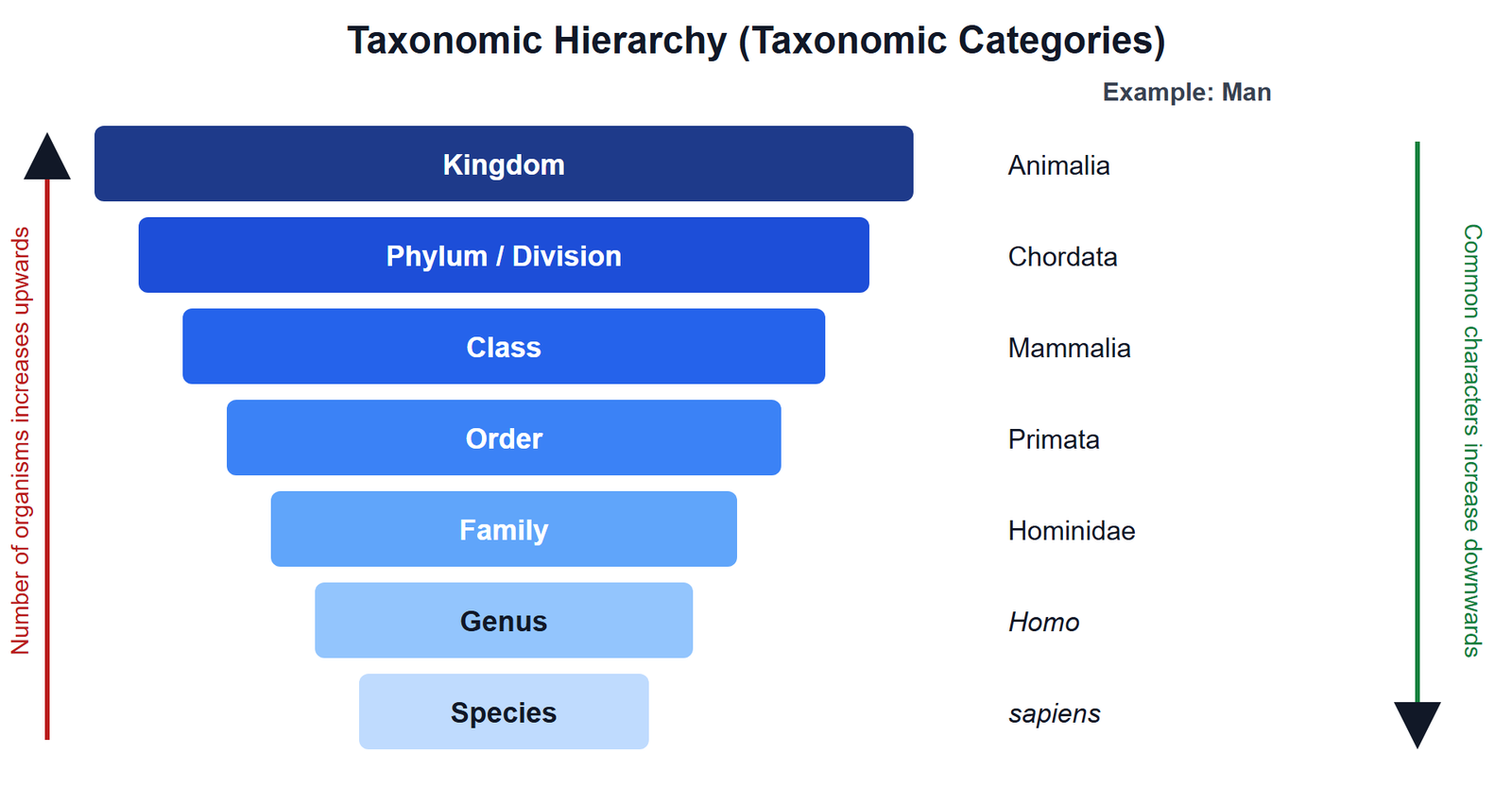
- Species: A group of individual organisms with fundamental similarities that can interbreed. It is the basic unit of classification. Example: Mangifera indica, Solanum tuberosum (potato), Panthera leo (lion).
- Genus: A group of related species with more characters in common than species of other genera. Example: Potato, tomato and brinjal are three species of genus Solanum. Lion (Panthera leo), leopard (Panthera pardus) and tiger (Panthera tigris) are species of genus Panthera.
- Family: A group of related genera. Example: Solanum, Petunia and Datura are placed in family Solanaceae. Panthera and Felis (cat) are placed in family Felidae.
- Order: A group of families with a few similar characters. Example: Felidae and Canidae (dogs) are in order Carnivora. Convolvulaceae and Solanaceae are in order Polymoniales.
- Class: A group of related orders. Example: Primata (monkeys, gorillas) and Carnivora (tigers, cats, dogs) are in class Mammalia.
- Phylum (for animals) / Division (for plants): A group of classes. Example: Mammalia, Aves, Reptilia, Amphibia and Pisces are in phylum Chordata.
- Kingdom: The highest category. Example: all animals are in kingdom Animalia; all plants are in kingdom Plantae.
Common name | Biological name | Genus | Family | Order | Class | Phylum / Division |
|---|---|---|---|---|---|---|
Man | Homo sapiens | Homo | Hominidae | Primata | Mammalia | Chordata |
Housefly | Musca domestica | Musca | Muscidae | Diptera | Insecta | Arthropoda |
Mango | Mangifera indica | Mangifera | Anacardiaceae | Sapindales | Dicotyledonae | Angiospermae |
Wheat | Triticum aestivum | Triticum | Poaceae | Poales | Monocotyledonae | Angiospermae |
Exam point: As we go up from species to kingdom, the number of common characteristics decreases and the number of organisms in the group increases.
Easy Memory Trick: “King Philip Came Over For Good Soup” for Kingdom, Phylum, Class, Order, Family, Genus, Species.
6. Taxonomical Aids
Taxonomical aids are tools and places that help in the identification, naming and classification of organisms.
- Herbarium: A store-house of collected plant specimens that are dried, pressed and preserved on sheets, arranged according to a universally accepted system. Each sheet carries a label with the name, date and place of collection.
- Botanical gardens: Specialised gardens with collections of living plants for reference. Example: Royal Botanical Gardens, Kew (England); Indian Botanical Garden, Howrah; National Botanical Research Institute, Lucknow.
- Museum: Collections of preserved plant and animal specimens. Specimens are kept in containers in preservative solutions; insects are preserved in insect boxes after collecting, killing and pinning; larger animals are stuffed.
- Zoological parks (zoos): Places where wild animals are kept in protected environments similar to their natural habitats, so we can study their food habits and behaviour.
- Key: A taxonomic aid used to identify plants and animals based on similarities and dissimilarities. It is based on contrasting characters in pairs called couplets; each statement is called a lead.
Conclusion: Living organisms are recognised by cellular organisation, metabolism and consciousness. Because there is enormous diversity, organisms are named by binomial nomenclature and classified into a taxonomic hierarchy from kingdom to species, with the help of taxonomical aids.