Waves – Class 11 Physics Notes
Chapter – 14
Waves
1. Introduction
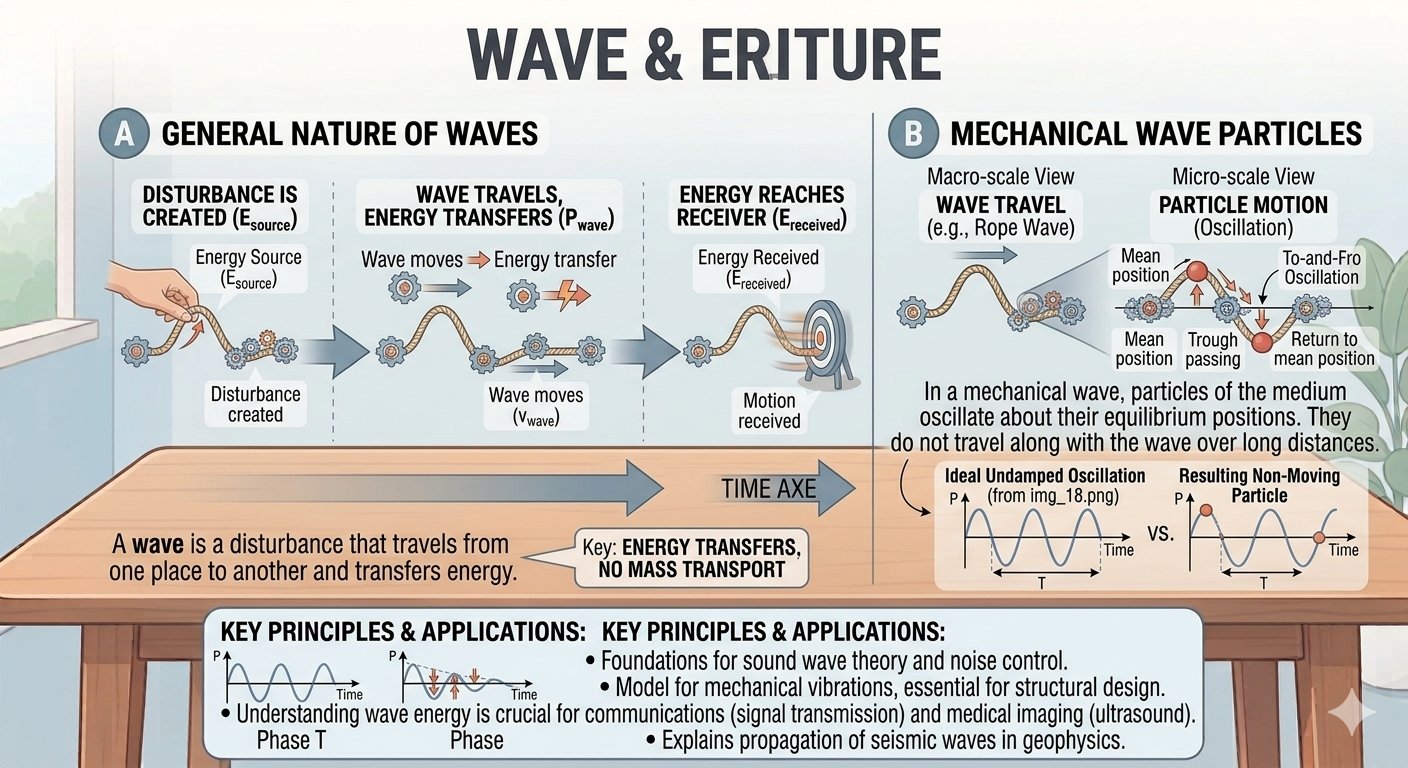
A wave is a disturbance that travels from one place to another and transfers energy.
In a mechanical wave, particles of the medium oscillate about their equilibrium positions. They do not travel along with the wave over long distances.
Examples:
- Sound travelling through air.
- A disturbance travelling along a stretched rope.
- Ripples on water.
Mechanical waves
Waves that require a material medium to travel are called mechanical waves.
Examples: Sound waves and waves on a string.
Sound cannot travel through a vacuum because there are no particles to carry the disturbance.
2. Transverse and Longitudinal Waves
A. Transverse Waves
Waves in which particles oscillate perpendicular to the direction of wave propagation.
Example: If a wave travels horizontally along a rope, the rope particles may move up and down.
- Crest: Maximum positive displacement.
- Trough: Maximum negative displacement.
Examples: Waves on a stretched string and electromagnetic waves.
Mechanical transverse waves can propagate in solids and stretched strings. Ordinary fluids do not support transverse waves in their bulk because they lack shear rigidity.
B. Longitudinal Waves
Waves in which particles oscillate parallel to the direction of wave propagation.
They produce:
- Compressions: Regions of higher pressure and density.
- Rarefactions: Regions of lower pressure and density.
Examples: Sound waves in air and compression waves in a spring.
Comparison
| Property | Transverse wave | Longitudinal wave |
|---|---|---|
| Particle motion | Perpendicular to wave travel | Parallel to wave travel |
| Main features | Crests and troughs | Compressions and rarefactions |
| Example | Wave on a stretched string | Sound in air |
Note: Water surface waves generally involve both vertical and horizontal particle motion.
3. Progressive or Travelling Waves
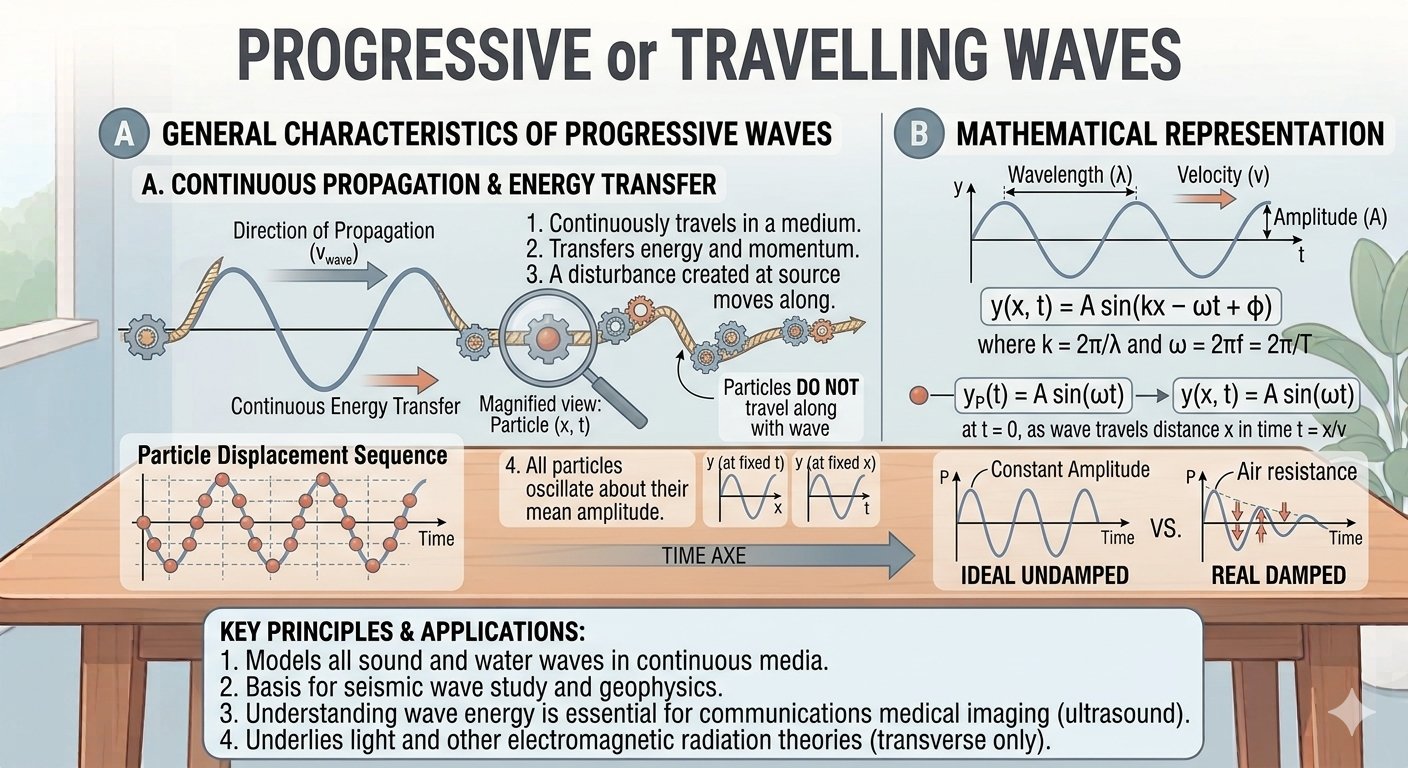
A progressive wave is a disturbance that travels through a medium, carrying energy from one region to another.
Displacement relation
For a sinusoidal wave travelling in the positive x-direction:
\boxed{y(x,t)=A\sin(kx-\omega t+\phi)}
For a wave travelling in the negative x-direction:
\boxed{y(x,t)=A\sin(kx+\omega t+\phi)}
Here:
- y(x,t): displacement of a medium particle.
- x: equilibrium position of that particle.
- t: time.
- A: amplitude.
- k: angular wave number.
- \omega: angular frequency.
- \phi: initial phase constant.
Direction trick: In these forms, kx-\omega t means travel towards +x, while kx+\omega t means travel towards -x.
For a transverse string wave, y is perpendicular displacement. For a longitudinal wave, an equivalent equation describes displacement along the direction of travel.
4. Amplitude and Phase
A. Amplitude (A)
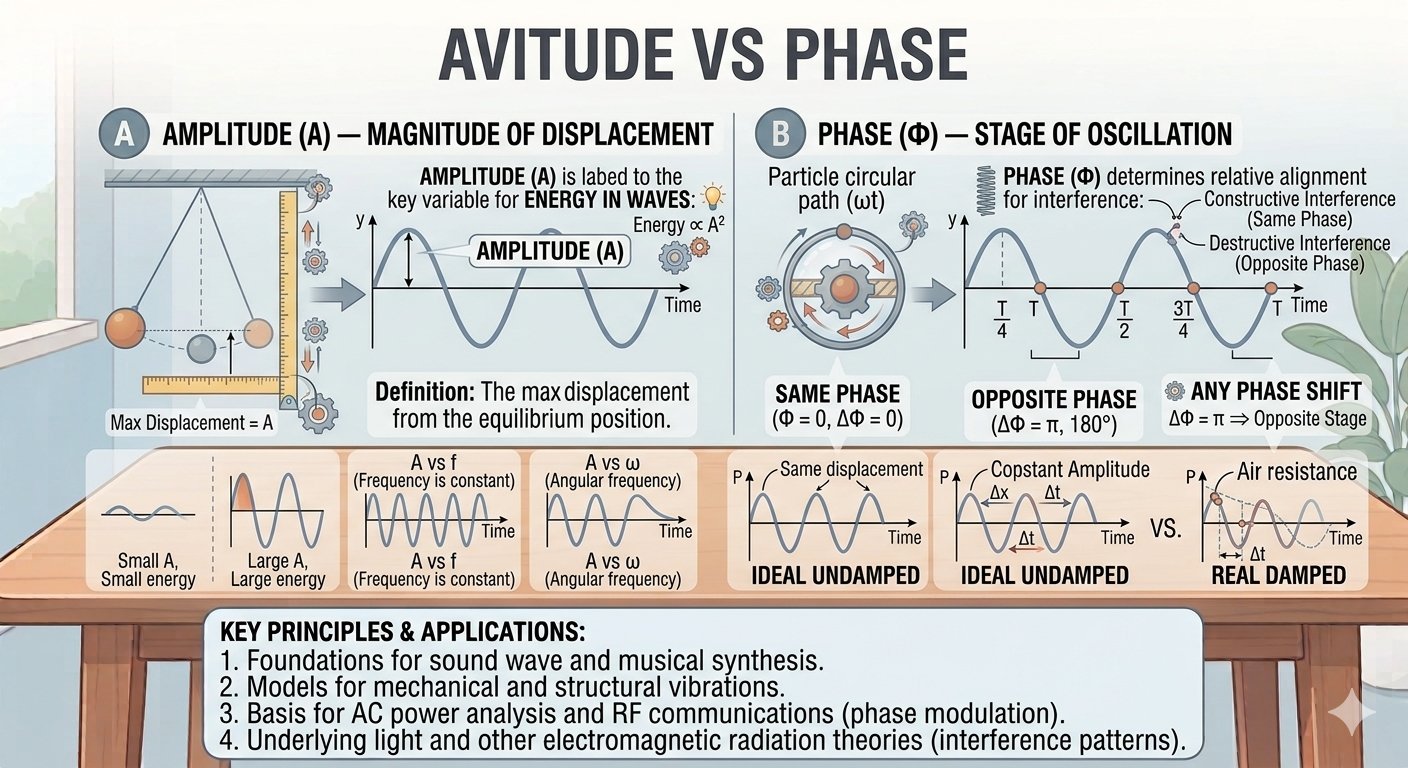
The maximum magnitude of displacement of a particle from its equilibrium position.
\boxed{|y|_{\max}=A}
SI unit: metre (m)
For a given medium and frequency, the average power carried by a sinusoidal wave is proportional to the square of amplitude:
\boxed{P_{\mathrm{avg}}\propto A^2}
If amplitude doubles, the average power becomes four times as large.
B. Phase
The phase tells us the stage of oscillation of a particle.
For:
y=A\sin(kx-\omega t+\phi)
the phase is:
\boxed{kx-\omega t+\phi}
Two particles are in phase if they are at the same stage of oscillation.
They are in opposite phase if their phase difference is an odd multiple of \pi.
Phase difference
At the same instant, for particles separated by \Delta x:
\boxed{\Delta\phi=k\Delta x=\frac{2\pi\Delta x}{\lambda}}
At the same position, the magnitude of phase change over a time interval \Delta t is:
\boxed{|\Delta\phi|=\omega\Delta t=\frac{2\pi\Delta t}{T}}
| Separation at the same instant | Phase difference |
|---|---|
| \lambda | 2\pi: in phase |
| \lambda/2 | \pi: opposite phase |
| \lambda/4 | \pi/2 |
5. Wavelength and Angular Wave Number
A. Wavelength (\lambda)
The shortest distance between two successive points in the same phase.
Examples:
- Distance between successive crests.
- Distance between successive troughs.
- Distance between successive compressions.
SI unit: metre (m)
B. Angular Wave Number (k)
The phase change per unit distance.
\boxed{k=\frac{2\pi}{\lambda}}
SI unit: \mathrm{rad\,m^{-1}}
A shorter wavelength means a greater angular wave number.
6. Period, Frequency and Angular Frequency
A. Time Period (T)
Time taken by a particle to complete one oscillation.
SI unit: second (s)
B. Frequency (f)
Number of complete oscillations per second.
\boxed{f=\frac1T}
SI unit: hertz (Hz)
C. Angular Frequency (\omega)
\boxed{\omega=2\pi f=\frac{2\pi}{T}}
SI unit: \mathrm{rad\,s^{-1}}
Wave speed
A travelling wave moves one wavelength in one time period:
\boxed{v=\frac{\lambda}{T}=f\lambda}
Also:
\boxed{v=\frac{\omega}{k}}
Remember: Wave speed is the speed of the disturbance. Particle velocity is the velocity of an individual oscillating particle.
For y=A\sin(kx-\omega t+\phi), particle velocity is:
u=\frac{\partial y}{\partial t} =-A\omega\cos(kx-\omega t+\phi)
Its maximum magnitude is A\omega.
7. Speed of Transverse Waves on a String
For an ideal stretched string:
\boxed{v=\sqrt{\frac{F_T}{\mu}}}
where:
- F_T: tension in the string.
- \mu: mass per unit length.
\boxed{\mu=\frac{m}{L}}
SI unit of \mu: \mathrm{kg\,m^{-1}}
Important conclusions
- Greater tension → greater wave speed.
- Greater mass per unit length → smaller wave speed.
v\propto\sqrt{F_T} \qquad v\propto\frac1{\sqrt\mu}
Example: If tension becomes four times as large, wave speed doubles.
8. Speed of Longitudinal Waves
Wave speed depends on the medium’s elasticity and density.
A. In a fluid
\boxed{v=\sqrt{\frac{B}{\rho}}}
where:
- B: bulk modulus.
- \rho: density.
B. Along a thin solid rod
For longitudinal waves:
\boxed{v=\sqrt{\frac{Y}{\rho}}}
where Y is Young’s modulus.
C. Sound in an ideal gas
Sound compressions and rarefactions are approximately adiabatic.
Thus:
B=\gamma P
and:
\boxed{v=\sqrt{\frac{\gamma P}{\rho}}}
Using the ideal gas equation:
\boxed{v=\sqrt{\frac{\gamma RT}{M}}}
where:
- \gamma=C_P/C_V
- T: absolute temperature
- M: molar mass in \mathrm{kg\,mol^{-1}}
Newton’s formula and Laplace’s correction
Newton assumed the changes were isothermal:
v=\sqrt{\frac{P}{\rho}}
This predicted a speed lower than the observed value.
Laplace used the approximately adiabatic nature of sound propagation:
\boxed{v=\sqrt{\frac{\gamma P}{\rho}}}
Temperature effect
For fixed gas composition and approximately constant \gamma:
\boxed{v\propto\sqrt T}
Sound travels faster in warmer air.
9. Principle of Superposition of Waves
Statement:
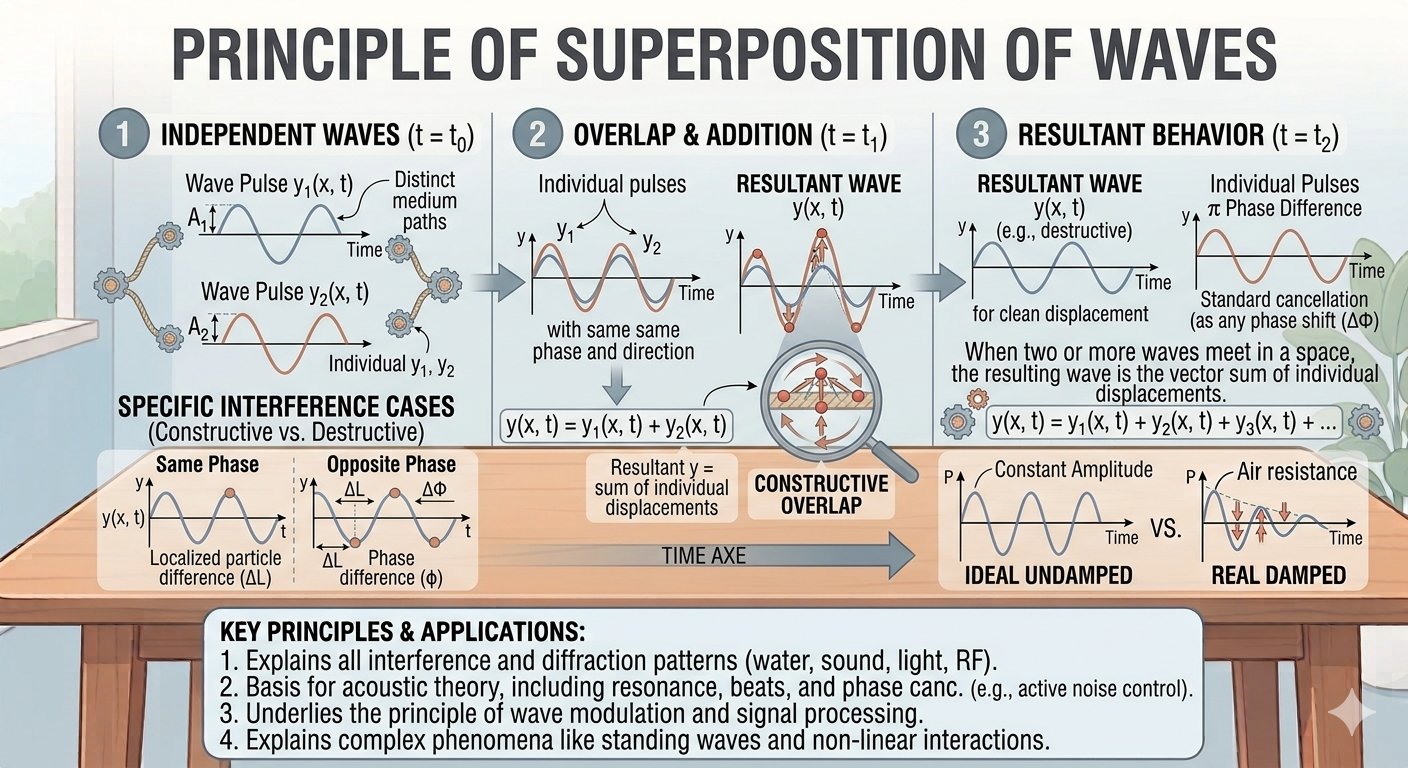
When waves overlap in a linear medium, the resultant displacement is the algebraic sum of the displacements produced by each wave separately.
\boxed{y=y_1+y_2+\cdots}
After overlapping, the waves continue to propagate according to the medium’s wave equation.
A. Constructive Interference
Waves reinforce each other.
For two waves in phase:
\boxed{A_{\mathrm{resultant}}=A_1+A_2}
For equal amplitudes:
\boxed{A_{\mathrm{resultant}}=2A}
B. Destructive Interference
Waves oppose each other.
For phase difference \pi:
\boxed{A_{\mathrm{resultant}}=|A_1-A_2|}
Equal amplitudes give complete cancellation.
General resultant amplitude
For waves of the same frequency with phase difference \delta:
\boxed{ A_{\mathrm{resultant}} =\sqrt{A_1^2+A_2^2+2A_1A_2\cos\delta} }
For equal amplitudes A:
\boxed{A_{\mathrm{resultant}}=2A\left|\cos\frac{\delta}{2}\right|}
10. Reflection of Waves
Reflection is the return of a wave into its original medium after meeting a boundary.
A. Reflection at a Fixed End
For displacement waves on a string:
- The end cannot move.
- The reflected pulse is inverted.
- Displacement undergoes a phase change of \pi.
Example: An upward pulse reflects as a downward pulse.
B. Reflection at a Free End
For displacement waves on a string:
- The end is free to move transversely.
- The reflected pulse is not inverted.
- There is no displacement phase reversal.
| Boundary | Reflected displacement pulse | Phase change |
|---|---|---|
| Fixed end | Inverted | \pi |
| Free end | Not inverted | 0 |
For sound: A rigid closed end is a displacement node and pressure antinode. An ideal open end is a displacement antinode and pressure node.
11. Standing or Stationary Waves
Standing waves form when two sinusoidal waves of equal amplitude and frequency travel in opposite directions and superpose.
Take:
y_1=A\sin(kx-\omega t)y_2=A\sin(kx+\omega t)
Adding:
\boxed{y=2A\sin kx\cos\omega t}
The amplitude depends on position:
\boxed{A_{\mathrm{local}}=2A|\sin kx|}
A. Nodes
Points where displacement is always zero.
\sin kx=0\boxed{x=\frac{n\lambda}{2}},\qquad n=0,1,2,\ldots
B. Antinodes
Points where the oscillation amplitude is maximum, equal to 2A.
\boxed{x=\frac{(2n+1)\lambda}{4}},\qquad n=0,1,2,\ldots
Important distances
\boxed{\text{Adjacent nodes}=\frac{\lambda}{2}}\boxed{\text{Adjacent antinodes}=\frac{\lambda}{2}}\boxed{\text{A node to its adjacent antinode}=\frac{\lambda}{4}}
Main features
- Nodes and antinodes stay at fixed positions.
- Particles between adjacent nodes oscillate in phase.
- Particles in neighbouring segments oscillate in opposite phase.
- An ideal standing wave carries no net average energy along the medium.
Travelling and standing waves
| Travelling wave | Standing wave |
|---|---|
| Wave pattern travels | Nodes and antinodes remain fixed |
| Carries energy along the medium | No net average energy transfer along the medium |
| Uniform amplitude in an ideal uniform medium | Amplitude varies with position |
| No permanent nodes | Permanent nodes and antinodes |
12. Normal Modes in a Stretched String
Normal modes are the allowed standing-wave patterns that satisfy the boundary conditions.
For a string of length L, fixed at both ends:
- Both ends are nodes.
- The length contains an integer number of half-wavelengths.
L=\frac{n\lambda_n}{2}
Therefore:
\boxed{\lambda_n=\frac{2L}{n}}\boxed{f_n=\frac{nv}{2L}},\qquad n=1,2,3,\ldots
Using v=\sqrt{F_T/\mu}:
\boxed{f_n=\frac{n}{2L}\sqrt{\frac{F_T}{\mu}}}
Fundamental frequency
The lowest allowed frequency:
\boxed{f_1=\frac{v}{2L}}
Harmonics and overtones
| Mode | Frequency | Wavelength | Number of loops |
|---|---|---|---|
| Fundamental: first harmonic | f_1 | 2L | 1 |
| First overtone: second harmonic | 2f_1 | L | 2 |
| Second overtone: third harmonic | 3f_1 | 2L/3 | 3 |
All integer harmonics are allowed:
\boxed{f_1,\ 2f_1,\ 3f_1,\ldots}
13. Normal Modes in Organ Pipes
An organ pipe contains an air column in which standing sound waves can form.
The following formulas neglect end correction.
A. Open Organ Pipe
Both ends are open.
For air displacement:
- Both ends are antinodes.
For pressure variation:
- Both ends are nodes.
Allowed wavelengths:
\boxed{\lambda_n=\frac{2L}{n}}
Allowed frequencies:
\boxed{f_n=\frac{nv}{2L}},\qquad n=1,2,3,\ldots
Fundamental frequency:
\boxed{f_1=\frac{v}{2L}}
All harmonics are present.
B. Closed Organ Pipe
One end is closed and the other is open.
For air displacement:
- Closed end: node.
- Open end: antinode.
For the fundamental mode:
L=\frac{\lambda_1}{4}
Thus:
\boxed{f_1=\frac{v}{4L}}
Allowed frequencies:
\boxed{f_n=\frac{(2n-1)v}{4L}},\qquad n=1,2,3,\ldots
Therefore:
\boxed{f_1,\ 3f_1,\ 5f_1,\ldots}
Only odd harmonics are present in the ideal model.
| Mode | Frequency | Harmonic |
|---|---|---|
| Fundamental | f_1 | First |
| First overtone | 3f_1 | Third |
| Second overtone | 5f_1 | Fifth |
Comparison
| Property | Open pipe | Closed pipe |
|---|---|---|
| Ends | Both open | One closed, one open |
| Displacement at ends | Antinode–antinode | Node–antinode |
| Fundamental wavelength | 2L | 4L |
| Fundamental frequency | v/(2L) | v/(4L) |
| Harmonics | All integer harmonics | Odd harmonics only |
For equal lengths and the same sound speed, an open pipe’s fundamental frequency is twice that of a closed pipe.
End correction: The displacement antinode lies slightly outside an open end, so the effective acoustic length is slightly greater than the physical length.
14. Beats
Beats are periodic variations in sound intensity produced by the superposition of two sounds with slightly different frequencies.
The sound alternately becomes louder and softer.
Why beats occur
The phase difference changes with time:
- Waves nearly in phase → loud sound.
- Waves nearly in opposite phase → soft sound.
Beat frequency
\boxed{f_b=|f_1-f_2|}
Beat period
\boxed{T_b=\frac{1}{|f_1-f_2|}}
Displacement relation
For equal-amplitude waves at a point:
y_1=A\cos(2\pi f_1t)y_2=A\cos(2\pi f_2t)
Their sum is:
\boxed{ y=2A\cos\!\left[\pi(f_1-f_2)t\right] \cos\!\left[2\pi\left(\frac{f_1+f_2}{2}\right)t\right] }
The slowly varying amplitude produces the beats.
Conditions for clear beats
- Frequencies should be close.
- Amplitudes should be comparable.
- Both sounds must reach the listener together.
For unequal amplitudes, the minimum intensity need not be zero.
Applications
- Tuning musical instruments.
- Comparing nearly equal frequencies.
- Finding an unknown frequency with additional information.
Example: Tuning forks of 256\,Hz and 260\,Hz produce:
f_b=|260-256|=\boxed{4\,Hz}
The listener hears four beats per second.
15. Simple Solved Examples
Example 1: Wave speed
A wave has frequency 50\,Hz and wavelength 2\,m.
v=f\lambda=50\times2\boxed{v=100\,\mathrm{m\,s^{-1}}}
Example 2: Reading a wave equation
A wave is described by:
y=0.02\sin(4\pi x-20\pi t)
where x,y are in metres and t is in seconds.
Comparing with y=A\sin(kx-\omega t):
\boxed{A=0.02\,m}\lambda=\frac{2\pi}{k}=\frac{2\pi}{4\pi} =\boxed{0.5\,m}f=\frac{\omega}{2\pi}=\frac{20\pi}{2\pi} =\boxed{10\,Hz}v=\frac{\omega}{k}=\frac{20\pi}{4\pi} =\boxed{5\,\mathrm{m\,s^{-1}}}
It travels in the positive x-direction.
Example 3: Organ pipes
An open pipe and a closed pipe each have length 0.85\,m. Take sound speed as 340\,\mathrm{m\,s^{-1}}.
For the open pipe:
f_1=\frac{340}{2(0.85)}=\boxed{200\,Hz}
For the closed pipe:
f_1=\frac{340}{4(0.85)}=\boxed{100\,Hz}