Thermal properties of Matter – Class 11 Physics Notes
Chapter – 10
Thermal properties of Matter
1. Introduction
Thermal properties of matter are the properties of substances that describe how they behave when heat is supplied or removed.
When a substance is heated:
- Its temperature may increase.
- It may expand.
- Its state may change from solid to liquid or liquid to gas.
- Heat may transfer from one body to another.
Examples:
- Ice melts when heated.
- Railway tracks expand in summer.
Water changes into steam on boiling.
2. Temperature and Heat
Temperature
Temperature is the physical quantity that tells us how hot or cold a body is.
- It determines the direction of heat flow.
- SI unit: Kelvin (K).
- It is measured using a thermometer.
Heat
Heat is energy transferred from one body to another due to a temperature difference.
- Heat flows naturally from a hotter body to a colder body.
- SI unit: Joule (J).
- Heat is a form of energy transfer.
Difference between Heat and Temperature
Heat | Temperature |
|---|---|
Energy transferred due to temperature difference | Degree of hotness or coldness |
SI unit is joule | SI unit is kelvin |
Depends on amount of substance and conditions | Does not directly depend on amount of substance |
Measured using calorimetry | Measured using a thermometer |
Thermal Equilibrium: Two bodies are in thermal equilibrium when they have the same temperature and no net heat flows between them.
3. Measurement of Temperature
Temperature is measured using a thermometer.
Types of thermometers:
- Clinical thermometer – Used to measure body temperature.
- Laboratory thermometer – Used in experiments.
- Digital thermometer – Uses an electronic sensor.
- Gas thermometer – Uses the temperature-dependent properties of a gas.
Temperature scales:
- Celsius (°C)
- Fahrenheit (°F)
Kelvin (K)
Conversion formulas:
\boxed{K={}^\circ C+273.15}
\boxed{F=\frac95C+32}
\boxed{\frac C5=\frac{F-32}{9}}
Important points:
- Freezing point of water = 0°C = 273.15 K.
- Boiling point of water = 100°C = 373.15 K at standard atmospheric pressure.
Absolute zero = 0 K = −273.15°C.
4. Ideal Gas Equation and Absolute Temperature
Ideal Gas: An ideal gas is a hypothetical gas that obeys the ideal gas equation under all conditions.
Ideal Gas Equation:
\boxed{PV=nRT}
Where:
- P = Pressure of gas
- V = Volume of gas
- n = Number of moles
- R = Universal gas constant
- T = Absolute temperature in kelvin
R=8.314\ \mathrm{J\,mol^{-1}K^{-1}}
Important gas laws:
Boyle’s Law: At constant temperature,
PV=\text{constant}
Charles’s Law: At constant pressure,
\frac VT=\text{constant}
Pressure Law: At constant volume,
\frac PT=\text{constant}
Absolute Temperature: Temperature measured on the Kelvin scale is called absolute temperature.
Absolute zero: The lowest possible thermodynamic temperature is 0 K.
5. Thermal Expansion
Definition: The increase in the dimensions of a substance due to a rise in temperature is called thermal expansion.
Types of thermal expansion:
- Linear expansion
- Area expansion
Volume expansion

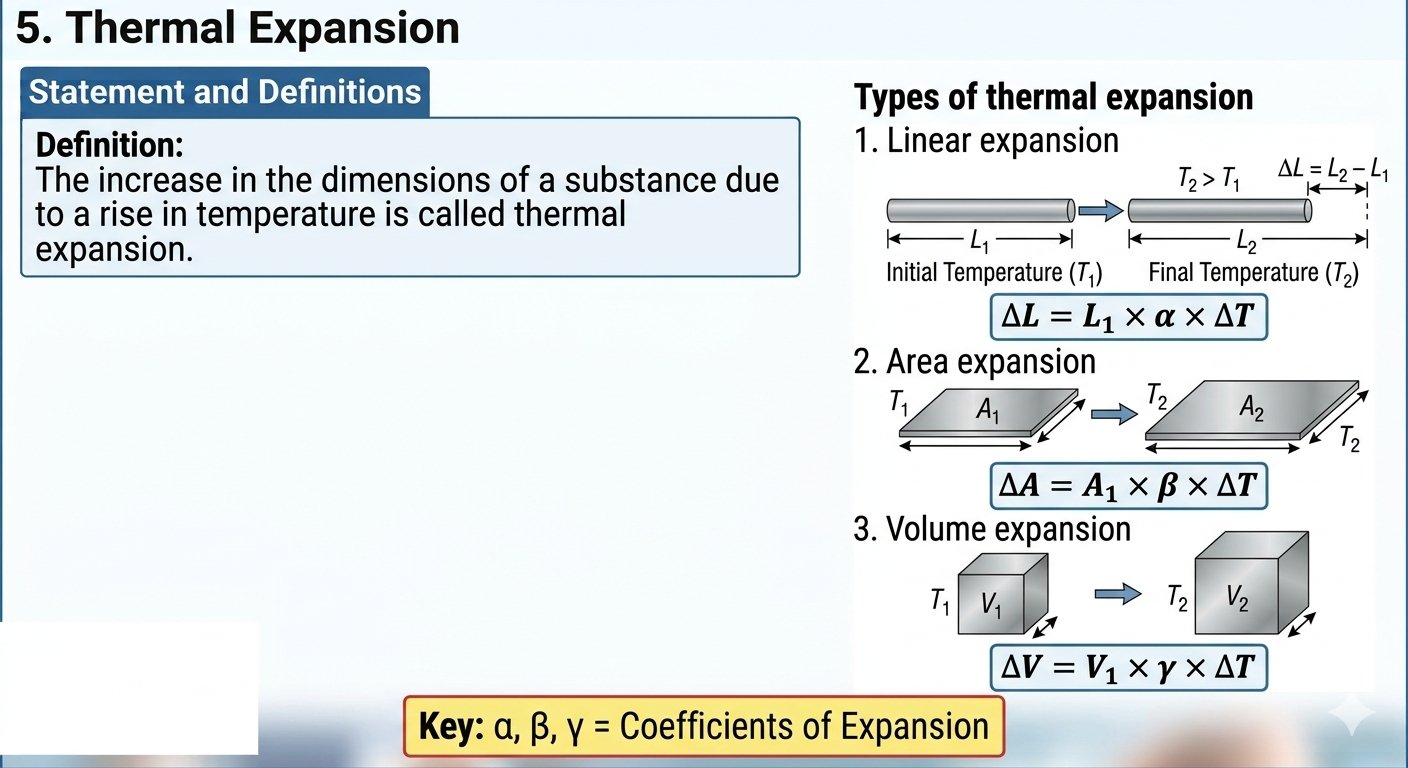
(a) Linear Expansion
The increase in length of a solid due to heating is called linear expansion.
\boxed{\Delta L=\alpha L_0\Delta T}
Or,
\boxed{L=L_0(1+\alpha\Delta T)}
Where:
- L_0 = Original length
- \Delta L = Increase in length
- \alpha = Coefficient of linear expansion
- \Delta T = Change in temperature
Coefficient of linear expansion:
\boxed{\alpha=\frac{\Delta L}{L_0\Delta T}}
SI unit: K⁻¹
(b) Area Expansion
The increase in area of a solid due to heating is called area expansion.
\boxed{\Delta A=\beta A_0\Delta T}
\boxed{A=A_0(1+\beta\Delta T)}
Where \beta = coefficient of area expansion.
SI unit: K⁻¹
(c) Volume Expansion
The increase in volume of a substance due to heating is called volume expansion.
\boxed{\Delta V=\gamma V_0\Delta T}
\boxed{V=V_0(1+\gamma\Delta T)}
Where \gamma = coefficient of volume expansion.
SI unit: K⁻¹
Applications of thermal expansion:
- Gaps are provided between railway track sections where required.
- Expansion joints are used in bridges.
- A tight metal lid can be loosened by heating.
Bimetallic strips are used in thermostats.
6. Relation Between Coefficients of Expansion
For an isotropic solid and a small temperature change:
\boxed{\beta\approx2\alpha}
\boxed{\gamma\approx3\alpha}
Therefore,
\boxed{\alpha:\beta:\gamma=1:2:3}
Derivation of \beta=2\alpha:
Consider a square sheet of side L.
Original area:
A=L^2
After heating:
L’=L(1+\alpha\Delta T)
New area:
A’=L^2(1+\alpha\Delta T)^2
Expanding:
A’=A(1+2\alpha\Delta T+\alpha^2\Delta T^2)
Neglecting the very small second-order term:
\Delta A=2\alpha A\Delta T
Comparing with \Delta A=\beta A\Delta T:
\boxed{\beta=2\alpha}
Derivation of \gamma=3\alpha:
Consider a cube of side L.
Original volume:
V=L^3
After heating:
V’=L^3(1+\alpha\Delta T)^3
Neglecting higher-order terms:
V’=V(1+3\alpha\Delta T)
Therefore,
\Delta V=3\alpha V\Delta T
Comparing with \Delta V=\gamma V\Delta T:
\boxed{\gamma=3\alpha}
Special case – Anomalous expansion of water:
Water behaves differently between 0°C and 4°C.
- When heated from 0°C to 4°C, water contracts.
- When cooled from 4°C to 0°C, water expands.
Water has maximum density at approximately 4°C.
7. Specific Heat Capacity
Specific heat capacity is the amount of heat required to raise the temperature of unit mass of a substance by 1 K.
\boxed{c=\frac{Q}{m\Delta T}}
Or,
\boxed{Q=mc\Delta T}
Where:
- Q = Heat supplied
- m = Mass
- c = Specific heat capacity
- \Delta T = Change in temperature
SI unit: J kg⁻¹ K⁻¹
Dimensional formula:
\boxed{[L^2T^{-2}\Theta^{-1}]}
Example: The specific heat capacity of water is approximately:
c=4200\ \mathrm{J\,kg^{-1}K^{-1}}
It means 4200 J of heat is required to raise the temperature of 1 kg of water by 1 K.
Important points:
- Different substances have different specific heat capacities.
- Water has a relatively high specific heat capacity.
Specific heat capacity depends on the material and heating conditions.
8. Molar Specific Heat Capacity
Molar specific heat capacity is the amount of heat required to raise the temperature of one mole of a substance by 1 K.
\boxed{C=\frac{Q}{n\Delta T}}
Or,
\boxed{Q=nC\Delta T}
Where:
- n = Number of moles
- C = Molar specific heat capacity
SI unit: J mol⁻¹ K⁻¹
Relation with specific heat capacity:
\boxed{C=Mc}
Where M is the molar mass in kg/mol.
For gases:
- C_V = Molar heat capacity at constant volume.
- C_P = Molar heat capacity at constant pressure.
For an ideal gas:
\boxed{C_P-C_V=R}
This is called Mayer’s relation.
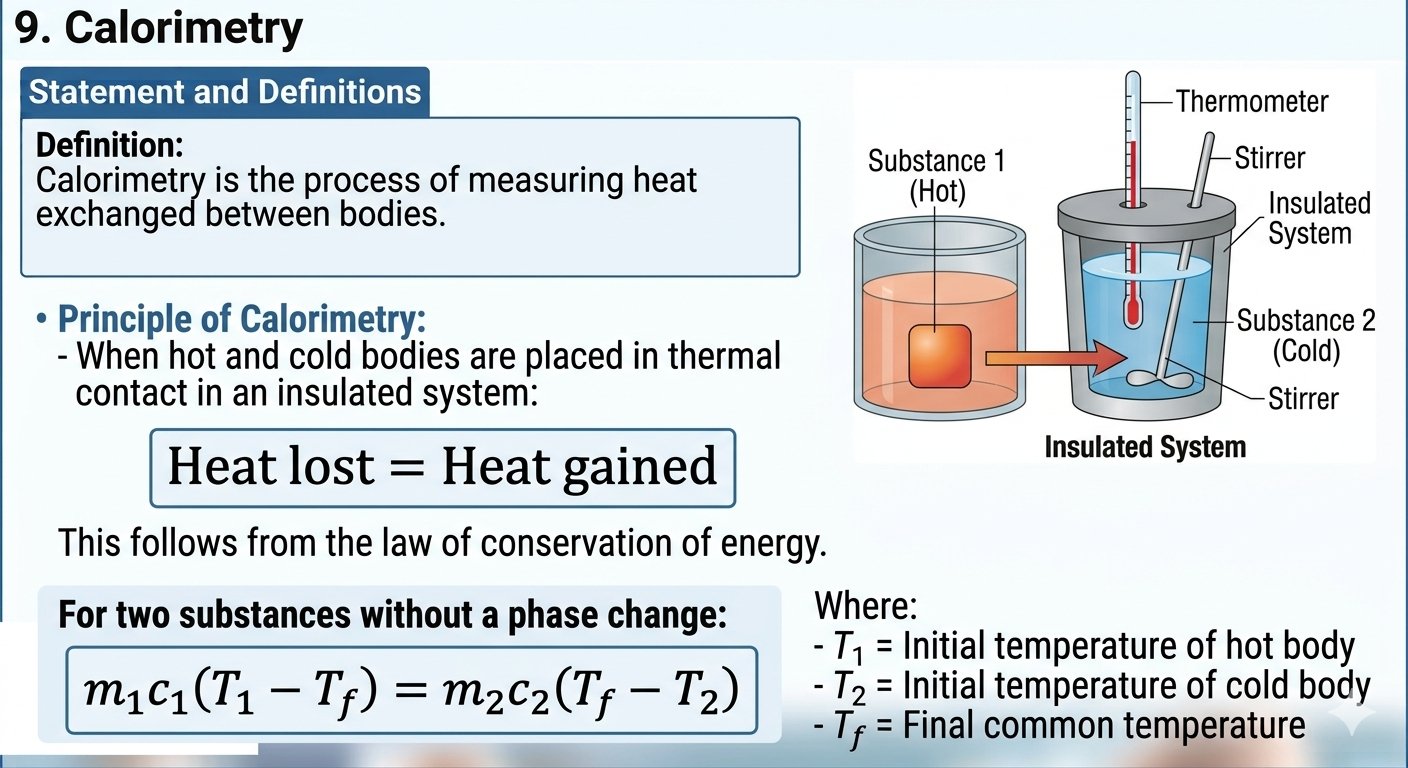
9. Calorimetry
Calorimetry is the process of measuring heat exchanged between bodies.
Principle of Calorimetry:
When hot and cold bodies are placed in thermal contact in an insulated system:
\boxed{\text{Heat lost}=\text{Heat gained}}
This follows from the law of conservation of energy.
For two substances without a phase change:
m_1c_1(T_1-T_f)=m_2c_2(T_f-T_2)
Where:
- T_1 = Initial temperature of hot body
- T_2 = Initial temperature of cold body
T_f = Final common temperature
Assumptions:
- No heat is lost to the surroundings.
- Both bodies reach the same final temperature.
- Heat absorbed by the calorimeter is neglected or included separately.
Uses: Finding specific heat capacity, latent heat and heat exchanged during mixing.
10. Change of State
The conversion of a substance from one physical state to another is called change of state.
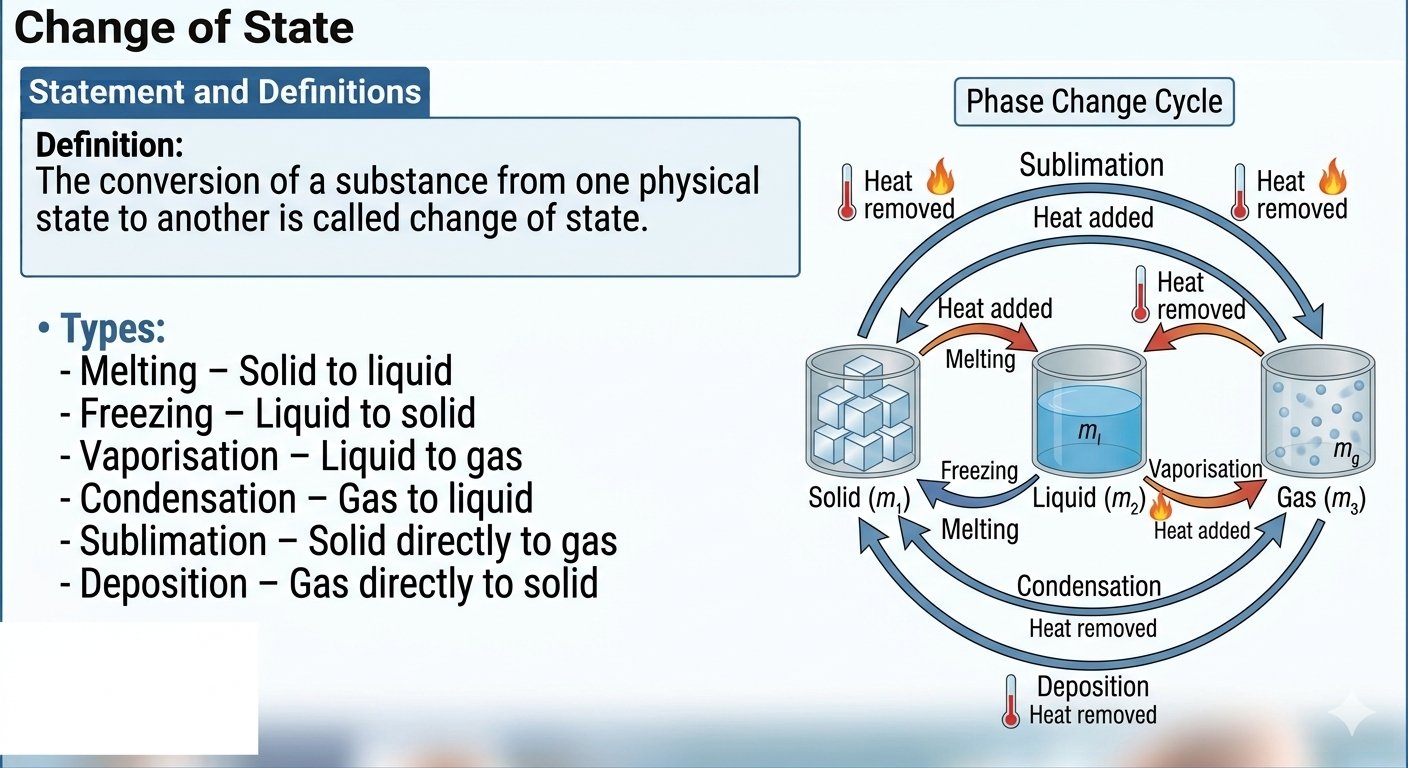
Types:
- Melting – Solid to liquid
- Freezing – Liquid to solid
- Vaporization – Liquid to gas
- Condensation – Gas to liquid
- Sublimation – Solid directly to gas
Deposition – Gas directly to solid
Melting Point: The temperature at which a solid changes into a liquid at a given pressure.
Boiling Point: The temperature at which the vapour pressure of a liquid becomes equal to the external pressure and boiling occurs.
Important point: During a phase change of a pure substance at constant pressure, temperature remains constant while latent heat is absorbed or released.
11. Latent Heat
Latent heat is the heat absorbed or released during a change of state without a change in temperature.
\boxed{Q=mL}
Where:
- Q = Heat absorbed or released
- m = Mass
- L = Specific latent heat
SI unit: J/kg
Types of latent heat:
(a) Latent Heat of Fusion
Heat required to convert unit mass of a solid into liquid at its melting point without changing temperature.
Example: Ice changing into water at 0°C.
(b) Latent Heat of Vaporization
Heat required to convert unit mass of a liquid into vapour at its boiling point without changing temperature.
Example: Water changing into steam at 100°C at standard atmospheric pressure.
Heating Curve of Water
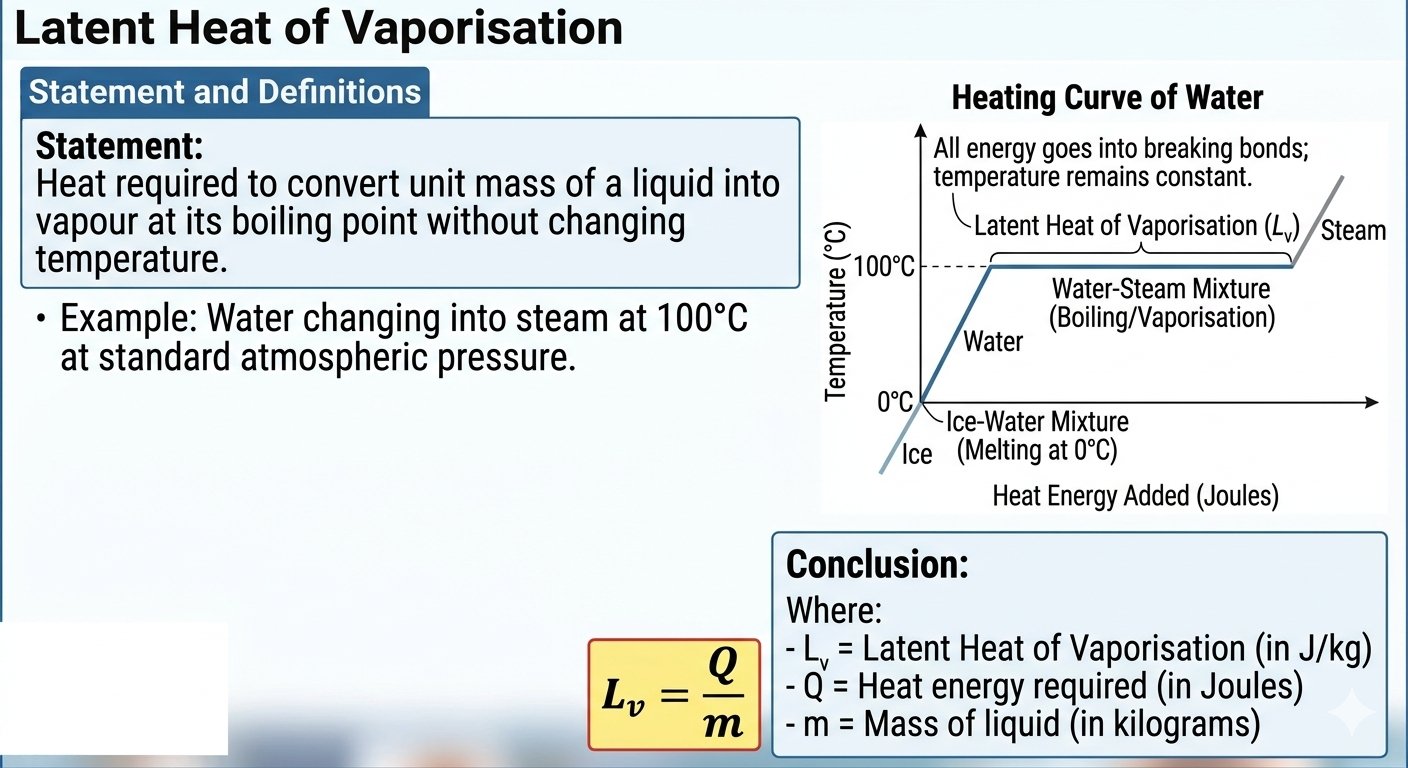
Explanation:
- Ice is heated and its temperature rises to 0°C.
- Ice melts at 0°C without a rise in temperature.
- Water temperature increases from 0°C to 100°C.
- Water boils at 100°C without a rise in temperature.
Steam temperature increases after complete vaporization.
12. Heat Transfer
Definition: The transfer of thermal energy from a hotter region to a colder region is called heat transfer.
There are three modes:
- Conduction
- Convection
Radiation
(a) Conduction
Definition: Conduction is the transfer of heat from the hotter part to the colder part of a body without bulk movement of the material.
Examples:
- A metal spoon becomes hot in tea.
- Heat passes through a metal rod.
Fourier’s Law of Heat Conduction:
\boxed{\frac Qt=kA\frac{T_1-T_2}{L}}
For steady one-dimensional conduction through a uniform slab.
Where:
- k = Thermal conductivity
- A = Cross-sectional area
- L = Thickness or length
- T_1-T_2 = Temperature difference
SI unit of thermal conductivity: W m⁻¹ K⁻¹
Good conductors: Copper, aluminum and silver.
Poor conductors: Wood, plastic and air.
(b) Convection
Definition: Convection is the transfer of heat by the actual movement of fluid particles.
Examples:
- Boiling water
- Sea breeze
- Land breeze
- Hot air rising
Types:
- Natural convection – Fluid movement due to density differences.
- Forced convection – Fluid movement caused by a fan, pump or another external device.
Sea Breeze: During the day, land heats faster than the sea. Warm air above land rises, and cooler air from the sea moves towards land.
(c) Radiation
Definition: Radiation is the transfer of heat through electromagnetic waves without requiring a material medium.
Examples:
- Heat from the Sun reaches Earth.
- We feel heat from a fire.
- A hot object emits thermal radiation.
Important points:
- Radiation can travel through a vacuum.
- All objects above absolute zero emit thermal radiation.
Dark, dull surfaces are generally better absorbers and emitters than shiny metallic surfaces under comparable conditions.
13. Blackbody Radiation
Blackbody: An ideal body that absorbs all electromagnetic radiation incident on it, irrespective of wavelength.
A blackbody is also an ideal emitter of thermal radiation.
Properties:
- It absorbs all incident radiation.
- Its radiation depends on its temperature.
- Its emitted spectrum is continuous.
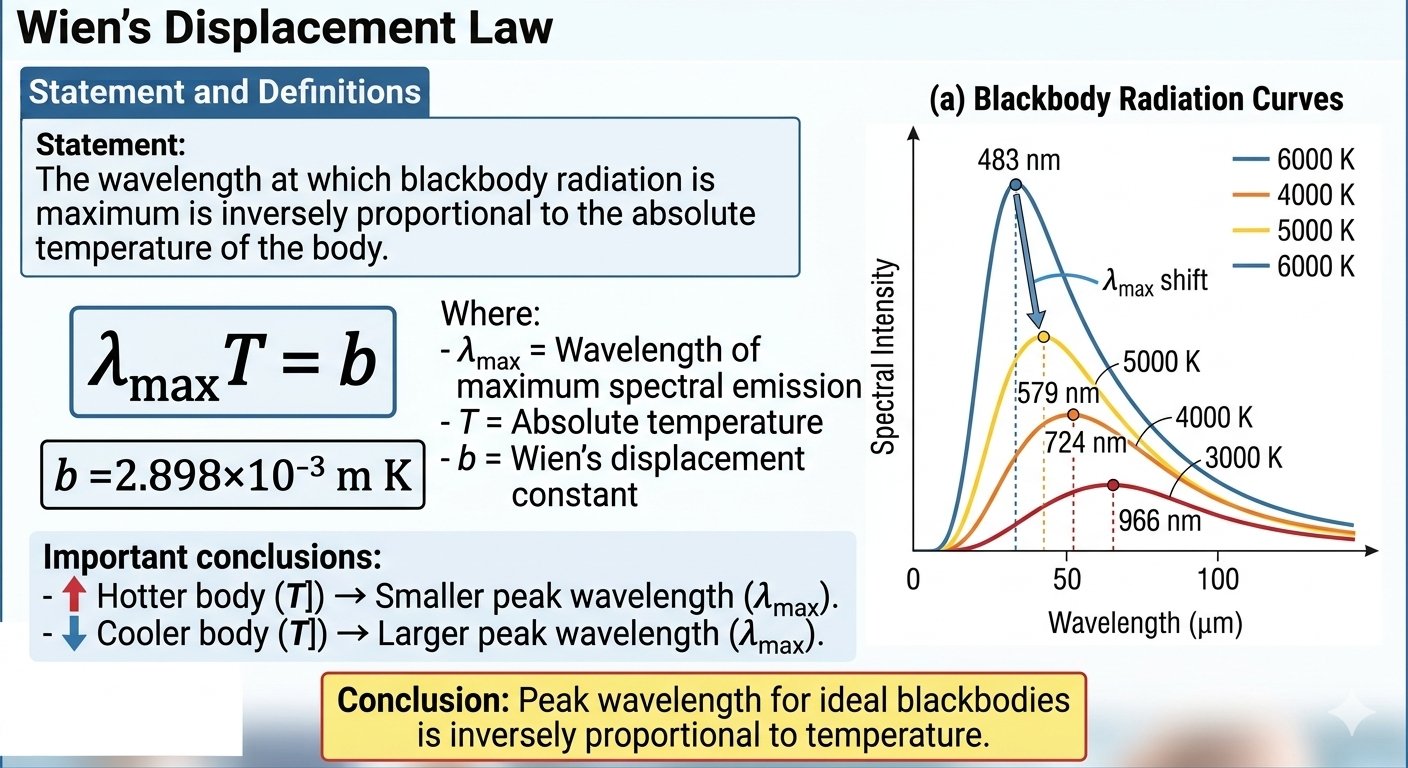
- As temperature increases, the peak wavelength becomes shorter.
(a) Wien’s Displacement Law
The wavelength at which blackbody radiation is maximum is inversely proportional to the absolute temperature of the body.
\boxed{\lambda_{\max}T=b}
Where:
- \lambda_{\max} = Wavelength of maximum spectral emission
- T = Absolute temperature
- b = Wien’s displacement constant
\boxed{b=2.898\times10^{-3}\ \mathrm{m\,K}}
Conclusion:
- Hotter body → Smaller peak wavelength.
- Cooler body → Larger peak wavelength.
Peak wavelength for ideal blackbodies at different temperatures.
(b) Stefan–Boltzmann Law
The total radiant power emitted per unit surface area of a blackbody is directly proportional to the fourth power of its absolute temperature.
\boxed{\frac PA=\sigma T^4}
Or,
\boxed{P=\sigma AT^4}
Where:
- P = Radiant power
- A = Surface area
- T = Absolute temperature
- \sigma = Stefan–Boltzmann constant
\boxed{\sigma=5.67\times10^{-8}\ \mathrm{W\,m^{-2}K^{-4}}}
For a real body of emissivity \varepsilon in surroundings at temperature T_s, the net radiative heat-loss rate is approximately:
\boxed{P_{\text{net}}=\varepsilon\sigma A(T^4-T_s^4)}
Important conclusion: If the absolute temperature of a blackbody doubles, its emitted power per unit area becomes 16 times.
14. Newton’s Law of Cooling
Statement: The rate of loss of heat of a body is directly proportional to the temperature difference between the body and its surroundings, provided the temperature difference is small and conditions remain nearly constant.
\boxed{-\frac{dT}{dt}=k(T-T_s)}
Where:
- T = Temperature of body
- T_s = Temperature of surroundings
- k = Positive cooling constant
- t = Time
Explanation:
- A hot body loses heat to cooler surroundings.
- Initially, the temperature difference is large, so cooling is faster.
- As the body cools, the temperature difference decreases.
- Therefore, the rate of cooling decreases.
Examples:
- Hot tea cools faster initially.
- Hot food cools in a room.
Warm water gradually reaches room temperature.
Integrated form:
\boxed{T-T_s=(T_0-T_s)e^{-kt}}
Where T_0 is the initial temperature of the body.
Conditions:
- Temperature difference is relatively small.
- Surrounding temperature remains constant.
- Cooling conditions do not change significantly.