Thermodynamics – Class 11 Physics Notes
Chapter – 11
Thermodynamics
1. Introduction
Thermodynamics is the study of heat, work, temperature and energy, and how they are related.
Example: When a gas is heated inside a cylinder, it may expand and push a piston. Here, heat supplied to the gas helps it do work.
Basic terms
- System: The part we choose to study, such as gas inside a cylinder.
- Surroundings: Everything outside the system.
- Boundary: The real or imaginary surface separating the system from its surroundings.
| Type of system | What can it exchange with surroundings? | Example |
|---|---|---|
| Open | Matter and energy | Water boiling in an open pot |
| Closed | Energy, but no matter | Gas inside a sealed cylinder with a movable piston |
| Isolated | Neither matter nor energy | An ideal insulated, sealed container |
2. Thermal Equilibrium
Two bodies are in thermal equilibrium when there is no net transfer of heat between them while they are in thermal contact.
They have the same temperature.
Example: A hot cup of tea gradually cools. Eventually, the tea and the surrounding air reach approximately the same temperature.
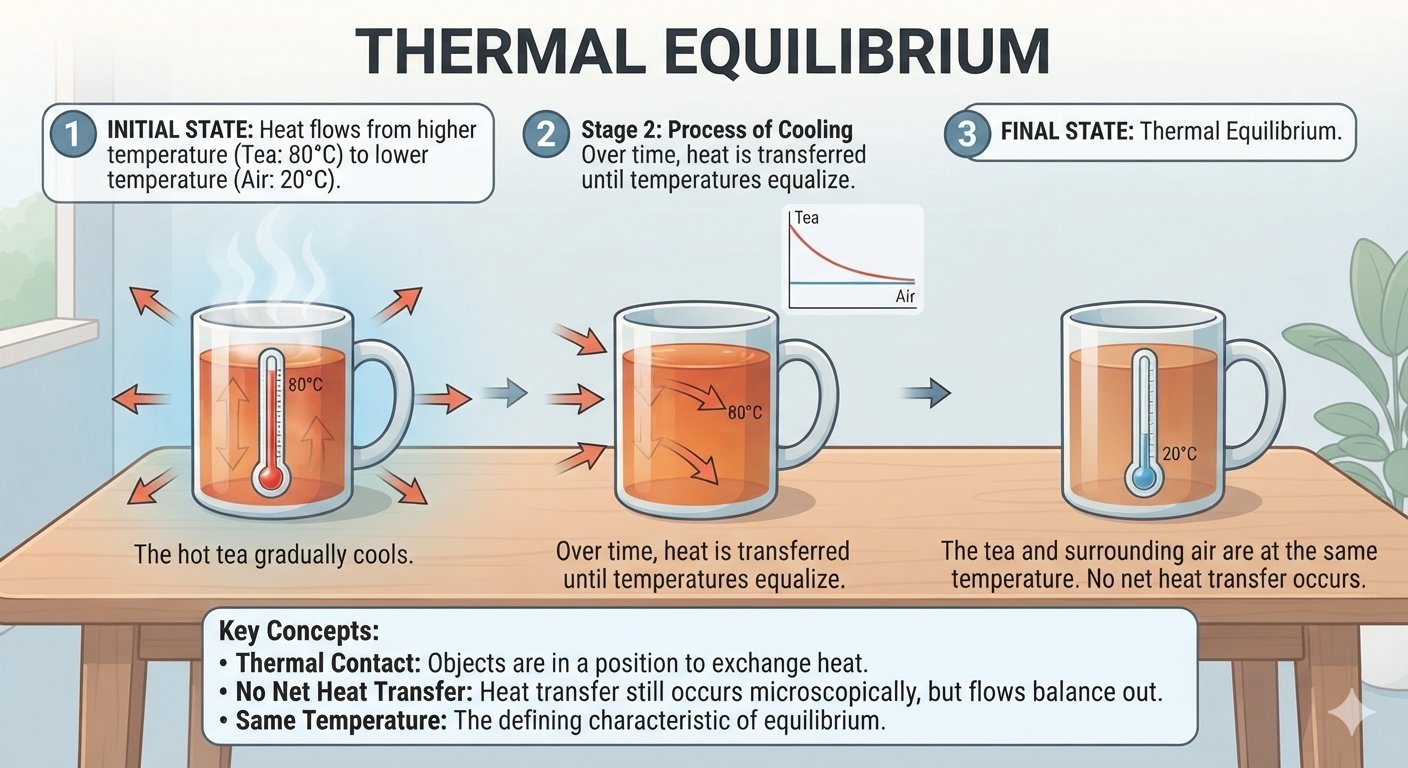
Remember: Heat flows naturally from a higher-temperature body to a lower-temperature body.
3. Zeroth Law of Thermodynamics
Statement:
If two bodies are separately in thermal equilibrium with a third body, they are also in thermal equilibrium with each other.
If:
T_A=T_C,\qquad T_B=T_C
then:
\boxed{T_A=T_B}
Easy meaning: If A and B each have the same temperature as C, then A and B have the same temperature.
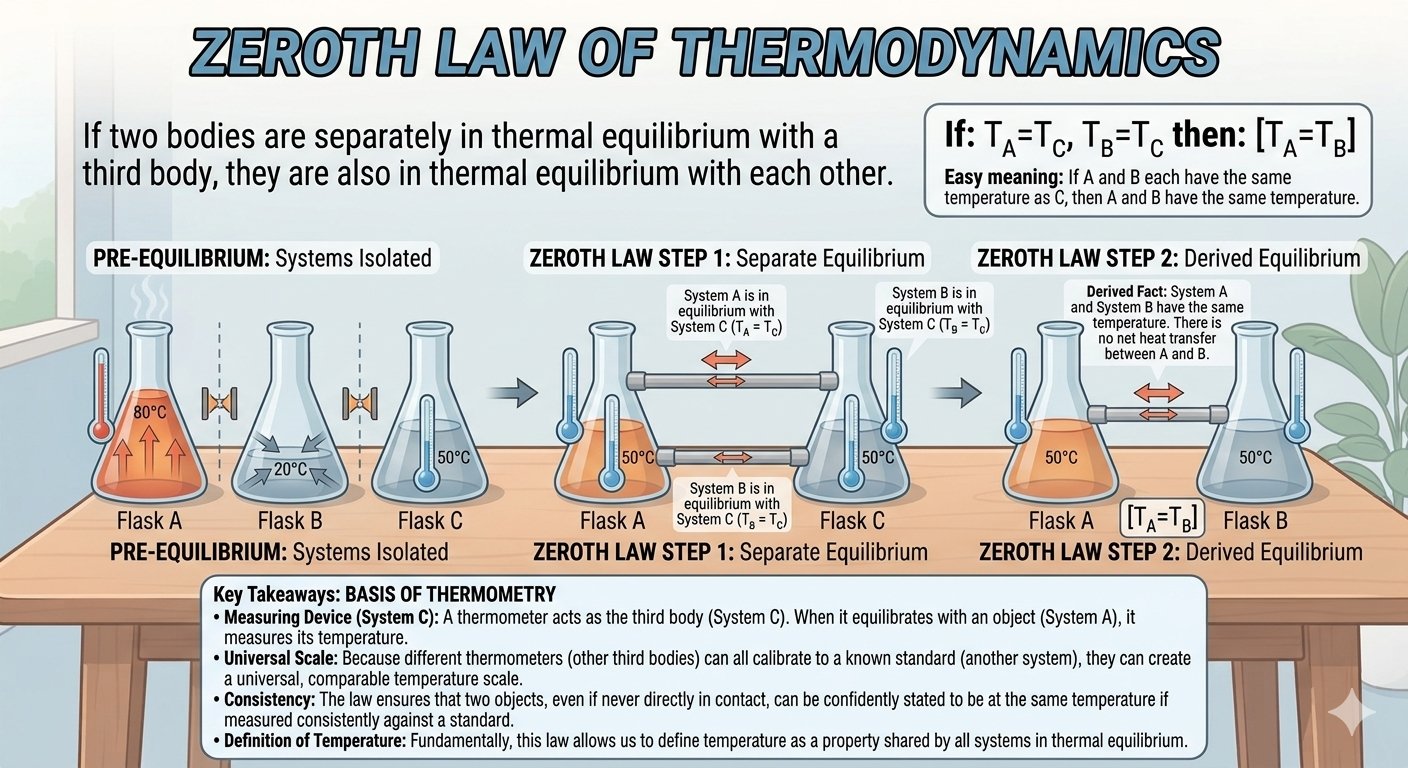
Importance: This law provides the basis for measuring temperature using a thermometer.
4. Heat, Internal Energy and Work
A. Heat (Q)
Heat is energy transferred between bodies because of a temperature difference.
- SI unit: joule (J)
- Heat is energy in transfer; it is not a substance stored inside a body.
Sign convention:
Q>0:\ \text{heat supplied to the system}Q<0:\ \text{heat released by the system}
B. Internal Energy (U)
Internal energy is the total microscopic kinetic and potential energy of the particles of a system.
It includes:
- Energy due to random motion of particles.
- Energy due to interactions between particles.
It does not include the kinetic energy of the whole system moving together.
For an ideal gas, internal energy depends only on temperature.
\boxed{\Delta U=nC_V\Delta T}
Here, n is the number of moles and C_V is the molar heat capacity at constant volume, assumed constant over the temperature range.
C. Work (W)
A gas does work when it expands and pushes its surroundings.
For a small, quasi-static volume change:
dW=P\,dV
For a finite change:
\boxed{W=\int_{V_1}^{V_2}P\,dV}
At constant pressure:
\boxed{W=P(V_2-V_1)}
Sign convention used in these notes:
- Expansion: W>0, work done by the gas.
- Compression: W<0, work done on the gas.
- Constant volume: W=0.
On a P–V graph, work is represented by the signed area under the process curve.
5. First Law of Thermodynamics
Statement:
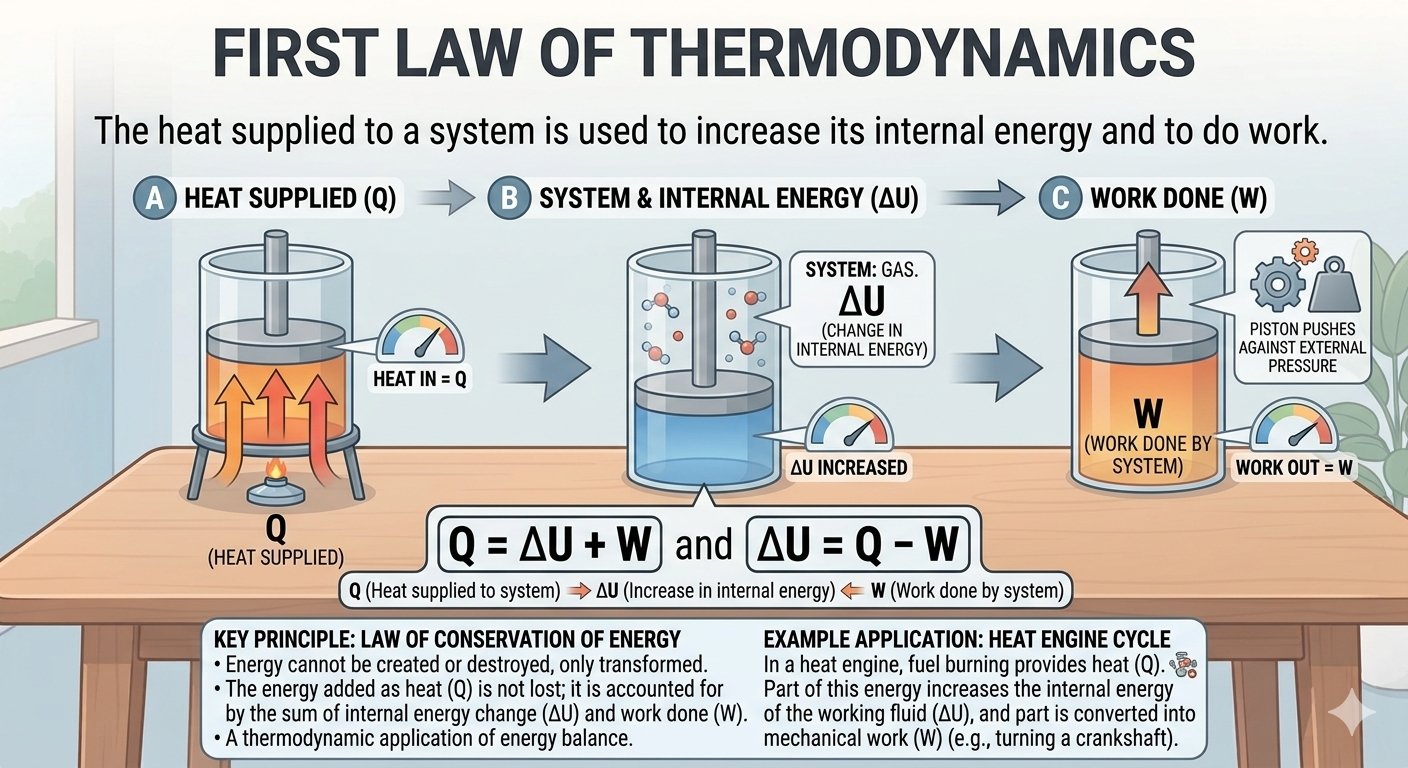
The heat supplied to a system is used to increase its internal energy and to do work.
\boxed{Q=\Delta U+W}
or:
\boxed{\Delta U=Q-W}
This is the law of conservation of energy applied to thermodynamics.
Simple example
A gas receives 500\,J of heat and does 200\,J of work.
\Delta U=500-200=\boxed{300\,J}
Its internal energy increases by 300\,J.
Useful cases
| Condition | Result |
|---|---|
| No work is done: W=0 | Q=\Delta U |
| No heat is exchanged: Q=0 | \Delta U=-W |
| Internal energy does not change: \Delta U=0 | Q=W |
6. Specific Heat Capacity
Specific heat capacity is the heat required to raise the temperature of unit mass of a substance by 1\,K or 1^\circ C, under specified conditions.
\boxed{c=\frac{Q}{m\Delta T}}
Therefore:
\boxed{Q=mc\Delta T}
- m: mass
- \Delta T: temperature change
- SI unit of c: \mathrm{J\,kg^{-1}\,K^{-1}}
This formula applies when there is no change of state.
Heat capacity
Heat required to raise the temperature of the whole body by 1\,K:
\boxed{C=\frac{Q}{\Delta T}=mc}
SI unit: \mathrm{J\,K^{-1}}
Molar heat capacity
Heat required to raise the temperature of one mole by 1\,K:
\boxed{C_m=\frac{Q}{n\Delta T}}
SI unit: \mathrm{J\,mol^{-1}\,K^{-1}}
Two important heat capacities of gases
At constant volume (C_V):
The gas does no expansion work, so heat increases its internal energy.
Q_V=nC_V\Delta T
At constant pressure (C_P):
Heat increases internal energy and allows the gas to do expansion work.
Q_P=nC_P\Delta T
Therefore, for an ideal gas:
\boxed{C_P>C_V}
Mayer’s relation for molar heat capacities:
\boxed{C_P-C_V=R}
The heat capacity ratio is:
\boxed{\gamma=\frac{C_P}{C_V}}
7. Thermodynamic State Variables
State variables describe the equilibrium condition of a system.
Examples:
- Pressure (P)
- Volume (V)
- Temperature (T)
- Internal energy (U)
- Amount of substance (n)
State functions and path-dependent quantities
Internal energy is a state function: Its change depends only on the initial and final states.
Heat and work depend on the path: Different processes between the same two states can involve different amounts of heat and work.
Equation of state
An equation of state relates the state variables of a system.
For an ideal gas:
\boxed{PV=nRT}
where:
R\approx8.314\ \mathrm{J\,mol^{-1}\,K^{-1}}
Use temperature in kelvin: T(K)=t(^\circ C)+273.15.
8. Thermodynamic Processes
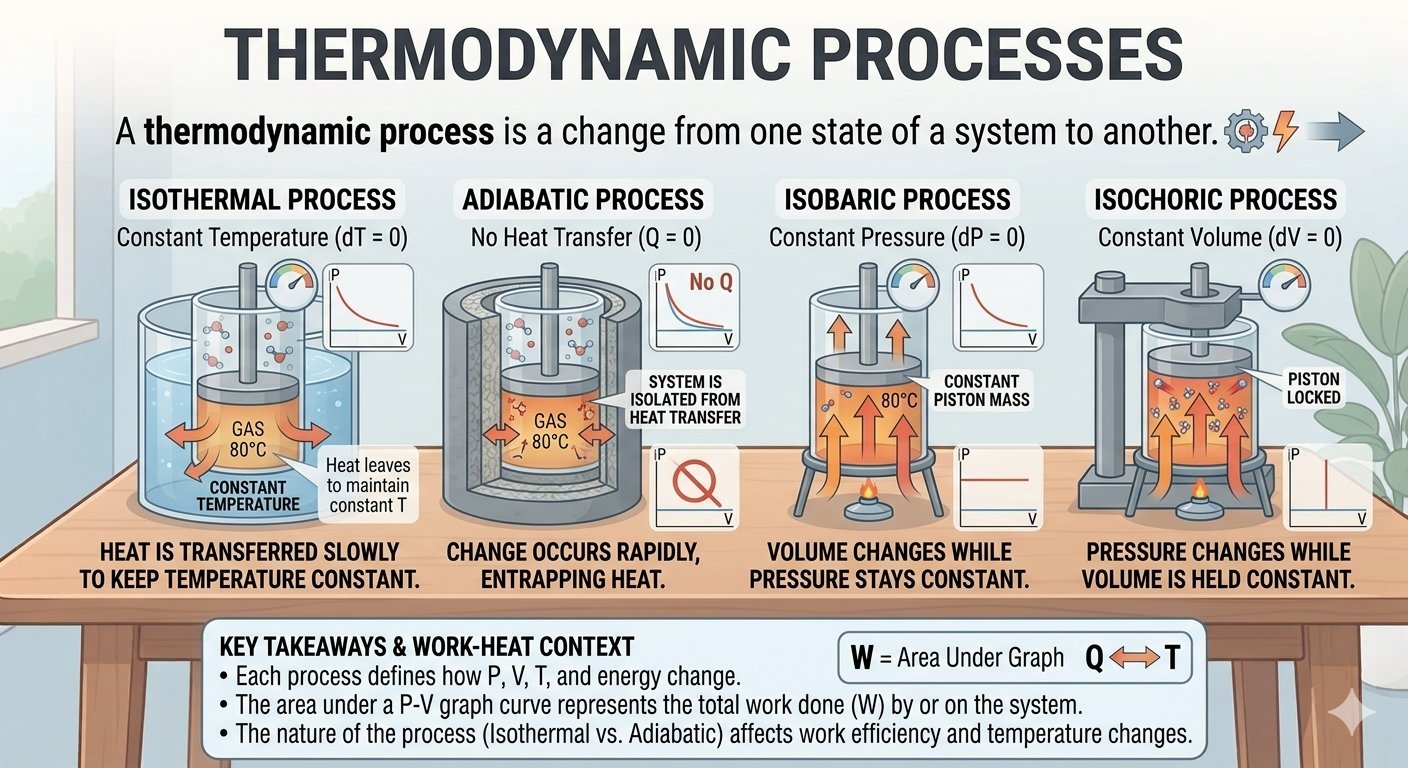
A thermodynamic process is a change from one state of a system to another.
A. Quasi-static Process
A process that takes place so slowly that the system remains very close to equilibrium at every stage.
Example: A piston moves very slowly while the gas pressure stays almost equal to the external pressure.
- Pressure and temperature are well defined at each stage.
- The process can be represented by a curve on a P–V graph.
Remember: A quasi-static process is not necessarily reversible; friction may still be present.
B. Isothermal Process — Constant Temperature
\boxed{T=\text{constant}}
For a fixed amount of ideal gas:
\boxed{PV=\text{constant}}
Therefore:
P_1V_1=P_2V_2
Since ideal-gas internal energy depends only on temperature:
\boxed{\Delta U=0}
Using the first law:
\boxed{Q=W}
For a quasi-static ideal-gas process:
\boxed{W=nRT\ln\left(\frac{V_2}{V_1}\right)}
Example: Slow expansion of a gas while it remains in thermal contact with a constant-temperature reservoir.
Graph: A falling curved line called a rectangular hyperbola.
C. Adiabatic Process — No Heat Exchange
\boxed{Q=0}
Using the first law:
\boxed{\Delta U=-W}
- Expansion: The gas does work, its internal energy decreases and it cools.
- Compression: Work is done on the gas, its internal energy increases and it warms.
For a reversible adiabatic process of an ideal gas, with constant heat capacities:
\boxed{PV^\gamma=\text{constant}}
Also:
\boxed{TV^{\gamma-1}=\text{constant}}
Work done:
\boxed{W=\frac{P_1V_1-P_2V_2}{\gamma-1}}
Conditions: Good thermal insulation, or a sufficiently rapid process so that heat exchange is negligible.
Example: Air warms during rapid compression in a bicycle pump.
Graph: The reversible adiabatic curve is steeper than the isothermal curve through the same point.
D. Isochoric Process — Constant Volume
\boxed{V=\text{constant}}
Since \Delta V=0:
\boxed{W=0}
Therefore:
\boxed{Q=\Delta U}
For an ideal gas:
Q=nC_V\Delta T
Also:
\boxed{\frac{P}{T}=\text{constant}}
Example: Heating gas inside a sealed, rigid container.
Graph: A vertical line on a P–V graph.
E. Isobaric Process — Constant Pressure
\boxed{P=\text{constant}}
Work done:
\boxed{W=P(V_2-V_1)}
For an ideal gas:
\boxed{W=nR(T_2-T_1)}
Heat supplied:
\boxed{Q=nC_P\Delta T}
Also:
\boxed{\frac{V}{T}=\text{constant}}
Example: Heating gas under a freely moving piston with a constant load.
Graph: A horizontal line on a P–V graph.
F. Cyclic Process — Return to Initial State
A cyclic process consists of several changes after which the system returns to its original state.
Since internal energy is a state function:
\boxed{\Delta U_{\text{cycle}}=0}
Therefore:
\boxed{Q_{\text{net}}=W_{\text{net}}}
- The P–V graph forms a closed loop.
- The enclosed area gives the magnitude of net work.
- Clockwise cycle: Net work done by the gas is positive.
- Anticlockwise cycle: Net work done by the gas is negative.
Example: The working substance in a heat engine undergoes repeated cycles.