Mechanical properties of Solids – Class 11 Physics Notes
Chapter – 8
Mechanical properties of Solids
1. Introduction
The mechanical properties of solids describe how solid objects behave when external forces act on them. These properties help us understand how materials stretch, compress, bend or change shape under the influence of a force.
When a force is applied to a solid, its shape or size may change. This change is called deformation.
Examples:
- A rubber band stretches when pulled.
- A spring becomes longer when a force is applied.
- A metal rod may become slightly longer when stretched.
- A sponge changes its shape when pressed.
Solids have two important properties:
- Elasticity: The ability of a material to regain its original shape and size after the deforming force is removed.
- Plasticity: The ability of a material to retain its changed shape even after the deforming force is removed.
A material is called elastic if it returns to its original shape after the force is removed, provided the elastic limit has not been exceeded.
2. Stress and Strain
When an external force acts on a solid, internal forces develop inside it to resist deformation. The resulting internal restoring force per unit area is called stress.
A. Stress
Stress is defined as the restoring force developed per unit area of a body.
\boxed{\text{Stress}=\frac{F}{A}}
Where:
- F = Applied force or magnitude of restoring force
- A = Cross-sectional area
The SI unit of stress is the pascal (Pa), which is equal to \mathrm{N/m^2}.
There are three main types of stress:
1. Longitudinal Stress
It develops when a force acts perpendicular to the cross-sectional area and changes the length of an object.
- Tensile stress: Increases the length of a body.
- Compressive stress: Decreases the length of a body.
2. Shearing Stress
It develops when a force acts parallel to the surface of a body and changes its shape.
3. Bulk Stress
It develops when equal pressure acts on all sides of a body, causing a change in its volume.
B. Strain
Strain is the ratio of the change in a dimension of a body to its original dimension.
For longitudinal strain,
\boxed{\text{Strain}=\frac{\Delta L}{L}}
Where:
- \Delta L = Change in length
- L = Original length
Strain has no unit because it is a ratio of two quantities with the same unit.
Types of strain:
- Longitudinal strain: Ratio of change in length to original length.
- Shearing strain: Change in angle between two initially perpendicular lines, measured in radians for small deformations.
- Volumetric strain: Ratio of change in volume to original volume.
\boxed{\text{Volumetric strain}=\frac{\Delta V}{V}}
Important points:
- Stress is related to the force acting on a body.
- Strain measures the deformation produced in the body.
Stress has a unit, but strain is dimensionless.
3. Hooke’s Law
Hooke’s law describes the relationship between stress and strain in an elastic material.
Statement: Within the elastic limit, stress is directly proportional to strain.
\boxed{\text{Stress}\propto\text{Strain}}
Therefore,
\boxed{\text{Stress}=E\times\text{Strain}}
Here, E represents the appropriate elastic modulus for the type of deformation.
For longitudinal deformation,
\boxed{E=\frac{\text{Longitudinal stress}}{\text{Longitudinal strain}}}
Hooke’s law is valid only when the material remains within its elastic limit.
Example: If a spring is stretched by a small force, its extension increases in proportion to the applied force, provided the elastic limit is not exceeded.
4. Stress-Strain Curve
A stress-strain curve is a graph showing how stress changes with strain in a material.
It helps us understand the elastic and plastic behaviour of a material.
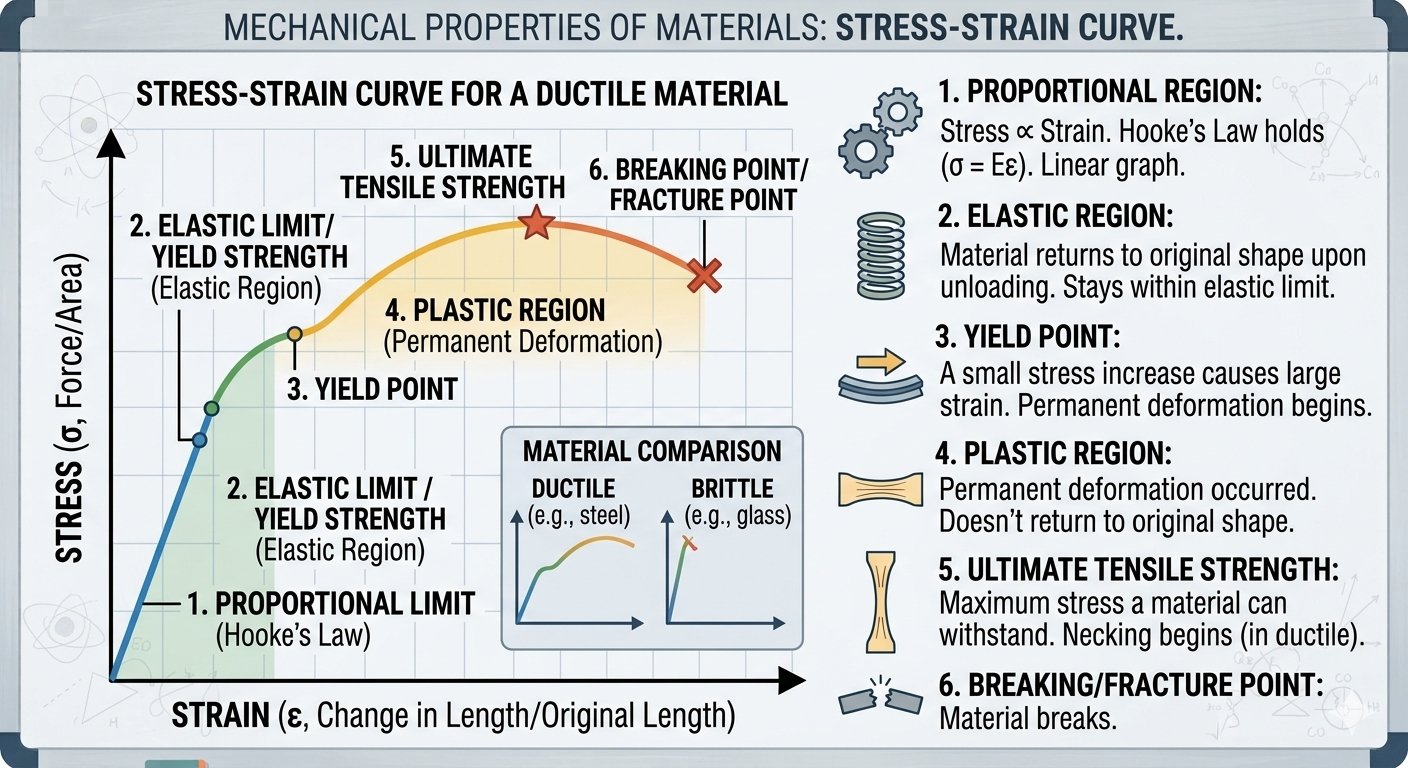
The main regions and points of the curve are:
1. Proportional Region
In this region, stress is directly proportional to strain. Hooke’s law is valid, and the graph is a straight line.
2. Elastic Region
The material returns to its original shape when the force is removed, as long as it remains within the elastic limit.
3. Yield Point
Beyond the yield point, a small increase in stress can produce a large increase in strain. Permanent deformation begins in a typical ductile material.
4. Plastic Region
The material undergoes permanent deformation and does not completely return to its original shape when the force is removed.
5. Ultimate Tensile Strength
This is the maximum tensile stress a material can withstand on the engineering stress-strain curve.
6. Breaking Point or Fracture Point
At this point, the material breaks.
The exact shape of the curve depends on the material. Brittle materials, such as glass, may fracture with very little plastic deformation.
5. Elastic Moduli
Elastic moduli measure the resistance of a material to deformation. A larger elastic modulus generally means that more stress is required to produce the same strain.
There are three main elastic moduli:
A. Young’s Modulus
Young’s modulus measures the resistance of a material to a change in length.
It is defined as the ratio of longitudinal stress to longitudinal strain within the elastic limit.
\boxed{Y=\frac{\text{Longitudinal stress}}{\text{Longitudinal strain}}}
Using the definitions of stress and strain,
Y=\frac{F/A}{\Delta L/L}
Therefore,
\boxed{Y=\frac{FL}{A\Delta L}}
Where:
- F = Applied tensile force
- L = Original length
- A = Cross-sectional area
- \Delta L = Change in length
The SI unit of Young’s modulus is pascal (Pa).
Example: Steel has a high Young’s modulus, so it undergoes relatively little extension under a given tensile stress.
B. Shear Modulus
Shear modulus measures the resistance of a material to a change in shape due to shearing forces.
It is defined as the ratio of shearing stress to shearing strain.
\boxed{G_s=\frac{\text{Shearing stress}}{\text{Shearing strain}}}
It is also called the modulus of rigidity.
The SI unit is pascal (Pa).
Example: When a force acts parallel to the top surface of a solid block while its bottom is fixed, the block may change shape. The shear modulus measures its resistance to this deformation.
C. Bulk Modulus
Bulk modulus measures the resistance of a material to a change in volume when pressure is applied.
It is defined as the ratio of the change in pressure to the corresponding fractional change in volume, with a negative sign because volume decreases when pressure increases.
\boxed{B=-\frac{\Delta P}{\Delta V/V}}
Or,
\boxed{B=-\frac{V\Delta P}{\Delta V}}
Where:
- B = Bulk modulus
- \Delta P = Change in pressure
- V = Original volume
- \Delta V = Change in volume
The SI unit is pascal (Pa).
Example: Liquids generally have a high bulk modulus, which means they are difficult to compress.
Difference Between the Three Elastic Moduli
Elastic Modulus | Type of deformation | Formula |
|---|---|---|
Young’s modulus | Change in length | Y=\frac{\text{Longitudinal stress}}{\text{Longitudinal strain}} |
Shear modulus | Change in shape | G_s=\frac{\text{Shearing stress}}{\text{Shearing strain}} |
Bulk modulus | Change in volume | B=-\frac{\Delta P}{\Delta V/V} |
6. Poisson’s Ratio
When a wire or rod is stretched, its length increases but its diameter usually decreases. Similarly, when a material is compressed lengthwise, its length decreases while its lateral dimensions usually increase.
Poisson’s ratio is the negative ratio of lateral strain to longitudinal strain.
\boxed{\nu=-\frac{\text{Lateral strain}}{\text{Longitudinal strain}}}
Where:
- \nu = Poisson’s ratio
- Lateral strain = Change in diameter divided by original diameter
- Longitudinal strain = Change in length divided by original length
The negative sign accounts for the opposite directions of the lateral and longitudinal changes during ordinary stretching or compression.
Poisson’s ratio has no unit.
For many common materials, its value lies between 0 and 0.5, although some specially structured materials can have negative Poisson’s ratios.
Example: When a rubber band is stretched, its length increases and its thickness generally decreases.
7. Elastic Potential Energy in a Stretched Wire
When a wire is stretched within its elastic limit, work is done against the restoring force. This work is stored in the wire as elastic potential energy.
Suppose a wire of original length L, cross-sectional area A, and Young’s modulus Y is stretched by an amount x.
According to Hooke’s law, the force increases gradually from zero to a final value F.
The average force during stretching is:
F_{\text{average}}=\frac{0+F}{2}=\frac{F}{2}
The work done in stretching the wire is:
U=F_{\text{average}}\times x
Therefore,
\boxed{U=\frac12 Fx}
Since F=\frac{YA}{L}x,
\boxed{U=\frac{YA x^2}{2L}}
Where:
- U = Elastic potential energy
- Y = Young’s modulus
- A = Cross-sectional area
- L = Original length
- x = Extension of the wire
The energy stored per unit volume is called elastic energy density.
\boxed{u=\frac12(\text{Stress})(\text{Strain})}
The SI unit of elastic potential energy is joule (J), while elastic energy density is measured in \mathrm{J/m^3}.
Important points:
- More extension stores more elastic energy.
- For the same wire, elastic energy is proportional to the square of the extension, as long as Hooke’s law remains valid.
The energy is recoverable when the wire returns to its original length within the elastic limit.
8. Applications of Elastic Behaviour of Materials
Elastic behaviour is important in engineering, construction and everyday life.
1. Construction of Buildings and Bridges
Engineers choose materials with suitable elastic properties to ensure that buildings and bridges can withstand loads without excessive deformation.
2. Railway Tracks
Railway tracks must withstand the loads of moving trains while limiting unwanted deformation.
3. Springs
Springs in weighing machines, toys and mechanical devices work by storing and releasing elastic potential energy.
4. Shock Absorbers
Shock absorbers and suspension systems help reduce the effects of bumps and vibrations in vehicles.
5. Cranes and Lifting Equipment
The elastic properties and strength of cables are considered when designing cranes and other lifting equipment.
6. Sports Equipment
Bats, rackets, poles and other sports equipment are designed with suitable stiffness and elasticity to perform effectively.
7. Medical Applications
Elastic materials are used in items such as elastic bandages and some medical supports because they can stretch and recover their shape.
8. Designing Machines
Engineers consider elastic moduli when designing machine parts to prevent excessive bending, stretching or compression during operation.