Laws of Motion – Class 11 Physics Notes
Chapter-4
Laws of Motion
1. Introduction
Motion means a change in the position of an object with time.
Force is a push or pull acting on an object.
Force can change the speed, direction, or shape of an object.
The laws of motion were given by Sir Isaac Newton.
These laws explain the relationship between force and motion.
Examples: Kicking a football, pushing a trolley, and stopping a moving bicycle.
2. Aristotle’s Fallacy
Aristotle was an ancient Greek philosopher.
He believed that a continuous force was necessary to keep an object moving.
According to his idea, an object stops when the applied force is removed.
This idea was later found to be incorrect.
Correct explanation: An object stops mainly because of opposing forces such as friction. If there is no net external force, an object continues moving with constant velocity.
Example: A football rolling on the ground stops because of friction between the ball and the ground and resistance from air.
3. The Law of Inertia
Inertia is the natural tendency of an object to resist any change in its state of rest or motion.
An object at rest tends to remain at rest.
A moving object tends to continue moving with constant velocity.
Inertia depends on the mass of an object.
Greater mass means greater inertia.
Types of inertia:
Inertia of rest: Resistance to a change from rest.
Inertia of motion: Resistance to a change in motion.
Inertia of direction: Resistance to a change in direction.
Examples:
Passengers move backward when a bus starts suddenly.
Passengers move forward when a moving bus stops suddenly.
A passenger leans sideways when a car takes a sharp turn.
4. Newton’s First Law of Motion
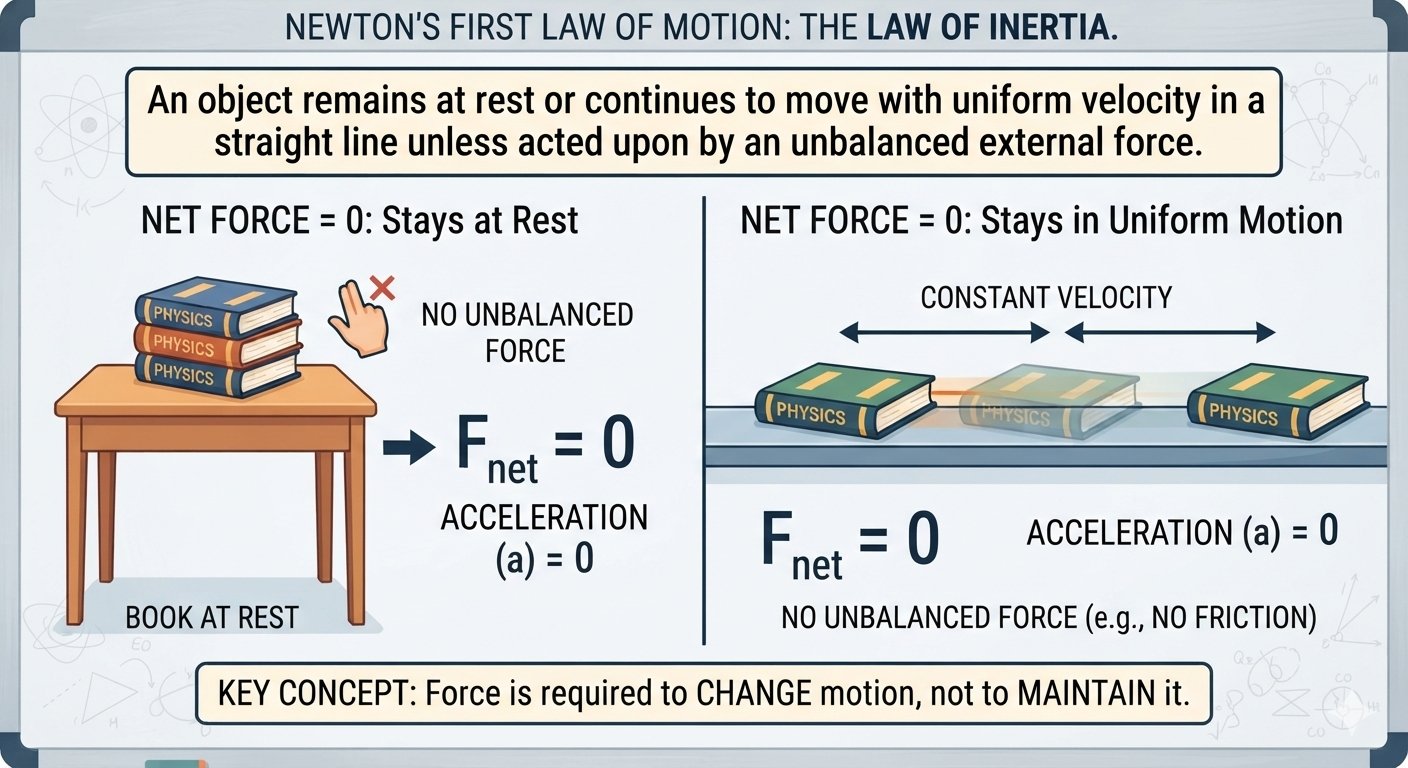
Newton’s first law is also called the Law of Inertia.
Statement: An object remains at rest or continues to move with uniform velocity in a straight line unless an unbalanced external force acts on it.
If the net force is zero, the velocity does not change.
If the net force is not zero, the velocity may change.
Force is required to change motion, not to maintain uniform motion.

Mathematically,
F_{\text{net}}=0 \Rightarrow a=0
Example: A book lying on a table remains at rest until someone moves it.
5. Newton’s Second Law of Motion
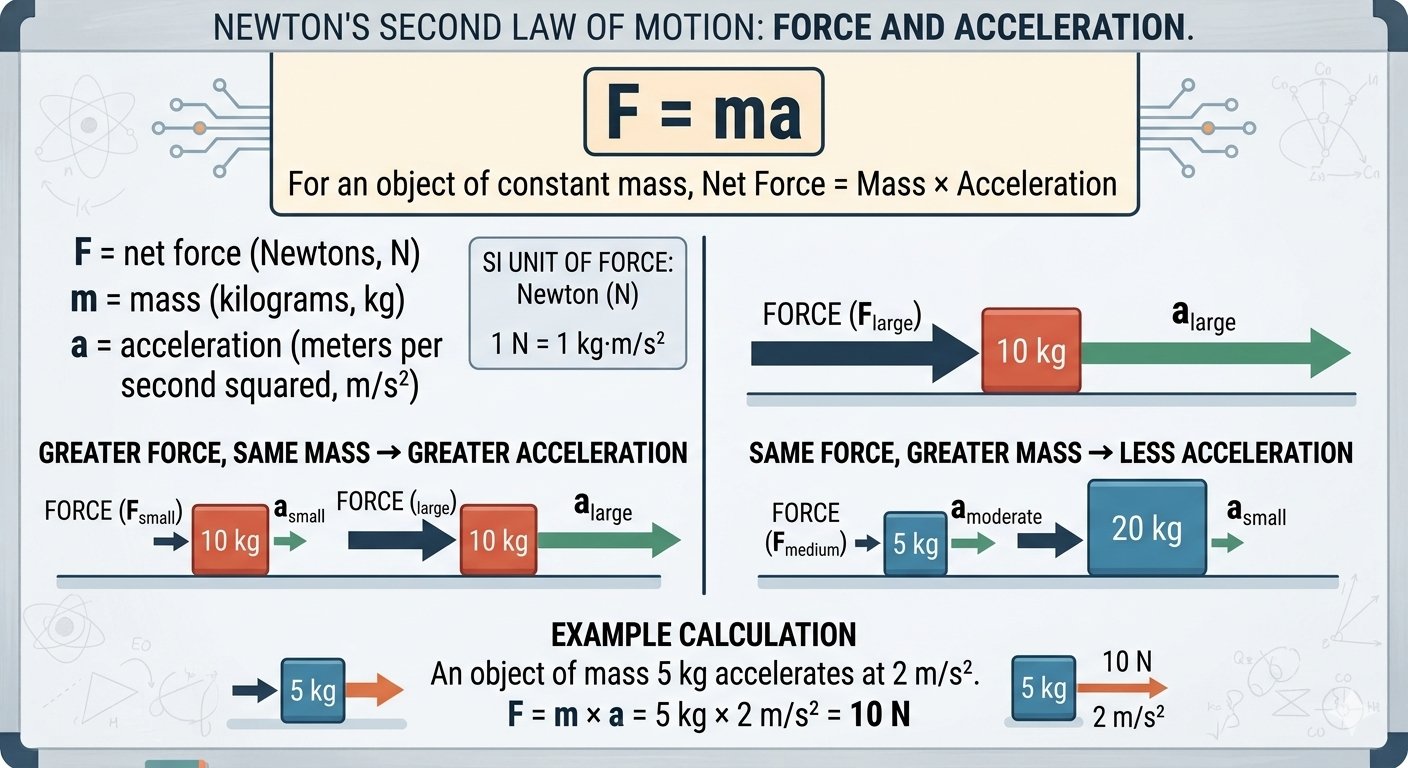
Statement: The rate of change of momentum of an object is directly proportional to the net external force acting on it and takes place in the direction of that force.
For an object of constant mass,
\boxed{F=ma}
Where:
F = net force (newton)
m = mass (kg)
a= acceleration (m/s²)
Important points:
Greater force produces greater acceleration for the same mass.
Greater mass produces less acceleration for the same force.
Acceleration takes place in the direction of the net force.
SI unit of force: newton (N)
1\,\text{N}=1\,\text{kg m/s}^2
Example: An object of mass 5 kg accelerates at 2 m/s². Find the force.
F=ma=5\times2=\boxed{10\,\text{N}}
6. Momentum
Momentum is the quantity of motion possessed by a moving object. It depends on its mass and velocity.
\boxed{p=mv}
Where:
p = momentum
m = mass
v= velocity
Momentum is a vector quantity.
Its direction is the same as the direction of velocity.
SI unit: kg m/s.
A heavier or faster object generally has greater momentum.
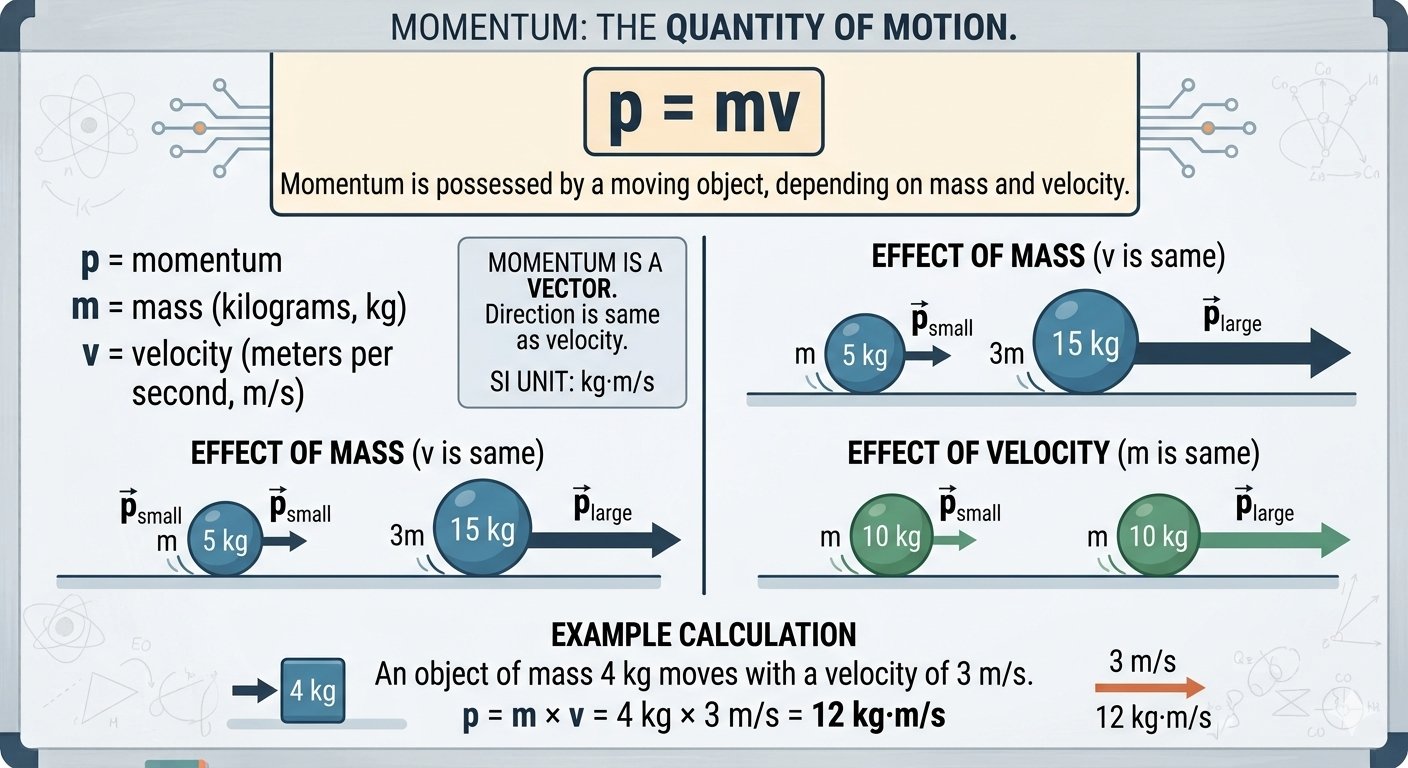
Example: A 4 kg object moves with a velocity of 3 m/s.
p=mv=4\times3=\boxed{12\,\text{kg m/s}}
7. Impulse
Impulse is the product of the force acting on an object and the time interval for which the force acts.
\boxed{J=F\Delta t}
Impulse is equal to the change in momentum.
\boxed{J=\Delta p=mv-mu}
Where u is initial velocity and v is final velocity.
SI unit: N s or kg m/s.
Impulse is a vector quantity.
A larger force or a longer contact time can produce a greater impulse.
Examples:
A cricketer moves their hands backward while catching a ball to increase the stopping time and reduce the force.
Airbags increase the time taken for a passenger to stop during a collision, reducing the average force.
8. Newton’s Third Law of Motion
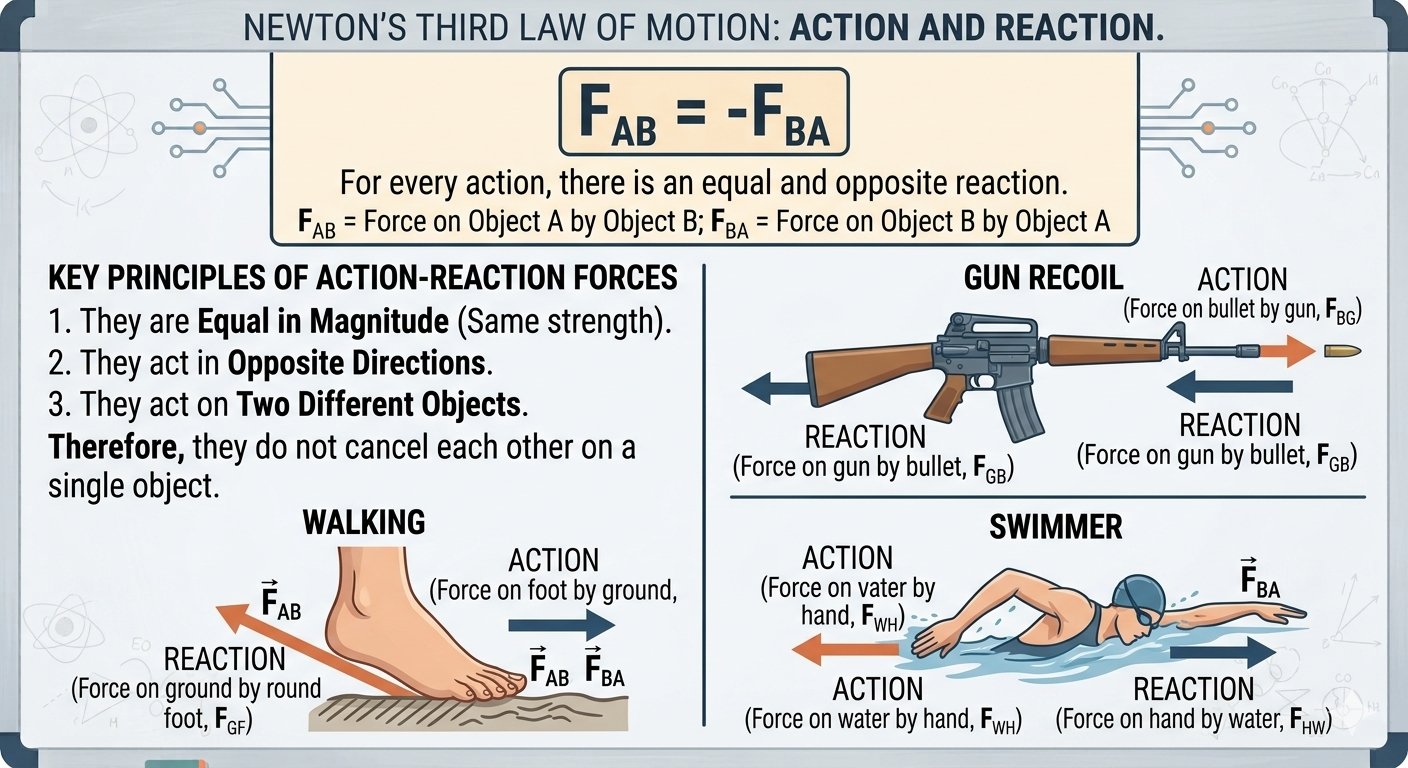
Statement: For every action, there is an equal and opposite reaction.
Action and reaction forces are equal in magnitude.
They act in opposite directions.
They act on two different objects.
Therefore, they do not cancel each other on a single object.
Examples:
While walking, we push the ground backward, and the ground pushes us forward.
A swimmer pushes water backward and moves forward.
A gun recoils backward when a bullet moves forward.
\boxed{\vec F_{AB}=-\vec F_{BA}}
Here, \vec F_{AB} is the force on object A by object B, and \vec F_{BA} is the force on B by A.
9. Conservation of Momentum and Its Applications
Law: If no net external force acts on a system, its total momentum remains constant.
\boxed{\text{Total initial momentum} =\text{Total final momentum}}
For two interacting objects,
m_1u_1+m_2u_2=m_1v_1+m_2v_2
Where u_1,u_2 are initial velocities and v_1,v_2 are final velocities.
Applications:
Recoil of a gun: The bullet moves forward and the gun moves backward.
Rocket propulsion: Gases move backward and the rocket moves forward.
Collision of objects: Total momentum remains conserved in an isolated system.
Explosion: Parts move in different directions, while total momentum is conserved if the initial momentum and external impulse are zero.
Numerical example: A 2 kg object moving at 4 m/s collides with a stationary 2 kg object. They stick together. Find their common velocity.
Using conservation of momentum,
2(4)+2(0)=(2+2)v
8=4v \Rightarrow \boxed{v=2\,\text{m/s}}
10. Equilibrium of a Particle
A particle is said to be in equilibrium when the resultant of all the forces acting on it is zero.
\boxed{\sum \vec F=0}
For equilibrium in two dimensions,
\sum F_x=0,\qquad \sum F_y=0
Conditions of equilibrium:
The net force must be zero.
Acceleration must be zero.
The particle may be at rest or moving with constant velocity.
Examples:
A book resting on a table.
A lamp hanging from the ceiling.
A vehicle moving in a straight line with constant velocity.
For a book resting on a table, the downward weight mg is balanced by the upward normal force N.
\boxed{N=mg}
This equality applies when no other vertical forces act on the book.
11. Common Forces in Mechanics
A force is an interaction that can change or tend to change the motion of an object.
(a) Gravitational force / Weight
The Earth attracts objects towards its centre.
The weight of an object is the gravitational force acting on it.
\boxed{W=mg}
Where m is mass and g is acceleration due to gravity.
(b) Normal force
The normal force is the force exerted by a surface on an object in contact with it.
It always acts perpendicular to the surface.
Example: A table pushes a book upward.
(c) Tension force
Tension acts through a stretched string, rope, or cable.
It pulls an object along the string.
For an ideal light string over a smooth pulley, tension is the same throughout the string.
(d) Spring force
A spring exerts a restoring force when stretched or compressed.
According to Hooke’s law, within the elastic limit,
\boxed{F=-kx}
Where k is the spring constant and x is the displacement from the natural position. The negative sign indicates that the force acts opposite to the displacement.
(e) Frictional force
Friction opposes relative motion or the tendency of relative motion between surfaces in contact.
It acts along the contact surface.
It may help or oppose the motion of an object, depending on the situation.
(f) Air resistance
Air resistance is the force exerted by air on a moving object. It generally acts opposite to the object’s motion relative to the air.
12. Friction
Friction is the force that opposes relative sliding or the tendency of sliding between two surfaces in contact.
Types of friction:
1. Static friction
Acts when the surfaces are not sliding relative to each other.
Adjusts its value according to the applied force, up to a maximum value.
\boxed{0\leq f_s\leq \mu_sN}
Maximum static friction is:
\boxed{f_{s,\max}=\mu_sN}
2. Kinetic friction
Acts when surfaces slide over each other.
Its approximate magnitude is
\boxed{f_k=\mu_kN}
Where:
N = normal reaction
\mu_s = coefficient of static friction
\mu_k = coefficient of kinetic friction
Usually, for the same pair of dry surfaces, \mu_k<\mu_s.
Advantages of friction
Helps us walk without slipping.
Helps vehicles move and stop.
Allows us to write with a pencil.
Helps us grip objects.
Disadvantages of friction
Causes wear and tear.
Produces unwanted heat.
Wastes some useful energy.
Methods of reducing friction: Lubrication, ball bearings, and making surfaces smoother.
13. Centripetal Force
When an object moves in a circular path, its velocity continuously changes direction. Therefore, it has an acceleration directed towards the centre of the circle.
This acceleration is called centripetal acceleration.
\boxed{a_c=\frac{v^2}{r}}
The net inward force required for circular motion is called centripetal force.
\boxed{F_c=\frac{mv^2}{r}}
Where:
m = mass of the object
v = speed
r = radius of the circular path
Important points:
Centripetal force always acts towards the centre.
It is not a separate type of force; it is the net inward force supplied by forces such as friction, tension, or gravity.
If the inward force disappears, the object continues along the tangent at that instant, assuming no other force acts.
Example: When a stone tied to a string is rotated in a circle, the tension in the string supplies the centripetal force.
14. Circular Motion of a Car on a Level Road
When a car moves along a circular road on a level surface, it needs an inward force to keep moving in a circle.
The weight mg acts vertically downward.
The normal force N acts vertically upward.
Static friction between the tyres and the road provides the centripetal force.
For vertical equilibrium,
N=mg
The maximum static friction is
f_{s,\max}=\mu_sN=\mu_smg
For circular motion,
\frac{mv^2}{r}\leq\mu_smg
Therefore, the maximum safe speed is
\boxed{v_{\max}=\sqrt{\mu_srg}}
Where r is the radius of the turn and \mu_s is the coefficient of static friction.
Important points:
Higher friction allows a car to take a turn at a higher speed.
A larger turning radius allows a higher speed.
If the speed becomes too high, the tyres may skid.
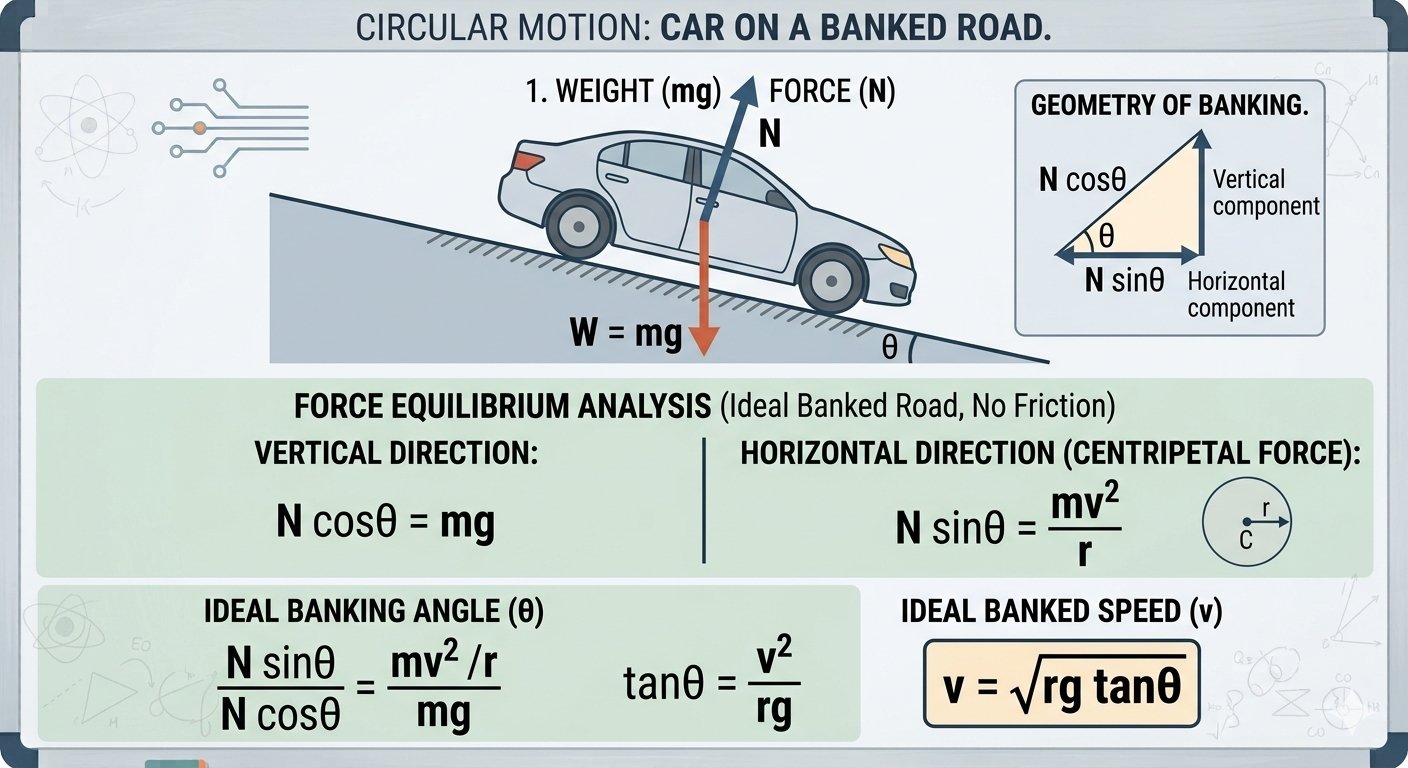
15. Circular Motion of a Car on a Banked Road
A banked road is a road whose outer edge is raised above its inner edge at a turn.
Banking helps a vehicle turn safely by allowing the normal force to provide an inward component.
For an ideal banked road without friction, the forces are:
Weight mg, vertically downward.
Normal force N, perpendicular to the road.
Resolving the normal force:
Vertical direction:
N\cos\theta=mg
Horizontal direction:
N\sin\theta=\frac{mv^2}{r}
Dividing the two equations,
\tan\theta=\frac{v^2}{rg}
Hence, the ideal speed is
\boxed{v=\sqrt{rg\tan\theta}}
Where:
r = radius of the turn
g = acceleration due to gravity
\theta = banking angle
Advantages of a banked road:
Reduces dependence on friction for the required centripetal force.
Helps vehicles turn safely at the designed speed.
Reduces the risk of skidding under suitable conditions.