Chapter – 12
Kinetic Theory
1. Introduction
Kinetic theory explains the behaviour of gases by studying the motion of their molecules.
The word kinetic means “related to motion.”
Main idea: Gas molecules move continuously and randomly. Their motion helps us understand pressure, temperature and internal energy.
Example: The smell of perfume spreads across a room because its molecules move and mix with air.
2. Molecular Nature of Matter
All matter is made of very small particles called atoms or molecules.
Important properties
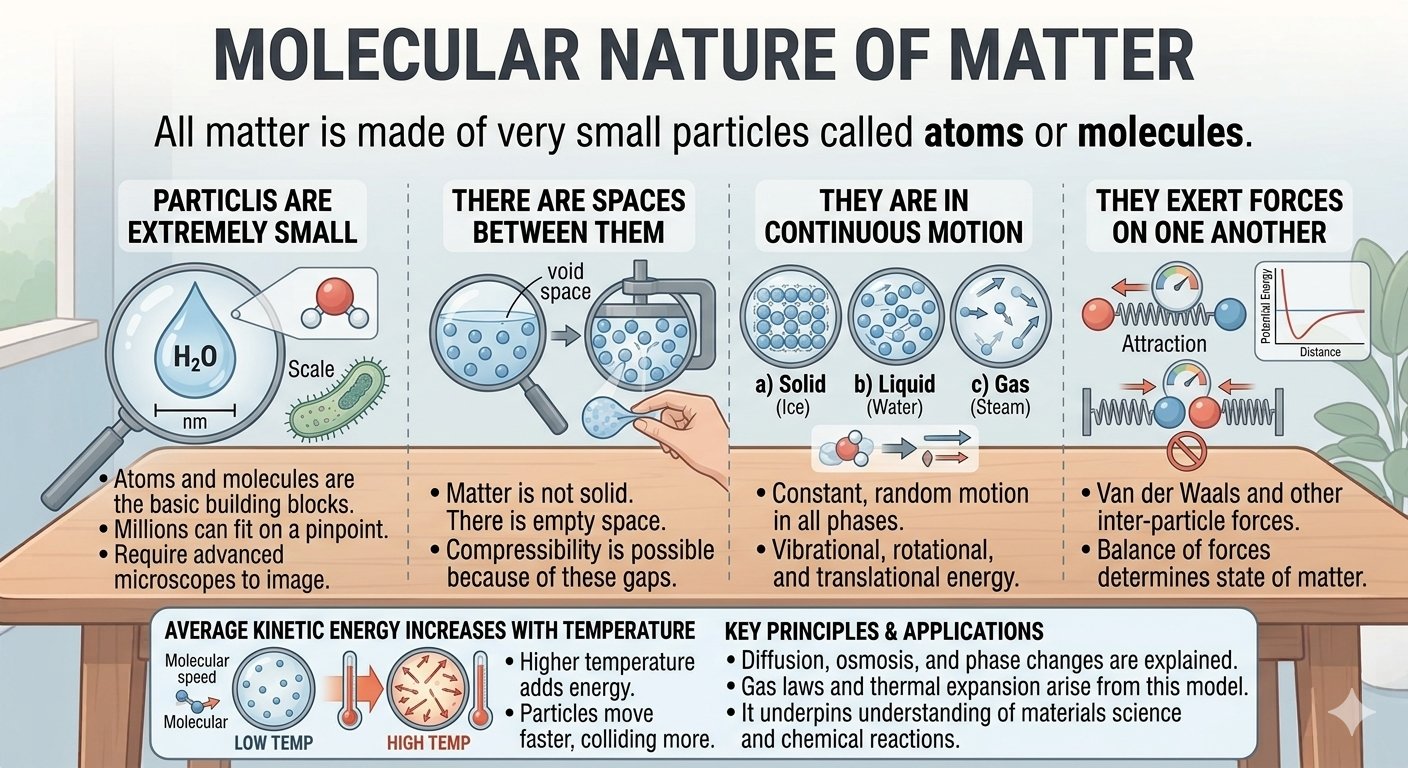
- Particles are extremely small.
- There are spaces between them.
- They are in continuous motion.
- They exert forces on one another.
- Their average kinetic energy increases when temperature increases.
Particles in different states
| State | Arrangement and motion |
|---|---|
| Solid | Particles are closely packed and vibrate about fixed positions |
| Liquid | Particles remain close but can move past one another |
| Gas | Particles are widely separated and move freely and randomly |
Evidence of molecular motion
A. Diffusion
The spreading and mixing of particles due to their random motion.
Example: Perfume spreading through air.
B. Brownian motion
The irregular, random motion of tiny particles suspended in a liquid or gas, caused by uneven collisions with surrounding molecules.
Example: Pollen grains moving irregularly in water.
Remember: Brownian motion is the motion of suspended particles caused by molecular collisions.
Useful molecular quantities
Avogadro constant:
\boxed{N_A=6.022\times10^{23}\ \mathrm{mol^{-1}}}
One mole contains approximately 6.022\times10^{23} particles.
If a gas contains n moles:
\boxed{N=nN_A}
where N is the total number of molecules.
3. Behavior of Gases
A gas:
- Has no fixed shape or volume.
- Fills its container.
- Can be compressed easily.
- Exerts pressure on the walls of its container.
A. Boyle’s Law
For a fixed amount of gas at constant temperature:
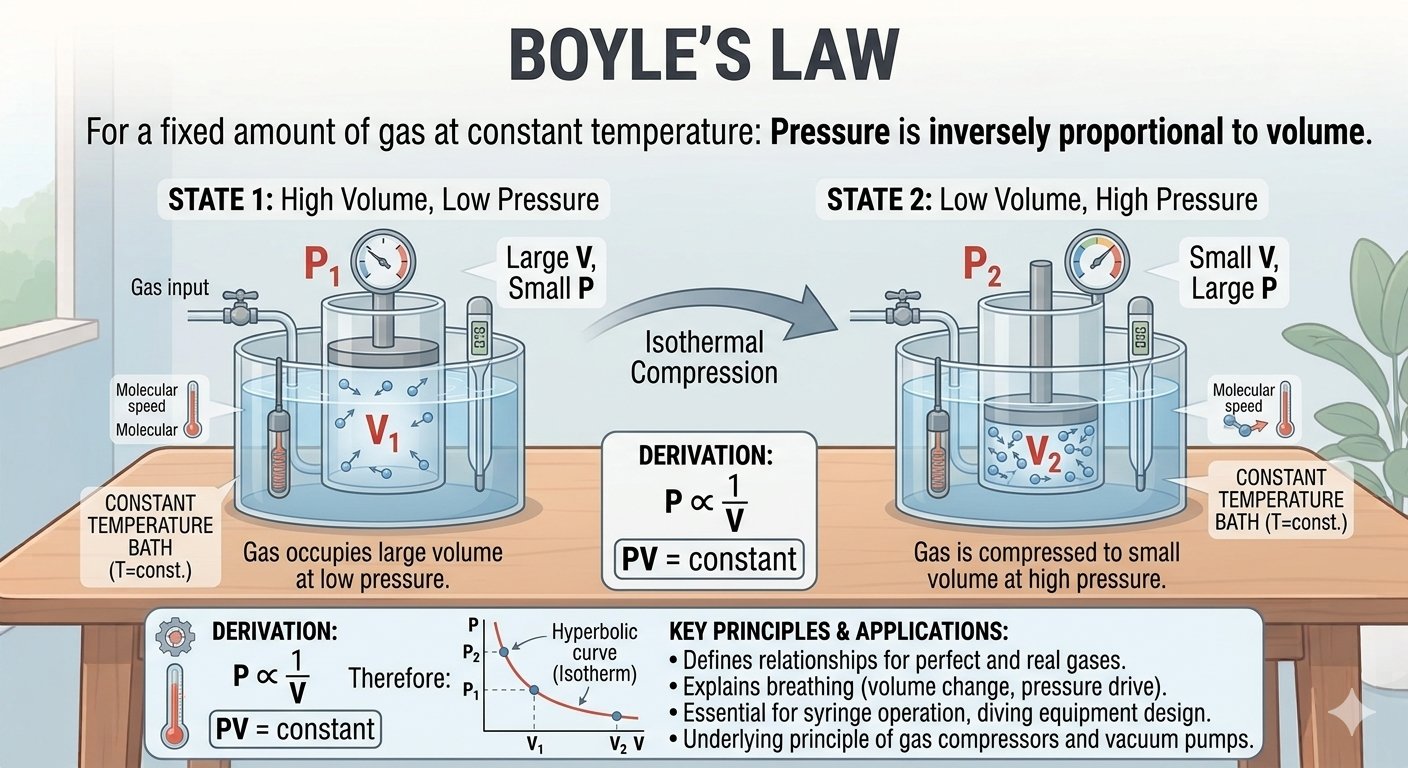
Pressure is inversely proportional to volume.
P\propto\frac{1}{V}\boxed{PV=\text{constant}}
Therefore:
\boxed{P_1V_1=P_2V_2}
Easy meaning: Decreasing the volume increases the pressure.
B. Charles’s Law
For a fixed amount of gas at constant pressure:
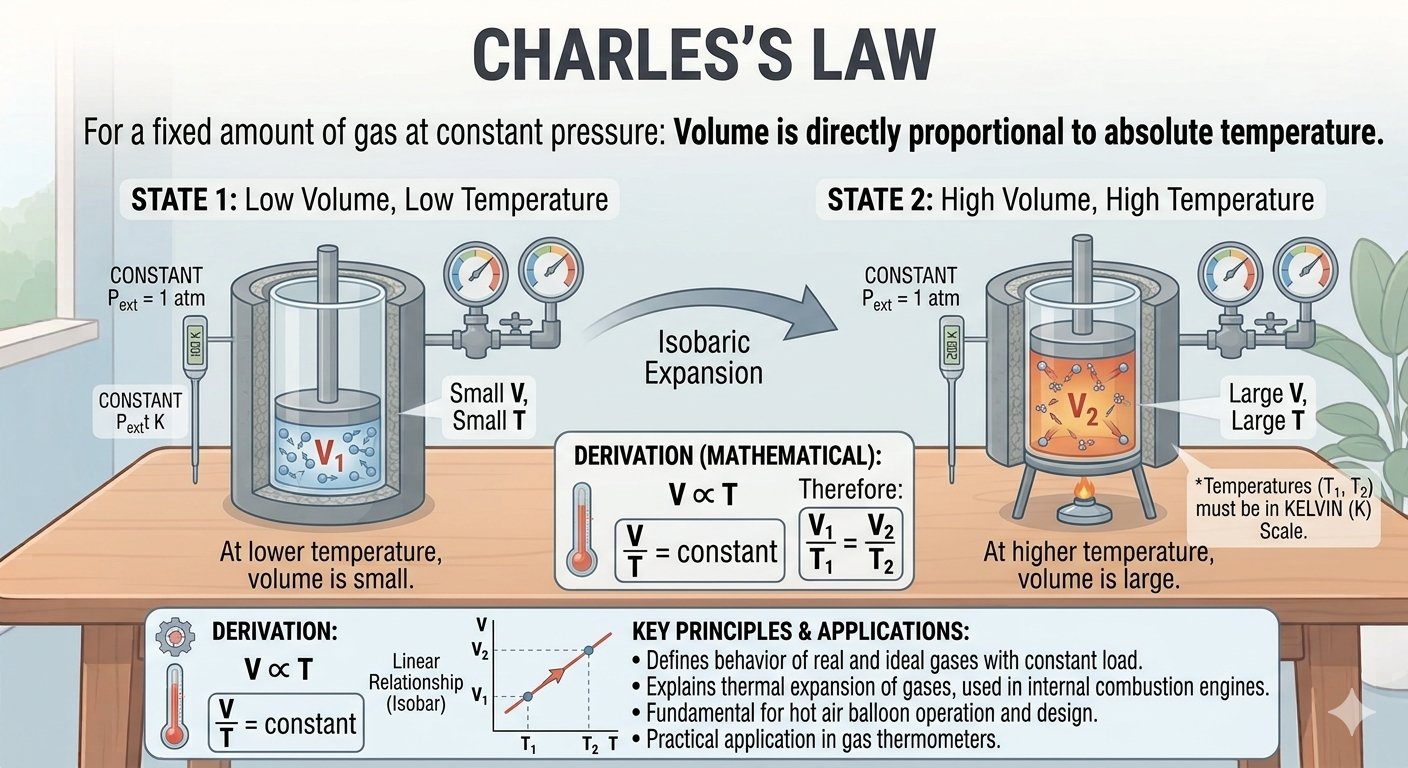
Volume is directly proportional to absolute temperature.
V\propto T\boxed{\frac{V}{T}=\text{constant}}
Therefore:
\boxed{\frac{V_1}{T_1}=\frac{V_2}{T_2}}
Easy meaning: A gas expands on heating if its pressure remains constant.
C. Pressure–Temperature Law
For a fixed amount of gas at constant volume:
P\propto T\boxed{\frac{P}{T}=\text{constant}}
Therefore:
\boxed{\frac{P_1}{T_1}=\frac{P_2}{T_2}}
D. Avogadro’s Law
At the same pressure and temperature:
Equal volumes of gases contain equal numbers of molecules.
\boxed{V\propto n}
Ideal Gas Equation
Combining the gas laws:
\boxed{PV=nRT}
Also:
\boxed{PV=Nk_BT}
where:
- P: pressure
- V: volume
- n: number of moles
- N: number of molecules
- T: absolute temperature
- R=8.314\ \mathrm{J\,mol^{-1}\,K^{-1}}
- k_B=1.38\times10^{-23}\ \mathrm{J\,K^{-1}}, the Boltzmann constant
The two constants are related by:
\boxed{R=N_Ak_B}
Always use kelvin: T(K)=t(^\circ C)+273.15.
Real gases behave approximately like ideal gases at low pressure and high temperature, away from liquefaction.
4. Kinetic Theory of an Ideal Gas
Main assumptions
- A gas contains a very large number of identical molecules.
- Molecules move continuously in random directions.
- Their own volume is negligible compared with the volume of the container.
- Intermolecular forces are neglected except during collisions.
- Molecules move in straight lines with constant velocity between collisions.
- Collisions between molecules and with the walls are perfectly elastic.
- Collision time is negligible compared with the time between collisions.
- Molecules obey Newton’s laws of motion.
Perfectly elastic collision: Total momentum and total kinetic energy are conserved.
Pressure arises because molecules repeatedly collide with the container walls and transfer momentum to them.
5. Pressure of an Ideal Gas
Consider a cubical container of side L, containing N molecules, each of mass m.
For one molecule, let its velocity component perpendicular to a chosen wall be v_x.
Step 1: Momentum transferred
After an elastic collision, its velocity component changes from v_x to -v_x.
The magnitude of momentum transferred to the wall is:
\boxed{2mv_x}
Step 2: Time between successive collisions with the same wall
The molecule travels to the opposite wall and back:
\Delta t=\frac{2L}{|v_x|}
Step 3: Average force due to this molecule
F=\frac{\text{momentum transferred}}{\text{time}} =\frac{mv_x^2}{L}
Adding the contributions of all molecules and dividing by wall area L^2:
P=\frac{Nm}{V}\overline{v_x^2}
Because random motion has no preferred direction:
\overline{v_x^2} =\overline{v_y^2} =\overline{v_z^2} =\frac13\overline{v^2}
Therefore:
\boxed{P=\frac13\frac{Nm}{V}\overline{v^2}}
Since gas density is:
\rho=\frac{Nm}{V}
we obtain:
\boxed{P=\frac13\rho v_{\mathrm{rms}}^2}
Here:
\boxed{v_{\mathrm{rms}}=\sqrt{\overline{v^2}}}
is the root mean square speed.
Pressure and translational kinetic energy
Total translational kinetic energy is:
E_{\mathrm{tr}}=\frac12Nm\overline{v^2}
Therefore:
\boxed{PV=\frac23E_{\mathrm{tr}}}
Easy meaning: At a fixed volume, greater total translational kinetic energy produces greater pressure.
6. Kinetic Interpretation of Temperature
From kinetic theory:
PV=\frac13Nm\overline{v^2}
From the ideal gas equation:
PV=Nk_BT
Comparing:
\frac13m\overline{v^2}=k_BT
Therefore, the average translational kinetic energy per molecule is:
\boxed{\frac12m\overline{v^2}=\frac32k_BT}
Meaning of temperature
Absolute temperature measures the average translational kinetic energy of gas molecules.
- Higher temperature → greater average translational kinetic energy.
- Lower temperature → smaller average translational kinetic energy.
At the same temperature, molecules of all ideal gases have the same average translational kinetic energy, even if their masses differ.
RMS speed
\boxed{v_{\mathrm{rms}}=\sqrt{\frac{3k_BT}{m}}}
Using molar mass M:
\boxed{v_{\mathrm{rms}}=\sqrt{\frac{3RT}{M}}}
Use M in \mathrm{kg\,mol^{-1}}.
Important conclusions
v_{\mathrm{rms}}\propto\sqrt{T}
At the same temperature:
v_{\mathrm{rms}}\propto\frac{1}{\sqrt{M}}
Thus, lighter gas molecules have greater RMS speed than heavier ones.
Example: At the same temperature, hydrogen molecules move faster on average than oxygen molecules.
7. Degrees of Freedom
Degrees of freedom (f) are the independent ways in which a molecule can move or store energy.
A. Translational motion
Movement along three perpendicular directions:
x,\quad y,\quad z
Every freely moving gas molecule has:
\boxed{3\text{ translational degrees of freedom}}
B. Rotational motion
Rotation about independent axes.
- A linear molecule normally has 2 active rotational degrees of freedom.
- A non-linear molecule normally has 3 active rotational degrees of freedom.
C. Vibrational motion
Atoms within a molecule vibrate relative to one another.
Each active vibrational mode has:
- A kinetic energy contribution.
- A potential energy contribution.
Thus, each active vibrational mode contributes two terms to the equipartition energy count.
The active modes depend on temperature. Vibrations are often largely inactive near room temperature.
8. Law of Equipartition of Energy
Statement:
In thermal equilibrium, each independent quadratic term in the energy contributes an average energy of:
\boxed{\frac12k_BT\text{ per molecule}}
For the usual school-level counting, if a molecule has f active energy contributions:
\boxed{\overline{E}=\frac{f}{2}k_BT}
For N molecules:
\boxed{U=\frac{f}{2}Nk_BT}
For n moles:
\boxed{U=\frac{f}{2}nRT}
These expressions describe the thermal internal energy of an ideal gas when the counted modes are active.
Vibrational energy
Each active vibrational mode contributes:
\frac12k_BT+\frac12k_BT =\boxed{k_BT}
Remember: The classical equipartition result applies to active modes. Quantum effects can make some rotational or vibrational modes inactive at low temperatures.
9. Specific Heat Capacity of Gases
For gases, heat capacity depends on whether heating occurs at constant volume or constant pressure.
Specific heat capacity
Heat required to raise the temperature of unit mass by 1\,K, under specified conditions:
\boxed{Q=mc\Delta T}
SI unit:
\mathrm{J\,kg^{-1}\,K^{-1}}
Molar heat capacities
- C_V: molar heat capacity at constant volume.
- C_P: molar heat capacity at constant pressure.
Their SI unit is:
\mathrm{J\,mol^{-1}\,K^{-1}}
General formulas
For constant f:
U=\frac{f}{2}nRT
At constant volume, no expansion work is done:
Q_V=\Delta U=nC_V\Delta T
Therefore:
\boxed{C_V=\frac{f}{2}R}
For an ideal gas, Mayer’s relation gives:
C_P-C_V=R
Hence:
\boxed{C_P=\frac{f+2}{2}R}
The heat capacity ratio is:
\boxed{\gamma=\frac{C_P}{C_V}=\frac{f+2}{f}}
Why is C_P>C_V?
At constant pressure, heat must increase internal energy and provide energy for expansion work.
10. Monoatomic Gases
A monoatomic gas contains single-atom particles.
Examples: Helium, neon and argon.
In the usual ideal-gas model, only translational motion contributes:
f=3
Therefore:
\boxed{U=\frac32nRT}\boxed{C_V=\frac32R}\boxed{C_P=\frac52R}\boxed{\gamma=\frac53\approx1.67}
11. Diatomic Gases
A diatomic molecule contains two atoms.
Examples: Hydrogen (H_2), nitrogen (N_2) and oxygen (O_2).
Near room temperature
For these gases, the usual approximation is:
- 3 translational contributions.
- 2 rotational contributions.
- Vibrations largely inactive.
Thus:
f=5\boxed{U=\frac52nRT}\boxed{C_V=\frac52R}\boxed{C_P=\frac72R}\boxed{\gamma=\frac75=1.4}
At sufficiently high temperature
If the single vibrational mode becomes fully active, it adds two energy contributions:
f=7
Therefore:
\boxed{C_V=\frac72R,\qquad C_P=\frac92R}\boxed{\gamma=\frac97\approx1.29}
These results assume the molecules remain intact.
12. Polyatomic Gases
A polyatomic molecule contains more than two atoms.
Examples: Carbon dioxide (CO_2), water vapour (H_2O) and methane (CH_4).
A. Non-linear molecules: vibrations neglected
A non-linear molecule has:
- 3 translational contributions.
- 3 rotational contributions.
Thus:
f=6\boxed{U=3nRT}\boxed{C_V=3R}\boxed{C_P=4R}\boxed{\gamma=\frac43\approx1.33}
Examples: Water vapour and methane, under the approximation that vibrations are inactive.
B. Linear molecules: vibrations neglected
A linear polyatomic molecule, such as CO_2, has:
- 3 translational contributions.
- 2 rotational contributions.
Thus:
f=5\boxed{C_V=\frac52R,\qquad C_P=\frac72R}\boxed{\gamma=\frac75}