Oscillations – Class 11 Physics Notes
Chapter – 13
Oscillations
1. Introduction
Oscillation is the repeated to-and-fro motion of a body about its mean or equilibrium position.
Examples:
- Motion of a swing.
- Motion of a simple pendulum.
- Vibrations of a tuning fork.
- Motion of a mass attached to a spring.
Mean position: The position where the body is in equilibrium.
Extreme positions: The positions of maximum displacement on either side of the mean position.
2. Periodic and Oscillatory Motion
A. Periodic Motion
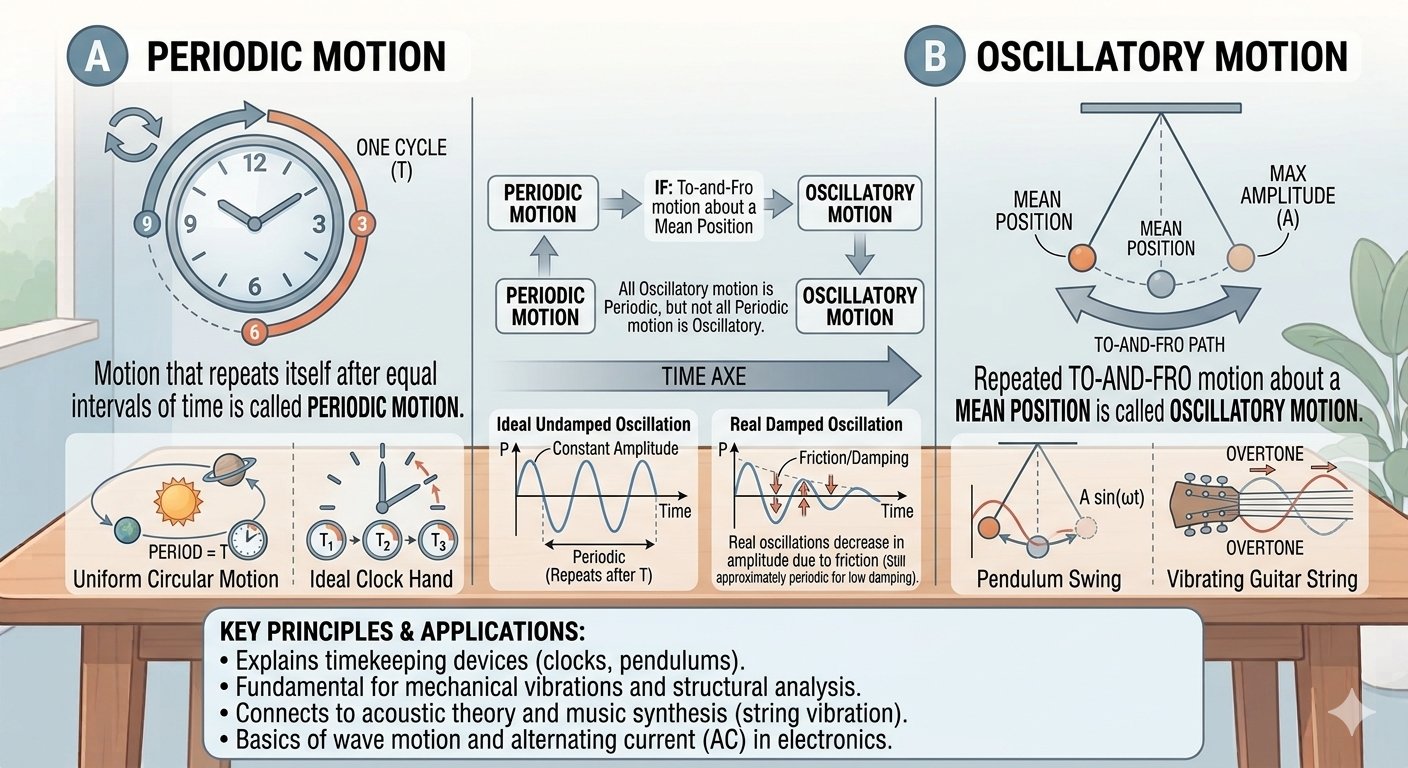
Motion that repeats itself after equal intervals of time is called periodic motion.
Examples: Uniform circular motion and the ideal motion of a clock’s hands.
B. Oscillatory Motion
Repeated to-and-fro motion about a mean position is called oscillatory motion.
Examples: A pendulum swinging and a vibrating guitar string.
An ideal undamped oscillation is periodic. Real oscillations may gradually decrease in amplitude due to friction.
Difference
| Periodic motion | Oscillatory motion |
|---|---|
| Repeats after equal time intervals | Moves to and fro about a mean position |
| Need not involve to-and-fro motion | Involves to-and-fro motion |
| Example: Uniform circular motion | Example: An ideal pendulum swinging |
3. Period and Frequency
A. Time Period (T)
The time taken to complete one full oscillation.
\boxed{T=\frac{\text{Total time}}{\text{Number of oscillations}}}
SI unit: second (s)
One complete oscillation means returning to the same position with the same direction of motion.
B. Frequency (f)
The number of complete oscillations made in one second.
\boxed{f=\frac{\text{Number of oscillations}}{\text{Total time}}}
SI unit: hertz (Hz)
1\,Hz=1\text{ oscillation per second}
Relation between period and frequency
\boxed{f=\frac1T} \qquad \boxed{T=\frac1f}
C. Angular Frequency (\omega)
The rate at which the phase of an oscillation changes.
\boxed{\omega=2\pi f=\frac{2\pi}{T}}
SI unit: \mathrm{rad\,s^{-1}}
Example
A body makes 20 oscillations in 10 seconds.
T=\frac{10}{20}=\boxed{0.5\,s}f=\frac{20}{10}=\boxed{2\,Hz}
4. Displacement, Amplitude and Phase
A. Displacement (x)
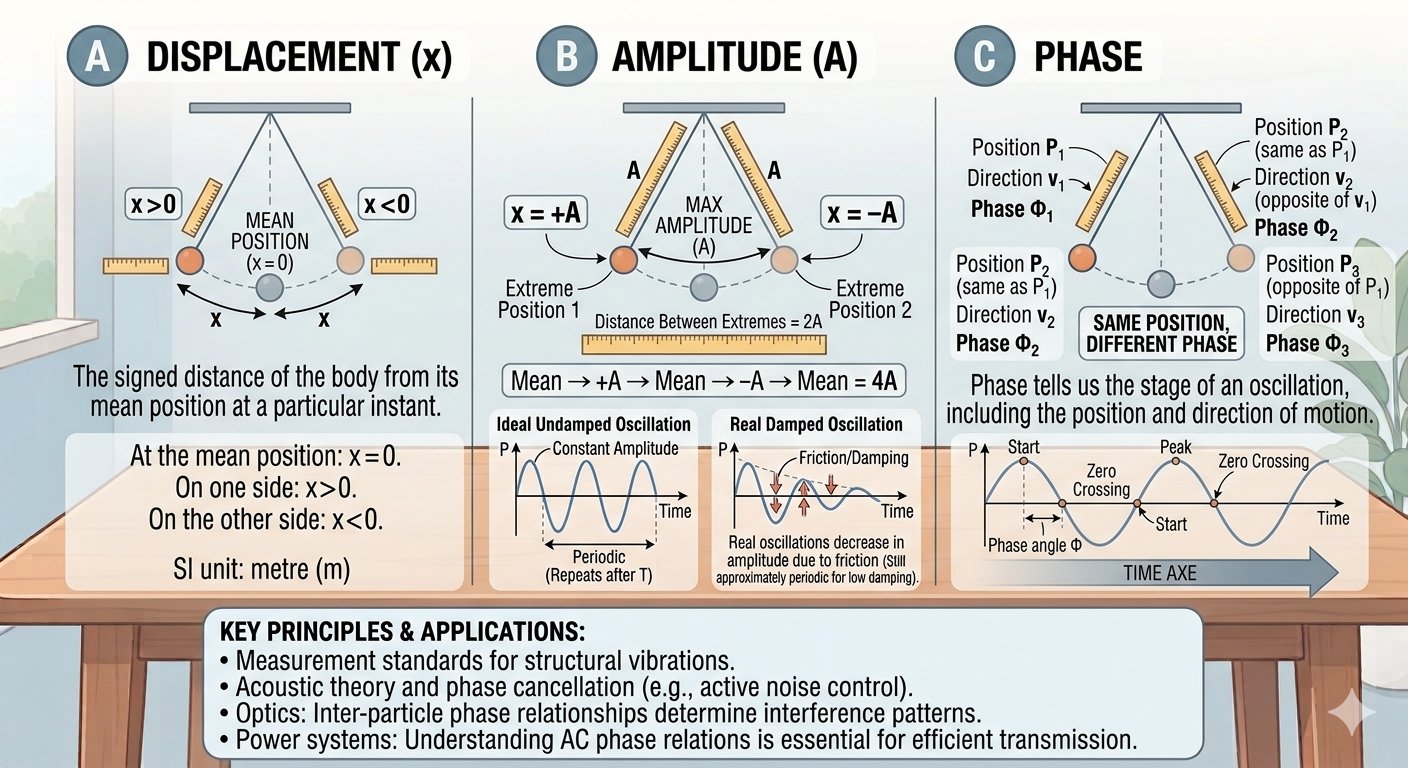
The signed distance of the body from its mean position at a particular instant.
- At the mean position: x=0
- On one side: x>0
- On the other side: x<0
SI unit: meter (m)
B. Amplitude (A)
The maximum magnitude of displacement from the mean position.
The extreme positions are:
\boxed{x=+A\quad\text{and}\quad x=-A}
The distance between the extreme positions is 2A.
The total distance travelled in one complete oscillation is:
\boxed{4A}
C. Phase
Phase tells us the stage of an oscillation, including the position and direction of motion.
For:
x=A\cos(\omega t+\phi)
- \omega t+\phi: phase at time t
- \phi: initial phase, or phase constant
5. Simple Harmonic Motion — SHM
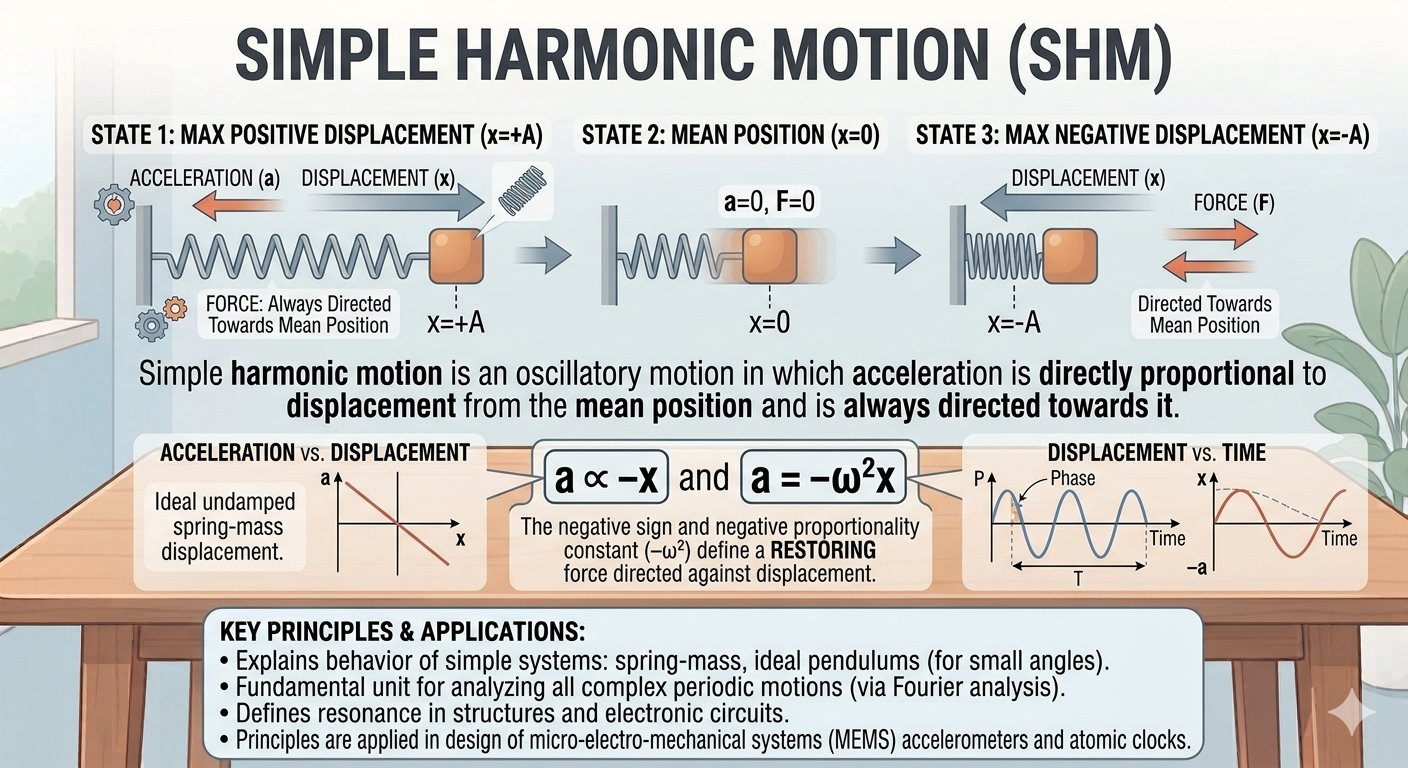
Simple harmonic motion is an oscillatory motion in which acceleration is directly proportional to displacement from the mean position and is always directed towards it.
\boxed{a=-\omega^2x}
The negative sign shows that acceleration acts opposite to displacement.
Conditions for SHM
- There must be a restoring force towards the mean position.
- The restoring force must be directly proportional to displacement.
\boxed{F=-kx}
Here, k is the restoring-force constant.
Every SHM is oscillatory, but every oscillatory motion is not SHM.
Displacement equation
\boxed{x=A\cos(\omega t+\phi)}
An equivalent form is:
\boxed{x=A\sin(\omega t+\phi)}
The phase constant depends on the initial conditions.
Motion starting from the positive extreme
If the body starts at x=+A at t=0:
\boxed{x=A\cos\omega t}
| Time | Position | Motion |
|---|---|---|
| 0 | +A | Momentarily at rest |
| T/4 | 0 | Moving towards the negative extreme |
| T/2 | -A | Momentarily at rest |
| 3T/4 | 0 | Moving towards the positive extreme |
| T | +A | One oscillation completed |
6. SHM and Uniform Circular Motion
The projection of uniform circular motion on any diameter performs SHM.
Imagine a particle moving uniformly around a circle of radius A. Its projection on a diameter moves between -A and +A.
If its angular position is:
\theta=\omega t+\phi
then the projection has displacement:
\boxed{x=A\cos\theta=A\cos(\omega t+\phi)}
Corresponding quantities
| Uniform circular motion | SHM of its projection |
|---|---|
| Radius of the circle | Amplitude A |
| Angular speed | Angular frequency \omega |
| Time for one revolution | Time for one oscillation T |
| Angular position | Phase |
Important: The particle on the circle moves at constant speed, but the speed of its projection changes.
7. Velocity in SHM
Velocity is the rate of change of displacement.
For:
x=A\cos(\omega t+\phi)
we get:
\boxed{v=-A\omega\sin(\omega t+\phi)}
Velocity–displacement relation
Using \sin^2\theta+\cos^2\theta=1:
\boxed{v^2=\omega^2(A^2-x^2)}
Therefore:
\boxed{v=\pm\omega\sqrt{A^2-x^2}}
The sign depends on the direction of motion.
At the mean position
When x=0, speed is maximum:
\boxed{v_{\max}=A\omega}
At the extreme positions
When x=\pm A:
\boxed{v=0}
Remember: The body moves fastest at the mean position and is momentarily at rest at each extreme.
8. Acceleration in SHM
Acceleration is the rate of change of velocity.
a=-A\omega^2\cos(\omega t+\phi)
Since x=A\cos(\omega t+\phi):
\boxed{a=-\omega^2x}
At the mean position
x=0\Rightarrow\boxed{a=0}
At the extreme positions
The magnitude of acceleration is maximum:
\boxed{a_{\max}=\omega^2A}
Its direction is towards the mean position.
Quick comparison
| Position | Speed | Acceleration |
|---|---|---|
| Mean: x=0 | Maximum: A\omega | Zero |
| Positive extreme: x=+A | Zero | -\omega^2A |
| Negative extreme: x=-A | Zero | +\omega^2A |
Phase relations: Velocity differs in phase from displacement by \pi/2, while acceleration and displacement differ by \pi.
9. Force Law of SHM
From Newton’s second law:
F=ma
Using a=-\omega^2x:
\boxed{F=-m\omega^2x}
Comparing with F=-kx:
\boxed{k=m\omega^2}
Thus:
\boxed{\omega=\sqrt{\frac{k}{m}}}
and:
\boxed{T=2\pi\sqrt{\frac{m}{k}}}
Restoring force
A restoring force acts towards the equilibrium position.
- At x>0, force acts in the negative direction.
- At x<0, force acts in the positive direction.
- At x=0, the net restoring force is zero.
Maximum magnitude:
\boxed{F_{\max}=kA}
10. Energy in SHM
In an ideal undamped oscillator, energy continuously changes between kinetic and potential energy.
A. Potential Energy (U)
Taking potential energy as zero at the mean position:
\boxed{U=\frac12kx^2}
Since k=m\omega^2:
\boxed{U=\frac12m\omega^2x^2}
- At the mean position: U=0
- At either extreme:
\boxed{U_{\max}=\frac12kA^2}
B. Kinetic Energy (K)
K=\frac12mv^2
Using v^2=\omega^2(A^2-x^2):
\boxed{K=\frac12m\omega^2(A^2-x^2)}
or:
\boxed{K=\frac12k(A^2-x^2)}
- At the mean position:
\boxed{K_{\max}=\frac12kA^2}
- At the extreme positions: K=0
C. Total Mechanical Energy (E)
E=K+U\boxed{E=\frac12kA^2=\frac12m\omega^2A^2}
It remains constant when there is no energy loss.
| Position | Kinetic energy | Potential energy |
|---|---|---|
| x=0 | Maximum | Zero |
| x=\pm A | Zero | Maximum |
| x=\pm A/\sqrt2 | E/2 | E/2 |
Important conclusions
\boxed{E\propto A^2}
If amplitude doubles, total energy becomes four times as large.
Over a complete cycle:
\boxed{\langle K\rangle=\langle U\rangle=\frac E2}
11. Oscillations Due to a Spring
Consider a mass m attached to an ideal spring of spring constant k, on a smooth horizontal surface.
Hooke’s Law
Within the elastic limit:
\boxed{F=-kx}
Using Newton’s second law:
ma=-kxa=-\frac{k}{m}x
This is the equation of SHM.
Therefore:
\boxed{\omega=\sqrt{\frac{k}{m}}}\boxed{T=2\pi\sqrt{\frac{m}{k}}}\boxed{f=\frac{1}{2\pi}\sqrt{\frac{k}{m}}}
SI unit of spring constant: \mathrm{N\,m^{-1}}
What affects the time period?
- Greater mass → longer time period.
- Greater spring constant → shorter time period.
- Time period is independent of amplitude for an ideal spring obeying Hooke’s law.
Vertical spring
At equilibrium, the spring extension x_0 satisfies:
\boxed{kx_0=mg}
When displacement is measured from this equilibrium position, the motion has the same time period:
\boxed{T=2\pi\sqrt{\frac{m}{k}}}
Gravity shifts the equilibrium position.
Assumptions: The spring’s mass and friction are negligible, and Hooke’s law holds.
12. Simple Pendulum
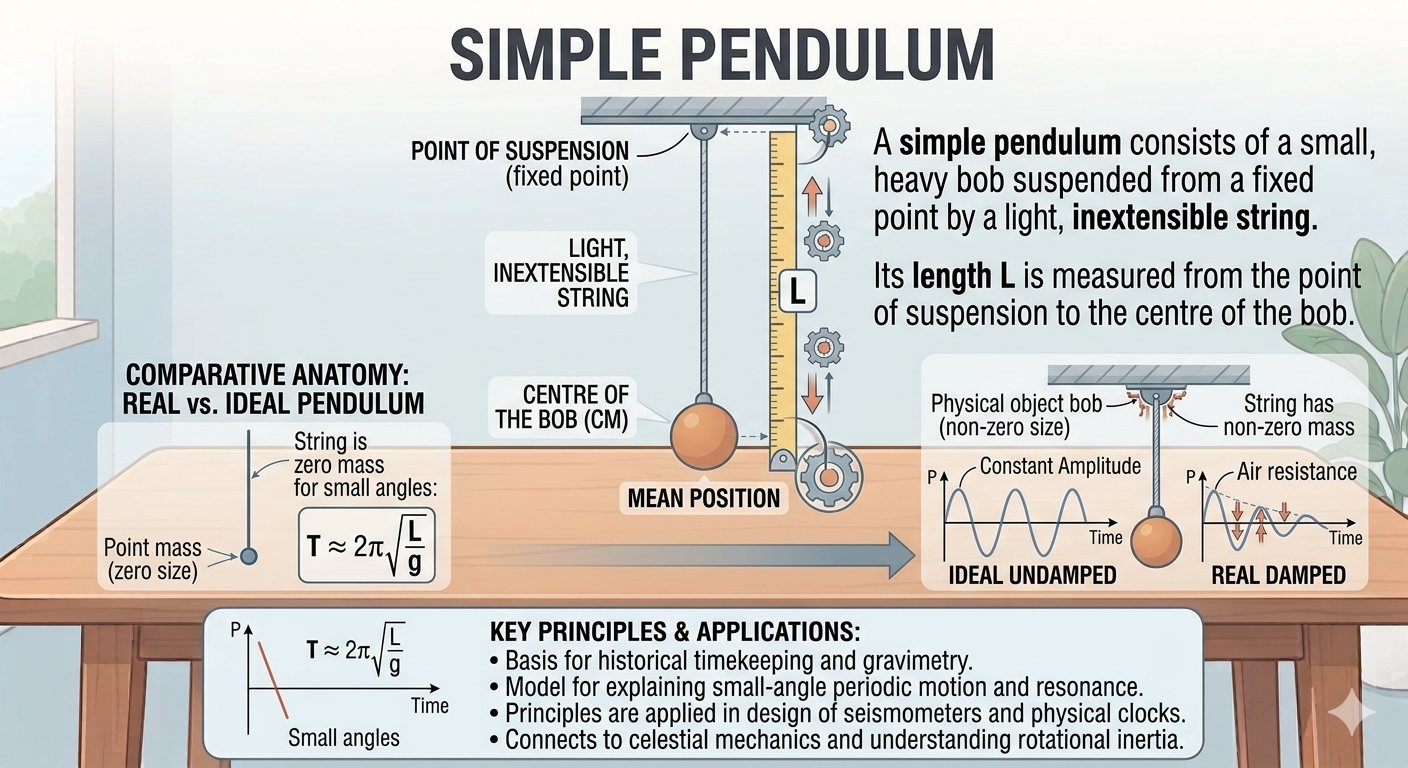
A simple pendulum consists of a small, heavy bob suspended from a fixed point by a light, inextensible string.
Its length L is measured from the point of suspension to the centre of the bob.
Restoring force
When the bob is displaced through an angle \theta, the tangential component of its weight is:
\boxed{F_t=-mg\sin\theta}
For small angular displacements, measured in radians:
\sin\theta\approx\theta
Hence:
F_t\approx-mg\theta
The displacement along the arc is s=L\theta, so:
F_t\approx-\frac{mg}{L}s
Therefore:
\boxed{a_t=-\frac{g}{L}s}
Comparing with a=-\omega^2s:
\boxed{\omega=\sqrt{\frac{g}{L}}}
Time period
\boxed{T=2\pi\sqrt{\frac{L}{g}}}
Frequency
\boxed{f=\frac{1}{2\pi}\sqrt{\frac{g}{L}}}
Important conclusions
- Time period depends on length:
T\propto\sqrt L
If length becomes four times as large, the time period doubles.
- Time period depends on gravitational acceleration:
T\propto\frac1{\sqrt g}
Smaller g gives a longer time period.
Time period is independent of bob mass.
Time period is approximately independent of amplitude only for small oscillations.
A simple pendulum performs approximate SHM at small angles. At large amplitudes, the small-angle formula is no longer accurate.
Conditions for the ideal model
- Small angular amplitude.
- Negligible air resistance and friction.
- Light, inextensible string.
- Bob small compared with the pendulum length.
- Fixed support.
Seconds pendulum
A pendulum with a time period of 2\,s is called a seconds pendulum.
L=\frac{gT^2}{4\pi^2}
Taking g=9.8\,\mathrm{m\,s^{-2}}:
\boxed{L\approx0.993\,m}
It takes approximately one second to move from one extreme to the other.