Chapter – 9
Mechanical Properties of Fluids
1. Introduction
Fluid: A substance that can flow is called a fluid.
Examples: Water, oil, air and milk.
- Liquids and gases are called fluids.
- Fluids do not have a fixed shape.
- Fluids take the shape of their container.
Fluids exert pressure on the walls of their container.
2. Pressure
Pressure is the normal force acting per unit area of a surface.
\boxed{P=\frac FA}
Where:
- P = Pressure
- F = Normal force
- A = Area
SI unit: Pascal (Pa) or N/m²
Dimensional formula: [ML^{-1}T^{-2}]
Important points:
- Pressure is a scalar quantity.
- Pressure increases when the same force acts on a smaller area.
- In a fluid at rest, pressure acts in all directions.
3. Pressure Due to a Liquid Column
The pressure exerted by a liquid column of height h is:
\boxed{P=\rho gh}
Where \rho = density of liquid, g = acceleration due to gravity, and h = depth of liquid.
Derivation:
Mass of liquid column:
m=\rho Ah
Weight of liquid:
F=mg=\rho Ahg
Pressure:
P=\frac FA=\frac{\rho Ahg}{A}
\boxed{P=\rho gh}
This is the gauge pressure due to the liquid. If atmospheric pressure is also included:
\boxed{P_{\text{total}}=P_{\text{atm}}+\rho gh}
Important conclusions:
- Pressure increases with depth.
- Pressure increases with liquid density.
- At the same depth, pressure is the same in a liquid at rest.
Pressure does not depend on the shape of the container.
4. Pascal’s Law
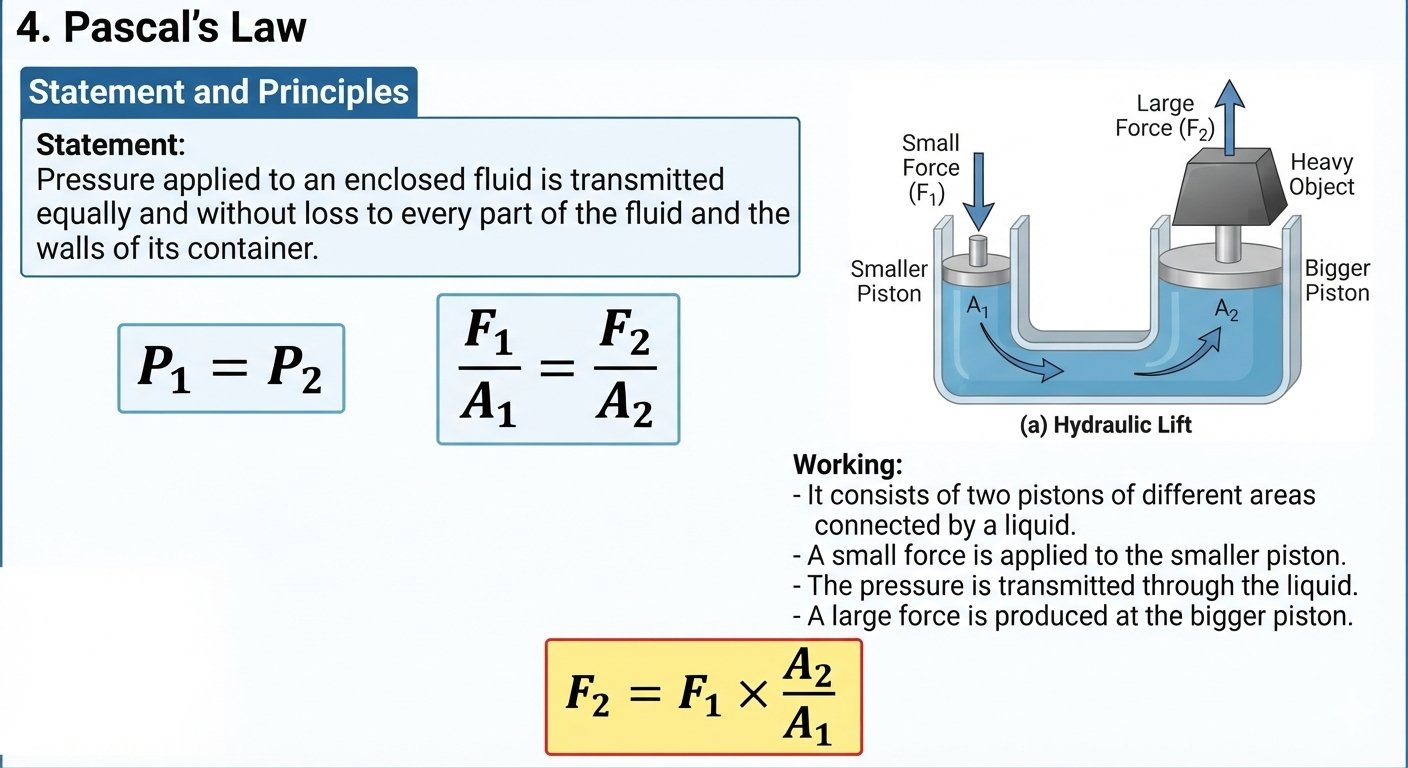
Statement: Pressure applied to an enclosed fluid is transmitted equally and without loss to every part of the fluid and the walls of its container.
\boxed{P_1=P_2}
\boxed{\frac{F_1}{A_1}=\frac{F_2}{A_2}}
Applications:
(a) Hydraulic Lift
A hydraulic lift is used to lift heavy objects using a small force.
Working:
- It consists of two pistons of different areas connected by a liquid.
- A small force is applied to the smaller piston.
- The pressure is transmitted through the liquid.
- A large force is produced at the bigger piston.
\boxed{F_2=F_1\frac{A_2}{A_1}}
(b) Hydraulic Brakes
Hydraulic brakes work on Pascal’s law.
Working:
- The driver presses the brake pedal.
- The master cylinder produces pressure in the brake fluid.
- This pressure is transmitted to the wheel brakes.
- Brake pads press against discs or drums.
- Friction slows down or stops the vehicle.
Advantage: Braking force can be transmitted effectively to multiple wheels.
5. Streamline Flow
Definition: Streamline flow is the motion of a fluid in which each particle follows a smooth path, and the velocity at any fixed point remains constant with time.
It is also called steady flow.
Properties:
- Two streamlines never intersect.
- Velocity is tangential to a streamline.
- Closer streamlines generally indicate greater speed.
In steady flow, velocity at a fixed point does not change with time.
6. Equation of Continuity
Statement: For a steady flow of an incompressible fluid, the volume of fluid flowing per second remains constant.
\boxed{A_1v_1=A_2v_2}
Where:
- A_1,A_2 = Cross-sectional areas
v_1,v_2 = Fluid speeds

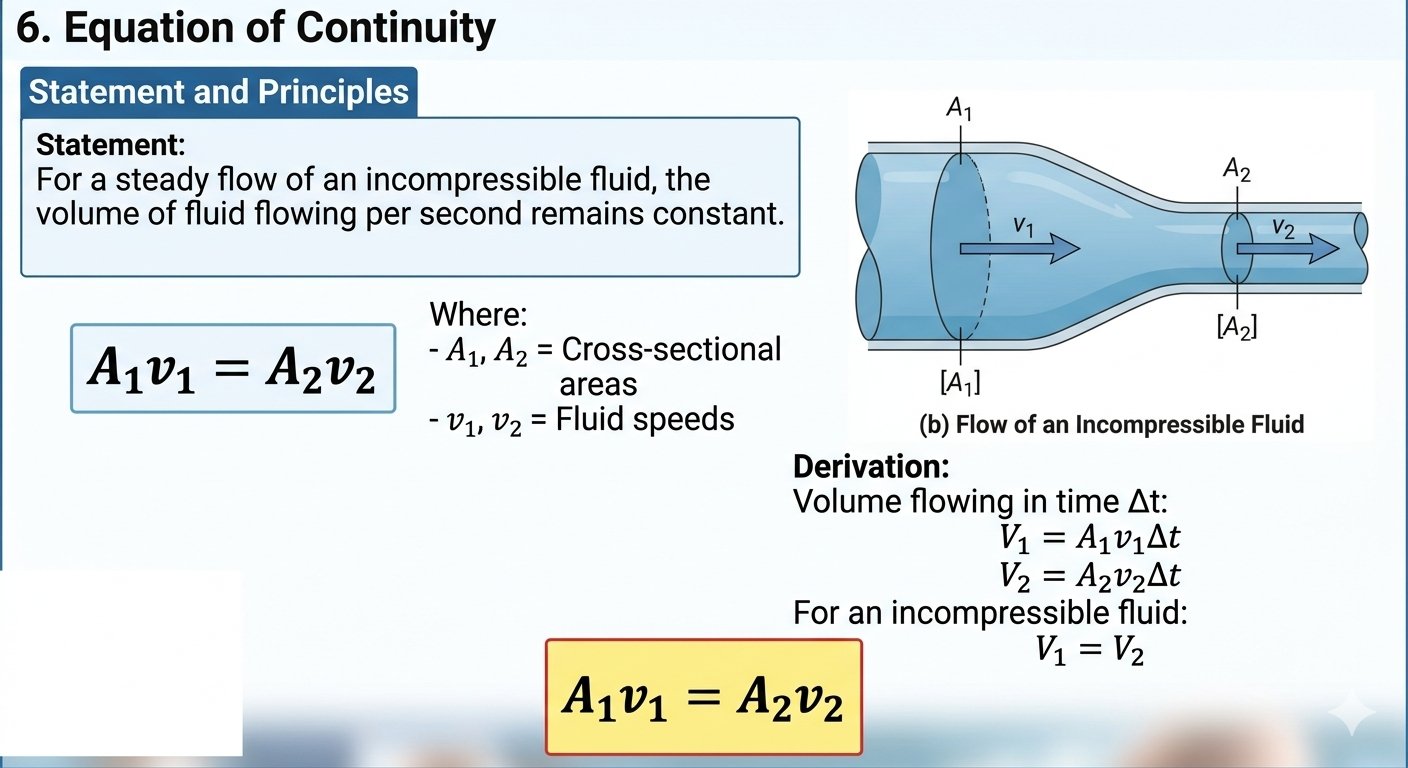
Derivation:
Volume flowing in time \Delta t:
V_1=A_1v_1\Delta t
V_2=A_2v_2\Delta t
For an incompressible fluid:
V_1=V_2
Therefore,
\boxed{A_1v_1=A_2v_2}
Conclusion:
- Narrow pipe → Higher speed
- Wide pipe → Lower speed
Example: Water comes out faster when the opening of a hosepipe is narrowed.
7. Bernoulli’s Principle
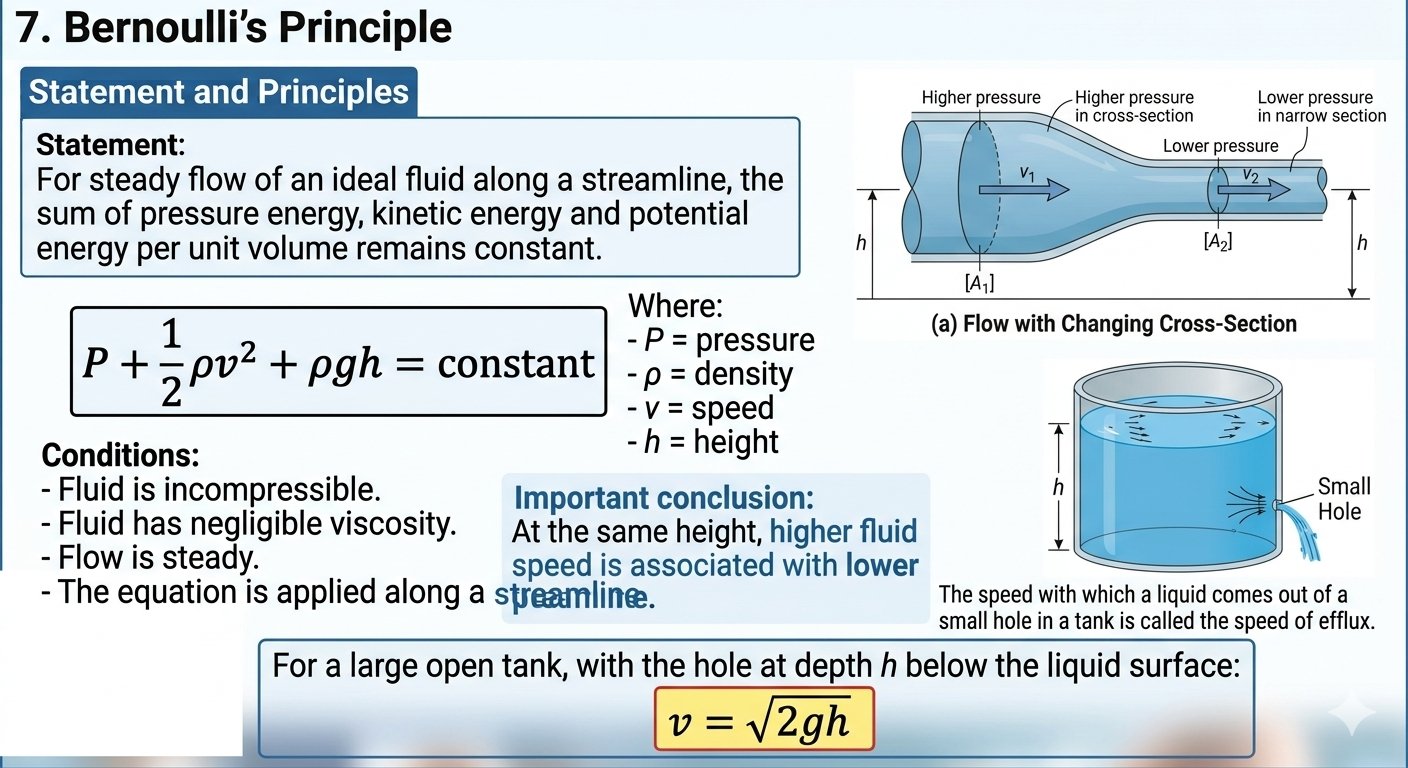
Statement: For steady flow of an ideal fluid along a streamline, the sum of pressure energy, kinetic energy and potential energy per unit volume remains constant.
\boxed{P+\frac12\rho v^2+\rho gh=\text{constant}}
Where P = pressure, \rho = density, v = speed and h = height.
Conditions:
- Fluid is incompressible.
- Fluid has negligible viscosity.
- Flow is steady.
- The equation is applied along a streamline.
Important conclusion: At the same height, higher fluid speed is associated with lower pressure.
Applications of Bernoulli’s Principle
(a) Speed of Efflux – Torricelli’s Theorem
The speed with which a liquid comes out of a small hole in a tank is called the speed of efflux.
For a large open tank, with the hole at depth h below the liquid surface:
\boxed{v=\sqrt{2gh}}
Derivation:
Using Bernoulli’s equation between the liquid surface and the hole:
P_1+\rho gh=P_2+\frac12\rho v^2
Since both points are exposed to atmospheric pressure:
P_1=P_2
Therefore,
\rho gh=\frac12\rho v^2
\boxed{v=\sqrt{2gh}}
(b) Dynamic Lift
Dynamic lift is the force produced due to fluid motion that acts perpendicular to the direction of flow.
Example: Aeroplane wing
- Airflow around the wing creates a pressure difference.
- In a typical lifting condition, pressure above the wing is lower than below it.
- This pressure difference produces an upward lift force.
- The wing’s shape and angle of attack help establish the required airflow and pressure distribution.
Other examples: Spinning balls and aerodynamic wings.
8. Viscosity
Definition: Viscosity is the property of a fluid by which it opposes the relative motion between its adjacent layers.
In simple words, viscosity is the internal friction of a fluid.
Examples:
- Honey flows slowly because it has high viscosity.
- Water flows easily because it has low viscosity.
Newton’s Law of Viscosity:
\boxed{F=\eta A\frac{dv}{dx}}
This gives the magnitude of viscous force.
Where:
- \eta = Coefficient of viscosity
- A = Area of contact between layers
- dv/dx = Velocity gradient
SI unit of viscosity: Pa s or N s/m²
Dimensional formula:
\boxed{[ML^{-1}T^{-1}]}
Effect of temperature:
- In liquids, viscosity generally decreases as temperature increases.
In gases, viscosity generally increases as temperature increases.
9. Stokes’ Law
Statement: The viscous force acting on a small spherical body moving slowly through a viscous fluid is directly proportional to its radius, speed and the viscosity of the fluid.
\boxed{F=6\pi\eta rv}
Where:
- F = Magnitude of viscous drag
- \eta = Coefficient of viscosity
- r = Radius of sphere
- v = Speed of sphere relative to fluid
Conditions: Slow, laminar flow around a small sphere in a sufficiently large fluid.
Applications: Motion of small droplets, sedimentation and measurement of viscosity.
10. Terminal Velocity
Definition: The maximum constant velocity attained by a body falling through a viscous fluid is called terminal velocity.
When a sphere falls through a fluid, three forces act on it:
- Weight – Downward
- Buoyant force – Upward
Viscous drag – Upward
At terminal velocity, net force becomes zero.
\text{Weight}=\text{Buoyancy}+\text{Viscous drag}
For a small sphere under Stokes’ law:
\boxed{v_t=\frac{2r^2(\rho_s-\rho_f)g}{9\eta}}
Where:
- r = Radius of sphere
- \rho_s = Density of sphere
- \rho_f = Density of fluid
- \eta = Viscosity
Important points:
- Terminal velocity is proportional to r^2.
- Terminal velocity decreases with increasing viscosity.
At terminal velocity, acceleration is zero.
11. Surface Tension
Definition: Surface tension is the tangential force acting per unit length on an imaginary line drawn on the free surface of a liquid.
\boxed{T=\frac Fl}
Where T = surface tension, F = force and l = length.
SI unit: N/m
Dimensional formula:
\boxed{[MT^{-2}]}
Cause: Cohesive forces between liquid molecules.
12. Surface Energy and Its Relation with Surface Tension
Surface energy: The work required to increase the free surface area of a liquid is called surface energy.
For a small increase in surface area:
\boxed{W=T\Delta A}
Where W = work done and \Delta A = increase in surface area.
Therefore,
\boxed{T=\frac{W}{\Delta A}}
Relation:
\boxed{\text{Surface tension}=\text{Surface energy per unit area}}
For a liquid surface at constant temperature.
SI units:
- Surface tension = N/m
- Surface energy per unit area = J/m²
These units are equivalent.
Note: A soap film has two surfaces, so if each surface increases by area A, the total increase is 2A.
13. Angle of Contact
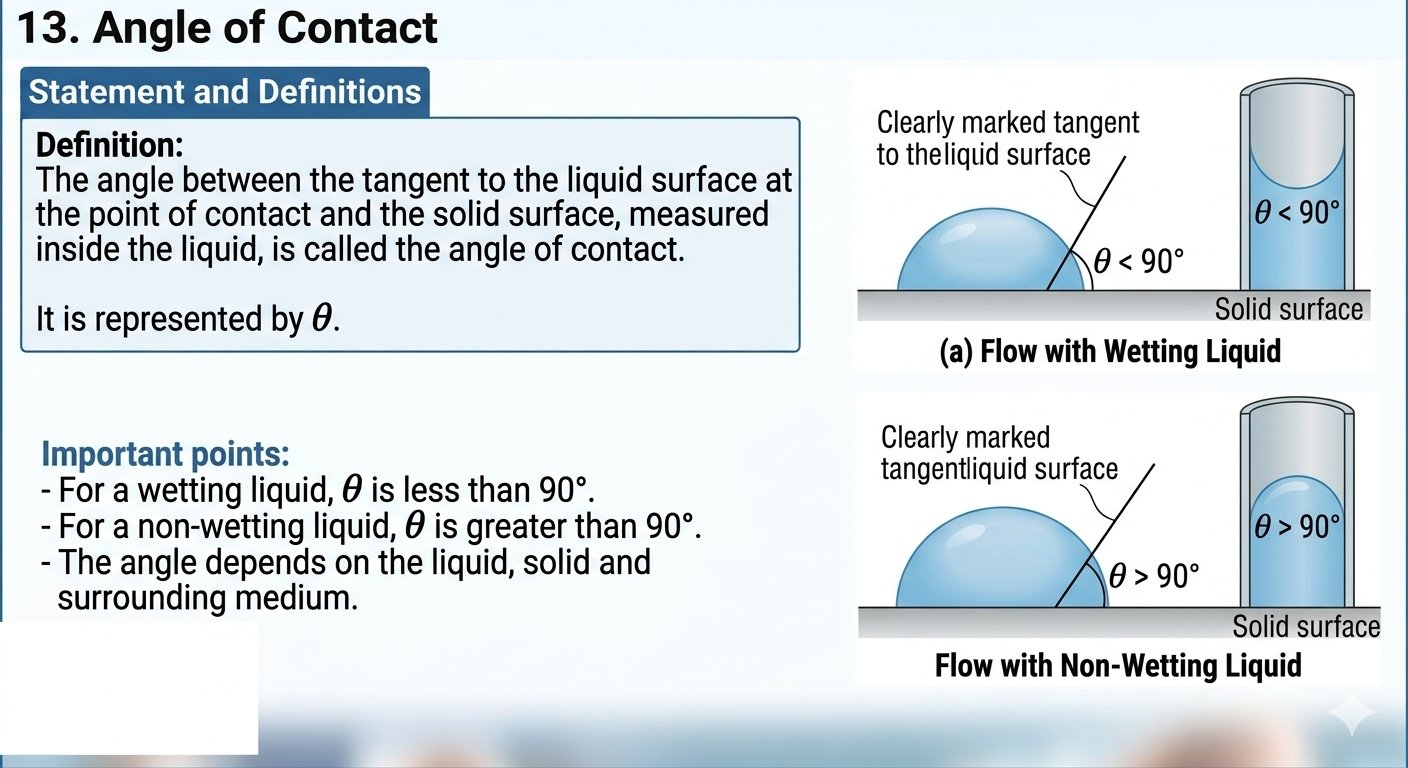
Definition: The angle between the tangent to the liquid surface at the point of contact and the solid surface, measured inside the liquid, is called the angle of contact.
It is represented by \theta.
Important points:
- For a wetting liquid, \theta is less than 90°.
- For a non-wetting liquid, \theta is greater than 90°.
- The angle depends on the liquid, solid and surrounding medium.
14. Excess Pressure Inside Drops and Bubbles
Due to surface tension, pressure inside a curved liquid surface can be greater than the pressure outside.
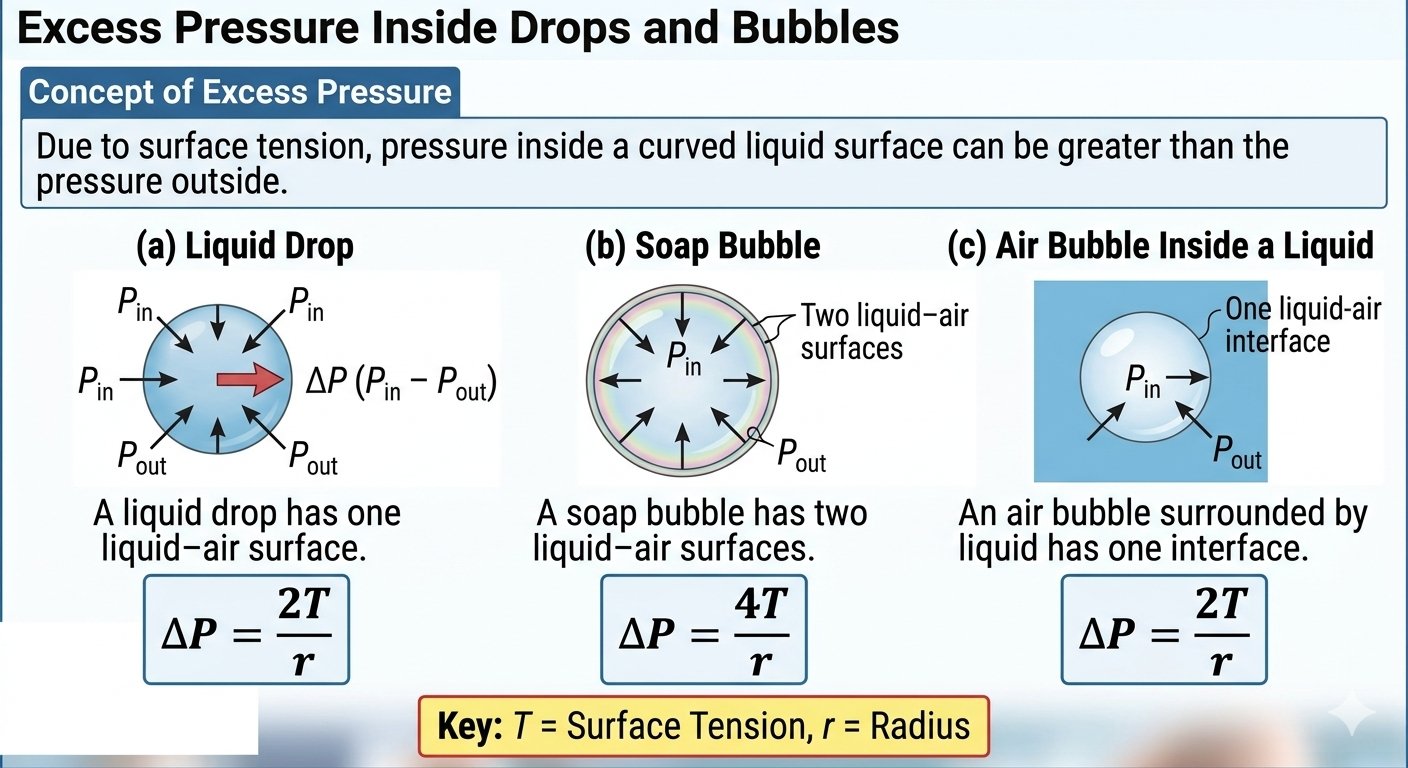
(a) Liquid Drop
A liquid drop has one liquid–air surface.
\boxed{\Delta P=\frac{2T}{r}}
(b) Soap Bubble
A soap bubble has two liquid–air surfaces.
\boxed{\Delta P=\frac{4T}{r}}
(c) Air Bubble Inside a Liquid
An air bubble surrounded by liquid has one interface.
\boxed{\Delta P=\frac{2T}{r}}
15. Capillary Rise
Definition: The rise or fall of a liquid in a narrow tube due to surface tension is called capillarity.
Examples:
- Water rises in a thin glass tube.
- Kerosene rises in the wick of a lamp.
Water moves through small pores in soil.
Formula:
\boxed{h=\frac{2T\cos\theta}{\rho gr}}
Where:
- h = Height of rise or fall
- T = Surface tension
- \theta = Angle of contact
- \rho = Density of liquid
- r = Radius of capillary tube
Derivation:
Upward vertical component of surface tension:
F=2\pi rT\cos\theta
Weight of liquid column (neglecting the small meniscus-volume correction):
W=\pi r^2h\rho g
At equilibrium:
2\pi rT\cos\theta=\pi r^2h\rho g
Therefore,
\boxed{h=\frac{2T\cos\theta}{\rho gr}}