Motion in a Straight Line – Class 11 Physics Notes
Chapter-2
Motion in a Straight Line
1. Introduction
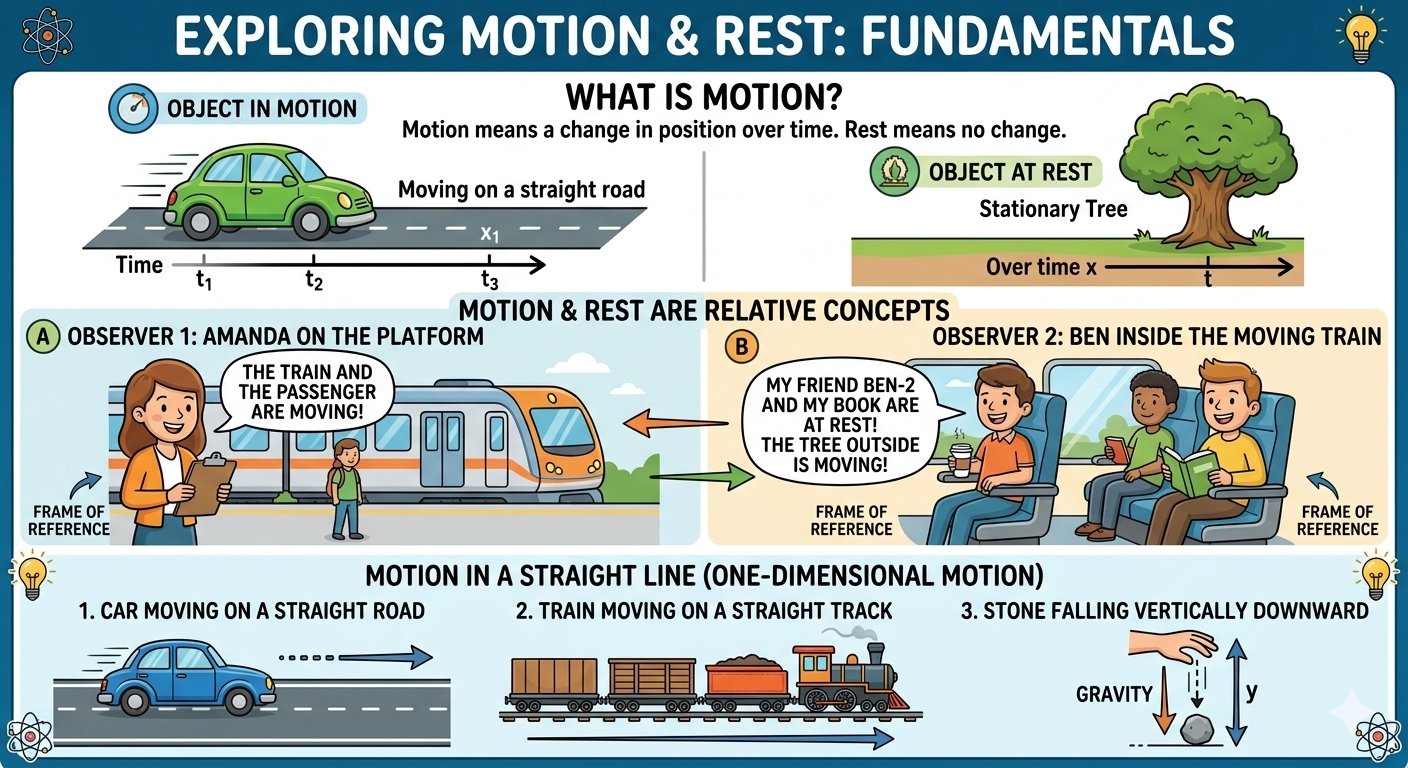
Motion means a change in the position of an object with time.
For example:
- A car moving on a straight road is in motion.
- A person walking along a straight path is in motion.
- A stationary tree is at rest with respect to the ground.
Motion and rest are relative concepts. An object may be at rest with respect to one observer but moving with respect to another.
Motion in a Straight Line
When an object moves along a straight path, its motion is called motion in a straight line or one-dimensional motion.
Examples:
- A car moving on a straight road.
- A train moving on a straight track.
- A stone falling vertically downward.
Position
The position of an object tells us where the object is located with respect to a reference point.
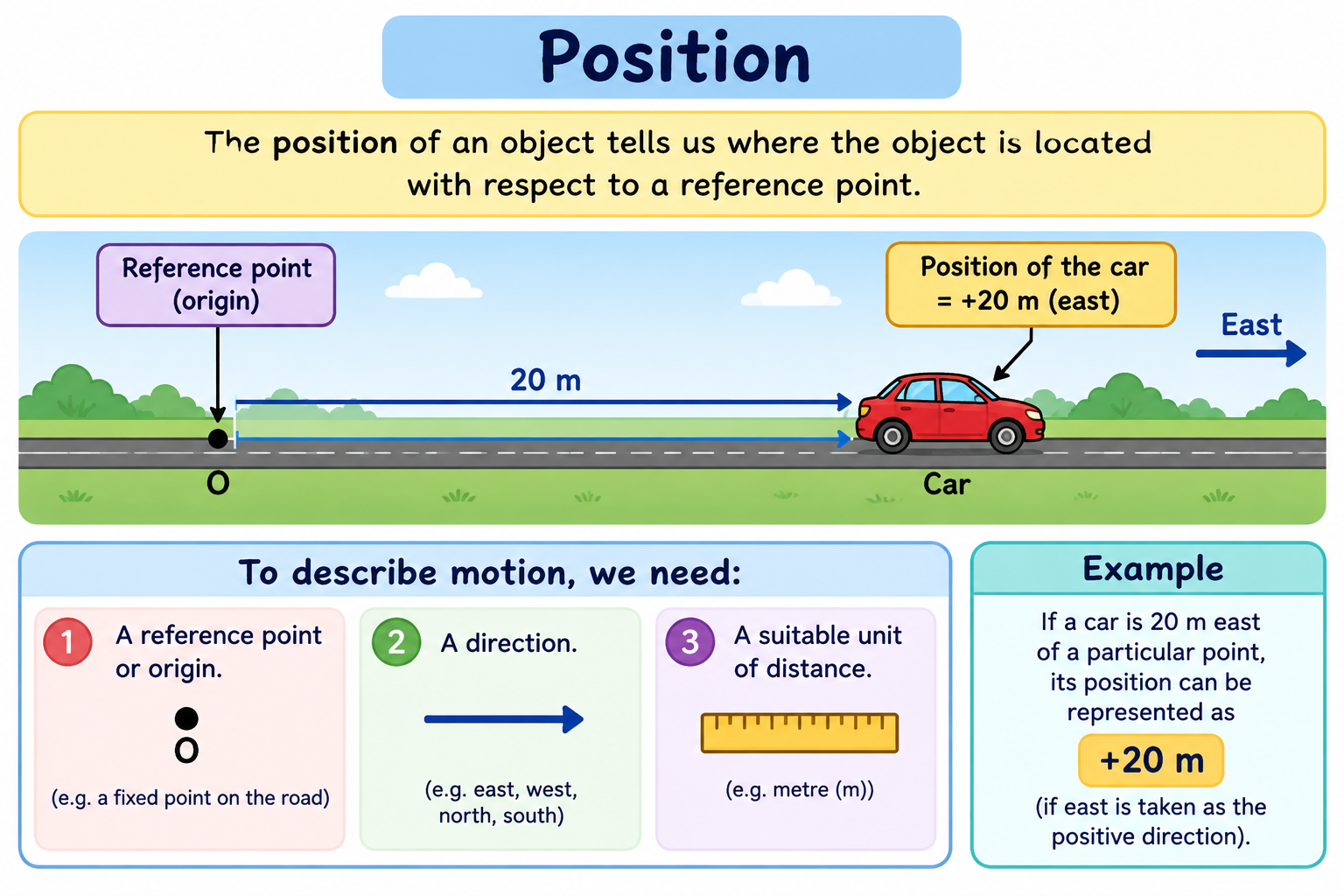
To describe motion, we need:
- A reference point or origin.
- A direction.
- A suitable unit of distance.
For example, if a car is 20 m east of a particular point, its position can be represented as +20 m if east is taken as the positive direction.
Distance
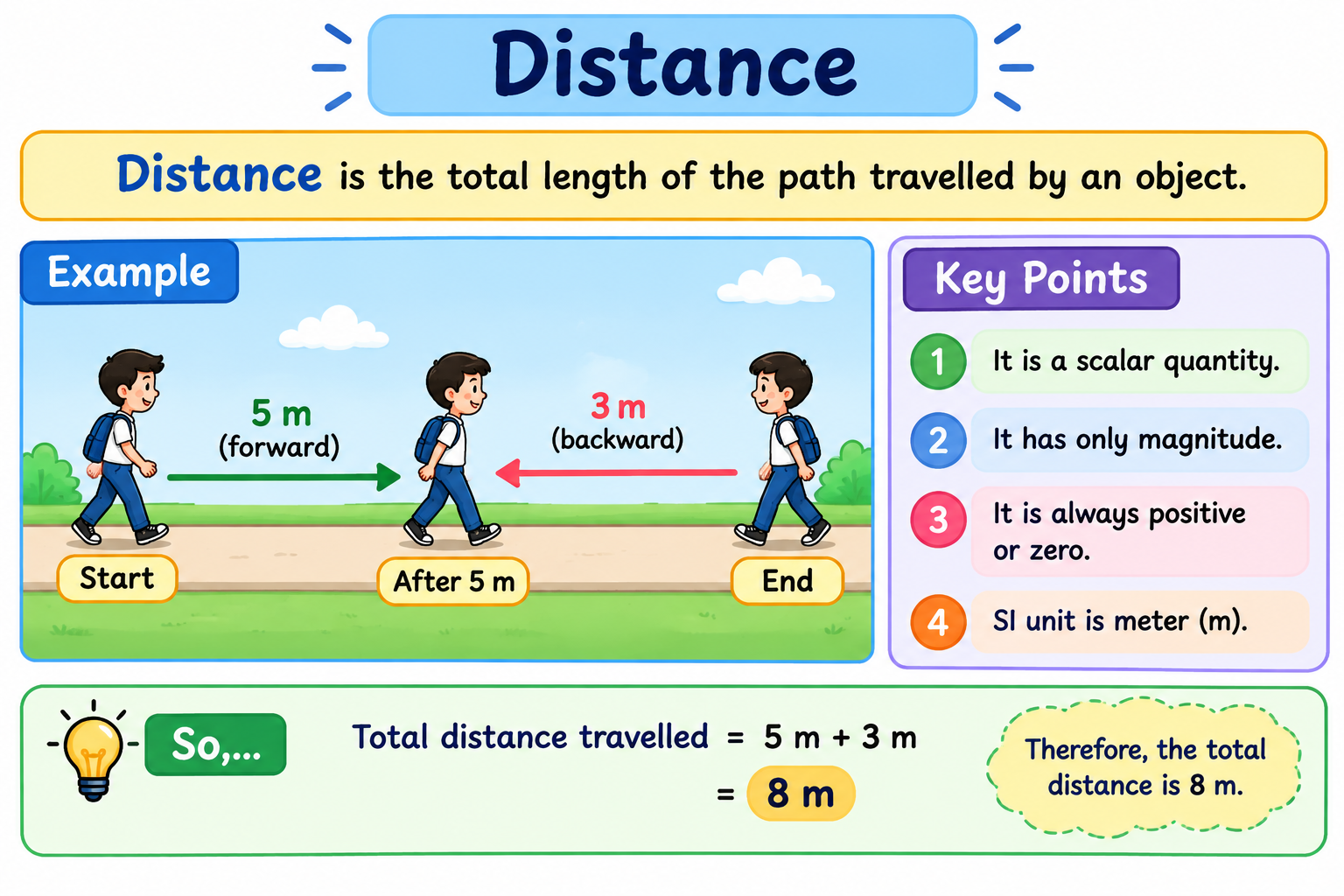
Distance is the total length of the path travelled by an object.
- It is a scalar quantity.
- It has only magnitude.
- It is always positive or zero.
- SI unit is meter (m).
Example:
If a student walks 5 m forward and then 3 m backward, the total distance travelled is:
5 + 3 = 8 m
Displacement
Displacement is the change in the position of an object.
It is the shortest distance between the initial and final positions, along with a direction.
- It is a vector quantity.
- It has both magnitude and direction.
- SI unit is meter (m).
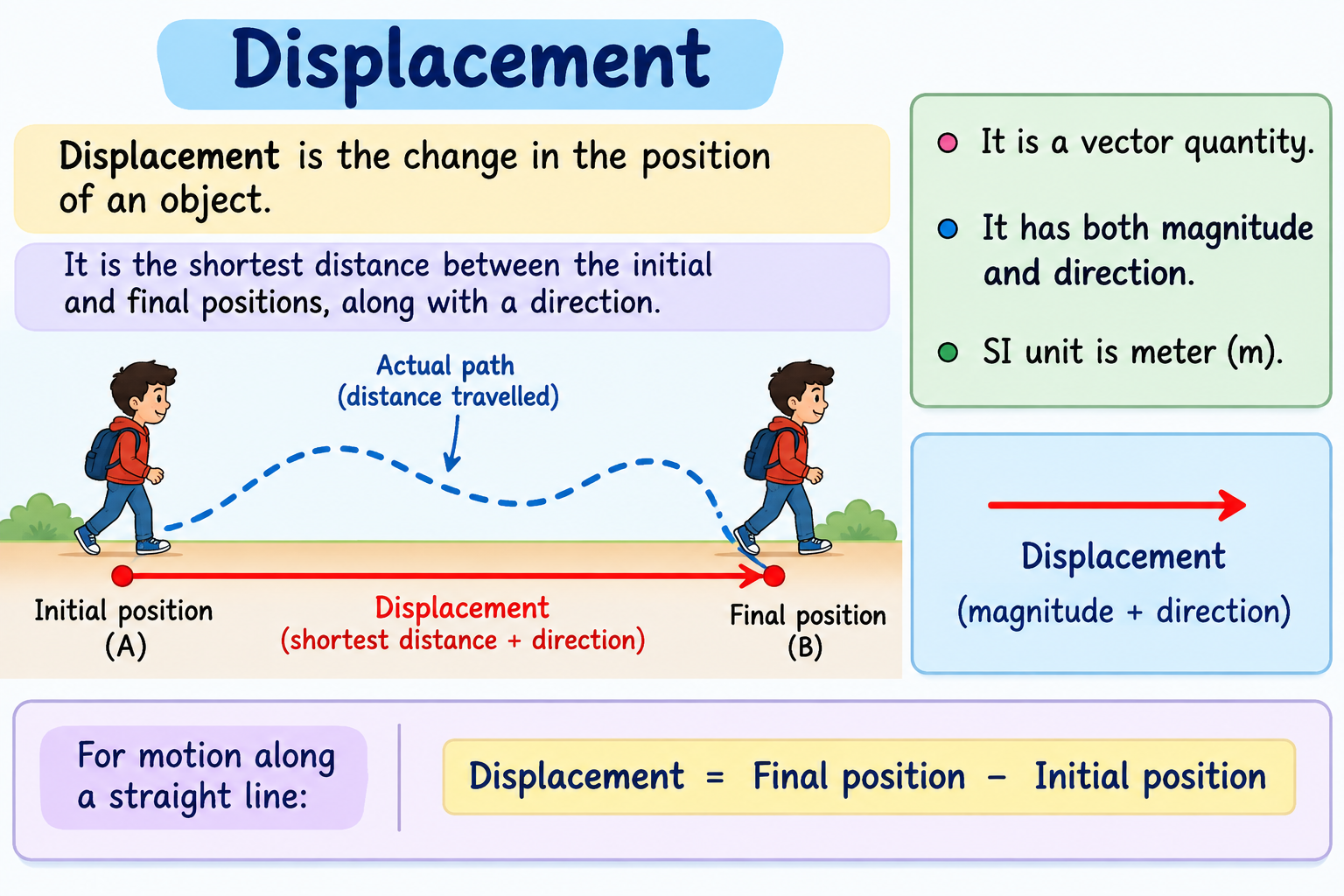
For motion along a straight line:
Displacement = Final position − Initial position
Distance and Displacement
| Distance | Displacement |
|---|---|
| Total path travelled | Change in position |
| Scalar quantity | Vector quantity |
| Has only magnitude | Has magnitude and direction |
| Always positive or zero | Can be positive, negative or zero |
2. Instantaneous Velocity and Speed
Speed
Speed tells us how fast an object is moving.
Average speed is defined as:
Average Speed = Total Distance / Total Time
SI Unit
The SI unit of speed is:
meter per second (m/s)
Other commonly used units are km/h and cm/s.
Example
If a car travels 100 m in 10 s:
Speed = 100/10 = 10 m/s
So, the speed of the car is 10 m/s.
Instantaneous Speed
The speed of an object at a particular instant of time is called instantaneous speed.
For example, the speed shown by the speedometer of a car at a particular moment is its instantaneous speed.
Velocity
Velocity is the rate of change of displacement with time.
Average velocity is:
Average Velocity = Displacement / Time Taken
Velocity is a vector quantity, so it has both magnitude and direction.
SI Unit
m/s
Instantaneous Velocity
The velocity of an object at a particular instant of time is called instantaneous velocity.
In simple words, it tells us how fast the position of an object is changing at that particular moment and in which direction.
For very small time intervals:
Instantaneous velocity = Change in displacement / Change in time
It can also be written as:
v = dx/dt
where:
- v = instantaneous velocity
- dx = very small change in position
- dt = very small change in time
Difference Between Speed and Velocity
| Speed | Velocity |
|---|---|
| Rate of change of distance | Rate of change of displacement |
| Scalar quantity | Vector quantity |
| Has only magnitude | Has magnitude and direction |
| Cannot be negative | Can be positive, negative or zero |
| SI unit is m/s | SI unit is m/s |
3. Acceleration
Acceleration is the rate at which velocity changes with time.
In simple words, when the velocity of an object changes, the object is said to be accelerating.
Acceleration can occur when:
- Speed increases.
- Speed decreases.
- Direction of motion changes.
- Both speed and direction change.
Formula
Acceleration = Change in velocity / Time
or
a = (v − u)/t
where:
- a = acceleration
- u = initial velocity
- v = final velocity
- t = time
SI Unit
The SI unit of acceleration is:
m/s²
Example
Suppose a car starts with a velocity of 10 m/s and reaches 20 m/s in 5 seconds.
Using:
a = (v − u)/t
a = (20 − 10)/5
a = 2 m/s²
Therefore, the acceleration is 2 m/s².
Positive Acceleration
When the velocity of an object increases in the positive direction, its acceleration is called positive acceleration.
Example: A car increasing its speed from 10 m/s to 20 m/s.
Negative Acceleration or Retardation
When the velocity decreases, the acceleration is generally called negative acceleration or retardation/deceleration.
Example: A car slowing down when brakes are applied.
Uniform Acceleration
If the velocity of an object changes by equal amounts in equal intervals of time, the acceleration is called uniform acceleration.
Example:
| Time | Velocity |
|---|---|
| 0 s | 0 m/s |
| 1 s | 2 m/s |
| 2 s | 4 m/s |
| 3 s | 6 m/s |
The velocity increases by 2 m/s every second. Therefore, the acceleration is uniform.
Non-Uniform Acceleration
If the velocity changes by different amounts in equal intervals of time, the acceleration is called non-uniform acceleration.
4. Kinematic Equations for Uniformly Accelerated Motion
Kinematics is the branch of mechanics that describes the motion of objects without discussing the causes of motion.
When an object moves with constant or uniform acceleration, we use three important equations called the kinematic equations.
The three equations are:
First Equation
v = u + at
where:
- u = initial velocity
- v = final velocity
- a = uniform acceleration
- t = time
This equation tells us how the velocity changes with time when acceleration is constant.
Second Equation
s = ut + ½at²
where:
- s = displacement
- u = initial velocity
- a = uniform acceleration
- t = time
This equation is useful for finding the displacement of an object when its initial velocity, acceleration and time are known.
Third Equation
v² = u² + 2as
where:
- v = final velocity
- u = initial velocity
- a = acceleration
- s = displacement
This equation is particularly useful when time is not given
Derivation of the Kinematic Equations
First Equation: v = u + at
We know:
Acceleration = Change in velocity / Time
Therefore:
a = (v − u)/t
Multiplying both sides by t:
at = v − u
Therefore:
v = u + at
Second Equation: s = ut + ½at²
For uniformly accelerated motion:
Average velocity = (u + v)/2
Therefore:
s = Average velocity × time
s = [(u + v)/2]t
Using the first equation:
v = u + at
Therefore:
s = [(u + u + at)/2]t
s = [(2u + at)/2]t
Therefore:
s = ut + ½at²
Third Equation: v² = u² + 2as
We know:
v = u + at
Therefore:
t = (v − u)/a
Also:
s = [(u + v)/2]t
Substituting the value of t:
s = [(u + v)/2] × [(v − u)/a]
s = (v² − u²)/2a
Therefore:
2as = v² − u²
Hence:
v² = u² + 2as