Hydrocarbons – Class 11 Chemistry Notes
Chapter – 9
Hydrocarbons
1. Classification of Hydrocarbons
Compounds of carbon and hydrogen only are called hydrocarbons. LPG, CNG, petrol, diesel and kerosene are mixtures of hydrocarbons and are used as fuels.
- Saturated hydrocarbons (alkanes): Contain only C–C single bonds. Example: methane, ethane.
- Unsaturated hydrocarbons: Contain at least one C=C double bond (alkenes) or C≡C triple bond (alkynes). Example: ethene, ethyne.
- Aromatic hydrocarbons (arenes): Contain a benzene ring with special stability. Example: benzene, toluene.
Property | Alkane | Alkene | Alkyne |
|---|---|---|---|
General formula | CnH2n+2 | CnH2n | CnH2n−2 |
Bond | C–C | C=C | C≡C |
Hybridisation | sp3 | sp2 | sp |
Bond angle | 109.5° | About 120° | 180° |
C–C bond length | 154 pm | 134 pm | 120 pm |
Bonds between carbons | 1 σ | 1 σ + 1 π | 1 σ + 2 π |
Typical reaction | Substitution | Addition | Addition |
First member | Methane, CH4 | Ethene, C2H4 | Ethyne, C2H2 |
2. Alkanes: Nomenclature, Isomerism and Conformation
Alkanes are also called paraffins (Latin: little affinity) because they are not very reactive.
Nomenclature: Example: CH3–CH2–CH2–CH3 is butane; CH3–CH(CH3)–CH3 is 2-methylpropane.
Isomerism: Alkanes with four or more carbon atoms show chain isomerism. C5H12 has three isomers:
- CH3–CH2–CH2–CH2–CH3: pentane (n-pentane), b.p. 309 K
- CH3–CH(CH3)–CH2–CH3: 2-methylbutane (isopentane), b.p. 301 K
- C(CH3)4: 2,2-dimethylpropane (neopentane), b.p. 282.5 K
Remember: More branching gives a more compact (spherical) shape, less surface area and weaker van der Waals forces, so the boiling point decreases.
Conformation of ethane: Rotation about the C–C single bond gives different spatial arrangements called conformations (conformers or rotamers). The two extreme forms of ethane are staggered and eclipsed.
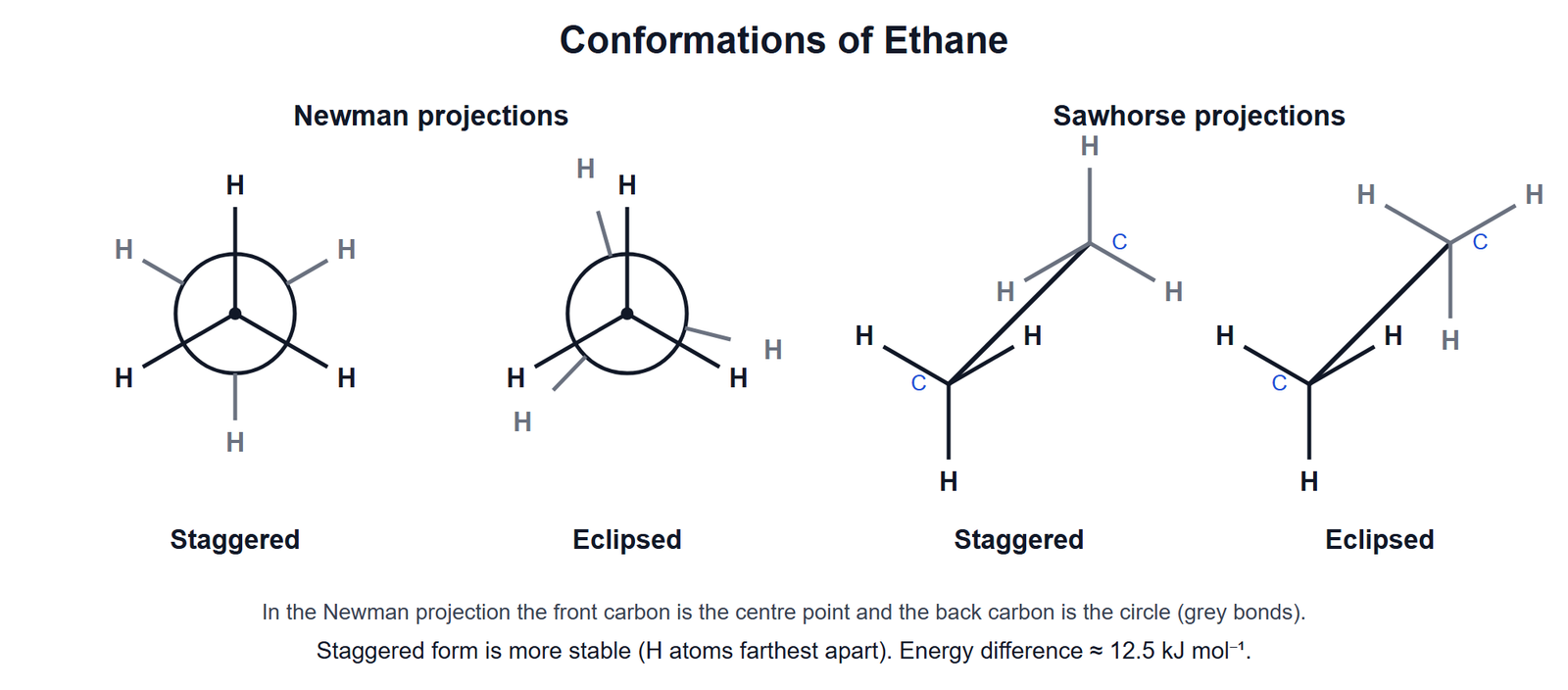
- Staggered: The hydrogens of the two carbons are as far apart as possible. Repulsion is minimum, so it is the most stable form.
- Eclipsed: The hydrogens of the back carbon are directly behind those of the front carbon. Repulsion (torsional strain) is maximum, so it is the least stable form.
- The energy difference is only about 12.5 kJ mol−1, so the forms change into one another rapidly at room temperature and cannot be separated.
3. Alkanes: Physical Properties and Preparation
Physical properties:
- C1 to C4 are gases, C5 to C17 are liquids and C18 onwards are solids at 298 K.
- They are non-polar, so they are insoluble in water but soluble in non-polar solvents like benzene.
- Boiling point increases with molecular mass, because van der Waals forces increase.
Methods of preparation (brief):
- From unsaturated hydrocarbons: Adding hydrogen in the presence of finely divided Pt, Pd or Ni. CH2=CH2 + H2 → CH3–CH3
- Wurtz reaction: Alkyl halides with sodium in dry ether give higher alkanes with double the carbon atoms. 2CH3Br + 2Na → CH3–CH3 + 2NaBr
- Decarboxylation: The sodium salt of a carboxylic acid heated with soda lime (NaOH + CaO) gives an alkane with one carbon less. CH3COONa + NaOH → CH4 + Na2CO3
4. Alkanes: Chemical Reactions
(a) Halogenation (substitution): In the presence of diffused sunlight (UV light) or heat, hydrogen atoms of alkanes are replaced by halogen atoms.
CH4 + Cl2 → CH3Cl + HCl; then CH2Cl2, CHCl3 and CCl4 are formed step by step.
Reactivity of halogens: F2 > Cl2 > Br2 > I2. Rate of replacement of hydrogens: 3° > 2° > 1°.
Free radical mechanism of chlorination of methane:
- Initiation: Cl–Cl breaks by homolytic fission in light. Cl2 → Cl• + Cl•
- Propagation: CH4 + Cl• → CH3• + HCl, then CH3• + Cl2 → CH3Cl + Cl•. The Cl• formed continues the chain.
- Termination: Free radicals combine and the chain stops. Cl• + Cl• → Cl2; CH3• + Cl• → CH3Cl; CH3• + CH3• → CH3–CH3
Exam point: The formation of a small amount of ethane during chlorination of methane is evidence for the free radical mechanism.
(b) Combustion: Alkanes burn in air to give CO2 and water with a large amount of heat.
CH4(g) + 2O2(g) → CO2(g) + 2H2O(l); ΔcH° = −890 kJ mol−1
General equation: CnH2n+2 + (3n+1)/2 O2 → nCO2 + (n+1)H2O
Incomplete combustion in a limited supply of air gives carbon black (used in ink and printer ink) and carbon monoxide.
(c) Controlled oxidation: 2CH4 + O2 → 2CH3OH (Cu, 523 K, 100 atm)
(d) Pyrolysis (cracking): Higher alkanes break into smaller alkanes and alkenes when heated to a high temperature in the absence of air.
Example: C6H14 (773 K) → C6H12 + H2, or C4H8 + C2H6, or C3H6 + C2H4 + CH4
Pyrolysis of kerosene or petrol is used to make oil gas or petrol gas.
(e) Aromatisation: n-Hexane heated at 773 K and 10–20 atm over oxides of vanadium, molybdenum or chromium on alumina gives benzene.
5. Alkenes: Structure, Nomenclature and Isomerism
Alkenes are also called olefins (oil forming), because ethylene forms an oily liquid with chlorine.
Structure of the double bond (ethene): Each carbon is sp2 hybridised. The C=C double bond has one strong σ bond (sp2–sp2 overlap) and one weaker π bond (sideways overlap of unhybridised 2p orbitals). The C=C bond length is 134 pm, and ethene is a planar molecule with bond angles of about 120°. The π electrons are loosely held, so alkenes are attacked by electrophiles.
Nomenclature:
- CH2=CH–CH2–CH3: but-1-ene
- CH3–CH=CH–CH3: but-2-ene
- CH2=C(CH3)–CH3: 2-methylprop-1-ene
Structural isomerism: The three compounds above are structural isomers of C4H8 (position and chain isomers).
Geometrical (cis–trans) isomerism: Because rotation about a C=C bond is restricted, the groups attached to the doubly bonded carbons can have different arrangements in space.
- cis-isomer: The similar groups are on the same side of the double bond.
- trans-isomer: The similar groups are on opposite sides of the double bond.
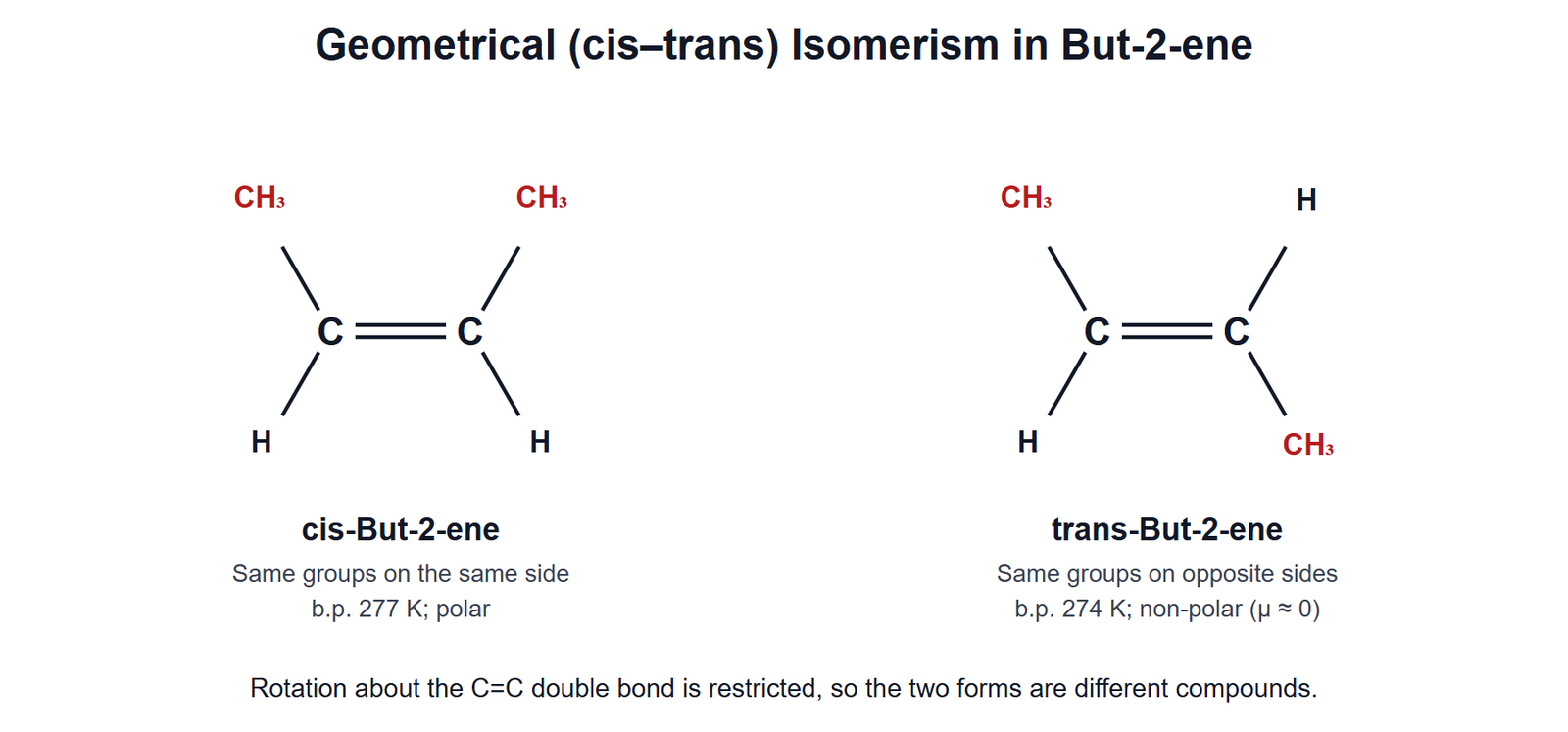
Important: Geometrical isomerism is possible only when each doubly bonded carbon carries two different atoms or groups. So propene (CH3–CH=CH2) does not show cis–trans isomerism.
6. Alkenes: Physical Properties and Preparation
Physical properties: Ethene to butene are gases, C5 to C17 are liquids and higher members are solids. Ethene is a colourless gas with a faint sweet smell. Alkenes are insoluble in water. The boiling point increases with size; cis-isomers usually have higher boiling points than trans-isomers because they are polar.
Methods of preparation:
- From alkynes: Partial reduction with Lindlar’s catalyst (palladised charcoal deactivated with sulphur compounds or quinoline) gives cis-alkenes. Reduction with sodium in liquid ammonia gives trans-alkenes.
- From alkyl halides (dehydrohalogenation): Heating with alcoholic KOH removes HX. CH3CH2Br + KOH(alc) → CH2=CH2 + KBr + H2O
- From vicinal dihalides: Heating with zinc metal removes both halogens. CH2Br–CH2Br + Zn → CH2=CH2 + ZnBr2
- From alcohols (acidic dehydration): Heating with conc. H2SO4 at 443 K removes water. CH3CH2OH → CH2=CH2 + H2O
7. Alkenes: Chemical Reactions
Alkenes mainly undergo electrophilic addition reactions, because the π electrons are easily available.
- Addition of hydrogen: CH2=CH2 + H2 → CH3–CH3 (Ni, Pt or Pd)
- Addition of halogens: CH2=CH2 + Br2 → BrCH2–CH2Br (1,2-dibromoethane). The reddish-orange colour of bromine in CCl4 disappears. This is a test for unsaturation.
- Addition of hydrogen halides: Reactivity order: HI > HBr > HCl. For unsymmetrical alkenes, the product is given by Markovnikov’s rule.
- Addition of water (hydration): In the presence of a few drops of conc. H2SO4, alkenes add water to form alcohols, following Markovnikov’s rule. CH3–CH=CH2 + H2O → CH3–CH(OH)–CH3 (propan-2-ol)
- Ozonolysis: Alkenes add ozone to form an ozonide, which is broken by Zn and water into aldehydes or ketones. Example: propene gives ethanal (CH3CHO) and methanal (HCHO). This helps to locate the position of the double bond.
- Oxidation: Cold, dilute, aqueous KMnO4 (Baeyer’s reagent) gives vicinal glycols, and its pink colour disappears (another test for unsaturation). CH2=CH2 + H2O + [O] → HOCH2–CH2OH. Acidic KMnO4 or K2Cr2O7 breaks the double bond to give ketones and/or acids. Example: but-2-ene gives two molecules of ethanoic acid.
- Polymerisation: Many ethene molecules join at high temperature and pressure with a catalyst to form polythene: n(CH2=CH2) → (–CH2–CH2–)n
Markovnikov’s rule: When an unsymmetrical reagent (like HBr) adds to an unsymmetrical alkene, the negative part of the reagent goes to the carbon atom that has fewer hydrogen atoms.
Example: CH3–CH=CH2 + HBr → CH3–CHBr–CH3 (2-bromopropane, major product)
Mechanism of electrophilic addition (HBr to propene):
- HBr gives H+ (electrophile) and Br−.
- H+ attacks the double bond. It can form a 2° carbocation (CH3–C+H–CH3) or a 1° carbocation (CH3–CH2–C+H2). The 2° carbocation is more stable, so it forms faster.
- Br− attacks the 2° carbocation to give 2-bromopropane as the main product.
Peroxide effect (Kharasch effect, anti-Markovnikov addition): In the presence of an organic peroxide, HBr adds to unsymmetrical alkenes against Markovnikov’s rule, by a free radical mechanism.
Example: CH3–CH=CH2 + HBr (peroxide) → CH3–CH2–CH2Br (1-bromopropane)
Exam point: The peroxide effect is seen only with HBr, not with HCl or HI.
8. Alkynes: Structure, Nomenclature and Preparation
Structure of the triple bond (ethyne): Each carbon is sp hybridised. The C≡C triple bond has one σ bond and two π bonds. Ethyne (HC≡CH) is a linear molecule with bond angle 180°. The C≡C bond length is 120 pm and the bond enthalpy is 823 kJ mol−1.
Nomenclature:
- HC≡CH: ethyne (acetylene)
- CH3–C≡CH: propyne
- CH3–CH2–C≡CH: but-1-yne
- CH3–C≡C–CH3: but-2-yne
Physical properties: The first three members are gases. Alkynes are non-polar and insoluble in water. Ethyne is a colourless gas.
Methods of preparation:
- From calcium carbide: CaC2 + 2H2O → Ca(OH)2 + C2H2 (industrial method)
- From vicinal dihalides: Heating with alcoholic KOH removes one HX to give a vinylic halide. Treating this with sodamide (NaNH2) removes the second HX to give an alkyne.
9. Alkynes: Chemical Reactions
(a) Acidic character of alkynes: Hydrogen atoms attached to a triple-bonded carbon are weakly acidic. Ethyne reacts with sodium metal or sodamide to form sodium acetylide.
HC≡CH + Na → HC≡C−Na+ + ½H2
- The sp carbon has 50% s-character, so it is more electronegative than sp2 (33%) or sp3 (25%) carbon. It holds the shared electrons more tightly and releases H+ more easily.
- Acidic strength: HC≡CH > H2C=CH2 > CH3–CH3
- Only terminal alkynes (with ≡C–H) are acidic. But-2-yne (CH3–C≡C–CH3) is not acidic.
(b) Addition reactions: Alkynes add two molecules of a reagent (one for each π bond).
- Hydrogen: HC≡CH + H2 → H2C=CH2; then + H2 → CH3–CH3 (Pt, Pd or Ni)
- Halogens: HC≡CH + 2Br2 → Br2CH–CHBr2 (1,1,2,2-tetrabromoethane). The reddish-orange colour of bromine is discharged.
- Hydrogen halides: Addition follows Markovnikov’s rule. HC≡CH + HBr → CH2=CHBr (bromoethene); then + HBr → CH3–CHBr2 (1,1-dibromoethane)
- Water: In the presence of mercuric sulphate and dilute sulphuric acid at 333 K, alkynes add water to form carbonyl compounds. HC≡CH + H2O → CH3CHO (ethanal). Propyne gives propanone (CH3COCH3).
(c) Polymerisation: When ethyne is passed through a red-hot iron tube at 873 K, three molecules join to form benzene (cyclic polymerisation). 3HC≡CH → C6H6
10. Aromatic Hydrocarbons: Introduction and Nomenclature
Aromatic hydrocarbons (arenes) contain one or more benzene rings. They were called aromatic because many of them have a pleasant smell. Example: benzene, toluene, naphthalene.
IUPAC nomenclature:
Compound | Common name | IUPAC name |
|---|---|---|
C6H5CH3 | Toluene | Methylbenzene |
C6H5OH | Phenol | Phenol |
C6H5NH2 | Aniline | Aniline (benzenamine) |
C6H4(CH3)2, positions 1 and 2 | o-Xylene | 1,2-Dimethylbenzene |
C6H4(CH3)2, positions 1 and 3 | m-Xylene | 1,3-Dimethylbenzene |
C6H4(CH3)2, positions 1 and 4 | p-Xylene | 1,4-Dimethylbenzene |
Remember: In a disubstituted benzene, positions 1,2 are called ortho (o-), 1,3 are meta (m-) and 1,4 are para (p-).
11. Benzene: Structure, Resonance and Aromaticity
Benzene (C6H6) was isolated by Michael Faraday in 1825. In 1865, August Kekulé proposed a cyclic structure with six carbon atoms in a ring and alternate single and double bonds.
But benzene does not behave like a normal alkene. It does not easily give addition reactions and is unusually stable. X-ray studies show that all six C–C bonds are equal (139 pm). This is explained by resonance.
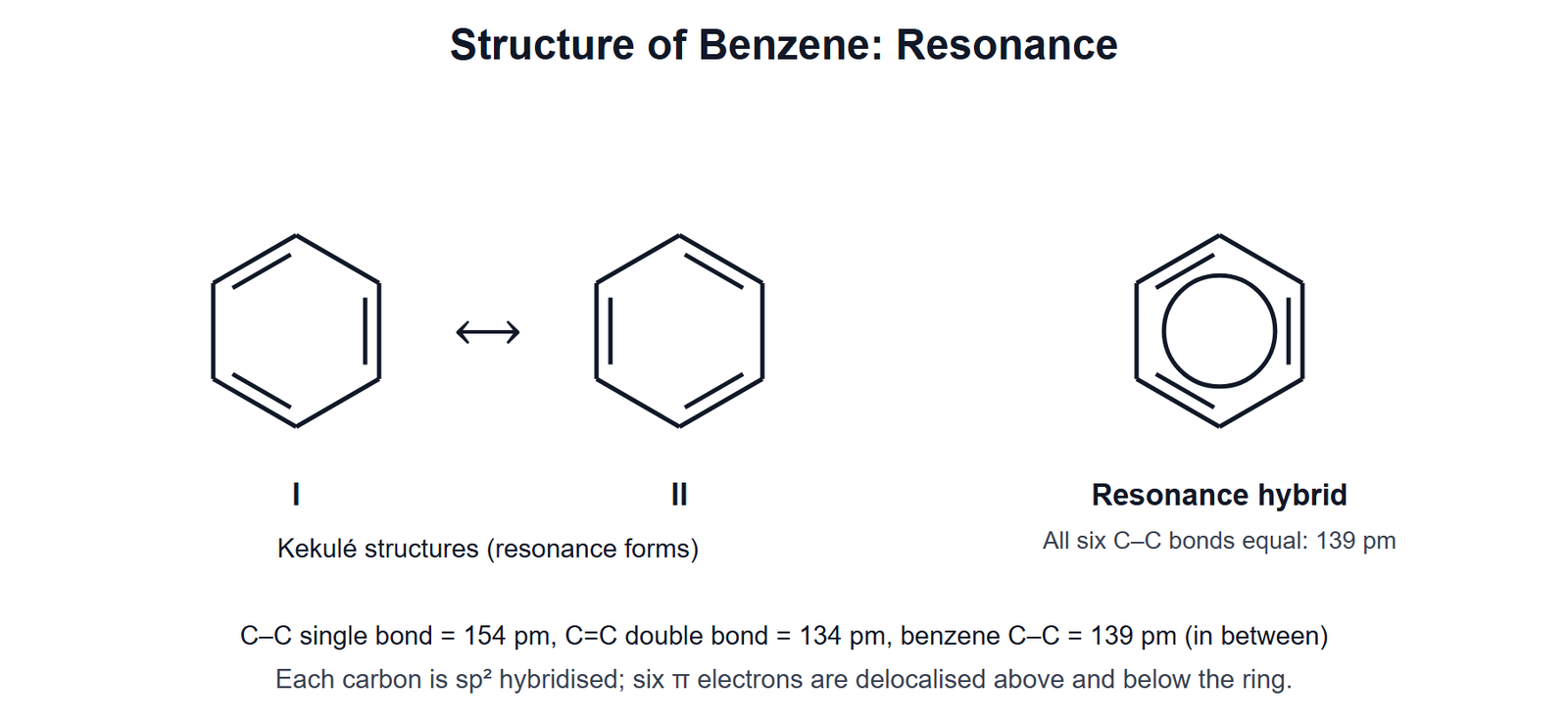
- Each carbon is sp2 hybridised and forms three σ bonds (two C–C and one C–H). Benzene is a planar hexagon with bond angles of 120°.
- The unhybridised p orbital on each carbon overlaps sideways with p orbitals on both neighbours. The six π electrons are delocalised over all six carbons, forming electron clouds above and below the ring.
- Delocalisation makes benzene extra stable.
Aromaticity (Hückel rule): A compound is aromatic if:
- It is planar.
- Its π electrons are completely delocalised in a ring.
- The ring contains (4n + 2) π electrons, where n = 0, 1, 2, …
Example: Benzene has 6 π electrons (4n + 2 = 6 for n = 1), so it is aromatic.
Preparation of benzene (brief): by cyclic polymerisation of ethyne, by heating sodium benzoate with soda lime (decarboxylation), or by reducing phenol with zinc dust.
12. Chemical Properties of Benzene: Electrophilic Substitution
Benzene has a high electron density above and below the ring, so it is attacked by electrophiles. It prefers substitution (which keeps the stable aromatic ring) over addition.
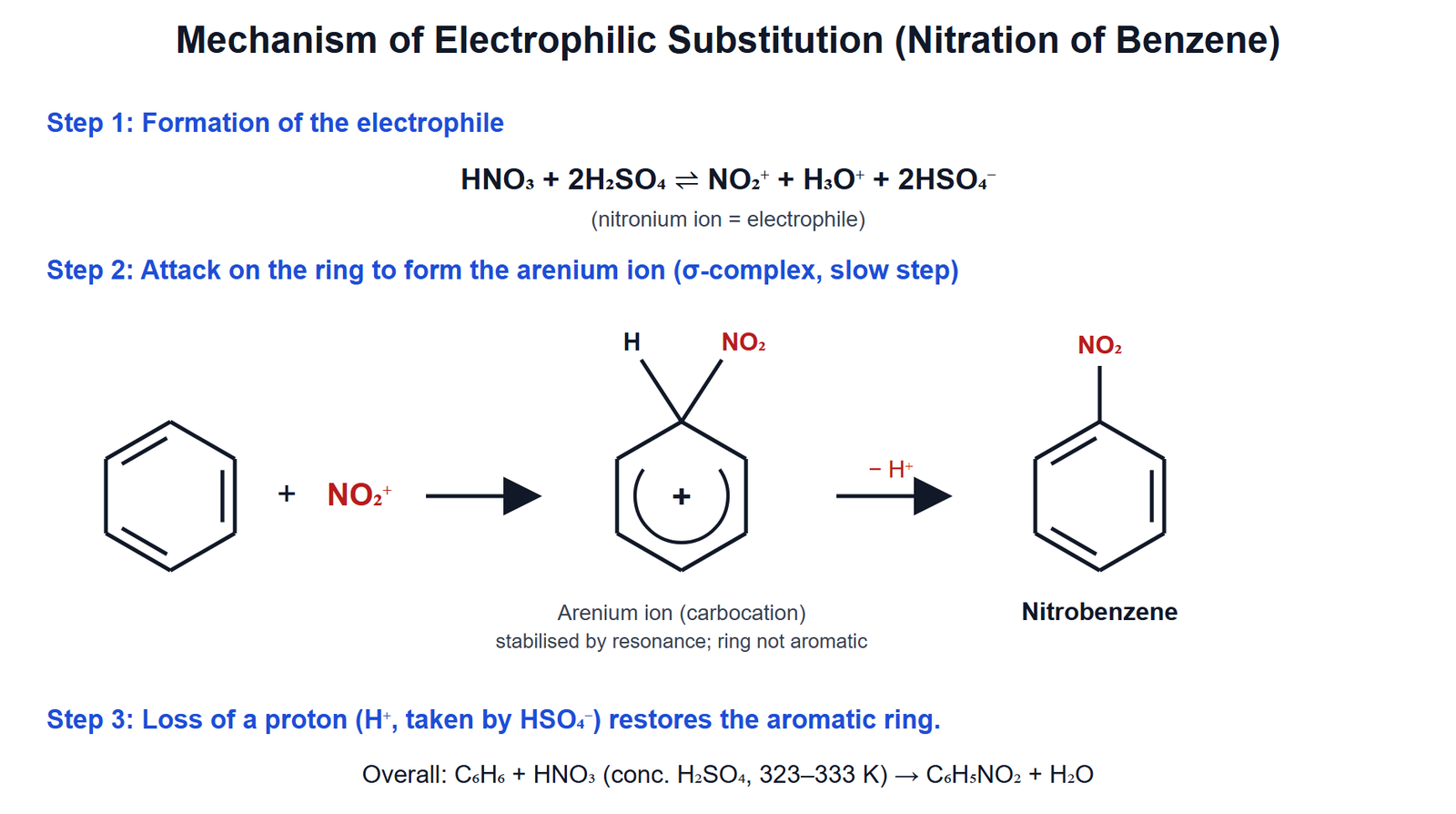
- Nitration: C6H6 + HNO3 (conc. H2SO4, 323–333 K) → C6H5NO2 (nitrobenzene) + H2O. Electrophile: NO2+.
- Halogenation: C6H6 + Cl2 (anhydrous FeCl3, in the dark) → C6H5Cl (chlorobenzene) + HCl. Electrophile: Cl+.
- Sulphonation: C6H6 + H2SO4 (fuming, containing SO3) → C6H5SO3H (benzenesulphonic acid) + H2O. Electrophile: SO3.
- Friedel–Crafts alkylation: C6H6 + CH3Cl (anhydrous AlCl3) → C6H5CH3 (toluene) + HCl. Electrophile: CH3+.
- Friedel–Crafts acylation: C6H6 + CH3COCl (anhydrous AlCl3) → C6H5COCH3 (acetophenone) + HCl. Electrophile: CH3CO+.
Mechanism of electrophilic substitution: It takes place in three steps.
- Generation of the electrophile (E+). Example: in nitration, HNO3 + 2H2SO4 → NO2+ + H3O+ + 2HSO4−.
- Attack of E+ on the ring to form a carbocation called the arenium ion (σ-complex). The ring loses its aromatic character in this slow step.
- Loss of a proton (H+) from the sp3 carbon, which restores aromaticity.
Addition and combustion reactions: Under drastic conditions benzene gives addition products. With H2 (Ni, high temperature and pressure) it gives cyclohexane. With Cl2 in UV light it gives benzene hexachloride (BHC, C6H6Cl6). Benzene burns with a sooty flame: 2C6H6 + 15O2 → 12CO2 + 6H2O.
13. Directive Influence of a Functional Group in Monosubstituted Benzene
When a monosubstituted benzene undergoes further substitution, the group already present decides the position of the new group.
Type | Groups | Effect on ring |
|---|---|---|
Ortho and para directing | –OH, –NH2, –NHR, –OCH3, –CH3, –C2H5 | Activating (increase electron density at o and p positions) |
Ortho and para directing | Halogens (–Cl, –Br, –I) | Slightly deactivating (strong −I effect), but o/p directing due to +R effect |
Meta directing | –NO2, –CN, –CHO, –COR, –COOH, –SO3H | Deactivating (withdraw electrons, mainly from o and p positions) |
Example: Nitration of toluene gives a mixture of o-nitrotoluene and p-nitrotoluene. Nitration of nitrobenzene gives m-dinitrobenzene.
Easy Memory Trick: Groups with a lone pair on the atom attached to the ring (–OH, –NH2, –X) and alkyl groups send the new group to ortho/para. Groups with a multiple bond to an electronegative atom (–NO2, –CHO, –COOH, –CN) send it to meta.
14. Carcinogenicity and Toxicity
Benzene and polynuclear hydrocarbons (with more than two benzene rings fused together) are toxic, and many are carcinogenic (cancer-causing).
- They are formed by the incomplete combustion of organic materials such as tobacco, coal and petroleum.
- They enter the body and undergo biochemical reactions that damage DNA, which can cause cancer.
- Examples of carcinogenic polynuclear hydrocarbons: 1,2-benzanthracene, 3,4-benzpyrene, 1,2,5,6-dibenzanthracene and 3-methylcholanthrene.
Important: Inhaling benzene vapour for a long time is harmful. This is one reason why smoking and burning of fuels in closed spaces are dangerous to health.
Conclusion: Alkanes are saturated and mainly undergo substitution (by a free radical mechanism) and combustion. Alkenes and alkynes are unsaturated and undergo electrophilic addition, following Markovnikov’s rule (except the peroxide effect with HBr). Benzene is a stable aromatic compound that undergoes electrophilic substitution, and the group already present on the ring directs the position of further substitution.