Chemical Thermodynamics – Class 11 Chemistry Notes
Chapter – 5
Chemical Thermodynamics
Thermodynamics is the branch of science that deals with energy changes in physical and chemical processes. It tells us whether a process can take place (feasibility) and how much energy is involved. It does not tell us how fast a reaction takes place.
1. System, Surroundings and Types of Systems
- System: The part of the universe under study. Example: a reaction mixture in a beaker.
- Surroundings: Everything else in the universe outside the system.
- Boundary: The real or imaginary wall that separates the system from the surroundings.
Universe = System + Surroundings
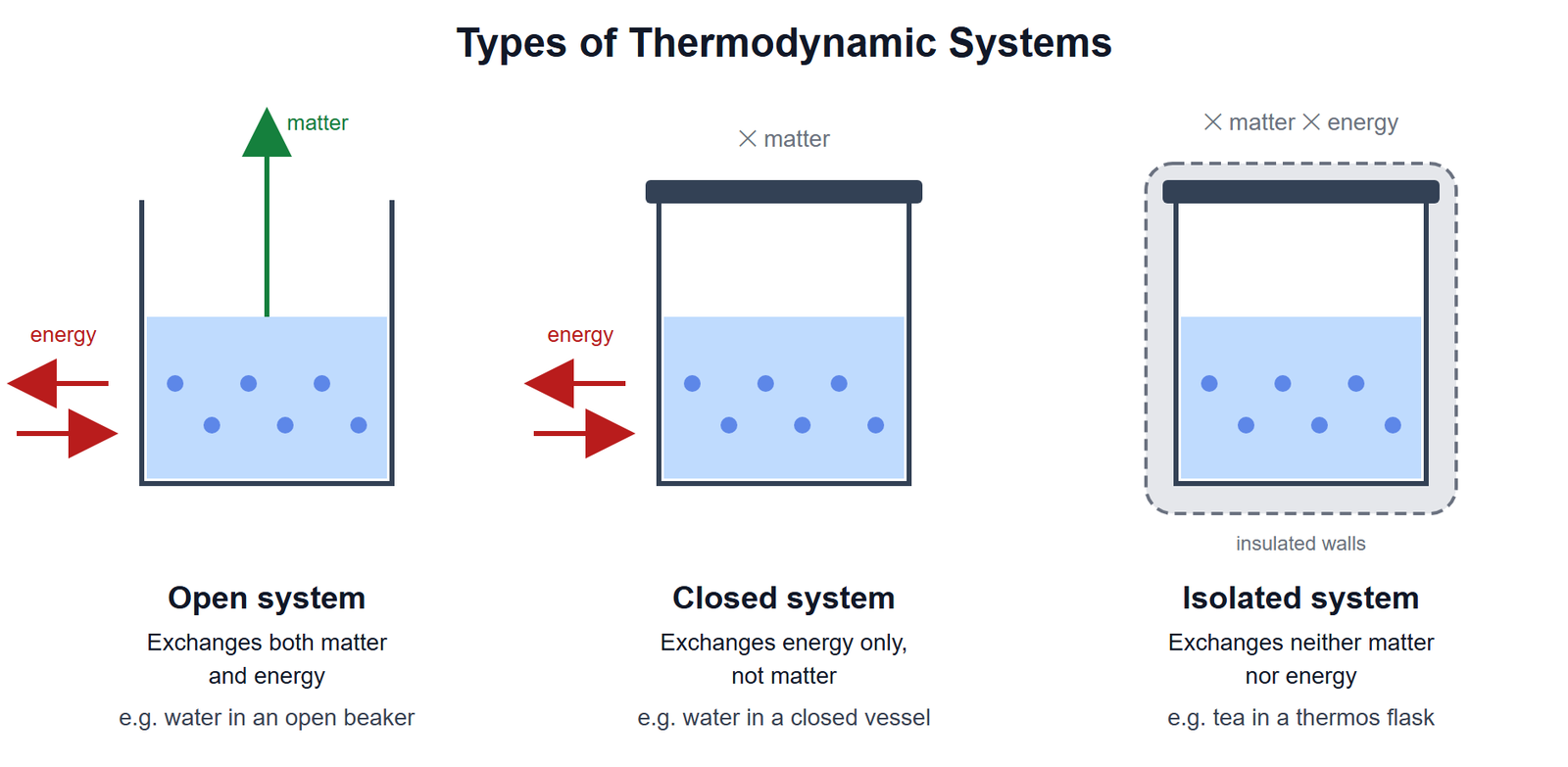
Types of systems:
Type of system | Exchange of energy | Exchange of matter | Example |
|---|---|---|---|
Open | Yes | Yes | Reactants in an open beaker |
Closed | Yes | No | Reactants in a closed vessel of conducting material |
Isolated | No | No | Reactants in a thermos flask |
2. State of a System, State Functions and Properties
The state of a system is described by measurable properties such as pressure (p), volume (V), temperature (T) and amount (n). These are called state variables.
- State function: A property whose value depends only on the initial and final states of the system, not on the path followed. Example: internal energy (U), enthalpy (H), entropy (S), Gibbs energy (G), p, V, T.
- Path function: A quantity whose value depends on the path followed. Example: heat (q) and work (w).
Example: If you climb a hill by a short steep road or a long gentle road, your change in height (a state function) is the same, but the distance walked (a path function) is different.
Extensive property | Intensive property |
|---|---|
Depends on the amount of matter | Does not depend on the amount of matter |
Mass, volume, internal energy, enthalpy, heat capacity | Temperature, pressure, density, molar heat capacity, refractive index |
Remember: A ratio of two extensive properties is an intensive property. Example: density = mass ÷ volume.
3. Internal Energy, Heat and Work
Internal energy (U): The total energy of a system. It includes chemical, electrical, mechanical and other forms of energy of its particles. Its absolute value cannot be measured, but its change (ΔU) can be measured.
Internal energy of a system can change when:
- Heat passes into or out of the system.
- Work is done on or by the system.
- Matter enters or leaves the system.
Sign conventions (IUPAC):
Process | Sign |
|---|---|
Heat absorbed by the system (q) | Positive (+) |
Heat released by the system (q) | Negative (−) |
Work done on the system (w) | Positive (+) |
Work done by the system (w) | Negative (−) |
Pressure–volume work: When a gas expands against a constant external pressure (pex), the work done is:
w = −pex (Vf − Vi) = −pex ΔV
Example: A gas expands from 2 L to 10 L against a constant external pressure of 1 atm. Find the work done. (1 L atm = 101.3 J)
w = −1 × (10 − 2) = −8 L atm = −8 × 101.3 J = −810.4 J
The negative sign shows that work is done by the system.
Important: When a gas expands into vacuum (pex = 0), no work is done. This is called free expansion.
4. First Law of Thermodynamics
Energy can neither be created nor destroyed; it can only be changed from one form to another. The energy of an isolated system is constant. This is also called the law of conservation of energy.
Mathematical form: ΔU = q + w
Example: A system absorbs 701 J of heat and does 394 J of work. Find the change in internal energy.
q = +701 J, w = −394 J
ΔU = 701 + (−394) = +307 J
Exam point: For an isolated system, q = 0 and w = 0, so ΔU = 0. For an adiabatic process (no heat exchange), ΔU = wad.
5. Enthalpy (H)
Most reactions take place at constant pressure (in open vessels). The heat absorbed at constant pressure is called the enthalpy change.
H = U + pV, and at constant pressure, ΔH = ΔU + pΔV = qp
For reactions involving gases: ΔH = ΔU + ΔngRT
where Δng = moles of gaseous products − moles of gaseous reactants, and R = 8.314 J K−1 mol−1.
Example: The enthalpy of vaporisation of water at 373 K is 41.00 kJ mol−1. Find ΔU for this process. (Assume water vapour is an ideal gas.)
H2O(l) → H2O(g), so Δng = 1 − 0 = 1
ΔU = ΔH − ΔngRT = 41.00 − 1 × 8.314 × 10−3 × 373 = 41.00 − 3.10 = 37.90 kJ mol−1
- Exothermic reaction: Heat is released, ΔH is negative. Example: burning of fuels.
- Endothermic reaction: Heat is absorbed, ΔH is positive. Example: melting of ice.
Remember: If Δng = 0 (equal moles of gases on both sides, or no gases), then ΔH = ΔU.
6. Heat Capacity and Specific Heat
- Heat capacity (C): The heat required to raise the temperature of a substance by 1 °C (or 1 K). q = C ΔT
- Specific heat capacity (c): The heat required to raise the temperature of 1 g (or 1 kg) of a substance by 1 °C. q = m × c × ΔT
- Molar heat capacity (Cm): The heat required to raise the temperature of 1 mole of a substance by 1 °C.
For an ideal gas: Cp − Cv = R, where Cp = molar heat capacity at constant pressure and Cv = at constant volume.
Example: Find the heat needed to raise the temperature of 60.0 g of aluminium from 35 °C to 55 °C. (Molar heat capacity of Al = 24 J mol−1 K−1, Al = 27 g mol−1)
Moles of Al = 60.0 ÷ 27 = 2.22 mol
q = n × Cm × ΔT = 2.22 × 24 × (55 − 35) = 1066.7 J ≈ 1.07 kJ
7. Measurement of ΔU and ΔH: Calorimetry
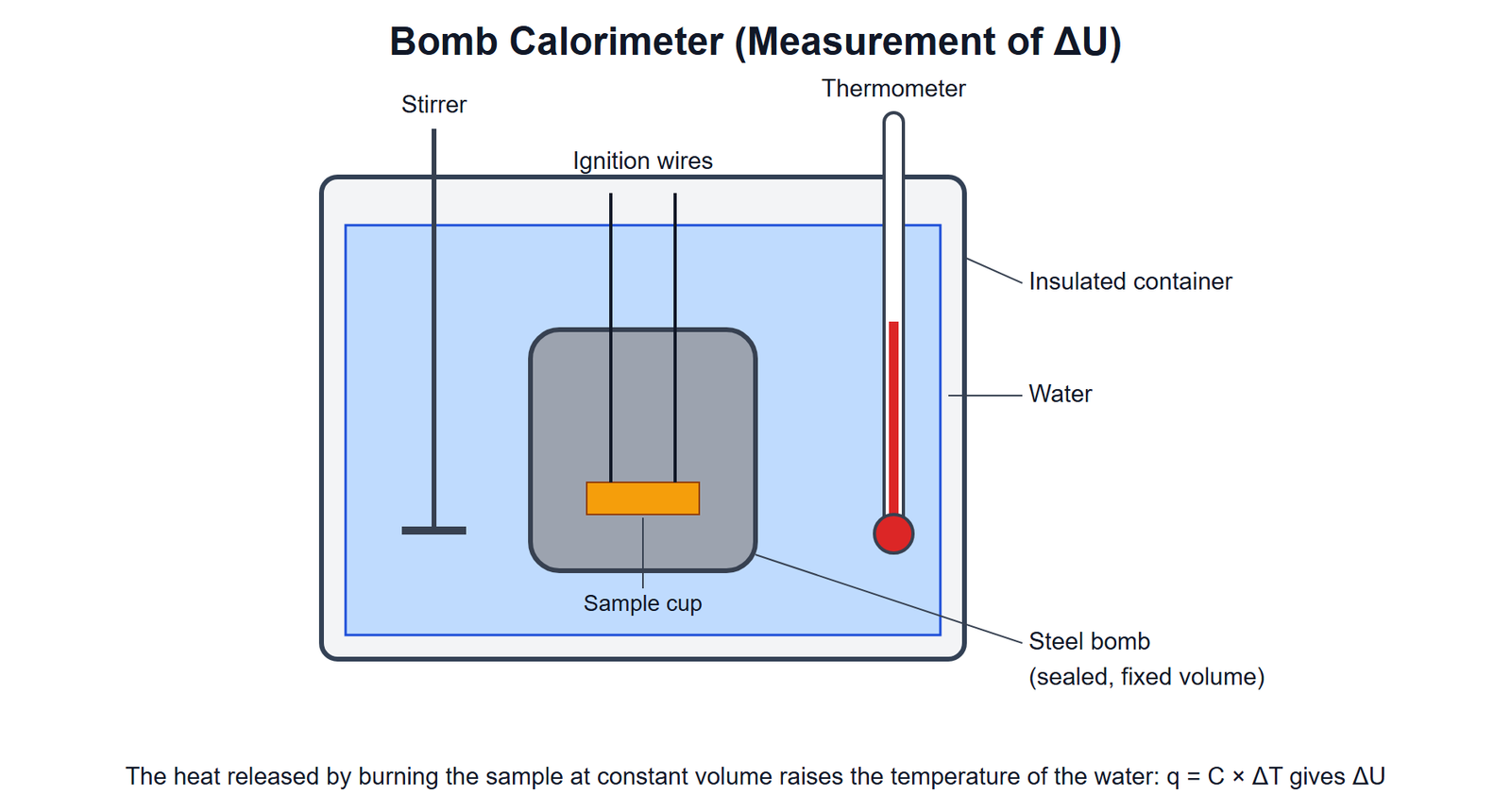
Energy changes in chemical processes are measured experimentally by calorimetry. The process is carried out in a vessel called a calorimeter, which is immersed in a known volume of water. The heat change is found from the temperature change of the water.
- Measurement of ΔU (bomb calorimeter): The substance is burnt in excess oxygen inside a sealed steel vessel (the bomb), so the volume is constant and no work is done. The heat given out raises the temperature of the water around the bomb. Here qv = ΔU.
- Measurement of ΔH: The reaction is carried out at constant pressure (for example, in a calorimeter open to the atmosphere). The heat absorbed or released is qp = ΔH.
8. Thermochemical Equations and Hess’s Law
A balanced equation along with the value of ΔH and the physical states of substances is called a thermochemical equation.
Example: CH4(g) + 2O2(g) → CO2(g) + 2H2O(l); ΔrH° = −890.3 kJ mol−1
Standard enthalpy of reaction (ΔrH°): The enthalpy change when all reactants and products are in their standard states. The standard state of a substance is its pure, most stable form at 1 bar pressure and a specified temperature (usually 298 K).
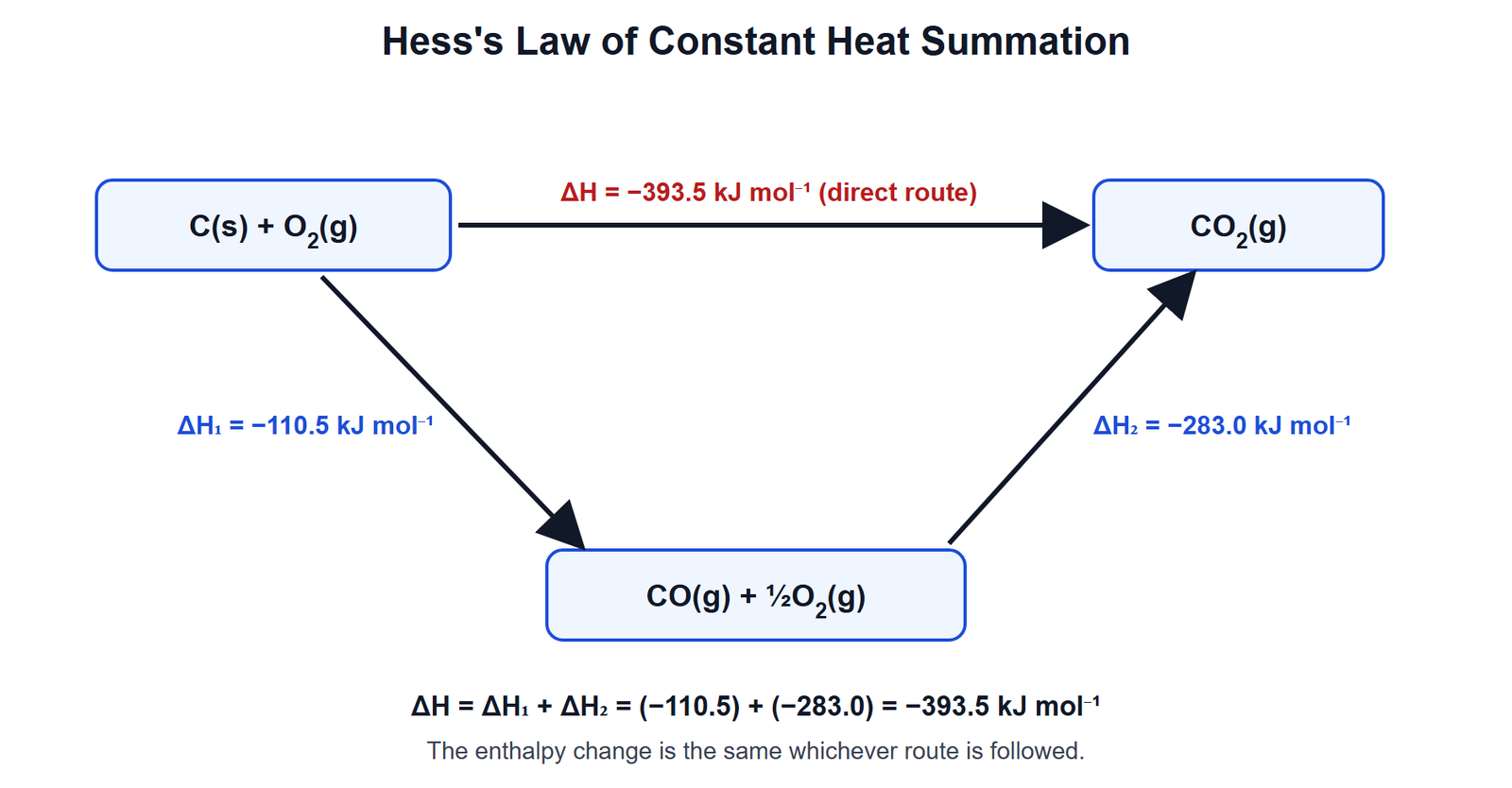
Hess’s law of constant heat summation: If a reaction takes place in several steps, its standard reaction enthalpy is the sum of the standard enthalpies of the individual steps, at the same temperature.
Example: Carbon can burn to CO2 directly, or first to CO and then to CO2.
- C(graphite) + ½O2(g) → CO(g); ΔH1 = −110.5 kJ mol−1
- CO(g) + ½O2(g) → CO2(g); ΔH2 = −283.0 kJ mol−1
- Adding: C(graphite) + O2(g) → CO2(g); ΔH = −393.5 kJ mol−1
Important: Hess’s law is used to find the enthalpy of reactions that cannot be measured directly. Thermochemical equations can be added, subtracted and multiplied like algebraic equations.
9. Enthalpies for Different Types of Reactions
- Standard enthalpy of formation (ΔfH°): The enthalpy change when one mole of a compound is formed from its elements in their most stable states. Example: C(graphite) + O2(g) → CO2(g); ΔfH° = −393.5 kJ mol−1. The ΔfH° of an element in its standard state is taken as zero.
- Standard enthalpy of combustion (ΔcH°): The enthalpy change when one mole of a substance burns completely in oxygen, with all reactants and products in their standard states. Example: butane, ΔcH° = −2658.0 kJ mol−1.
- Bond dissociation enthalpy (ΔbondH°): The enthalpy change when one mole of covalent bonds of a gaseous molecule is broken to form gaseous products. Example: H2(g) → 2H(g); ΔH–HH° = 435.0 kJ mol−1.
- Enthalpy of atomization (ΔaH°): The enthalpy change when one mole of bonds is completely broken to obtain atoms in the gas phase. Example: CH4(g) → C(g) + 4H(g); ΔaH° = 1665 kJ mol−1. For metals: Na(s) → Na(g); ΔaH° = 108.4 kJ mol−1.
- Enthalpy of sublimation (ΔsubH°): The enthalpy change when one mole of a solid changes directly into vapour. Example: naphthalene, ΔsubH° = 73.0 kJ mol−1.
- Enthalpy of phase transition: Enthalpy of fusion (solid to liquid) of water is 6.00 kJ mol−1 at 273 K. Enthalpy of vaporisation (liquid to vapour) of water is 40.79 kJ mol−1 at 373 K.
- Ionization enthalpy: The enthalpy change when an electron is removed from an isolated gaseous atom (see Chapter 3). The lattice enthalpy of an ionic compound is related to this through the Born–Haber cycle.
- Enthalpy of solution (ΔsolH°): The enthalpy change when one mole of a substance dissolves in a specified amount of solvent. For an ionic compound, ΔsolH° = ΔlatticeH° + ΔhydH°.
- Enthalpy of dilution: The enthalpy change when a solution is diluted by adding more solvent. It depends on the original concentration and on the amount of solvent added.
Finding ΔrH° from enthalpies of formation:
ΔrH° = Σ ΔfH°(products) − Σ ΔfH°(reactants)
Example: Calculate ΔrH° for CH4(g) + 2O2(g) → CO2(g) + 2H2O(l). (ΔfH° in kJ mol−1: CH4 = −74.8, CO2 = −393.5, H2O(l) = −285.8)
ΔrH° = [−393.5 + 2 × (−285.8)] − [−74.8 + 2 × 0] = −965.1 + 74.8 = −890.3 kJ mol−1
Finding ΔrH° from bond enthalpies (gas-phase reactions):
ΔrH° = Σ bond enthalpies of reactants − Σ bond enthalpies of products
10. Second Law of Thermodynamics and Entropy (Brief Introduction)
A spontaneous process is one that takes place by itself without outside help. Example: water flows downhill, heat flows from a hot body to a cold body, a gas spreads to fill its container.
A negative ΔH alone cannot decide spontaneity, because some endothermic processes (like melting of ice above 0 °C or dissolving of NH4Cl in water) are also spontaneous. Another factor, entropy, is needed.
Entropy (S): A measure of the degree of randomness or disorder of a system. It is a state function.
- Entropy increases from solid to liquid to gas.
- Entropy increases when temperature increases.
- For a reversible process at temperature T: ΔS = qrev ÷ T
Example: Find the entropy change when 1 mole of ice melts at 273 K. (ΔfusH = 6.0 kJ mol−1)
ΔS = 6000 J ÷ 273 K = 21.98 J K−1 mol−1
Second law of thermodynamics: The total entropy of the universe (system + surroundings) increases in every spontaneous process. ΔStotal = ΔSsystem + ΔSsurroundings > 0
11. Gibbs Energy and Spontaneity
Gibbs energy (G) combines enthalpy and entropy: G = H − TS
At constant temperature and pressure: ΔG = ΔH − TΔS
ΔG | Nature of process |
|---|---|
Negative (ΔG < 0) | Spontaneous |
Positive (ΔG > 0) | Non-spontaneous |
Zero (ΔG = 0) | At equilibrium |
ΔH | ΔS | ΔG = ΔH − TΔS | Spontaneous? |
|---|---|---|---|
− | + | Always negative | At all temperatures |
+ | − | Always positive | Never |
− | − | Negative at low T | At low temperatures |
+ | + | Negative at high T | At high temperatures |
Example: A reaction has ΔH = −110 kJ mol−1 and ΔS = +40 J K−1 mol−1. Is it spontaneous at 298 K?
ΔG = ΔH − TΔS = −110 − 298 × (40 ÷ 1000) = −110 − 11.92 = −121.92 kJ mol−1. ΔG is negative, so the reaction is spontaneous.
Example: A reaction has ΔH = +179 kJ mol−1 and ΔS = +160 J K−1 mol−1. Above what temperature will it become spontaneous?
At the turning point ΔG = 0, so T = ΔH ÷ ΔS = 179,000 ÷ 160 = 1118.75 K. The reaction is spontaneous above about 1119 K.
Gibbs energy and equilibrium: ΔG° = −RT ln K = −2.303 RT log K. A large negative ΔG° means a large equilibrium constant K (the reaction goes nearly to completion).
12. Third Law of Thermodynamics (Brief Introduction)
The entropy of a perfectly crystalline substance is zero at absolute zero (0 K). This law allows us to calculate the absolute entropy of substances at other temperatures.
Easy Memory Trick: First law: energy is conserved. Second law: entropy of the universe increases. Third law: entropy of a perfect crystal is zero at 0 K.
Conclusion: The first law of thermodynamics tells us that energy is conserved (ΔU = q + w). Enthalpy changes can be measured by calorimetry and calculated using Hess’s law. The second law introduces entropy, and Gibbs energy (ΔG = ΔH − TΔS) tells us whether a process is spontaneous.