Organic Chemistry: Some Basic Principles and Techniques – Class 11 Chemistry Notes
Chapter – 8
Organic Chemistry: Some Basic Principles and Techniques
1. General Introduction
Organic chemistry is the chemistry of carbon compounds (other than a few simple ones like CO, CO2 and carbonates). Organic compounds are found in food, fuels, medicines, plastics, dyes, soaps and in all living things.
- Vital force theory (Berzelius): It was once believed that organic compounds could be made only by living organisms with the help of a “vital force”.
- Wöhler (1828) prepared urea, an organic compound, from ammonium cyanate, an inorganic compound. NH4CNO → NH2CONH2
- Later, Kolbe (1845) made acetic acid and Berthelot (1856) made methane from inorganic substances. The vital force theory was rejected.
Why carbon forms so many compounds:
- Tetravalence: Carbon (1s2 2s2 2p2) forms four covalent bonds.
- Catenation: Carbon atoms join with each other to form long chains and rings.
- Multiple bonds: Carbon forms single, double and triple bonds.
Carbon in | Hybridisation | Shape | Example |
|---|---|---|---|
Only single bonds | sp3 | Tetrahedral | CH4 |
One double bond | sp2 | Trigonal planar | CH2=CH2 |
One triple bond | sp | Linear | HC≡CH |
Representation of structures: Butane can be written as a complete structural formula (all bonds shown), a condensed formula CH3CH2CH2CH3, or a bond-line formula (a zig-zag line where each corner and end is a carbon atom and hydrogens are not shown).
2. Classification of Organic Compounds
- Acyclic (open chain or aliphatic) compounds: Carbon atoms form straight or branched chains. Example: ethane, propene, acetic acid.
- Alicyclic (closed chain) compounds: Carbon atoms form rings, but the compounds behave like aliphatic compounds. Example: cyclopropane, cyclohexane.
- Aromatic compounds: Special ring compounds.
- Benzenoid aromatic compounds: contain a benzene ring. Example: benzene, aniline, naphthalene.
- Non-benzenoid aromatic compounds: aromatic but without a benzene ring. Example: tropolone.
- Heterocyclic aromatic compounds: ring contains an atom other than carbon (N, O, S). Example: furan, thiophene, pyridine.
Functional group: An atom or group of atoms in a molecule that gives it its characteristic chemical properties.
Homologous series: A series of compounds with the same functional group, in which successive members differ by a –CH2– unit (14 u). Members show similar chemical properties and a gradual change in physical properties. Example: methane, ethane, propane, butane.
Class | Functional group | IUPAC suffix / prefix | Example |
|---|---|---|---|
Alkene | C=C | -ene | CH2=CH2 (ethene) |
Alkyne | C≡C | -yne | HC≡CH (ethyne) |
Haloalkane | –X (F, Cl, Br, I) | halo- (prefix) | CH3Cl (chloromethane) |
Alcohol | –OH | -ol | CH3CH2OH (ethanol) |
Ether | –O– | alkoxy- (prefix) | CH3OCH3 (methoxymethane) |
Aldehyde | –CHO | -al | CH3CHO (ethanal) |
Ketone | >C=O | -one | CH3COCH3 (propanone) |
Carboxylic acid | –COOH | -oic acid | CH3COOH (ethanoic acid) |
Ester | –COOR | alkyl …oate | CH3COOCH3 (methyl ethanoate) |
Amine | –NH2 | -amine | CH3NH2 (methanamine) |
Nitrile | –CN | -nitrile | CH3CN (ethanenitrile) |
Nitro compound | –NO2 | nitro- (prefix) | CH3NO2 (nitromethane) |
3. IUPAC Nomenclature of Organic Compounds
The IUPAC name has three parts: prefix + word root + suffix.
Carbon atoms | 1 | 2 | 3 | 4 | 5 | 6 | 7 | 8 | 9 | 10 |
|---|---|---|---|---|---|---|---|---|---|---|
Word root | Meth | Eth | Prop | But | Pent | Hex | Hept | Oct | Non | Dec |
Rules:
- Longest chain rule: Select the longest continuous carbon chain (the parent chain). It must contain the functional group and multiple bonds, if present.
- Lowest locant rule: Number the chain from the end that gives the lowest number to the functional group, then to multiple bonds, then to substituents.
- Substituents: Name side groups as prefixes with their position numbers (methyl, ethyl, chloro, nitro). Use di, tri, tetra for repeated groups.
- Alphabetical order: Write different substituents in alphabetical order (ignore di, tri while arranging).
- Use commas between numbers and hyphens between numbers and words. Example: 2,3-dimethylpentane.
Priority of functional groups (for choosing the suffix): carboxylic acid > ester > amide > nitrile > aldehyde > ketone > alcohol > amine > alkene > alkyne. Halo, nitro and alkoxy groups are always written as prefixes.
Structure | IUPAC name |
|---|---|
CH3–CH(CH3)–CH2–CH3 | 2-Methylbutane |
CH3–C(CH3)2–CH2–CH3 | 2,2-Dimethylbutane |
CH3–CH(OH)–CH3 | Propan-2-ol |
CH2=CH–CH3 | Propene |
CH3–C≡C–CH3 | But-2-yne |
CH3–CH2–CH2–Cl | 1-Chloropropane |
CH3–CH2–CO–CH3 | Butan-2-one |
CH3–CH(Cl)–COOH | 2-Chloropropanoic acid |
Exam point: In CH3–CH(CH3)–CH2–CH3, numbering from the left gives the methyl group position 2, but from the right it would be 3. So the correct name is 2-methylbutane, not 3-methylbutane.
Isomerism (brief): Compounds with the same molecular formula but different structures are called isomers.
- Chain isomers: Different carbon skeletons. Example: butane and 2-methylpropane (C4H10).
- Position isomers: Different position of the functional group. Example: propan-1-ol and propan-2-ol.
- Functional isomers: Different functional groups. Example: ethanol (C2H5OH) and methoxymethane (CH3OCH3).
- Metamers: Different alkyl groups on either side of the functional group. Example: CH3OC3H7 and C2H5OC2H5.
4. Methods of Purification of Organic Compounds
- Sublimation: Used for solids that change directly into vapour on heating, from non-sublimable impurities. Example: camphor, naphthalene, iodine.
- Crystallisation: The impure compound is dissolved in a hot solvent in which it is sparingly soluble at room temperature. On cooling, the pure compound crystallises out. Example: purification of sugar, benzoic acid.
- Simple distillation: Separates a volatile liquid from non-volatile impurities, or two liquids with a large difference in boiling points. Example: chloroform (b.p. 334 K) and aniline (b.p. 457 K).
- Fractional distillation: Separates liquids whose boiling points are close. A fractionating column is used. Example: separating fractions of crude oil.
- Distillation under reduced pressure: Used for liquids that decompose at or below their boiling point. Lowering the pressure lowers the boiling point. Example: glycerol is purified this way, and sugar-cane juice is concentrated this way in sugar industry.
- Steam distillation: Used for substances that are steam volatile and immiscible with water. Example: aniline is separated from an aniline–water mixture; essential oils are extracted from plants.
- Differential extraction: An organic compound present in water is shaken with an organic solvent (in which it is more soluble) in a separating funnel. The two layers are separated.
- Chromatography: Separates the components of a mixture based on their different movement through a stationary phase with a mobile phase.
- Adsorption chromatography: column chromatography and thin layer chromatography (TLC).
- Partition chromatography: paper chromatography.
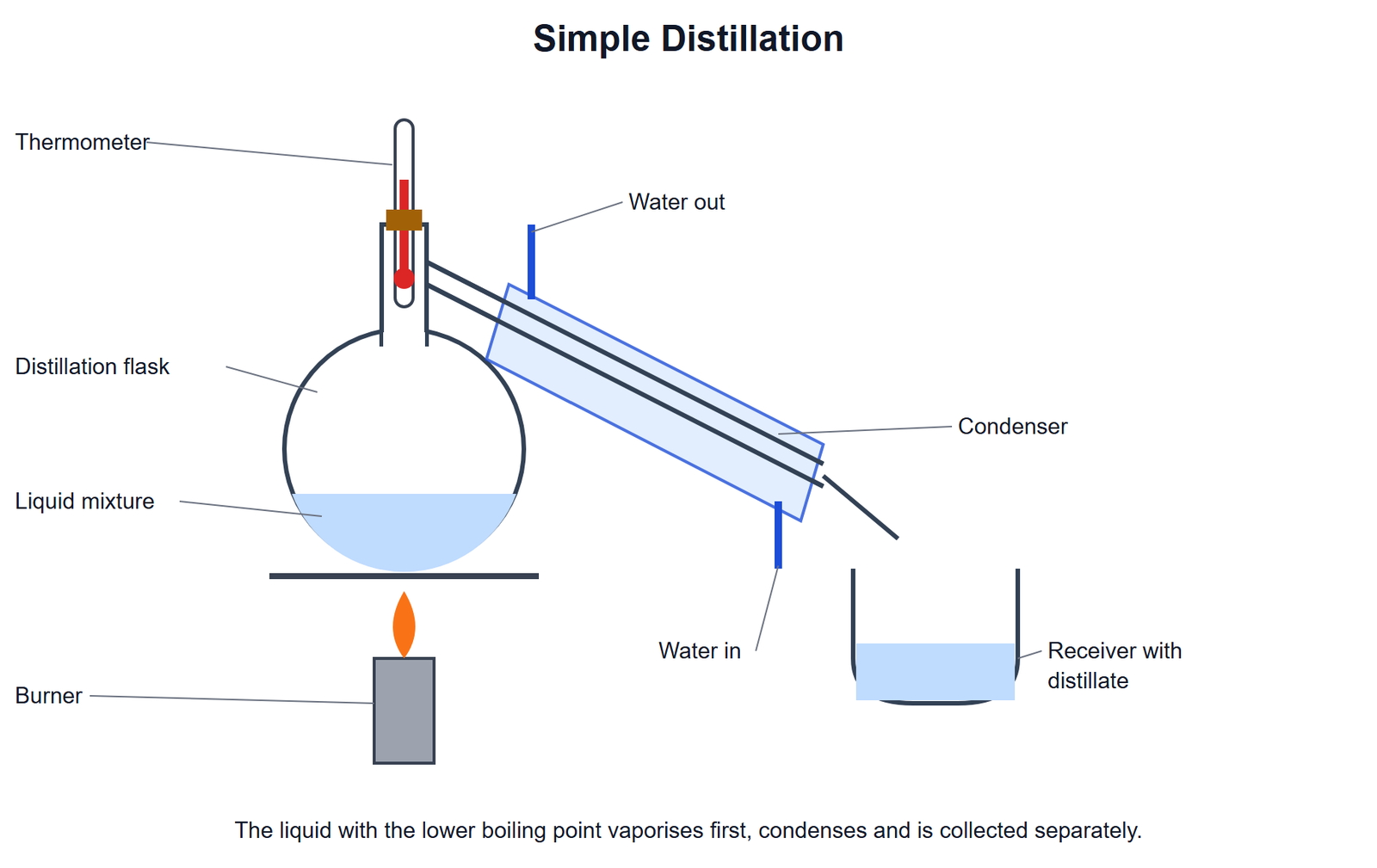
Retardation factor (Rf): In TLC and paper chromatography, Rf = Distance moved by the substance from the base line ÷ Distance moved by the solvent front from the base line.
5. Qualitative Analysis of Organic Compounds
(a) Detection of carbon and hydrogen: The compound is heated with copper(II) oxide. Carbon is oxidised to CO2, which turns lime water milky. Hydrogen is oxidised to water, which turns white anhydrous copper sulphate blue.
C + 2CuO → 2Cu + CO2; 2H + CuO → Cu + H2O
(b) Lassaigne’s test (sodium fusion extract): The compound is fused with sodium metal. N, S and halogens present change into ionic forms: NaCN, Na2S and NaX. The fused mass is boiled with water to get the sodium fusion extract.
Element | Test | Positive result |
|---|---|---|
Nitrogen | Boil extract with FeSO4, then acidify with conc. H2SO4 | Prussian blue colour, Fe4[Fe(CN)6]3 |
Sulphur | (i) Acidify with acetic acid, add lead acetate | (i) Black precipitate of PbS |
N and S together | Add FeCl3 to the extract | Blood red colour (Fe(SCN)2+) |
Halogens | Acidify with HNO3, add AgNO3 | White ppt (AgCl, soluble in NH3), pale yellow (AgBr, sparingly soluble), yellow (AgI, insoluble) |
Phosphorus | Oxidise with Na2O2, boil with HNO3, add ammonium molybdate | Yellow precipitate |
Important: Before testing for halogens, the extract is boiled with HNO3 to destroy any cyanide or sulphide present, which would otherwise interfere with the AgNO3 test.
6. Quantitative Analysis of Organic Compounds
(a) Carbon and hydrogen (Liebig’s method): A known mass (m) of the compound is burnt in excess oxygen and copper(II) oxide. The CO2 and H2O formed are absorbed and weighed.
- % C = (12 × mass of CO2 × 100) ÷ (44 × m)
- % H = (2 × mass of H2O × 100) ÷ (18 × m)
Example: 0.246 g of an organic compound gave 0.198 g of CO2 and 0.1014 g of H2O on combustion. Find % C and % H.
% C = (12 × 0.198 × 100) ÷ (44 × 0.246) = 21.95%
% H = (2 × 0.1014 × 100) ÷ (18 × 0.246) = 4.58%
(b) Nitrogen:
- Dumas method: The compound is heated with CuO in an atmosphere of CO2. Nitrogen gas is collected and its volume is measured.
- Kjeldahl’s method: The compound is heated with conc. H2SO4, which changes nitrogen into ammonium sulphate. This is heated with NaOH and the ammonia given off is absorbed in a known volume of standard acid. % N = (1.4 × N × V) ÷ m, where N = normality of acid and V = volume (mL) of acid neutralised by ammonia. (Not used for nitro, azo compounds or nitrogen in rings.)
(c) Halogens (Carius method): The compound is heated with fuming HNO3 and AgNO3. The halogen forms AgX, which is weighed.
% X = (Atomic mass of X × mass of AgX × 100) ÷ (Molar mass of AgX × m)
Example: 0.15 g of an organic compound gave 0.12 g of AgBr in the Carius method. Find % Br. (Br = 80, AgBr = 188)
% Br = (80 × 0.12 × 100) ÷ (188 × 0.15) = 34.04%
(d) Sulphur: Sulphur is oxidised to H2SO4 and precipitated as BaSO4. % S = (32 × mass of BaSO4 × 100) ÷ (233 × m)
(e) Oxygen: Usually found by difference: % O = 100 − (sum of percentages of all other elements).
7. Electronic Displacements in a Covalent Bond
(a) Inductive effect: The permanent displacement of σ-bond electrons along a carbon chain due to an electronegative or electropositive atom or group attached to it.
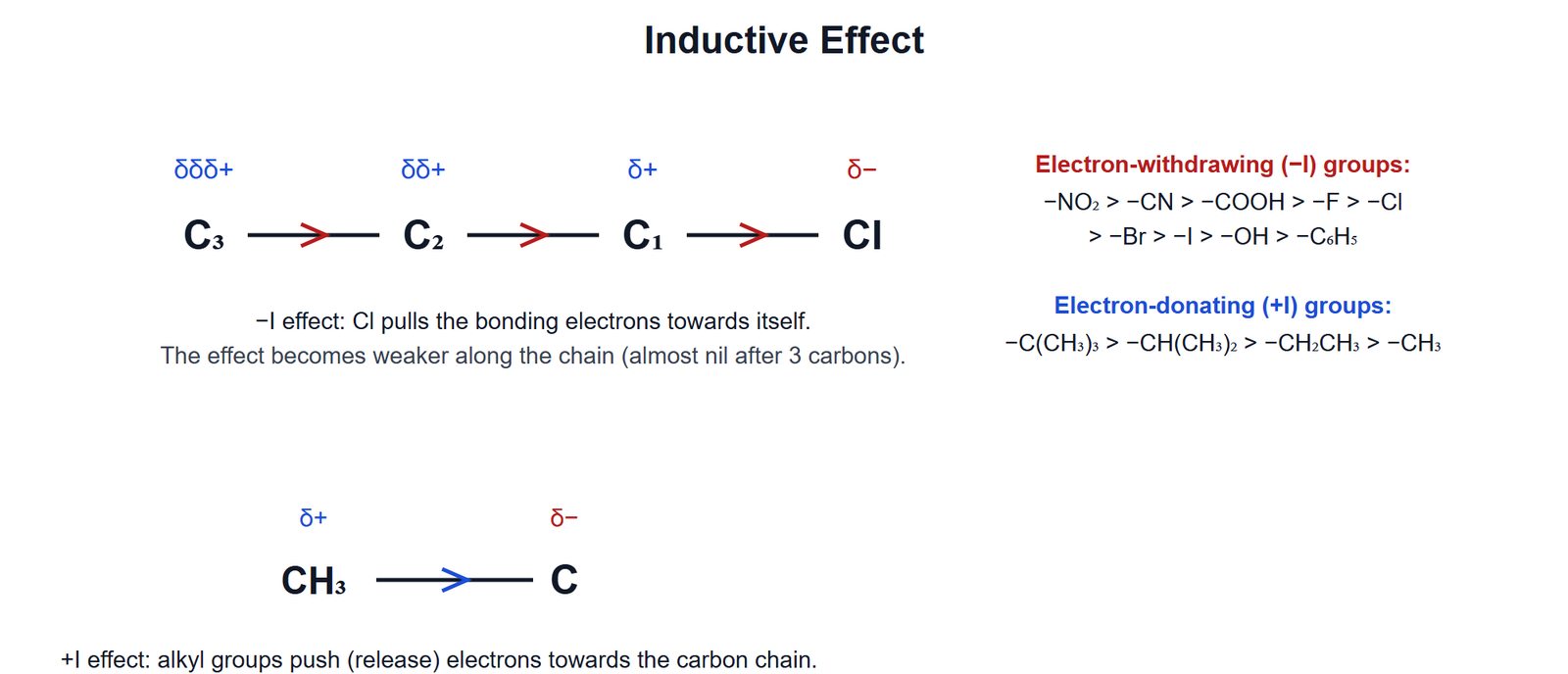
- −I effect: Groups that withdraw electrons. Example: –NO2, –CN, –COOH, –F, –Cl, –Br, –I, –OH.
- +I effect: Groups that release electrons. Example: alkyl groups like –CH3, –C2H5.
- It is a permanent effect and decreases quickly with distance.
Example: Chloroacetic acid (ClCH2COOH) is a stronger acid than acetic acid (CH3COOH), because the −I effect of Cl stabilises the anion formed.
(b) Electromeric effect (E effect): A temporary effect in which the π-electrons of a multiple bond shift completely to one of the bonded atoms when an attacking reagent comes near. It disappears when the reagent is removed.
- +E effect: π-electrons move towards the atom to which the reagent attaches.
- −E effect: π-electrons move away from the atom to which the reagent attaches.
(c) Resonance (mesomeric) effect: The polarity produced in a molecule due to the interaction of π-electrons with lone pairs or with other π bonds (conjugation).
- +R (+M) effect: Groups that donate electrons to the conjugated system. Example: –OH, –OR, –NH2, –Cl, –Br.
- −R (−M) effect: Groups that withdraw electrons from the conjugated system. Example: –NO2, –CHO, >C=O, –COOH, –CN.
(d) Hyperconjugation: The delocalisation of σ-electrons of a C–H bond of an alkyl group directly attached to an unsaturated system or to a carbon with a positive charge (or an unshared p orbital). It is also called no-bond resonance.
Example: The more the number of C–H bonds next to the positive carbon, the more the hyperconjugation and the more stable the carbocation. So (CH3)3C+ (9 C–H bonds) > (CH3)2CH+ (6) > CH3CH2+ (3) > CH3+ (0).
8. Fission of a Covalent Bond: Free Radicals, Carbocations and Carbanions
- Homolytic fission: The bond breaks so that each atom takes one of the shared electrons. Free radicals are formed. It takes place in the presence of light, heat or peroxides.
- Heterolytic fission: The bond breaks so that the shared pair stays with one atom (usually the more electronegative one). Ions are formed.
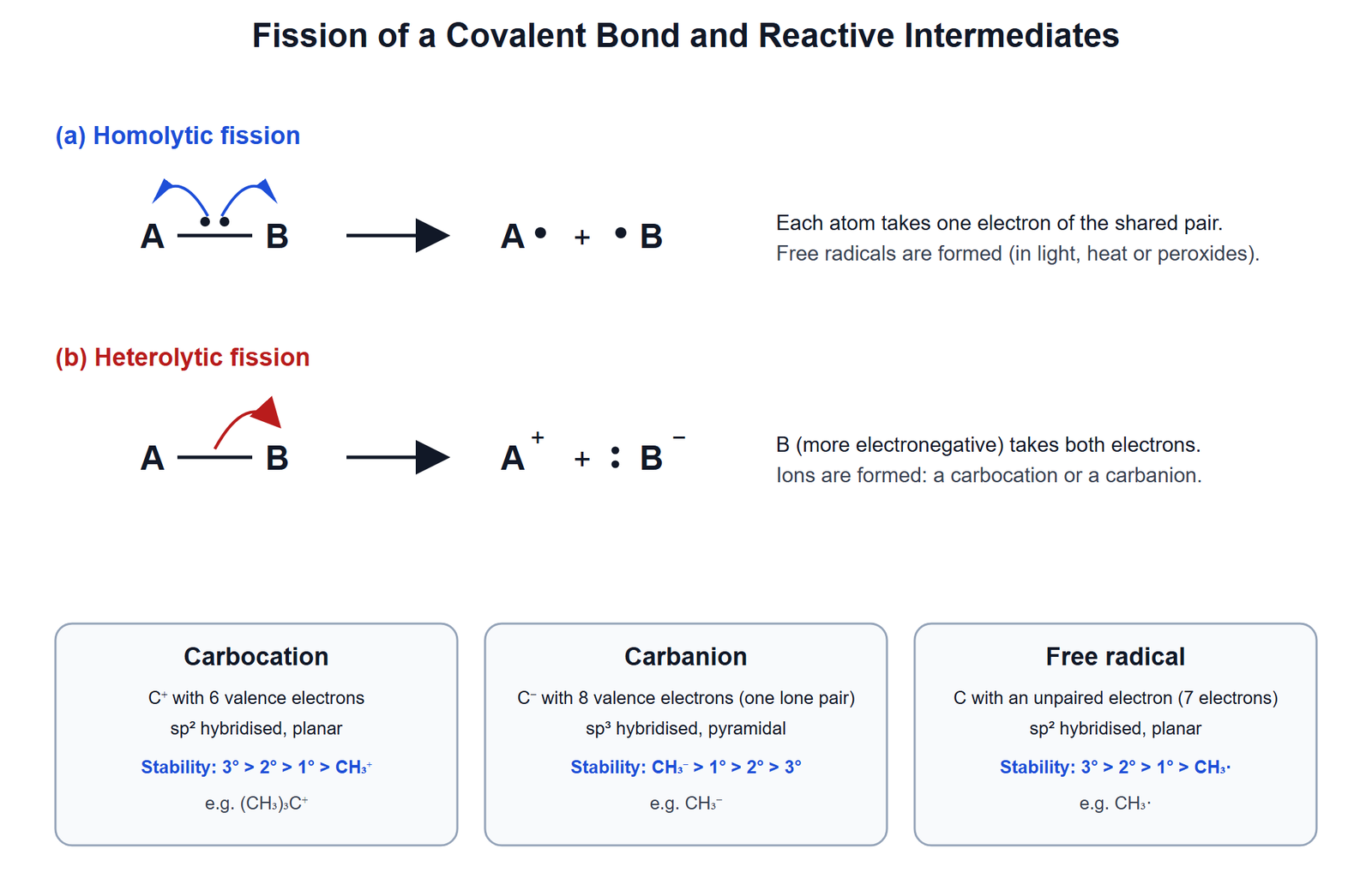
Easy Memory Trick: Homo = same (each atom gets the same, one electron). Hetero = different (one gets both).
9. Electrophiles and Nucleophiles
Electrophile | Nucleophile |
|---|---|
“Electron loving”: attacks electron-rich centres | “Nucleus loving”: attacks electron-deficient centres |
Electron-deficient: positive ions or neutral species with incomplete octet | Electron-rich: negative ions or neutral species with lone pairs |
Acts as a Lewis acid (accepts an electron pair) | Acts as a Lewis base (donates an electron pair) |
Examples: H+, NO2+, Cl+, carbocations (R3C+), BF3, AlCl3 | Examples: OH−, CN−, Cl−, CH3O−, H2O, NH3, R–NH2 |
10. Types of Organic Reactions
- Substitution reaction: An atom or group is replaced by another. Example: CH3Br + OH− → CH3OH + Br−
- Addition reaction: Atoms or groups add to a multiple bond. Example: CH2=CH2 + Br2 → BrCH2–CH2Br
- Elimination reaction: Atoms or groups are removed from adjacent carbon atoms, forming a multiple bond. Example: CH3CH2Br + KOH (alcoholic) → CH2=CH2 + KBr + H2O
- Rearrangement reaction: The atoms of a molecule are rearranged to form a new compound (an isomer).
Conclusion: Organic compounds are classified by their carbon skeleton and functional groups, and named by IUPAC rules. They are purified by methods such as crystallisation, distillation and chromatography, and analysed qualitatively and quantitatively. Electronic effects (inductive, electromeric, resonance and hyperconjugation) and reactive intermediates help us understand how organic reactions take place.