Redox Reactions – Class 11 Chemistry Notes
Chapter – 7
Redox Reactions
1. Classical Concept of Oxidation and Reduction
Oxidation is:
- Addition of oxygen: 2Mg(s) + O2(g) → 2MgO(s)
- Removal of hydrogen: 2H2S(g) + O2(g) → 2S(s) + 2H2O(l) (H2S is oxidised)
- Addition of an electronegative element: Mg(s) + Cl2(g) → MgCl2(s)
- Removal of an electropositive element: 2K4[Fe(CN)6] + H2O2 → 2K3[Fe(CN)6] + 2KOH (removal of K)
Reduction is the opposite:
- Removal of oxygen: CuO(s) + H2(g) → Cu(s) + H2O(l) (CuO is reduced)
- Addition of hydrogen: CH2=CH2(g) + H2(g) → H3C–CH3(g)
- Removal of an electronegative element: 2FeCl3 + H2 → 2FeCl2 + 2HCl
- Addition of an electropositive element: 2HgCl2 + SnCl2 → Hg2Cl2 + SnCl4 (HgCl2 gains Hg)
Important: Oxidation and reduction always take place together. A reaction in which both occur is called a redox reaction.
2. Electronic Concept of Redox Reactions
- Oxidation: Loss of electrons by an atom, ion or molecule. Example: Na → Na+ + e−
- Reduction: Gain of electrons. Example: Cl2 + 2e− → 2Cl−
- Oxidising agent (oxidant): A substance that accepts electrons. It gets reduced itself.
- Reducing agent (reductant): A substance that gives electrons. It gets oxidised itself.
Example: 2Na(s) + Cl2(g) → 2NaCl(s). Each Na loses one electron (oxidation) and Cl2 gains two electrons (reduction). Na is the reducing agent and Cl2 is the oxidising agent.
Easy Memory Trick: OIL RIG: Oxidation Is Loss, Reduction Is Gain (of electrons).
3. Competitive Electron Transfer Reactions
When a strip of zinc is placed in a copper sulphate solution, the blue colour of the solution slowly fades and a reddish deposit of copper forms on the zinc strip.
Zn(s) + Cu2+(aq) → Zn2+(aq) + Cu(s)
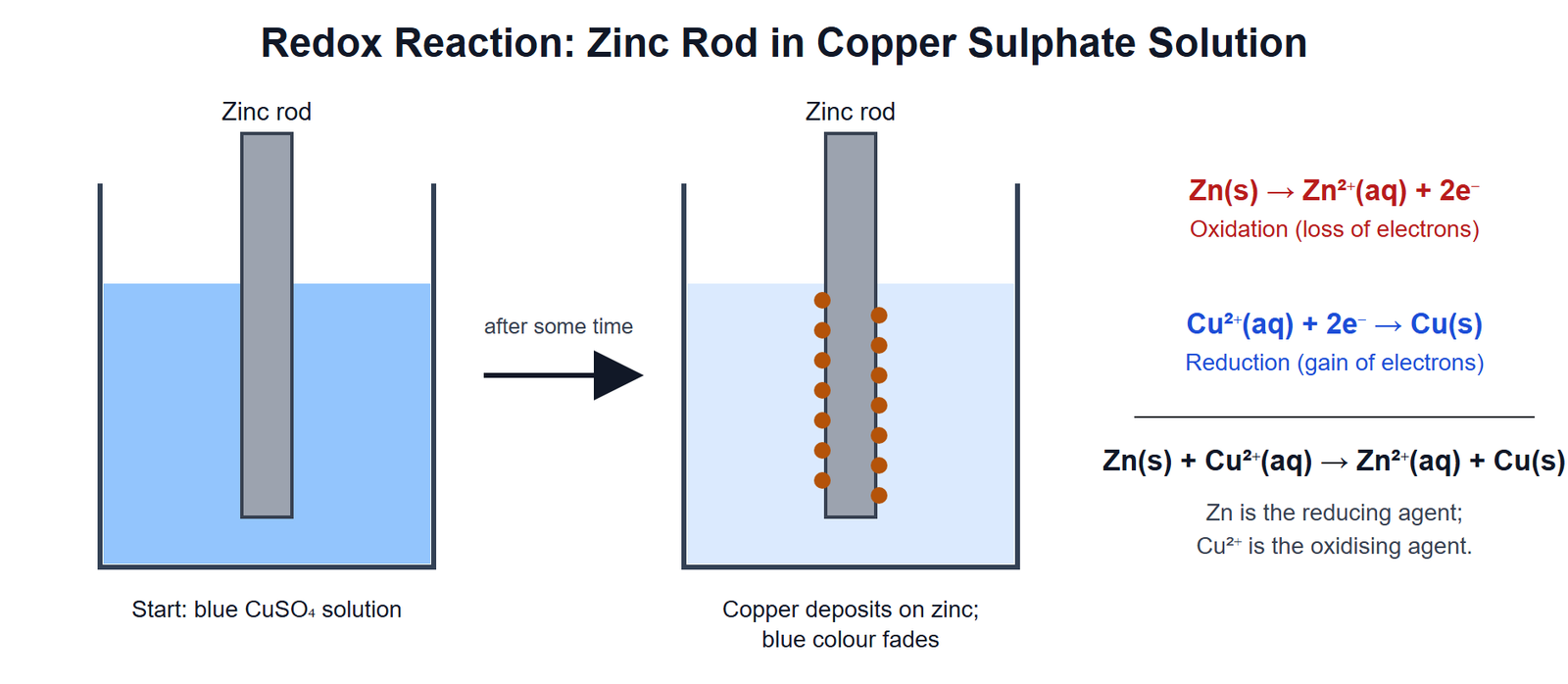
- Zinc loses electrons to Cu2+ ions. Zinc is oxidised and Cu2+ is reduced.
- When copper is placed in silver nitrate solution, copper displaces silver: Cu(s) + 2Ag+(aq) → Cu2+(aq) + 2Ag(s).
- Copper cannot displace zinc from zinc sulphate solution.
Remember: The tendency to release electrons is in the order Zn > Cu > Ag. This order is the basis of the electrochemical series.
4. Oxidation Number
Oxidation number (or oxidation state) is the charge that an atom appears to have in a compound when all its bonds are counted as fully ionic, with the shared electrons given to the more electronegative atom.
Rules for finding oxidation numbers:
- An atom in the free (uncombined) state has oxidation number zero. Example: H2, O2, Na, P4, S8.
- For a simple ion, the oxidation number equals its charge. Example: Na+ = +1, Mg2+ = +2, Cl− = −1.
- Oxygen is usually −2. Exceptions: in peroxides (H2O2, Na2O2) it is −1; in superoxides (KO2) it is −½; in OF2 it is +2.
- Hydrogen is usually +1. In metal hydrides (NaH, CaH2) it is −1.
- Fluorine is always −1. Other halogens are −1 in halides, but can be positive when combined with oxygen.
- Alkali metals are always +1 and alkaline earth metals are always +2 in their compounds.
- The sum of oxidation numbers of all atoms in a neutral compound is zero. In an ion, the sum equals the charge on the ion.
Worked examples:
Compound | Working | Oxidation number |
|---|---|---|
S in H2SO4 | 2(+1) + x + 4(−2) = 0 | +6 |
Mn in KMnO4 | +1 + x + 4(−2) = 0 | +7 |
Cr in K2Cr2O7 | 2(+1) + 2x + 7(−2) = 0 | +6 |
N in NH3 | x + 3(+1) = 0 | −3 |
N in HNO3 | +1 + x + 3(−2) = 0 | +5 |
S in SO42− | x + 4(−2) = −2 | +6 |
Fe in Fe3O4 | 3x + 4(−2) = 0 | +8/3 (average) |
Exam point: A fractional oxidation number (like +8/3 for Fe in Fe3O4) is an average value. Fe3O4 actually contains Fe2+ and Fe3+ in the ratio 1 : 2.
5. Redox Reactions in Terms of Oxidation Number
- Oxidation: Increase in the oxidation number of an element.
- Reduction: Decrease in the oxidation number of an element.
- Oxidising agent: A substance that decreases the oxidation number of another element (it is itself reduced).
- Reducing agent: A substance that increases the oxidation number of another element (it is itself oxidised).
Example: 2Cu2O(s) + Cu2S(s) → 6Cu(s) + SO2(g)
- Cu: +1 (in Cu2O and Cu2S) → 0. Decrease, so copper is reduced.
- S: −2 (in Cu2S) → +4 (in SO2). Increase, so sulphur is oxidised.
- Cu2O is the oxidising agent; Cu2S acts as both oxidising agent (its Cu) and reducing agent (its S).
6. Types of Redox Reactions
- Combination reactions: Two or more substances combine to form one compound, and at least one element changes its oxidation number. Example: C(s) + O2(g) → CO2(g); 3Mg(s) + N2(g) → Mg3N2(s)
- Decomposition reactions: A compound breaks down into two or more substances, at least one of which is an element. Example: 2H2O(l) → 2H2(g) + O2(g); 2KClO3(s) → 2KCl(s) + 3O2(g)
- Displacement reactions: An atom or ion in a compound is replaced by another element.
- Metal displacement: CuSO4(aq) + Zn(s) → Cu(s) + ZnSO4(aq)
- Non-metal displacement: Cl2(g) + 2KBr(aq) → 2KCl(aq) + Br2(l); 2Na(s) + 2H2O(l) → 2NaOH(aq) + H2(g)
- Disproportionation reactions: The same element in one oxidation state is oxidised and reduced at the same time.
- 2H2O2(aq) → 2H2O(l) + O2(g). Oxygen goes from −1 to −2 (in H2O) and to 0 (in O2).
- Cl2(g) + 2OH−(aq) → ClO−(aq) + Cl−(aq) + H2O(l). Chlorine goes from 0 to +1 and to −1.
Remember: For disproportionation, the element must be in an intermediate oxidation state, so that it can go both up and down. F2 cannot disproportionate because fluorine cannot have a positive oxidation state.
7. Balancing Redox Reactions
(a) Oxidation number method
- Write the skeletal equation and find the oxidation numbers of all atoms.
- Identify the atoms whose oxidation numbers change. Find the increase and decrease per formula.
- Multiply by suitable numbers so that the total increase equals the total decrease.
- Balance charges by adding H+ (acidic medium) or OH− (basic medium).
- Balance hydrogen and oxygen by adding H2O molecules.
Example: Balance Cr2O72− + SO32− → Cr3+ + SO42− (acidic medium)
- Cr: +6 → +3, a decrease of 3 per Cr, so 6 for 2 Cr atoms.
- S: +4 → +6, an increase of 2 per S.
- To make increase = decrease, take 3 SO32−: Cr2O72− + 3SO32− → 2Cr3+ + 3SO42−
- Charges: left = −2 + 3(−2) = −8; right = 2(+3) + 3(−2) = 0. Add 8H+ on the left.
- Balance H and O with 4H2O on the right.
Balanced equation: Cr2O72− + 3SO32− + 8H+ → 2Cr3+ + 3SO42− + 4H2O
(b) Half-reaction (ion–electron) method
- Split the reaction into an oxidation half and a reduction half.
- Balance atoms other than O and H in each half.
- Balance O by adding H2O and H by adding H+ (in basic medium, then add OH− to both sides to remove H+).
- Balance charge by adding electrons.
- Multiply the half-reactions so that the electrons lost equal the electrons gained, then add them.
Example: Balance Fe2+ + Cr2O72− → Fe3+ + Cr3+ (acidic medium)
- Oxidation half: Fe2+ → Fe3+ + e−
- Reduction half: Cr2O72− + 14H+ + 6e− → 2Cr3+ + 7H2O
- Multiply the oxidation half by 6 and add.
Balanced equation: Cr2O72− + 6Fe2+ + 14H+ → 2Cr3+ + 6Fe3+ + 7H2O
Check: charge on left = −2 + 12 + 14 = +24; charge on right = 6 + 18 = +24. Balanced.
Example: MnO4− + Fe2+ (acidic medium). Reduction half: MnO4− + 8H+ + 5e− → Mn2+ + 4H2O. Balanced equation: MnO4− + 5Fe2+ + 8H+ → Mn2+ + 5Fe3+ + 4H2O
8. Applications of Redox Reactions
- Redox titrations: Used to find the strength of solutions. In titrations with KMnO4, the permanganate ion itself acts as an indicator (self-indicator): the end point is shown by the first permanent light pink colour. K2Cr2O7 titrations use an external or internal indicator such as diphenylamine.
- Electrochemical cells: A redox reaction can produce electricity when the oxidation and reduction halves take place in separate containers. Example: the Daniell cell.
- Metallurgy: Metals are extracted from their ores by reduction. Example: Fe2O3 + 3CO → 2Fe + 3CO2 in the blast furnace.
- Daily life and nature: Burning of fuels, respiration, photosynthesis, bleaching, rusting of iron and the working of batteries are all redox processes.
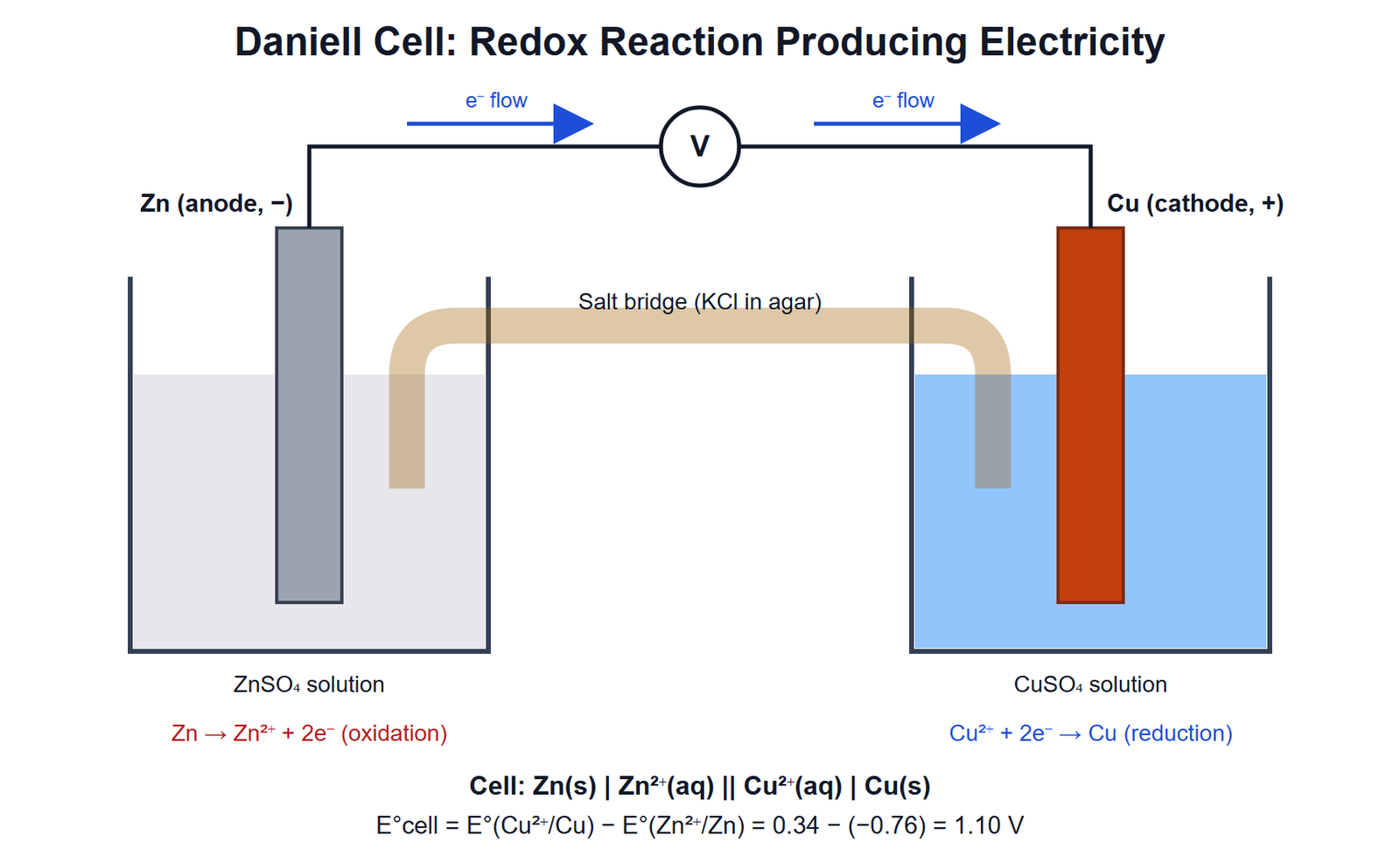
Daniell cell:
- Zinc rod in ZnSO4 solution is the anode (oxidation, negative). Copper rod in CuSO4 solution is the cathode (reduction, positive).
- Electrons flow from zinc to copper through the outer wire. A salt bridge completes the circuit and keeps the solutions electrically neutral.
- With 1 M solutions at 298 K, the cell gives 1.10 V.
Standard electrode potential (E°): The potential of an electrode in contact with a 1 M solution of its ions at 298 K, measured against the standard hydrogen electrode (SHE, E° = 0.00 V). A more negative E° means a stronger reducing agent. Example: E°(Zn2+/Zn) = −0.76 V and E°(Cu2+/Cu) = +0.34 V, so zinc is a stronger reducing agent than copper.
Conclusion: Oxidation is loss of electrons (increase in oxidation number) and reduction is gain of electrons (decrease in oxidation number). Both always occur together in a redox reaction. Redox reactions can be balanced by the oxidation number method or the half-reaction method, and they have wide uses in titrations, cells, metallurgy and daily life.