Equilibrium – Class 11 Chemistry Notes
Chapter – 6
Equilibrium
1. Equilibrium in Physical Processes
Equilibrium is the state of a process in which the observable properties (like temperature, pressure, concentration) do not change with time. At equilibrium, two opposite processes take place at the same rate.
- Solid–liquid equilibrium: Ice and water kept together at 273 K and 1 atm in a perfectly insulated thermos flask. The rate of melting of ice equals the rate of freezing of water. H2O(s) ⇌ H2O(l)
- Liquid–vapour equilibrium: Water in a closed vessel evaporates. Some vapour condenses back. When the rate of evaporation equals the rate of condensation, the pressure of the vapour becomes constant. This is the equilibrium vapour pressure of water. H2O(l) ⇌ H2O(vap)
- Solid–vapour equilibrium: Solid iodine in a closed vessel gives violet vapour. After some time the colour intensity becomes constant. I2(solid) ⇌ I2(vapour)
- Dissolution of solids in liquids: In a saturated sugar solution, the rate of dissolution of sugar equals the rate of crystallisation. Sugar(solid) ⇌ Sugar(solution)
- Dissolution of gases in liquids: In a sealed soda water bottle, CO2(gas) ⇌ CO2(in solution). The amount of gas dissolved depends on its pressure above the liquid (Henry’s law).
Characteristics of physical equilibria:
- Equilibrium is possible only in a closed system at a given temperature.
- Both opposing processes occur at the same rate, so the equilibrium is dynamic but stable.
- All measurable properties of the system remain constant.
2. Equilibrium in Chemical Processes: Dynamic Equilibrium
Many chemical reactions do not go to completion. They are reversible: the products can react to form the reactants again.
Example: H2(g) + I2(g) ⇌ 2HI(g)
At the start, only H2 and I2 are present, so the forward reaction is fast. As HI forms, the backward reaction starts. Its rate increases while the forward rate decreases. Finally both rates become equal. This state is called chemical equilibrium.
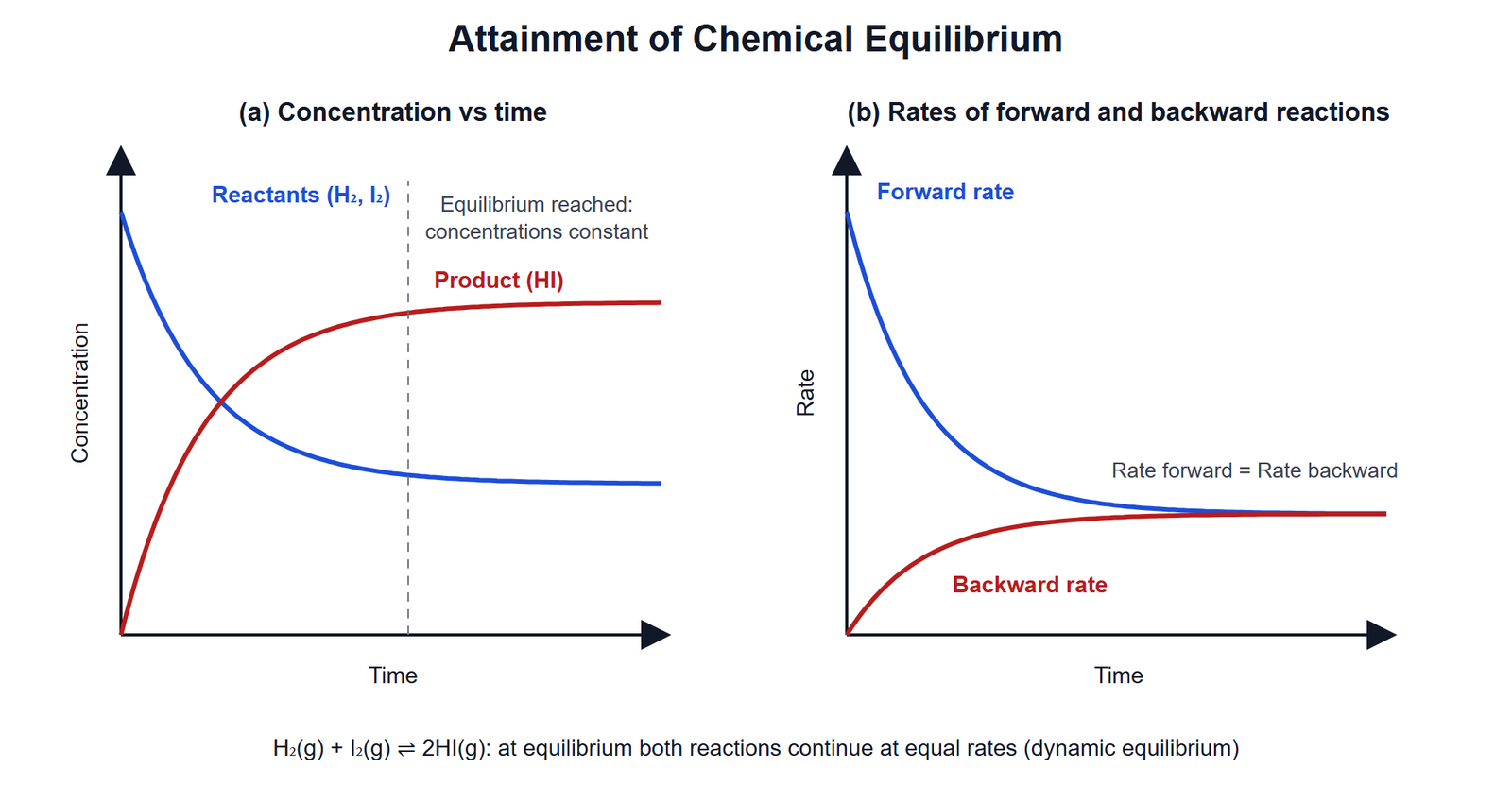
Important: Chemical equilibrium is dynamic. The forward and backward reactions do not stop; they continue at the same rate. This was shown by experiments with radioactive isotopes (for example, adding 14C-labelled species or deuterium to an equilibrium mixture).
Remember: The same equilibrium can be reached from either side, whether we start with reactants or with products.
3. Law of Mass Action and the Equilibrium Constant
Law of mass action (Guldberg and Waage): At a constant temperature, the rate of a chemical reaction is proportional to the product of the molar concentrations of the reactants, each raised to the power of its stoichiometric coefficient.
Law of chemical equilibrium: For a general reaction aA + bB ⇌ cC + dD,
Kc = [C]c[D]d ÷ [A]a[B]b
where square brackets show molar concentrations at equilibrium and Kc is the equilibrium constant. It is constant at a given temperature.
For gases, partial pressures can be used: Kp = (pC)c(pD)d ÷ (pA)a(pB)b
Relation: Kp = Kc(RT)Δn, where Δn = moles of gaseous products − moles of gaseous reactants.
Example: At 500 K, the equilibrium concentrations for N2(g) + 3H2(g) ⇌ 2NH3(g) are [N2] = 1.5 × 10⁻² M, [H2] = 3.0 × 10⁻² M and [NH3] = 1.2 × 10⁻² M. Find Kc.
Kc = [NH3]2 ÷ [N2][H2]3 = (1.2 × 10⁻²)2 ÷ [(1.5 × 10−2) × (3.0 × 10−2)3]
= 1.44 × 10⁻⁴ ÷ (1.5 × 10−2 × 2.7 × 10−5) = 1.44 × 10⁻⁴ ÷ 4.05 × 10−7 = 3.56 × 10²
Properties of the equilibrium constant:
- K depends only on temperature, not on the starting concentrations.
- For the reverse reaction, K’ = 1/K.
- If the equation is multiplied by n, the new constant is Kn.
- Pure solids and pure liquids are not included in the expression (their concentration is constant).
Heterogeneous equilibrium: Reactants and products are in different phases. Example: CaCO3(s) ⇌ CaO(s) + CO2(g); Kp = pCO2
Applications of the equilibrium constant:
- Predicting the extent of reaction: If K > 103, products are favoured (reaction nearly complete). If K < 10−3, reactants are favoured (reaction hardly proceeds). In between, both are present in appreciable amounts.
- Predicting the direction of reaction: Calculate the reaction quotient Qc (same expression as Kc but with concentrations at any moment).
- Qc < Kc: reaction proceeds forward.
- Qc > Kc: reaction proceeds backward.
- Qc = Kc: the mixture is at equilibrium.
- Calculating equilibrium concentrations from initial concentrations and K.
4. Factors Affecting Equilibrium: Le Chatelier’s Principle
Le Chatelier’s principle: If a system at equilibrium is disturbed by a change in concentration, pressure or temperature, the equilibrium shifts in the direction that tends to undo the effect of the change.
Change made | Shift of equilibrium |
|---|---|
Add a reactant / remove a product | Forward (more products) |
Add a product / remove a reactant | Backward (more reactants) |
Increase pressure | Towards fewer moles of gas |
Decrease pressure | Towards more moles of gas |
Increase temperature | In the endothermic direction |
Decrease temperature | In the exothermic direction |
Add a catalyst | No shift; equilibrium is reached faster |
Add an inert gas at constant volume | No shift |
Example: Haber process for ammonia: N2(g) + 3H2(g) ⇌ 2NH3(g); ΔH = −92.38 kJ mol−1
- 4 moles of gas give 2 moles of gas, so high pressure favours NH3.
- The forward reaction is exothermic, so low temperature favours NH3. But at very low temperature the reaction is too slow, so an optimum temperature of about 700 K is used.
- An iron oxide catalyst (with small amounts of K2O and Al2O3) is used to reach equilibrium faster. A pressure of about 200 atm is used.
Exam point: Only a change in temperature changes the value of K. Changes in concentration, pressure or a catalyst do not change K.
5. Ionic Equilibrium: Acids, Bases and Electrolytes
- Strong electrolytes: Ionise almost completely in water. Example: NaCl, HCl, NaOH.
- Weak electrolytes: Ionise only partially. An equilibrium is set up between ions and un-ionised molecules. Example: CH3COOH, NH4OH.
Degree of ionisation (α): The fraction of the total number of molecules that ionise. For strong electrolytes α ≈ 1.
Concepts of acids and bases:
Concept | Acid | Base |
|---|---|---|
Arrhenius | Gives H+ (H3O+) in water | Gives OH− in water |
Brønsted–Lowry | Proton (H+) donor | Proton acceptor |
Lewis | Electron pair acceptor (e.g. BF3, AlCl3) | Electron pair donor (e.g. NH3, OH−) |
Conjugate acid–base pairs: An acid and a base that differ by one proton. Example: In NH3 + H2O ⇌ NH4+ + OH−, the pairs are NH4+/NH3 and H2O/OH−.
Remember: A strong acid has a weak conjugate base, and a weak acid has a strong conjugate base.
6. Ionisation of Water and the pH Scale
Water ionises slightly: H2O + H2O ⇌ H3O+ + OH−
Ionic product of water: Kw = [H3O+][OH−] = 1.0 × 10⁻¹⁴ at 298 K
In pure water, [H3O+] = [OH−] = 1.0 × 10⁻⁷ M.
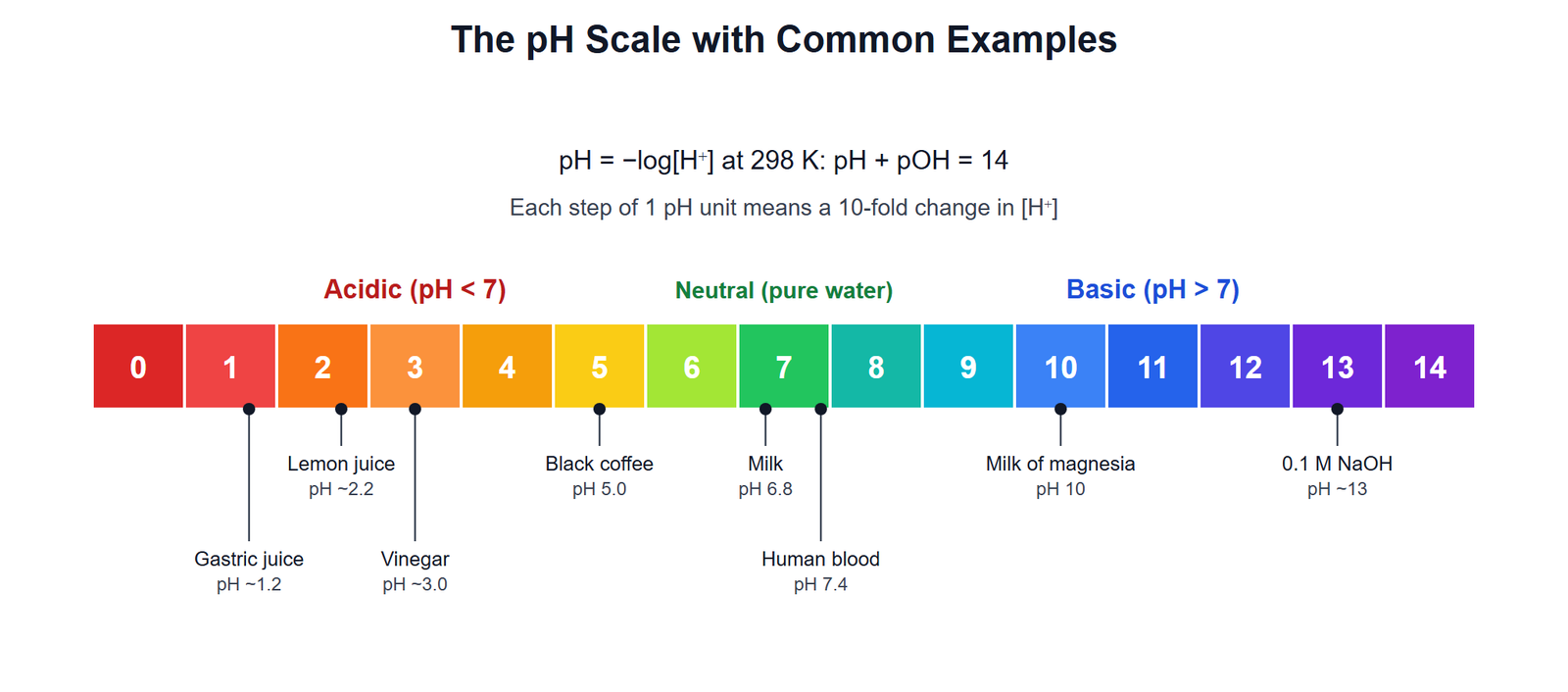
pH: The negative logarithm (base 10) of the hydrogen ion concentration. pH = −log[H+]
pOH = −log[OH−], and at 298 K, pH + pOH = 14
- Acidic solution: pH < 7
- Neutral solution: pH = 7
- Basic solution: pH > 7
Example: Find the pH of 0.001 M HCl. HCl is a strong acid, so [H+] = 1 × 10⁻³ M. pH = −log(10−3) = 3
Example: Find the pH of 0.01 M NaOH. [OH−] = 1 × 10⁻² M, so pOH = 2 and pH = 14 − 2 = 12
Example: The pH of a solution is 5. Find [H+]. [H+] = 10−5 M
7. Ionisation of Weak Acids and Weak Bases
For a weak acid HA of concentration c: HA ⇌ H+ + A−
Ionisation constant Ka = [H+][A−] ÷ [HA] = cα2 ÷ (1 − α)
Since α is very small, 1 − α ≈ 1, so Ka = cα2 and α = √(Ka/c)
[H+] = cα = √(Ka × c)
Example: Find the pH of 0.1 M acetic acid. (Ka = 1.8 × 10⁻⁵)
[H+] = √(1.8 × 10−5 × 0.1) = √(1.8 × 10⁻⁶) = 1.34 × 10⁻³ M
pH = −log(1.34 × 10⁻³) = 2.87
Degree of ionisation α = 1.34 × 10⁻³ ÷ 0.1 = 0.0134 (only 1.34% ionised)
For a weak base BOH: Kb = [B+][OH−] ÷ [BOH], and [OH−] = √(Kb × c)
Relation for a conjugate pair: Ka × Kb = Kw, and pKa + pKb = 14 (at 298 K), where pKa = −log Ka.
Important: The larger the Ka (or the smaller the pKa), the stronger the acid.
8. Polybasic Acids and Acid Strength
Polybasic (polyprotic) acids have more than one ionisable proton per molecule. They ionise in steps, each with its own constant. Example: carbonic acid, H2CO3.
- H2CO3 ⇌ H+ + HCO3−; Ka1
- HCO3− ⇌ H+ + CO32−; Ka2
Always Ka1 > Ka2 > Ka3, because it is harder to remove a positive proton from a negative ion than from a neutral molecule. Other examples: oxalic acid (H2C2O4), sulphuric acid, phosphoric acid (H3PO4).
Factors affecting acid strength (H–A acids):
- Down a group, bond strength decides: The H–A bond becomes weaker as the size of A increases, so acid strength increases. HF < HCl < HBr < HI.
- Across a period, polarity decides: Electronegativity of A increases, so the H–A bond becomes more polar and acid strength increases. CH4 < NH3 < H2O < HF.
9. Hydrolysis of Salts (Elementary Idea)
Salt hydrolysis is the reaction of the cation or anion of a salt with water, which makes the solution acidic or basic.
Salt formed from | Example | Nature of solution | pH |
|---|---|---|---|
Strong acid + strong base | NaCl, KNO3 | Neutral (no hydrolysis) | 7 |
Weak acid + strong base | CH3COONa, Na2CO3 | Basic (anion hydrolyses) | > 7 |
Strong acid + weak base | NH4Cl | Acidic (cation hydrolyses) | < 7 |
Weak acid + weak base | CH3COONH4 | Depends on Ka and Kb | About 7 |
Example: CH3COO− + H2O ⇌ CH3COOH + OH−. The OH− ions make sodium acetate solution basic.
10. Buffer Solutions and the Henderson Equation
A buffer solution resists a change in pH when a small amount of acid or base is added, or when it is diluted.
- Acidic buffer: A weak acid and its salt with a strong base. Example: CH3COOH + CH3COONa (pH about 4.75).
- Basic buffer: A weak base and its salt with a strong acid. Example: NH4OH + NH4Cl (pH about 9.25).
Henderson–Hasselbalch equation:
- For an acidic buffer: pH = pKa + log ([Salt] ÷ [Acid])
- For a basic buffer: pOH = pKb + log ([Salt] ÷ [Base])
Example: Find the pH of a buffer containing 0.1 M CH3COOH and 0.1 M CH3COONa. (pKa = 4.76)
pH = 4.76 + log (0.1 ÷ 0.1) = 4.76 + log 1 = 4.76
Example: Find the pH if the buffer contains 0.2 M CH3COONa and 0.1 M CH3COOH.
pH = 4.76 + log (0.2 ÷ 0.1) = 4.76 + log 2 = 4.76 + 0.30 = 5.06
Remember: When [Salt] = [Acid], pH = pKa. Our blood is a buffer (pH about 7.4), mainly due to H2CO3/HCO3−.
11. Solubility Product (Ksp)
In a saturated solution of a sparingly soluble salt, an equilibrium exists between the undissolved solid and its ions.
Example: AgCl(s) ⇌ Ag+(aq) + Cl−(aq); Ksp = [Ag+][Cl−]
For a salt AxBy with molar solubility S: Ksp = (xS)x (yS)y = xx yy S(x+y)
Salt type | Example | Ksp in terms of S |
|---|---|---|
AB | AgCl, BaSO4 | S2 |
AB2 | CaF2, PbCl2 | 4S3 |
A2B | Ag2CrO4 | 4S3 |
Example: The Ksp of AgCl is 1.8 × 10⁻¹⁰. Find its solubility.
Ksp = S2, so S = √(1.8 × 10⁻¹⁰) = 1.34 × 10⁻⁵ mol L−1
Example: The solubility of CaF2 is 2 × 10⁻⁴ mol L−1. Find its Ksp.
Ksp = 4S3 = 4 × (2 × 10−4)3 = 4 × 8 × 10−12 = 3.2 × 10⁻¹¹
Condition for precipitation: Compare the ionic product (Qsp, the product of ion concentrations at any moment) with Ksp.
- Qsp > Ksp: precipitation occurs.
- Qsp < Ksp: no precipitation; more solid can dissolve.
- Qsp = Ksp: the solution is just saturated.
12. Common Ion Effect
The suppression of the ionisation of a weak electrolyte (or the decrease in solubility of a sparingly soluble salt) by adding a strong electrolyte that has an ion in common with it is called the common ion effect. It follows from Le Chatelier’s principle.
- Acetic acid and sodium acetate: Adding CH3COONa increases [CH3COO−], so the equilibrium CH3COOH ⇌ H+ + CH3COO− shifts back. The ionisation of acetic acid decreases.
- NH4OH and NH4Cl: NH4Cl suppresses the ionisation of NH4OH, so [OH−] is kept low. This is used in group III of qualitative salt analysis to precipitate only Fe3+ and Al3+ hydroxides.
- Purification of common salt: When HCl gas is passed through a saturated NaCl solution, [Cl−] increases and pure NaCl crystallises out.
Example: Find the solubility of AgCl in 0.1 M NaCl. (Ksp of AgCl = 1.8 × 10⁻¹⁰)
[Cl−] ≈ 0.1 M (from NaCl). S = [Ag+] = Ksp ÷ [Cl−] = 1.8 × 10⁻¹⁰ ÷ 0.1 = 1.8 × 10⁻⁹ mol L−1
This is about 7,400 times less than its solubility in pure water (1.34 × 10⁻⁵ mol L−1).
Conclusion: At equilibrium, forward and backward reactions occur at equal rates. The equilibrium constant tells the extent of a reaction, and Le Chatelier’s principle tells how equilibrium shifts when conditions change. In ionic equilibrium, ideas such as pH, Ka, buffers, hydrolysis, solubility product and the common ion effect explain the behaviour of acids, bases and salts in water.