Classification of Elements and Periodicity in Properties – Class 11 Chemistry Notes
Chapter – 3
Classification of Elements and Periodicity in Properties
1. Significance of Classification
More than 100 elements are known today. It is very difficult to study the properties of each element separately. So elements with similar properties are arranged in groups. This arrangement is called classification.
- Easy study: We can study a whole group of elements together instead of each element separately.
- Prediction: Properties of an element can be predicted from its position.
- Relationship: It shows the relationship between the properties of different elements.
- Discovery: It helped in the discovery of new elements.
2. Brief History of the Development of the Periodic Table
(a) Dobereiner’s Triads (1829)
Johann Dobereiner arranged similar elements in groups of three called triads. The atomic mass of the middle element is about the average of the other two.
Triad | Atomic masses | Average of first and third |
|---|---|---|
Li, Na, K | 7, 23, 39 | (7 + 39) ÷ 2 = 23 |
Ca, Sr, Ba | 40, 88, 137 | (40 + 137) ÷ 2 = 88.5 |
Cl, Br, I | 35.5, 80, 127 | (35.5 + 127) ÷ 2 = 81.25 |
Limitation: Only a few triads could be found, so this method was not useful for all elements.
(b) Newlands’ Law of Octaves (1865)
John Newlands arranged elements in increasing order of atomic weights. He noted that every eighth element had properties similar to the first, like the eighth note of a musical scale.
Limitation: It worked well only up to calcium.
(c) Mendeleev’s Periodic Law (1869)
Dmitri Mendeleev stated: “The properties of the elements are a periodic function of their atomic weights.”
He arranged elements in horizontal rows (periods) and vertical columns (groups) in increasing order of atomic weights, so that elements with similar properties fell in the same group. Lothar Meyer independently gave a similar arrangement.
Merits of Mendeleev’s table:
- He left gaps for elements not yet discovered and predicted their properties. Example: eka-aluminium (gallium) and eka-silicon (germanium) were later discovered with properties very close to his predictions.
- He corrected the atomic weights of some elements.
- Where needed, he gave more importance to similarity of properties than to atomic weight. Example: iodine (lower atomic weight) was placed after tellurium so that it fell in the group with fluorine, chlorine and bromine.
Demerits of Mendeleev’s table:
- The position of hydrogen was not fixed.
- Isotopes have different atomic weights but were not given separate places.
- Some elements with higher atomic weights were placed before elements with lower atomic weights (anomalous pairs like Ar and K, Co and Ni, Te and I).
3. Modern Periodic Law and the Present Form of the Periodic Table
In 1913, Henry Moseley showed that the atomic number is a more fundamental property of an element than its atomic mass.
Modern periodic law: The physical and chemical properties of the elements are periodic functions of their atomic numbers.
The periodic repetition of properties is because the outer electronic configuration repeats after regular intervals.
Long form of the periodic table:
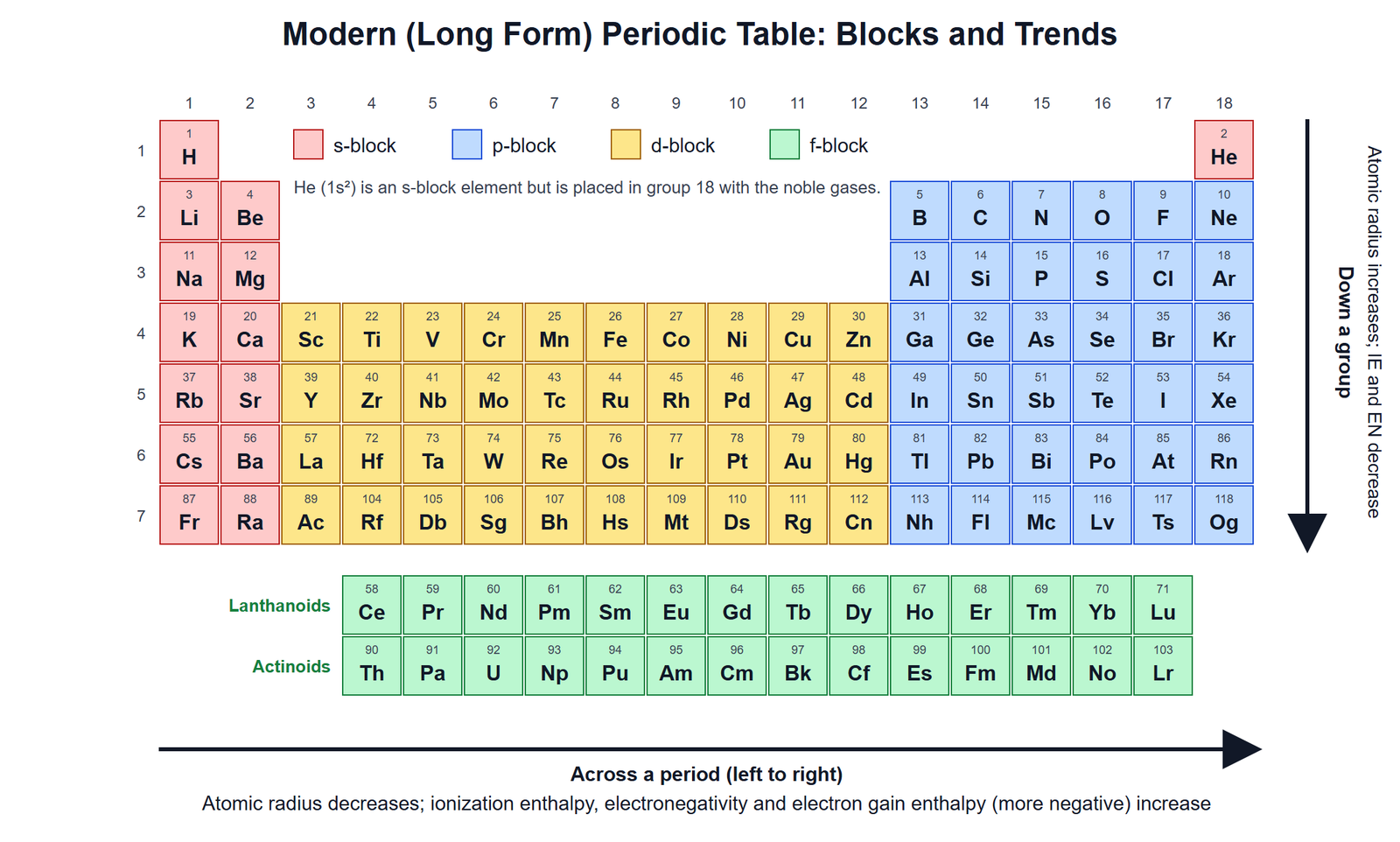
- Groups: There are 18 vertical columns called groups, numbered 1 to 18 (IUPAC). Elements in a group have the same outer electronic configuration.
- Periods: There are 7 horizontal rows called periods. The period number is equal to the highest principal quantum number (n) of the element.
- The 14 elements after lanthanum (lanthanoids, Z = 58 to 71) and after actinium (actinoids, Z = 90 to 103) are placed in two separate rows at the bottom.
Period | Orbitals being filled | Number of elements |
|---|---|---|
1 | 1s | 2 |
2 | 2s, 2p | 8 |
3 | 3s, 3p | 8 |
4 | 4s, 3d, 4p | 18 |
5 | 5s, 4d, 5p | 18 |
6 | 6s, 4f, 5d, 6p | 32 |
7 | 7s, 5f, 6d, 7p | 32 |
4. Electronic Configuration and Types of Elements (Blocks)
Depending on the orbital that receives the last electron, elements are divided into four blocks.
Block | Groups | General outer configuration | Examples |
|---|---|---|---|
s-block | 1 and 2 | ns1 or ns2 | Na, K, Mg, Ca |
p-block | 13 to 18 | ns2np1 to ns2np6 | B, C, N, O, Cl, Ne |
d-block | 3 to 12 | (n−1)d1−10 ns0−2 | Fe, Cu, Zn |
f-block | Separate rows | (n−2)f1−14 (n−1)d0−1 ns2 | Ce, U |
- s-block elements: Reactive metals with low ionization enthalpies. Group 1 are alkali metals and group 2 are alkaline earth metals. They lose electrons easily to form +1 and +2 ions.
- p-block elements: Contain metals, non-metals and metalloids. Group 17 elements are halogens and group 18 elements are noble gases. Noble gases have completely filled valence shells (ns2np6) and are very unreactive. s-block and p-block together are called representative or main group elements.
- d-block elements (transition elements): All are metals. They usually form coloured ions, show variable oxidation states and are often used as catalysts.
- f-block elements (inner transition elements): Lanthanoids and actinoids. All are metals. Most actinoids are radioactive.
Metals, non-metals and metalloids:
- Metals: About 78% of known elements. They are on the left side of the table. Usually solids, good conductors of heat and electricity, malleable and ductile. Mercury is a liquid metal.
- Non-metals: Found at the top right of the table. Usually solids or gases, poor conductors. Bromine is a liquid non-metal.
- Metalloids (semi-metals): Show properties of both metals and non-metals. Example: silicon, germanium, arsenic, antimony, tellurium. They lie along the zig-zag line between metals and non-metals.
Exam point: To find the position of an element: period = highest value of n; group = number of valence electrons for s-block, and 10 + number of valence electrons for p-block. Example: Cl (Z = 17) is [Ne] 3s2 3p5, so period 3 and group 10 + 7 = 17.
5. Nomenclature of Elements with Atomic Number Greater than 100
New elements are sometimes discovered and their names are disputed. Until a permanent name is approved, IUPAC gives a temporary name and a three-letter symbol made directly from the atomic number.
Digit | 0 | 1 | 2 | 3 | 4 | 5 | 6 | 7 | 8 | 9 |
|---|---|---|---|---|---|---|---|---|---|---|
Root | nil | un | bi | tri | quad | pent | hex | sept | oct | enn |
Abbreviation | n | u | b | t | q | p | h | s | o | e |
Rule: Write the roots of the digits in order and add “ium” at the end. The symbol is made from the first letters of the roots.
Atomic number | IUPAC temporary name | Symbol | Official name |
|---|---|---|---|
101 | Unnilunium | Unu | Mendelevium (Md) |
104 | Unnilquadium | Unq | Rutherfordium (Rf) |
109 | Unnilennium | Une | Meitnerium (Mt) |
110 | Ununnilium | Uun | Darmstadtium (Ds) |
118 | Ununoctium | Uuo | Oganesson (Og) |
120 | Unbinilium | Ubn | Not yet discovered |
Remember: In “bi” + “ium” and “tri” + “ium”, the extra “i” is dropped (bium, trium). In “enn” + “nil”, one “n” is dropped (ennil).
6. Periodic Trends: Atomic Radius
The size of an atom is measured as its atomic radius, the distance from the centre of the nucleus to the outermost shell.
- Covalent radius: Half of the distance between the nuclei of two atoms joined by a single covalent bond. Example: the Cl–Cl bond length is 198 pm, so the covalent radius of chlorine is 99 pm.
- Metallic radius: Half of the distance between the nuclei of two neighbouring atoms in a metal. Example: the distance between two Cu atoms is 256 pm, so the metallic radius of copper is 128 pm.
Trends:
- Across a period (left to right): Atomic radius decreases. Electrons are added to the same shell, but the nuclear charge increases. The electrons are pulled closer to the nucleus.
- Down a group: Atomic radius increases. A new shell is added at each step, so the outer electrons are farther from the nucleus. Inner electrons also shield (screen) the outer electrons from the nucleus.
Period 2 atom | Li | Be | B | C | N | O | F |
|---|---|---|---|---|---|---|---|
Radius (pm) | 152 | 111 | 88 | 77 | 74 | 66 | 64 |
Group 1 atom | Li | Na | K | Rb | Cs |
|---|---|---|---|---|---|
Radius (pm) | 152 | 186 | 231 | 244 | 262 |
7. Ionic Radius and Inert Gas Radius
Ionic radius: The size of an ion.
- Cation (positive ion): Always smaller than its parent atom. It has fewer electrons, but the same nuclear charge, so the electrons are pulled in more strongly. Example: Na is 186 pm and Na+ is 95 pm.
- Anion (negative ion): Always larger than its parent atom. Adding electrons increases electron repulsion and lowers the effective nuclear charge per electron. Example: F is 64 pm and F− is 136 pm.
Isoelectronic species: Atoms or ions with the same number of electrons. Example: O2−, F−, Ne, Na+ and Mg2+ all have 10 electrons. Among isoelectronic ions, the one with the greater nuclear charge (more protons) is smaller.
Size order: O2− > F− > Na+ > Mg2+ (nuclear charges +8, +9, +11, +12)
Inert gas (noble gas) radius: Noble gases do not form covalent bonds easily, so their size is measured as the van der Waals radius. The van der Waals radius is half the distance between the nuclei of two neighbouring non-bonded atoms. It is larger than a covalent radius, so noble gases appear larger than the halogens just before them.
8. Ionization Enthalpy
Ionization enthalpy (ΔiH) is the energy required to remove the most loosely bound electron from an isolated gaseous atom in its ground state.
X(g) → X+(g) + e−
Unit: kJ mol−1. The second ionization enthalpy is always higher than the first, because it is harder to remove an electron from a positive ion. ΔiH1 < ΔiH2 < ΔiH3
Factors affecting ionization enthalpy: size of atom, nuclear charge, shielding effect of inner electrons, and stability of the electronic configuration (half-filled and fully filled are more stable).
Trends:
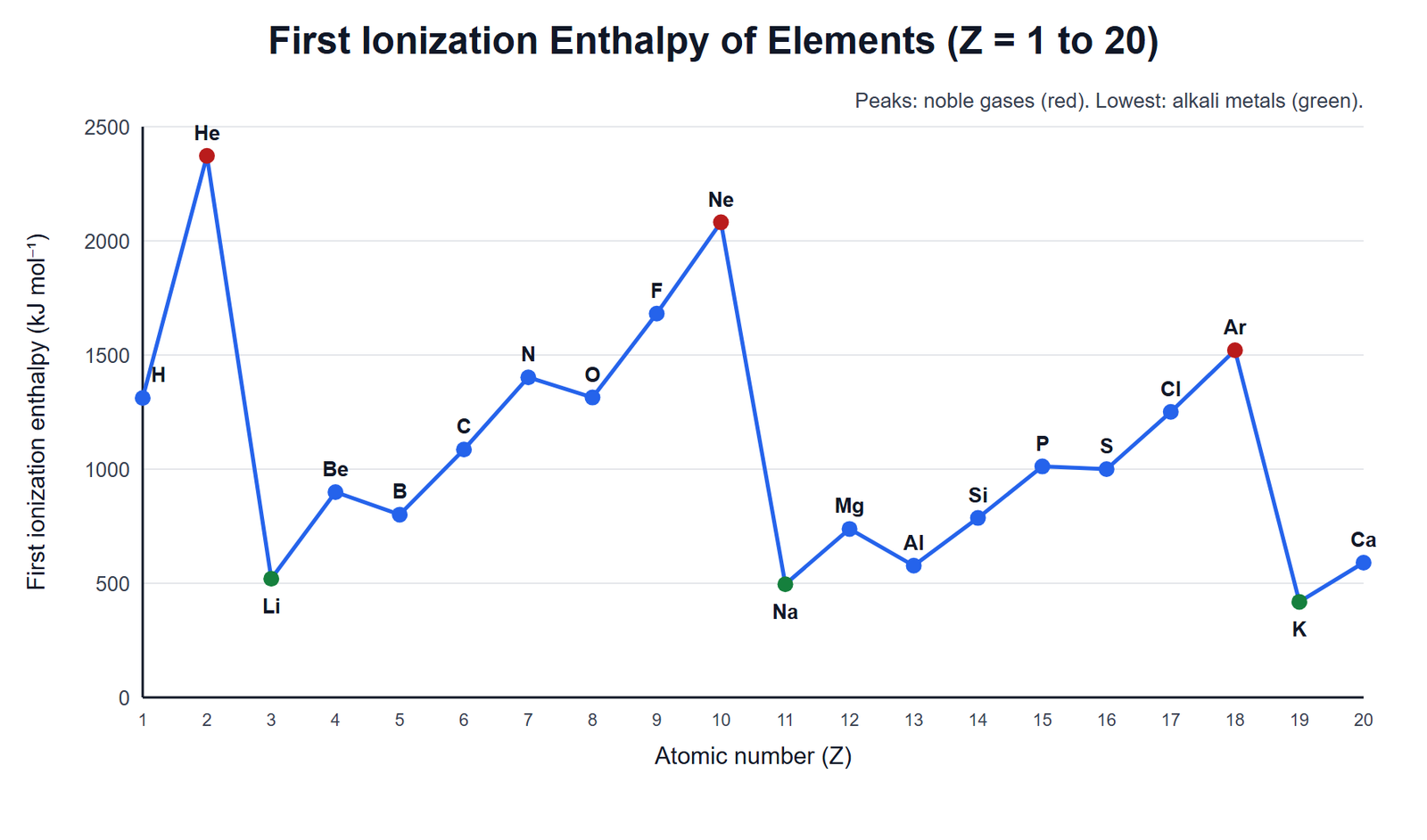
- Across a period: Generally increases, because nuclear charge increases and size decreases.
- Down a group: Decreases, because size and shielding increase, so outer electrons are held less tightly.
Exceptions in period 2:
- Be (899) > B (801): In boron the electron is removed from 2p, which is higher in energy and better shielded than the 2s electron of beryllium.
- N (1402) > O (1314): Nitrogen has a stable half-filled 2p3 configuration. In oxygen (2p4), two electrons share one orbital and repel each other, so one is removed more easily.
Remember: Noble gases have the highest ionization enthalpy in each period and alkali metals have the lowest.
9. Electron Gain Enthalpy
Electron gain enthalpy (ΔegH) is the enthalpy change when an electron is added to an isolated gaseous atom to form a negative ion.
X(g) + e− → X−(g)
- When energy is released, ΔegH is negative. Halogens have very negative values because they need only one electron to get a noble gas configuration.
- Noble gases have large positive values because the electron must enter a new, higher shell.
Trends:
- Across a period: Becomes more negative, because nuclear charge increases and size decreases.
- Down a group: Becomes less negative, because size increases.
Important: Chlorine has the most negative electron gain enthalpy (−349 kJ mol−1), more negative than fluorine (−328 kJ mol−1). Fluorine is very small, so the added electron faces strong repulsion from the electrons already present in its compact 2p sub-shell.
Exam point: The second electron gain enthalpy of oxygen (O− + e− → O2−) is positive, because the incoming electron is repelled by the negative ion.
10. Electronegativity
Electronegativity is the tendency of an atom in a chemical compound to attract the shared pair of electrons towards itself.
- It is not a measurable energy, so it has no unit. Linus Pauling gave the most common scale.
- Fluorine is the most electronegative element (4.0 on the Pauling scale), followed by oxygen (3.5).
Trends: Electronegativity increases across a period and decreases down a group.
Basis | Electron gain enthalpy | Electronegativity |
|---|---|---|
Refers to | An isolated gaseous atom | An atom in a bonded state |
Unit | kJ mol−1 | No unit |
Nature | Measurable energy | A relative tendency |
Remember: Higher electronegativity means more non-metallic character. Metallic character decreases across a period and increases down a group.
11. Valency
Valency is the combining capacity of an element. For representative elements, it is usually equal to the number of valence electrons, or 8 minus the number of valence electrons.
Group | 1 | 2 | 13 | 14 | 15 | 16 | 17 | 18 |
|---|---|---|---|---|---|---|---|---|
Valence electrons | 1 | 2 | 3 | 4 | 5 | 6 | 7 | 8 |
Valency | 1 | 2 | 3 | 4 | 3, 5 | 2, 6 | 1, 7 | 0, 8 |
Example hydride | LiH | CaH2 | B2H6 | CH4 | NH3 | H2O | HF | – |
Valency also changes periodically. Across period 3, the formulas of oxides are Na2O, MgO, Al2O3, SiO2, P4O10, SO3 and Cl2O7. Oxides on the left are basic (Na2O), Al2O3 is amphoteric, and oxides on the right are acidic (Cl2O7).
Example: Predict the formula of the compound formed by aluminium and oxygen. Al has valency 3 and O has valency 2, so the formula is Al2O3.
Easy Memory Trick: Across a period, size goes down and everything else (IE, EN, electron gain enthalpy) goes up. Down a group it is the opposite.
Conclusion: The modern periodic table arranges elements by atomic number, so elements with similar outer electronic configurations fall in the same group. This explains the periodic trends in atomic and ionic radii, ionization enthalpy, electron gain enthalpy, electronegativity and valency.