Structure of Atom – Class 11 Chemistry Notes
Chapter – 2
Structure of Atom
1. Discovery of Sub-atomic Particles
Dalton believed that the atom is indivisible. Experiments in the late 19th and early 20th century showed that atoms are made of smaller particles called sub-atomic particles: electrons, protons and neutrons.
(a) Discovery of electron: Cathode ray discharge tube
When a high voltage is applied across two electrodes in a glass tube containing gas at very low pressure, a stream of particles moves from the cathode (−) to the anode (+). These are called cathode rays.
- Cathode rays travel in straight lines from cathode to anode.
- They are not visible themselves, but they make certain materials (like zinc sulphide) glow.
- They are deflected towards the positive plate in an electric field, so they carry negative charge.
- Their properties do not depend on the material of the electrodes or the gas in the tube.
These negatively charged particles were named electrons.
- J.J. Thomson (1897) measured the charge to mass ratio of the electron: e/me = 1.758820 × 10¹¹ C kg−1
- R.A. Millikan (oil drop experiment, 1909) found the charge on the electron: e = −1.602 × 10⁻¹⁹ C
- Mass of electron: me = 9.1094 × 10⁻³¹ kg
(b) Discovery of proton: Canal rays
Goldstein, using a modified discharge tube with a perforated cathode, observed rays moving in the opposite direction to cathode rays. These positively charged rays are called canal rays (anode rays). The smallest positive particle, obtained from hydrogen gas, was named the proton.
(c) Discovery of neutron
James Chadwick (1932) bombarded a thin sheet of beryllium with α-particles and found electrically neutral particles with mass slightly more than that of the proton. These were named neutrons.
Particle | Symbol | Charge (C) | Relative charge | Mass (kg) | Mass (u) |
|---|---|---|---|---|---|
Electron | e | −1.602 × 10⁻¹⁹ | −1 | 9.109 × 10⁻³¹ | 0.00054 |
Proton | p | +1.602 × 10⁻¹⁹ | +1 | 1.6726 × 10⁻²⁷ | 1.00727 |
Neutron | n | 0 | 0 | 1.6749 × 10⁻²⁷ | 1.00867 |
Remember: The mass of a proton is about 1836 times the mass of an electron.
2. Atomic Number, Mass Number, Isotopes and Isobars
- Atomic number (Z): Number of protons in the nucleus. In a neutral atom it is also equal to the number of electrons.
- Mass number (A): Total number of protons and neutrons (nucleons) in the nucleus. A = Z + n, so number of neutrons = A − Z.
An atom is written as AZX. Example: 3517Cl has 17 protons, 17 electrons and 35 − 17 = 18 neutrons.
- Isotopes: Atoms of the same element having the same atomic number but different mass numbers. They differ only in the number of neutrons.
- Hydrogen: protium 11H (0 neutrons), deuterium 21H (1 neutron), tritium 31H (2 neutrons)
- Carbon: 126C, 136C, 146C
- Isobars: Atoms of different elements having the same mass number but different atomic numbers. Example: 146C and 147N; 4018Ar, 4019K and 4020Ca.
Basis | Isotopes | Isobars |
|---|---|---|
Atomic number | Same | Different |
Mass number | Different | Same |
Element | Same element | Different elements |
Chemical properties | Same | Different |
Example | 1H, 2H, 3H | 14C, 14N |
Important: Chemical properties depend on the number of electrons, so all isotopes of an element show the same chemical properties.
3. Thomson’s Model of Atom and its Limitations
J.J. Thomson (1898) proposed that an atom is a sphere of radius about 10−10 m in which the positive charge is spread uniformly. Electrons are embedded in it like seeds in a watermelon. This is also called the plum pudding model or raisin pudding model.
Limitations:
- It could not explain the results of Rutherford’s α-particle scattering experiment.
- It could not explain the stability of the atom or the arrangement of electrons.
4. Rutherford’s Nuclear Model and its Limitations
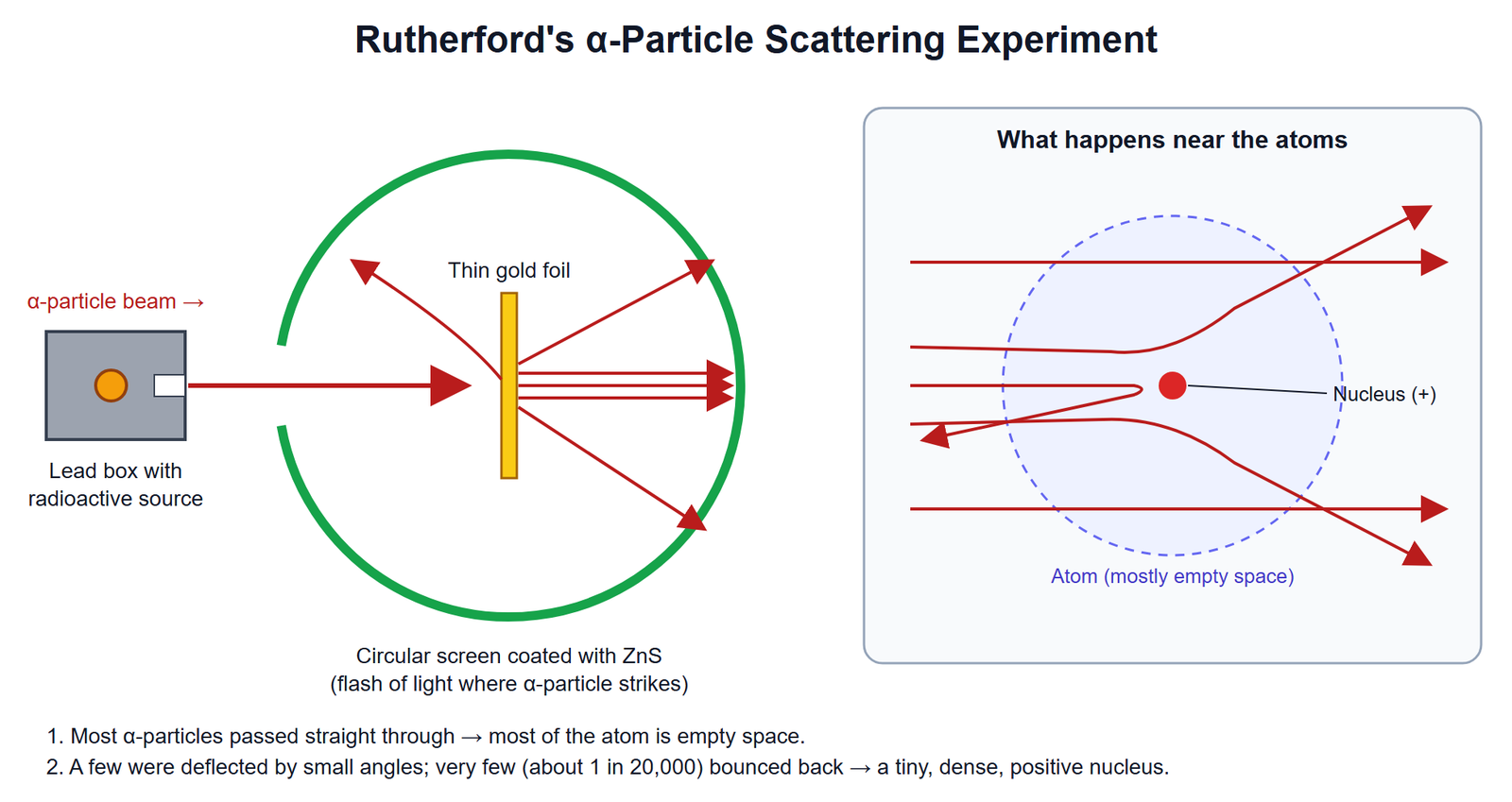
Rutherford and his students bombarded a very thin gold foil (about 100 nm thick) with fast moving α-particles (He2+). A circular screen coated with zinc sulphide was placed around the foil. A flash of light appeared wherever an α-particle hit the screen.
Observations and conclusions:
Observation | Conclusion |
|---|---|
Most α-particles passed through the foil undeflected | Most of the space in an atom is empty |
A small fraction was deflected by small angles | The positive charge is concentrated in a very small region |
Very few (about 1 in 20,000) bounced back | The nucleus is very small, heavy and positively charged |
Rutherford’s model:
- The positive charge and most of the mass of the atom are concentrated in a very small region called the nucleus.
- The radius of the nucleus is about 10−15 m, while the radius of the atom is about 10−10 m.
- Electrons move around the nucleus in circular paths called orbits, like planets around the sun.
- Electrons and the nucleus are held together by electrostatic forces of attraction.
Limitations:
- According to electromagnetic theory, a charged particle moving in a circular path is accelerated and must radiate energy. The electron would lose energy and spiral into the nucleus. So the model cannot explain the stability of the atom.
- It says nothing about the distribution of electrons around the nucleus or their energies.
5. Developments Leading to Bohr’s Model
(a) Wave nature of electromagnetic radiation
Light and other radiations travel as waves with electric and magnetic fields at right angles to each other. All electromagnetic waves travel in vacuum with the speed of light, c = 3.0 × 10⁸ m s−1.
- Wavelength (λ): Distance between two successive crests.
- Frequency (ν): Number of waves passing a point in one second. Unit: hertz (Hz = s−1).
- Wave number (ν̄): Number of wavelengths per unit length, ν̄ = 1/λ.
c = νλ
Example: Find the frequency of yellow light of wavelength 580 nm.
ν = c/λ = 3.0 × 10⁸ ÷ 580 × 10−9 = 5.17 × 10¹⁴ Hz
(b) Planck’s quantum theory (1900)
Radiant energy is emitted or absorbed not continuously but in small packets called quanta. A quantum of light is called a photon.
E = hν, where h = Planck’s constant = 6.626 × 10⁻³⁴ J s
(c) Photoelectric effect
When light of suitable frequency falls on the surface of metals like potassium, rubidium and caesium, electrons are ejected. This is the photoelectric effect.
- Electrons are ejected only if the frequency of light is more than a minimum value called the threshold frequency (ν0).
- The number of electrons ejected depends on the intensity (brightness) of light.
- The kinetic energy of ejected electrons depends on the frequency of light, not on its intensity.
Einstein explained it with Planck’s theory: hν = hν0 + ½ mev2
(d) Atomic spectra and the hydrogen spectrum
When an element is heated or excited, it emits light of only certain wavelengths. This gives a line spectrum with bright lines on a dark background (emission spectrum). Each element has its own unique line spectrum, like a fingerprint.
The wave numbers of all lines in the hydrogen spectrum are given by the Rydberg formula:
ν̄ = 109,677 (1/n12 − 1/n22) cm−1, where n2 > n1
Series | n1 | n2 | Spectral region |
|---|---|---|---|
Lyman | 1 | 2, 3, 4, … | Ultraviolet |
Balmer | 2 | 3, 4, 5, … | Visible |
Paschen | 3 | 4, 5, 6, … | Infrared |
Brackett | 4 | 5, 6, 7, … | Infrared |
Pfund | 5 | 6, 7, 8, … | Infrared |
Easy Memory Trick: “Lazy Boys Play Basket ball Properly” for Lyman, Balmer, Paschen, Brackett, Pfund (n1 = 1 to 5).
6. Bohr’s Model for Hydrogen Atom and its Limitations
Niels Bohr (1913) gave a model of the hydrogen atom. Its postulates are:
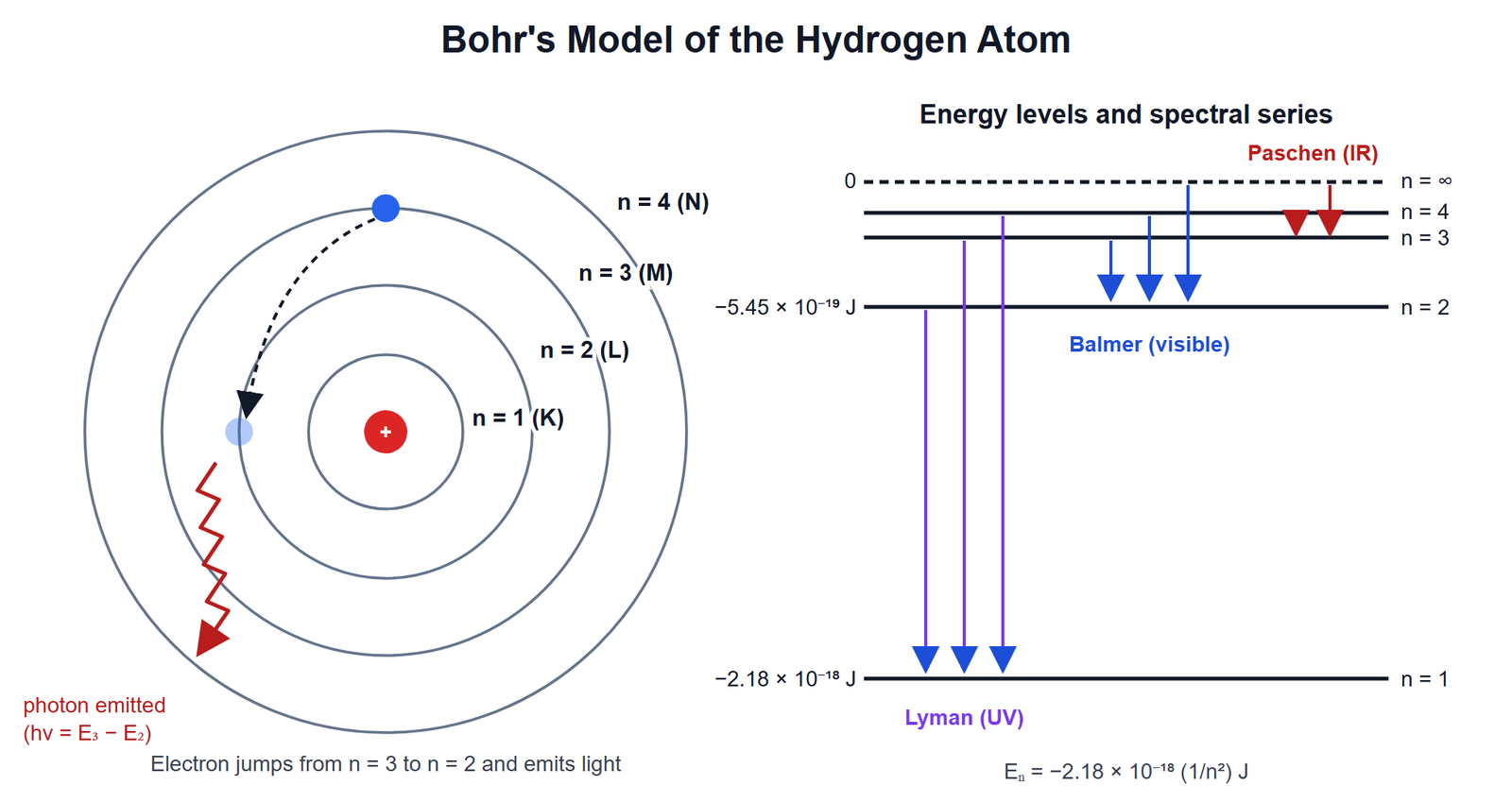
- The electron moves around the nucleus in fixed circular paths called orbits, stationary states or energy levels. These are numbered n = 1, 2, 3, … (or K, L, M, N, …).
- The energy of an electron in an orbit does not change with time. While moving in a fixed orbit, it neither absorbs nor emits energy.
- Energy is absorbed when the electron jumps from a lower orbit to a higher orbit, and emitted when it falls back. The frequency of the radiation is given by ν = ΔE/h = (E2 − E1)/h.
- The angular momentum of the electron is quantised: mevr = nh/2π. So only certain orbits are allowed.
Important results of Bohr’s theory:
- Radius of the nth orbit: rn = 52.9 × n2/Z pm. For hydrogen, the first orbit (Bohr radius) is 52.9 pm.
- Energy of the electron in the nth orbit: En = −2.18 × 10⁻¹⁸ (Z2/n2) J
- The negative sign means the electron is bound to the nucleus. Its energy is lower than that of a free electron (E = 0 at n = ∞).
- Energy absorbed or emitted: ΔE = 2.18 × 10⁻¹⁸ (1/ni2 − 1/nf2) J
Example: What is the wavelength of light emitted when the electron in a hydrogen atom falls from n = 5 to n = 2?
ΔE = 2.18 × 10−18 × (1/22 − 1/52) = 2.18 × 10−18 × (0.25 − 0.04) = 4.58 × 10⁻¹⁹ J
ν = ΔE/h = 4.58 × 10⁻¹⁹ ÷ 6.626 × 10−34 = 6.91 × 10¹⁴ Hz
λ = c/ν = 3.0 × 10⁸ ÷ 6.91 × 1014 = 4.34 × 10⁻⁷ m = 434 nm (blue light, Balmer series)
Exam point: The energy needed to remove the electron from a hydrogen atom in its ground state (ionization energy) is 2.18 × 10⁻¹⁸ J per atom, which is 1312 kJ mol−1.
Limitations of Bohr’s model:
- It could not explain the spectra of atoms with more than one electron (like helium and lithium).
- It could not explain the fine structure of the hydrogen spectrum (very close doublets seen in better spectroscopes).
- It could not explain the splitting of spectral lines in a magnetic field (Zeeman effect) or in an electric field (Stark effect).
- It could not explain how atoms combine to form molecules.
- It ignores the dual nature of the electron and the uncertainty principle.
7. Dual Nature of Matter and Light: de Broglie’s Relationship
Light shows both wave-like properties (interference, diffraction) and particle-like properties (photoelectric effect). This is called the dual nature of light.
In 1924, de Broglie proposed that matter, like light, also has dual behaviour. Every moving particle has a wave associated with it.
λ = h/mv = h/p, where m = mass, v = velocity and p = momentum
Example: Find the wavelength of an electron (mass 9.1 × 10⁻³¹ kg) moving with a velocity of 2.19 × 10⁶ m s−1.
λ = 6.626 × 10⁻³⁴ ÷ (9.1 × 10−31 × 2.19 × 106) = 3.32 × 10⁻¹⁰ m = 332 pm
Example: Find the wavelength of a ball of mass 0.1 kg moving with a velocity of 10 m s−1.
λ = 6.626 × 10⁻³⁴ ÷ (0.1 × 10) = 6.626 × 10⁻³⁴ m
Remember: The wavelength of large objects is too small to be detected. Wave nature is important only for very small particles like electrons. Electron diffraction (used in the electron microscope) proves the wave nature of electrons.
8. Heisenberg’s Uncertainty Principle
Werner Heisenberg (1927) stated that it is impossible to determine simultaneously the exact position and exact momentum (or velocity) of an electron.
Δx × Δp ≥ h/4π or Δx × m Δv ≥ h/4π
where Δx = uncertainty in position and Δp = uncertainty in momentum.
Example: An electron is located within a distance of 0.1 Å (1 × 10⁻¹¹ m). Find the uncertainty in its velocity.
Δv = h ÷ (4π m Δx) = 6.626 × 10⁻³⁴ ÷ (4 × 3.14 × 9.11 × 10−31 × 1 × 10−11) = 5.79 × 10⁶ m s−1
Important: The uncertainty principle rules out the existence of fixed paths (orbits) for electrons, as proposed by Bohr. We can only talk about the probability of finding an electron in a region of space.
9. Concept of Orbitals and the Quantum Mechanical Model
Erwin Schrödinger (1926) gave an equation (the Schrödinger wave equation) that describes the electron as a wave. Its solution is the wave function, ψ (psi).
- ψ itself has no physical meaning.
- ψ2 gives the probability of finding the electron at a point.
- Atomic orbital: The three-dimensional region around the nucleus where the probability of finding an electron is maximum.
Orbit | Orbital |
|---|---|
A definite circular path around the nucleus | A 3-D region of maximum probability of finding the electron |
Two-dimensional | Three-dimensional |
Can hold up to 2n2 electrons | Can hold a maximum of 2 electrons |
Not in agreement with the uncertainty principle | In agreement with the uncertainty principle |
10. Quantum Numbers
Quantum numbers are a set of four numbers that give the complete address of an electron in an atom.
- Principal quantum number (n): Gives the shell. It decides the size and energy of the orbital. n = 1, 2, 3, 4, … (K, L, M, N, …). Number of orbitals in a shell = n2, maximum electrons = 2n2.
- Azimuthal quantum number (l): Gives the sub-shell and the shape of the orbital. For a given n, l = 0 to (n − 1). l = 0, 1, 2, 3 stand for s, p, d, f sub-shells.
- Magnetic quantum number (ml): Gives the orientation of the orbital in space. ml = −l to +l, including 0. So a sub-shell has (2l + 1) orbitals.
- Spin quantum number (ms): Gives the direction of spin of the electron. ms = +½ (clockwise, ↑) or −½ (anticlockwise, ↓).
Sub-shell | l | ml values | Number of orbitals | Maximum electrons |
|---|---|---|---|---|
s | 0 | 0 | 1 | 2 |
p | 1 | −1, 0, +1 | 3 | 6 |
d | 2 | −2, −1, 0, +1, +2 | 5 | 10 |
f | 3 | −3 to +3 | 7 | 14 |
Example: Write the quantum numbers n and l for 3d and 4f orbitals.
- 3d: n = 3, l = 2
- 4f: n = 4, l = 3
Remember: A sub-shell is named by n and its letter. 2p means n = 2 and l = 1. There is no 1p or 2d orbital, because l must be less than n.
11. Shapes of s, p and d Orbitals
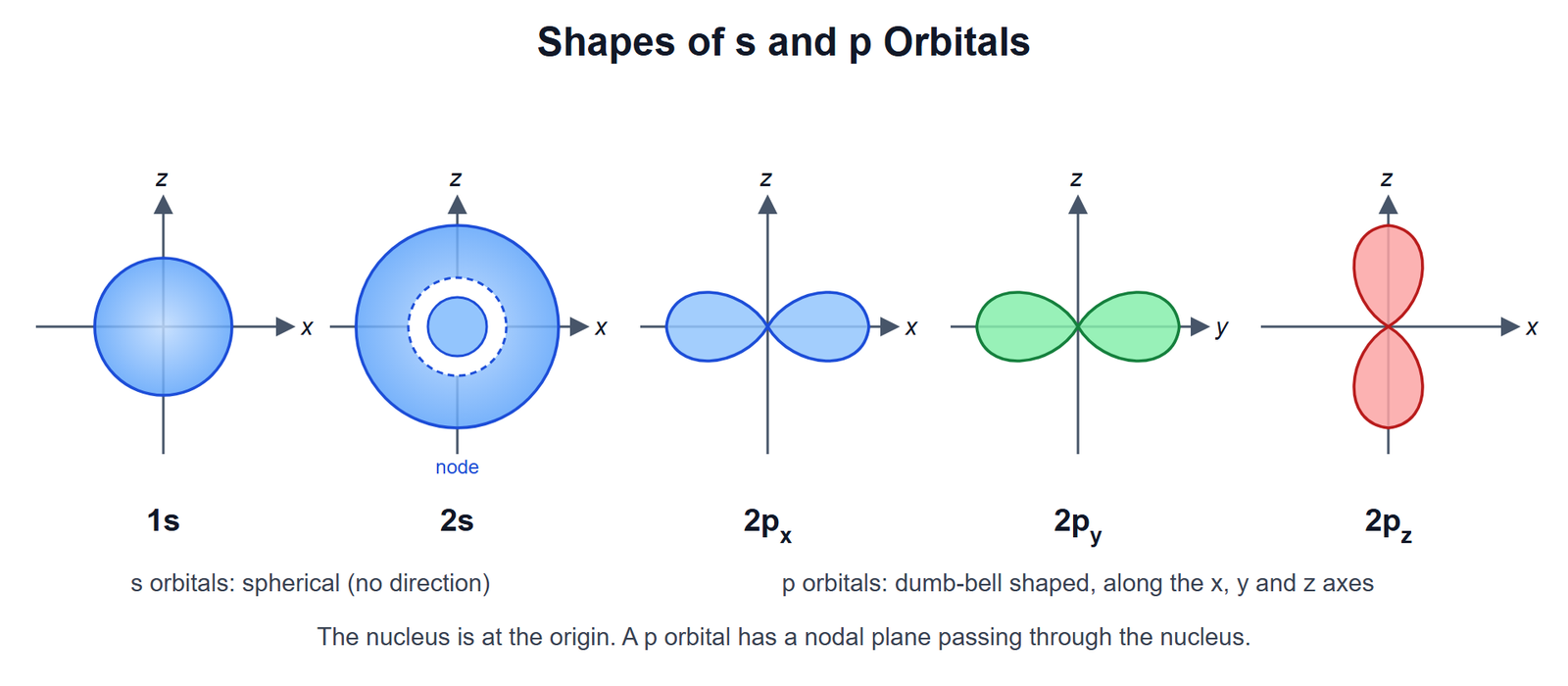
- s orbital: Spherical in shape and non-directional. The size increases with n (1s < 2s < 3s).
- p orbitals: Dumb-bell shaped. There are three p orbitals (px, py, pz) along the x, y and z axes. The two lobes lie on either side of a nodal plane passing through the nucleus.
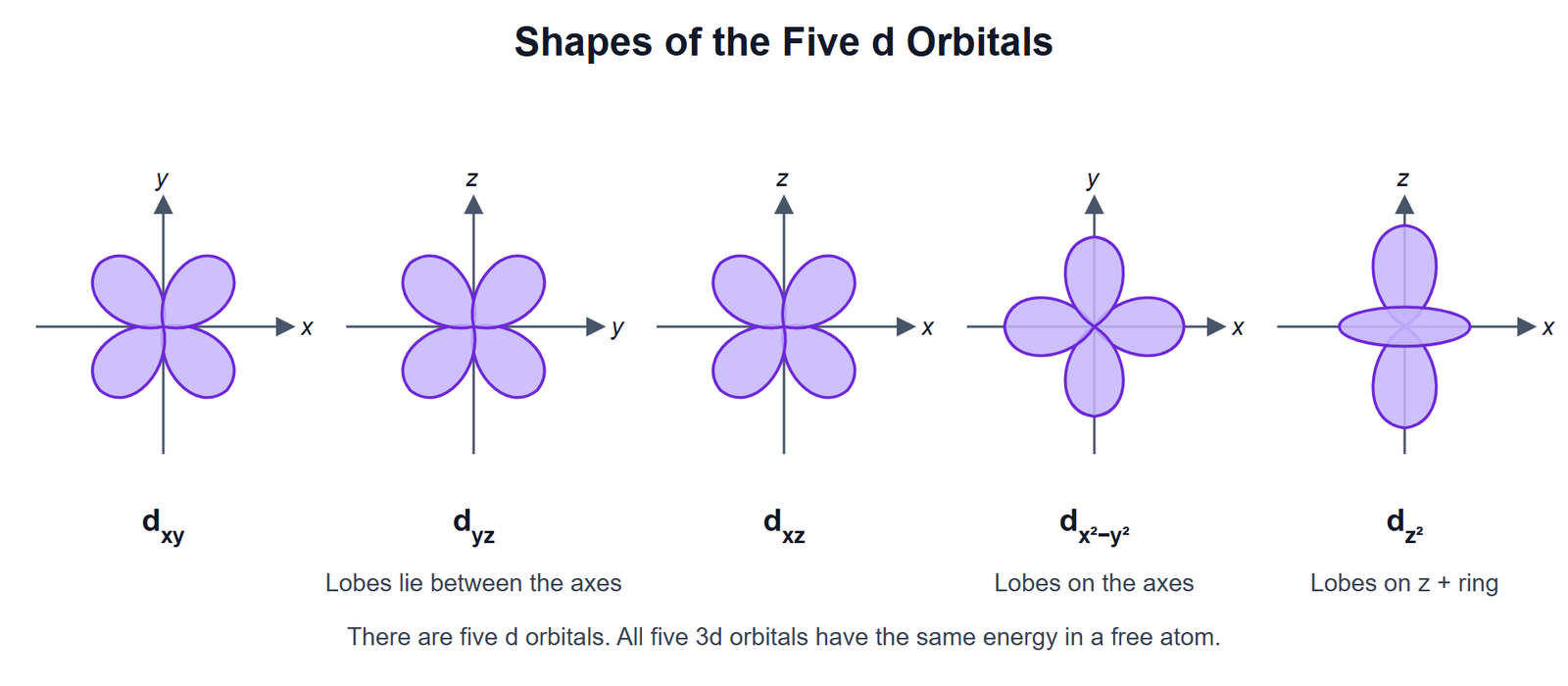
- d orbitals: There are five d orbitals: dxy, dyz, dxz, dx2−y2 and dz2. The first four are double dumb-bell (clover-leaf) shaped. The dz2 orbital has two lobes along the z-axis and a ring (collar) around the middle.
Nodes: A node is a region where the probability of finding the electron is zero.
- Radial nodes = n − l − 1
- Angular nodes (nodal planes) = l
- Total nodes = n − 1
Example: 3p orbital (n = 3, l = 1): radial nodes = 3 − 1 − 1 = 1, angular nodes = 1, total nodes = 2.
12. Energies of Orbitals
In the hydrogen atom, the energy of an orbital depends only on n. So 2s and 2p have the same energy.
In multi-electron atoms, the energy depends on both n and l. It is decided by the (n + l) rule:
- The orbital with the lower value of (n + l) has lower energy and is filled first.
- If two orbitals have the same (n + l) value, the one with the lower n has lower energy.
Example: 4s (n + l = 4 + 0 = 4) is filled before 3d (n + l = 3 + 2 = 5). 3d (n + l = 5, n = 3) is filled before 4p (n + l = 5, n = 4).
13. Rules for Filling Electrons in Orbitals
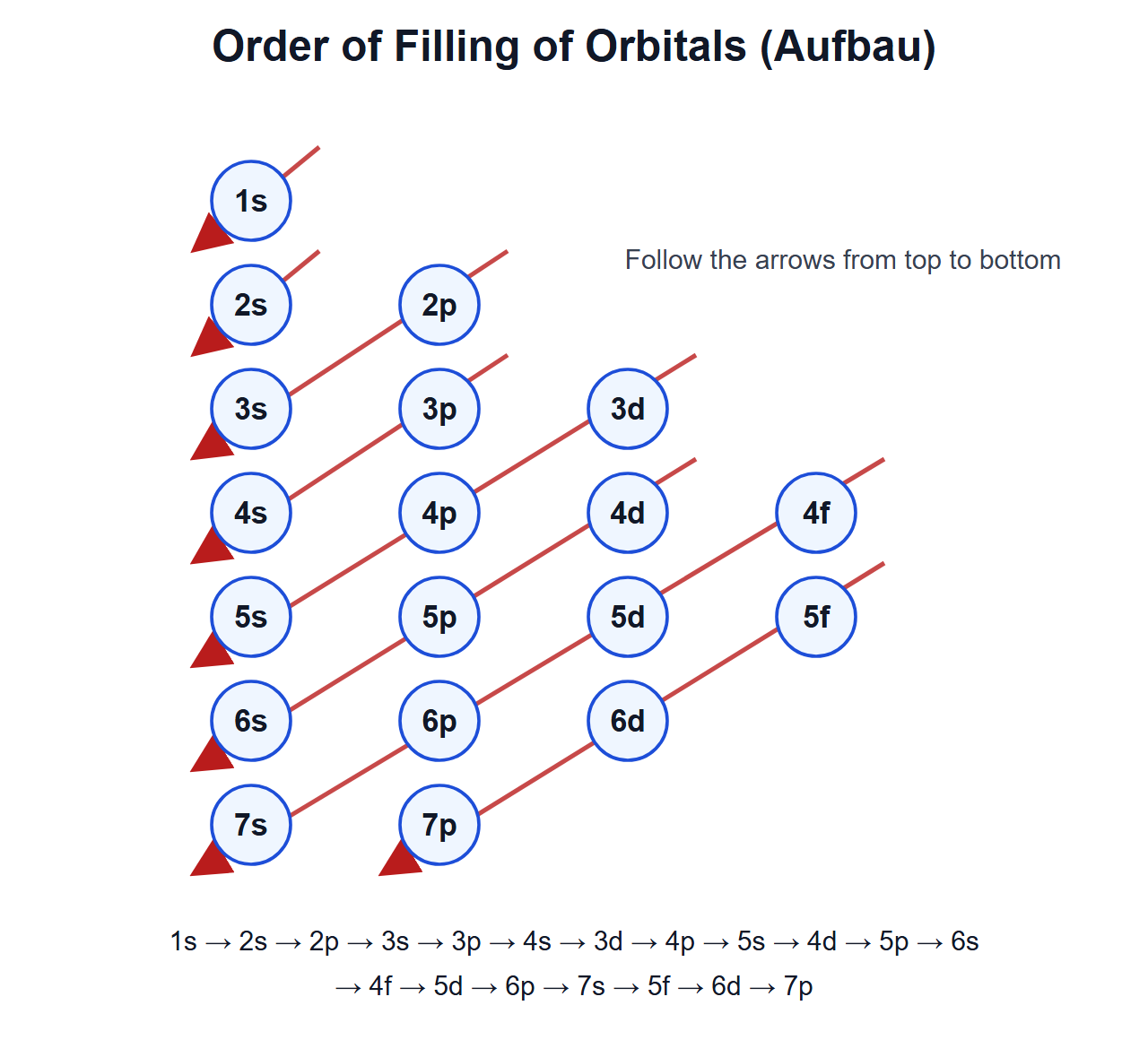
(a) Aufbau principle
In the ground state, electrons enter orbitals in order of increasing energy. Aufbau is a German word meaning “building up”.
(b) Pauli’s exclusion principle
No two electrons in an atom can have the same set of all four quantum numbers. So an orbital can hold a maximum of two electrons, and they must have opposite spins.
(c) Hund’s rule of maximum multiplicity
Pairing of electrons in the orbitals of a sub-shell (p, d or f) does not take place until each orbital of that sub-shell has got one electron. The singly occupied orbitals have electrons with parallel spins.
Example: Nitrogen (Z = 7) is 1s2 2s2 2p3. The three 2p electrons go into 2px, 2py and 2pz one each, with parallel spins.
Element | 1s | 2s | 2p |
|---|---|---|---|
C (Z = 6) | ↑↓ | ↑↓ | [↑] [↑] [ ] |
N (Z = 7) | ↑↓ | ↑↓ | [↑] [↑] [↑] |
O (Z = 8) | ↑↓ | ↑↓ | [↑↓] [↑] [↑] |
14. Electronic Configuration of Atoms
The distribution of electrons in the orbitals of an atom is called its electronic configuration. It is written as nlx, where x is the number of electrons in that sub-shell.
Element | Z | Electronic configuration |
|---|---|---|
H | 1 | 1s1 |
C | 6 | 1s2 2s2 2p2 |
O | 8 | 1s2 2s2 2p4 |
Na | 11 | 1s2 2s2 2p6 3s1 or [Ne] 3s1 |
Cl | 17 | [Ne] 3s2 3p5 |
K | 19 | [Ar] 4s1 |
Fe | 26 | [Ar] 3d6 4s2 |
Cr | 24 | [Ar] 3d5 4s1 (not 3d4 4s2) |
Cu | 29 | [Ar] 3d10 4s1 (not 3d9 4s2) |
Remember: [Ne] = 1s2 2s2 2p6 and [Ar] = 1s2 2s2 2p6 3s2 3p6. Writing the noble gas core makes configurations shorter.
15. Stability of Half-filled and Completely Filled Orbitals
Sub-shells that are exactly half-filled (p3, d5, f7) or completely filled (p6, d10, f14) are extra stable. This is why chromium is 3d5 4s1 and copper is 3d10 4s1.
- Symmetrical distribution: In half-filled and fully filled sub-shells, the electrons are distributed symmetrically. Symmetry leads to stability.
- Exchange energy: Electrons with parallel spins in degenerate orbitals can exchange their positions. Each exchange releases energy (exchange energy). The number of possible exchanges is maximum in half-filled and fully filled sub-shells, so they are most stable.
Exam point: In Cr, one 4s electron moves to 3d to give a half-filled 3d5. In Cu, one 4s electron moves to 3d to give a completely filled 3d10.
Conclusion: The atom has a tiny, heavy, positive nucleus surrounded by electrons. Bohr’s model explained the hydrogen spectrum, but the quantum mechanical model, based on the dual nature of matter and the uncertainty principle, describes electrons in orbitals. Quantum numbers and the Aufbau, Pauli and Hund’s rules tell us how electrons are arranged in atoms.