Chemical Bonding and Molecular Structure – Class 11 Chemistry Notes
Chapter – 4
Chemical Bonding and Molecular Structure
1. Valence Electrons and the Octet Rule
The attractive force that holds two or more atoms (or ions) together in a molecule is called a chemical bond.
Valence electrons: The electrons present in the outermost shell of an atom. They take part in bond formation. Example: Na (2, 8, 1) has 1 valence electron; Cl (2, 8, 7) has 7 valence electrons.
Lewis symbols: The symbol of the element with dots around it showing its valence electrons. Example: Na with one dot, Cl with seven dots.
Kossel–Lewis approach (octet rule): Atoms combine by losing, gaining or sharing electrons so as to get eight electrons (an octet) in their valence shell, like the nearest noble gas.
Limitations of the octet rule:
- Incomplete octet: The central atom has less than eight electrons. Example: LiCl, BeH2, BCl3 (B has only 6 electrons).
- Odd-electron molecules: Molecules with an odd number of electrons cannot give every atom an octet. Example: NO, NO2.
- Expanded octet: Elements of period 3 and beyond can have more than eight electrons around them by using their d orbitals. Example: PF5 (10 electrons around P), SF6 (12 electrons around S), H2SO4.
- Noble gases like xenon and krypton form compounds such as XeF2, KrF2 and XeOF2.
- It does not explain the shapes of molecules or their energies.
2. Ionic (Electrovalent) Bond
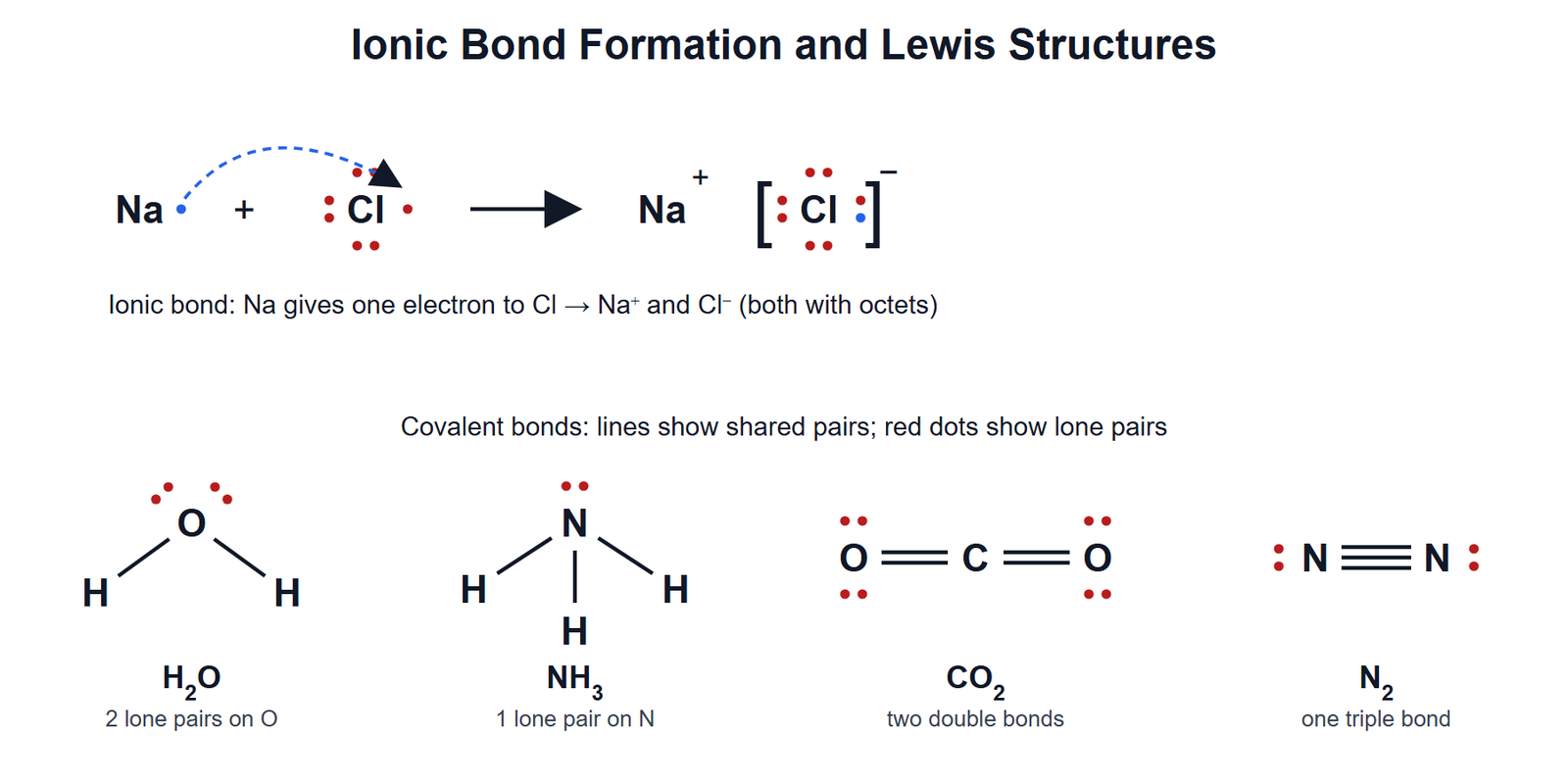
An ionic bond is formed by the complete transfer of one or more electrons from one atom (usually a metal) to another atom (usually a non-metal). The positive and negative ions formed are held together by electrostatic attraction.
Example: Na → Na+ + e− (2, 8, 1 → 2, 8)
Cl + e− → Cl− (2, 8, 7 → 2, 8, 8)
Na+ + Cl− → NaCl
Conditions favouring ionic bond formation:
- Low ionization enthalpy of the metal atom.
- High negative electron gain enthalpy of the non-metal atom.
- High lattice enthalpy of the compound formed.
Lattice enthalpy: The energy required to completely separate one mole of a solid ionic compound into its gaseous ions. Example: The lattice enthalpy of NaCl is 788 kJ mol−1. The higher the lattice enthalpy, the more stable the ionic compound.
Remember: Ionic compounds are usually hard crystalline solids with high melting and boiling points. They conduct electricity in the molten state and in water solution.
3. Covalent Bond and Lewis Structures
A covalent bond is formed by the mutual sharing of electrons between two atoms. Each atom contributes one electron to the shared pair.
- Sharing of one pair forms a single bond (H–H, Cl–Cl).
- Sharing of two pairs forms a double bond (O=O, C=O in CO2).
- Sharing of three pairs forms a triple bond (N≡N).
Steps to write a Lewis structure:
- Add the valence electrons of all atoms. Add one electron for each negative charge and subtract one for each positive charge.
- Place the least electronegative atom in the centre (H and F are always at the ends).
- Put a single bond (one shared pair) between the central atom and each outer atom.
- Use the remaining electrons as lone pairs to complete octets. If octets are not complete, make double or triple bonds.
Example: Lewis structure of CO2. Total valence electrons = 4 + 2 × 6 = 16. Carbon is central. To give every atom an octet, carbon forms two double bonds: O=C=O, with two lone pairs on each oxygen.
4. Bond Parameters
- Bond length: The equilibrium distance between the nuclei of two bonded atoms. It is measured in picometres (pm).
- Bond angle: The angle between the orbitals containing the bonding electron pairs around the central atom. Example: H–O–H in water is 104.5°.
- Bond enthalpy: The energy required to break one mole of bonds of a particular type between two atoms in the gaseous state. Example: H–H bond enthalpy is 435.8 kJ mol−1; O=O is 498 kJ mol−1; N≡N is 946.0 kJ mol−1.
- Bond order: The number of bonds between two atoms. Example: H2 = 1, O2 = 2, N2 = 3.
Bond | Bond order | Bond length (pm) |
|---|---|---|
C–C | 1 | 154 |
C=C | 2 | 134 |
C≡C | 3 | 120 |
Important: As bond order increases, bond length decreases and bond enthalpy increases.
5. Polar Character of Covalent Bonds
- Non-polar covalent bond: Formed between two identical atoms. The shared pair is equally attracted by both atoms. Example: H2, Cl2, O2.
- Polar covalent bond: Formed between atoms of different electronegativity. The shared pair moves towards the more electronegative atom, which gets a partial negative charge (δ−). The other atom gets a partial positive charge (δ+). Example: Hδ+–Fδ−.
Dipole moment (μ): A measure of the polarity of a bond or molecule.
Dipole moment (μ) = Charge (Q) × Distance of separation (r)
Unit: debye (D). 1 D = 3.33564 × 10⁻³⁰ C m. Dipole moment is a vector quantity, shown by an arrow pointing from the positive end to the negative end.
Molecule | Shape | Dipole moment | Reason |
|---|---|---|---|
CO2 | Linear | 0 | Two equal bond dipoles cancel |
BF3 | Trigonal planar | 0 | Three bond dipoles cancel |
H2O | Bent | 1.85 D | Bond dipoles do not cancel |
NH3 | Pyramidal | 1.47 D | Lone pair adds to bond dipoles |
NF3 | Pyramidal | 0.23 D | Lone pair opposes bond dipoles |
Exam point: NH3 and NF3 both have pyramidal shapes. In NH3, the N–H bond dipoles point towards N, in the same direction as the lone pair dipole, so they add up. In NF3, the N–F bond dipoles point away from N, opposite to the lone pair, so they partly cancel. Hence μ(NH3) > μ(NF3).
6. Covalent Character of Ionic Bonds (Fajans’ Rules)
No bond is 100% ionic. When a cation comes near an anion, it pulls the electron cloud of the anion towards itself. This distortion is called polarisation. The more the polarisation, the more the covalent character of the ionic bond.
Fajans’ rules: Covalent character of an ionic bond increases when:
- The cation is small: A small cation has a high charge density and polarises the anion more. Example: LiCl is more covalent than NaCl.
- The anion is large: A large anion is easily polarised. Example: LiI is more covalent than LiF.
- The charge on the ions is high: Example: AlCl3 (Al3+) is more covalent than NaCl (Na+).
- The cation has an 18-electron outer shell (n s2 n p6 n d10) instead of a noble gas configuration. Example: CuCl is more covalent than NaCl, although Cu+ and Na+ are of similar size.
7. Valence Bond Theory
Valence bond theory (Heitler and London, developed by Pauling) explains covalent bond formation in terms of overlapping atomic orbitals.
Formation of H2: When two hydrogen atoms come close, new attractive forces (nucleus of one atom and electron of the other) and repulsive forces (nucleus–nucleus and electron–electron) arise. Attraction is stronger than repulsion until the atoms reach a distance of 74 pm. At this distance the energy is minimum and a stable H2 molecule is formed, with the release of 435.8 kJ mol−1 of energy.
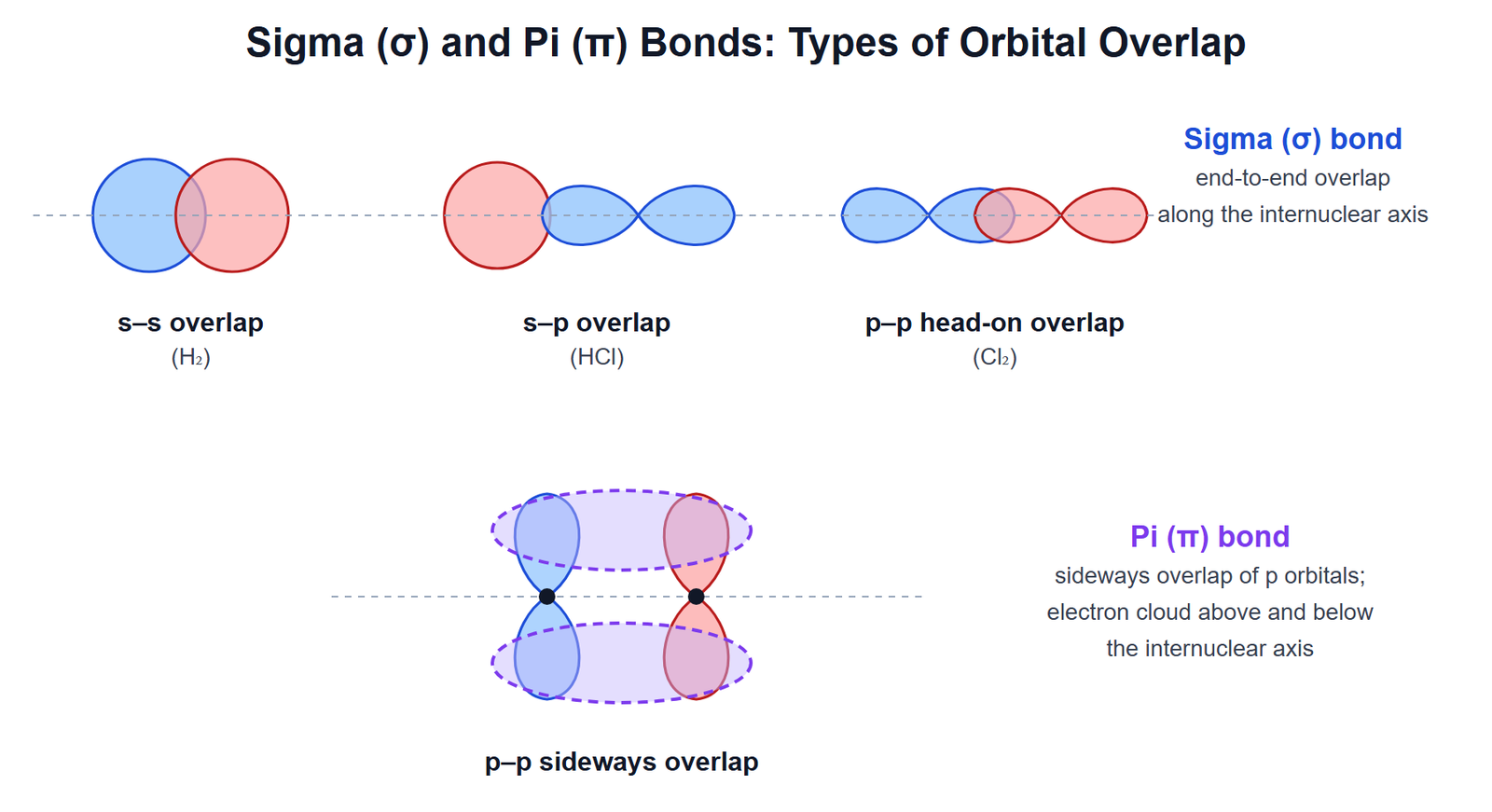
Orbital overlap concept: A covalent bond is formed when half-filled atomic orbitals of two atoms overlap and their electrons pair up with opposite spins. Greater overlap gives a stronger bond.
Sigma (σ) bond | Pi (π) bond |
|---|---|
Formed by end-to-end (head-on) overlap along the internuclear axis | Formed by sideways overlap of p orbitals |
Overlap is large, so the bond is strong | Overlap is small, so the bond is weaker |
Can be formed by s–s, s–p and p–p overlap | Formed only by p–p (or p–d) overlap |
Free rotation about the bond is possible | Free rotation is not possible |
Can exist alone (single bond) | Always formed along with a σ bond |
Remember: A single bond has 1 σ bond. A double bond has 1 σ + 1 π bond. A triple bond has 1 σ + 2 π bonds. Example: In ethene (C2H4) there are 5 σ bonds and 1 π bond.
8. Resonance
Sometimes a single Lewis structure cannot explain all the properties of a molecule. Then two or more structures, called resonance (canonical) structures, are written. The actual molecule is a resonance hybrid of these structures.
Example: Ozone (O3). One Lewis structure shows one O–O single bond and one O=O double bond. But experimentally both O–O bonds in ozone are equal, 128 pm, which is between the single bond (148 pm) and double bond (121 pm) lengths. So ozone is a resonance hybrid of two structures: O=O–O and O–O=O.
Example: In the carbonate ion (CO32−), all three C–O bonds are equal. It is a resonance hybrid of three structures.
- Resonance structures differ only in the position of electrons, not of atoms.
- The resonance hybrid is more stable than any single resonance structure.
- The canonical forms have no real existence.
9. VSEPR Theory and Geometry of Covalent Molecules
The Valence Shell Electron Pair Repulsion (VSEPR) theory, given by Sidgwick and Powell and improved by Nyholm and Gillespie, predicts the shapes of molecules.
Main postulates:
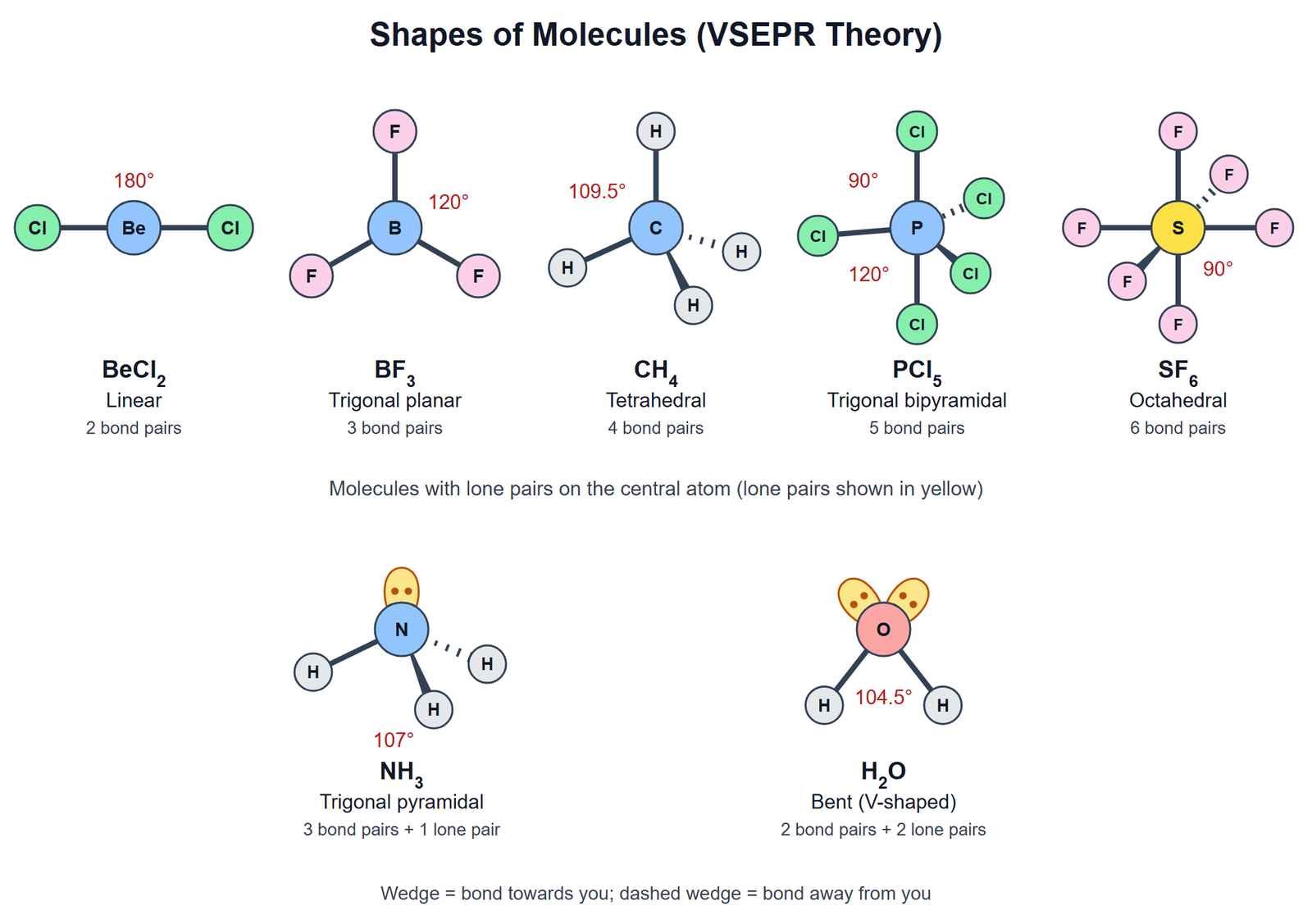
- The shape of a molecule depends on the number of valence shell electron pairs (bonded or non-bonded) around the central atom.
- Electron pairs repel each other, so they arrange themselves as far apart as possible to keep repulsion minimum.
- A multiple bond is treated as a single electron pair (super pair).
- Lone pairs occupy more space than bond pairs. The order of repulsion is: lone pair–lone pair > lone pair–bond pair > bond pair–bond pair.
Bond pairs | Lone pairs | Shape | Bond angle | Example |
|---|---|---|---|---|
2 | 0 | Linear | 180° | BeCl2, CO2 |
3 | 0 | Trigonal planar | 120° | BF3 |
4 | 0 | Tetrahedral | 109.5° | CH4 |
5 | 0 | Trigonal bipyramidal | 120° and 90° | PCl5 |
6 | 0 | Octahedral | 90° | SF6 |
3 | 1 | Trigonal pyramidal | 107° | NH3 |
2 | 2 | Bent (V-shaped) | 104.5° | H2O |
Exam point: CH4, NH3 and H2O all have four electron pairs around the central atom. The bond angle decreases from 109.5° (CH4, no lone pair) to 107° (NH3, one lone pair) to 104.5° (H2O, two lone pairs), because lone pairs repel bond pairs more strongly.
10. Concept of Hybridisation
Hybridisation is the process of intermixing of atomic orbitals of slightly different energies to form a new set of equivalent orbitals called hybrid orbitals. (Concept given by Pauling.)
Main features:
- The number of hybrid orbitals formed is equal to the number of atomic orbitals mixed.
- Hybrid orbitals are equivalent in energy and shape.
- Hybrid orbitals form stronger bonds than pure atomic orbitals.
- Hybrid orbitals point in directions that keep electron pair repulsion minimum. So hybridisation decides the shape of the molecule.
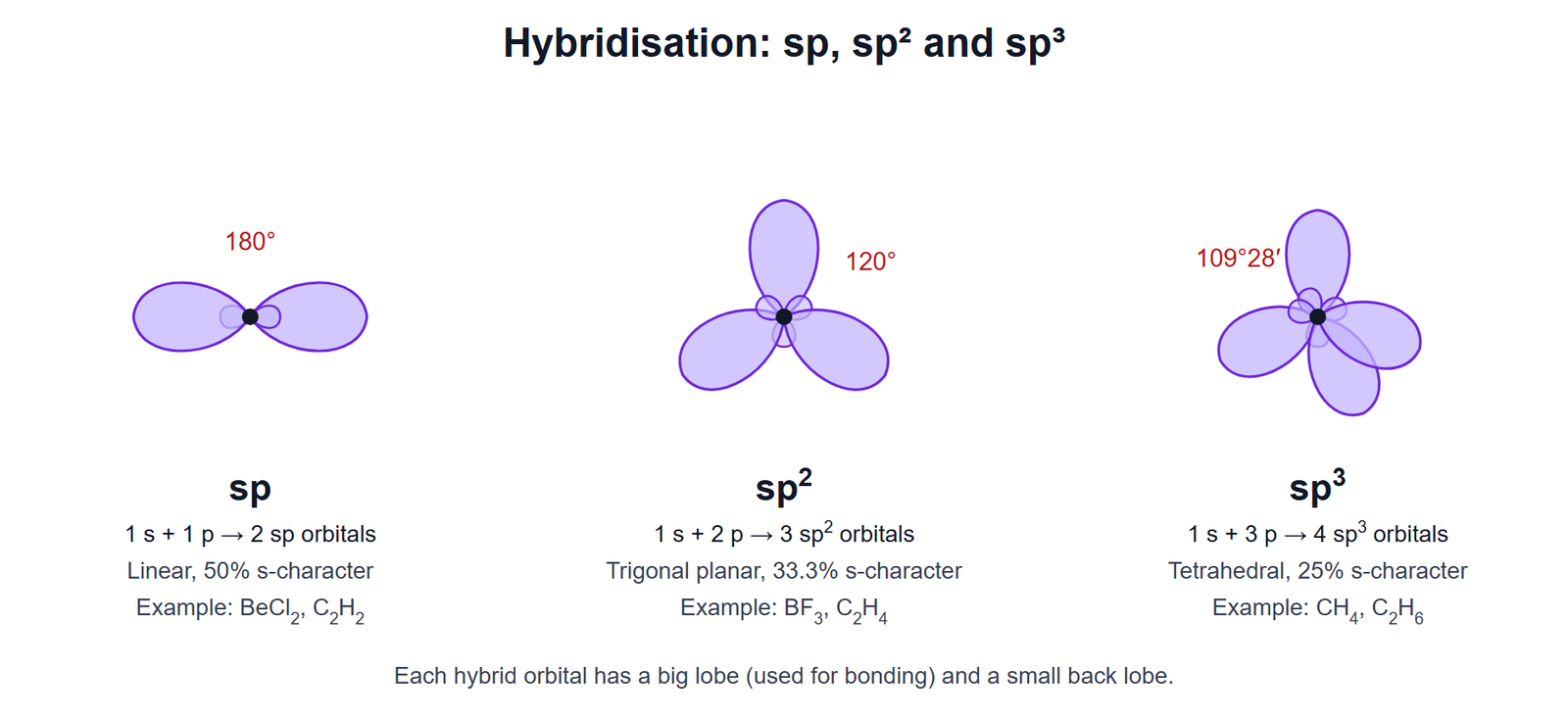
- sp hybridisation: One s and one p orbital mix to give two sp orbitals at 180° (linear). Example: BeCl2. Be (2s2) promotes one electron to 2p; its 2s and one 2p orbital mix to give two sp orbitals, which overlap with the 3p orbitals of two Cl atoms.
- sp2 hybridisation: One s and two p orbitals mix to give three sp2 orbitals at 120° (trigonal planar). Example: BCl3, BF3, and each carbon of ethene.
- sp3 hybridisation: One s and three p orbitals mix to give four sp3 orbitals at 109°28′ (tetrahedral). Example: CH4. In NH3 and H2O, N and O are also sp3 hybridised, but one or two hybrid orbitals hold lone pairs.
Hybridisation involving s, p and d orbitals:
Hybridisation | Orbitals mixed | Shape | Example |
|---|---|---|---|
sp | 1 s + 1 p | Linear | BeCl2, C2H2 |
sp2 | 1 s + 2 p | Trigonal planar | BF3, C2H4 |
sp3 | 1 s + 3 p | Tetrahedral | CH4, C2H6 |
sp3d | 1 s + 3 p + 1 d | Trigonal bipyramidal | PCl5 |
sp3d2 | 1 s + 3 p + 2 d | Octahedral | SF6 |
Easy Memory Trick: Count the electron pairs (σ bonds + lone pairs) on the central atom: 2 → sp, 3 → sp2, 4 → sp3, 5 → sp3d, 6 → sp3d2.
11. Molecular Orbital Theory (Homonuclear Diatomic Molecules)
Molecular orbital theory (Hund and Mulliken) treats the electrons of a molecule as belonging to the whole molecule.
Main ideas:
- Atomic orbitals of comparable energy and proper symmetry combine to form molecular orbitals (linear combination of atomic orbitals, LCAO).
- The number of molecular orbitals formed is equal to the number of atomic orbitals combined. Two atomic orbitals give one bonding and one antibonding molecular orbital.
- Electrons fill molecular orbitals in order of increasing energy, following the Aufbau principle, Pauli’s exclusion principle and Hund’s rule.
Bonding molecular orbital | Antibonding molecular orbital |
|---|---|
Formed by addition (constructive interference) of atomic orbitals | Formed by subtraction (destructive interference) of atomic orbitals |
Lower energy than the atomic orbitals | Higher energy than the atomic orbitals |
Electron density is high between the nuclei | Has a node between the nuclei |
Stabilises the molecule (σ, π) | Destabilises the molecule (σ*, π*) |
Energy order of molecular orbitals:
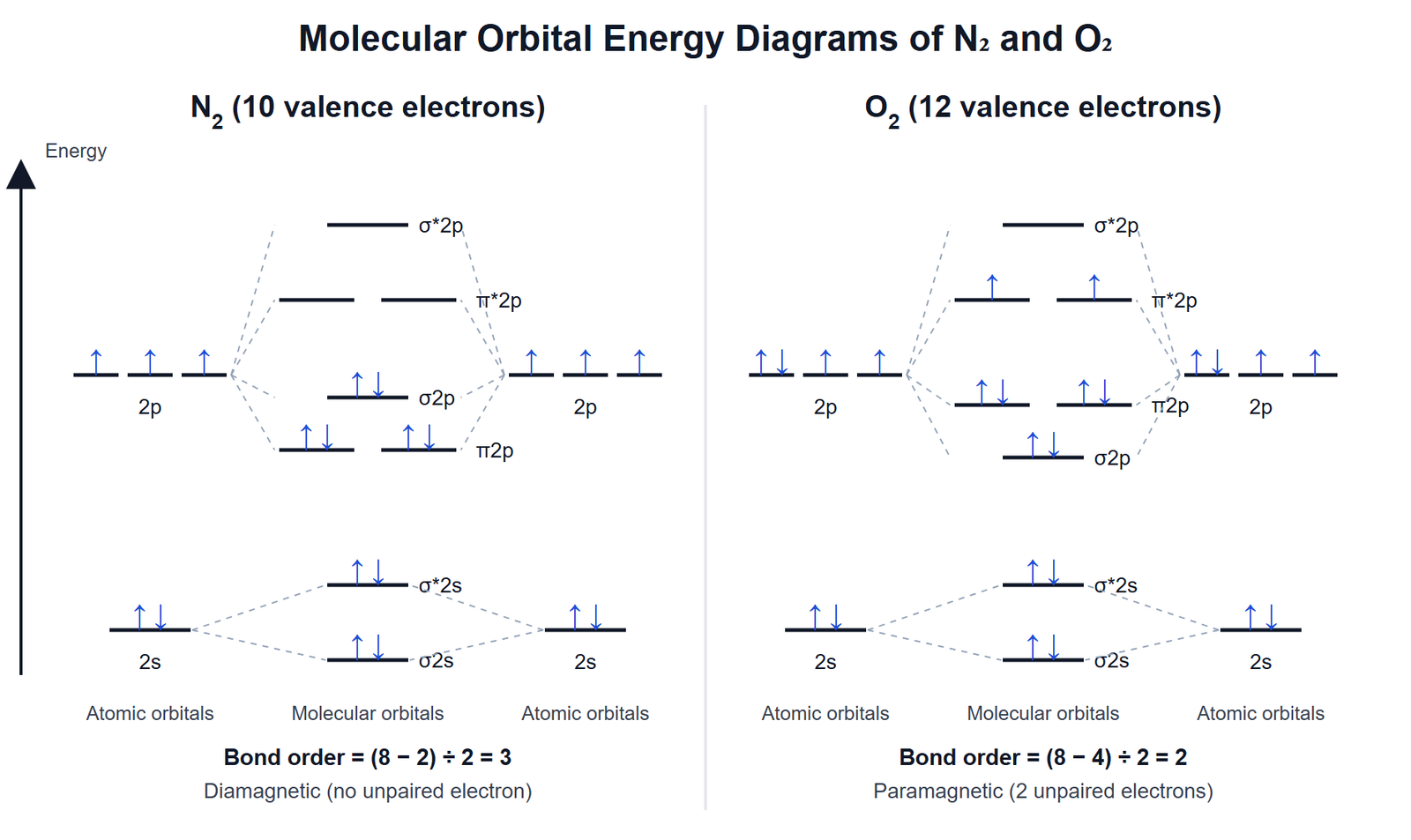
- For Li2, Be2, B2, C2 and N2: σ1s < σ*1s < σ2s < σ*2s < (π2px = π2py) < σ2pz < (π*2px = π*2py) < σ*2pz
- For O2, F2 and Ne2: σ1s < σ*1s < σ2s < σ*2s < σ2pz < (π2px = π2py) < (π*2px = π*2py) < σ*2pz
Bond order = ½ (Nb − Na), where Nb = electrons in bonding orbitals and Na = electrons in antibonding orbitals.
- Positive bond order: the molecule is stable. Zero bond order: the molecule does not exist.
- Higher bond order means a shorter, stronger bond.
- If all electrons are paired, the molecule is diamagnetic. If there are unpaired electrons, it is paramagnetic.
Molecule | Electrons | Nb | Na | Bond order | Magnetic nature |
|---|---|---|---|---|---|
H2 | 2 | 2 | 0 | 1 | Diamagnetic |
He2 | 4 | 2 | 2 | 0 (does not exist) | – |
N2 | 14 | 10 | 4 | 3 | Diamagnetic |
O2 | 16 | 10 | 6 | 2 | Paramagnetic |
Example: Electronic configuration of O2 (16 electrons): σ1s2 σ*1s2 σ2s2 σ*2s2 σ2pz2 (π2px2 = π2py2) (π*2px1 = π*2py1). Bond order = (10 − 6) ÷ 2 = 2. It has two unpaired electrons, so O2 is paramagnetic.
Important: The paramagnetism of O2 could not be explained by its Lewis structure (O=O, all electrons paired). Molecular orbital theory explains it correctly. This is a big success of MOT.
12. Hydrogen Bond
When hydrogen is bonded to a highly electronegative atom (F, O or N), the shared pair moves towards that atom and hydrogen gets a partial positive charge. This hydrogen is then attracted by a lone pair of another electronegative atom. This weak attraction is called a hydrogen bond. It is shown by a dotted line (- – -).
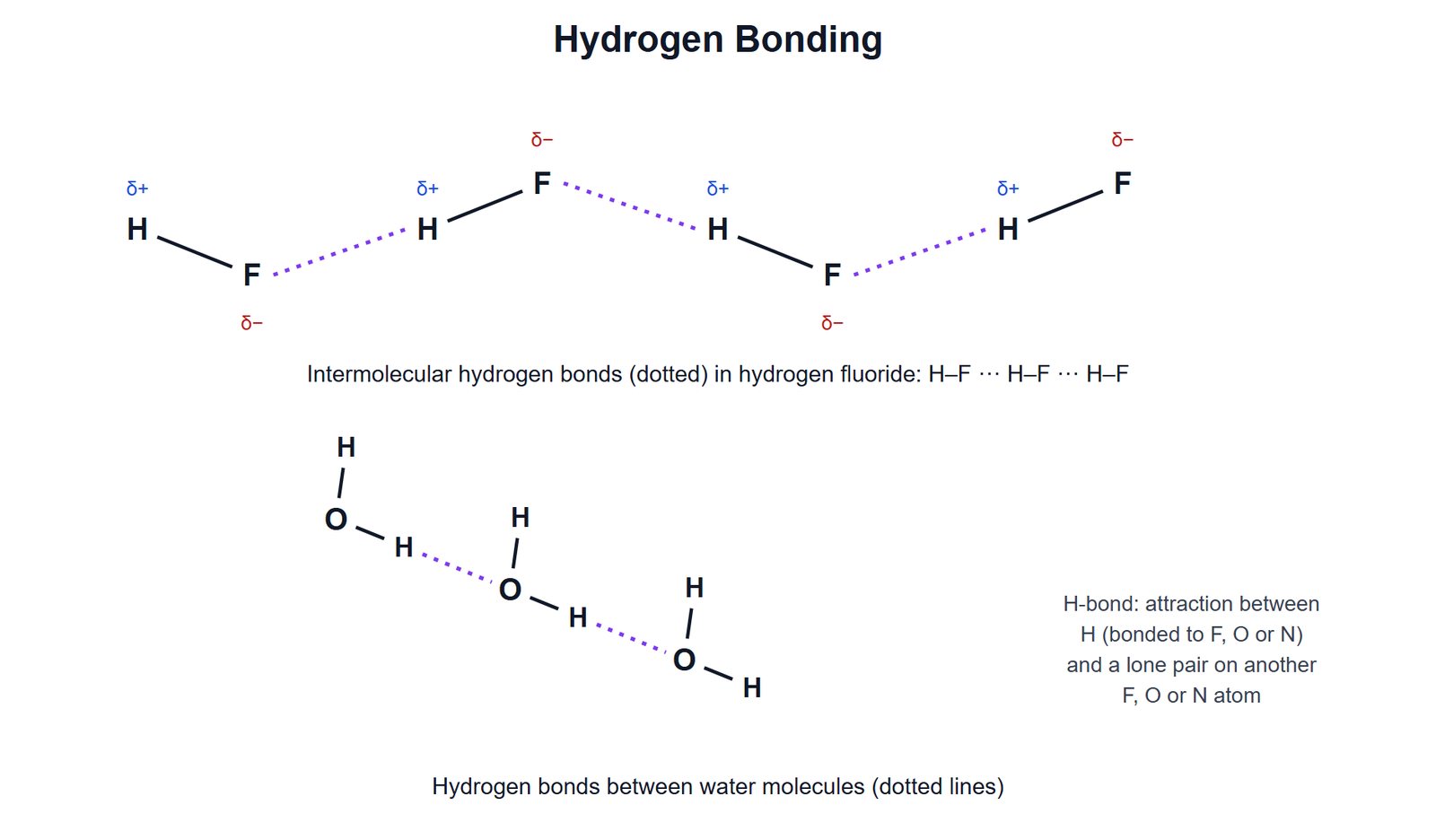
- Intermolecular hydrogen bond: Formed between two different molecules of the same or different compounds. Example: HF, water, alcohols.
- Intramolecular hydrogen bond: Formed between hydrogen and an electronegative atom within the same molecule. Example: o-nitrophenol.
Effects of hydrogen bonding:
- Water has an unusually high boiling point (373 K) compared with H2S, because water molecules are associated through hydrogen bonds.
- Ice has an open cage-like structure due to hydrogen bonds, so it is less dense than water and floats on it.
- Hydrogen bonds are much weaker than covalent bonds, but they hold the two strands of DNA together.
Conclusion: Atoms combine to attain stable configurations by transferring electrons (ionic bond) or sharing them (covalent bond). VSEPR theory and hybridisation explain the shapes of molecules, valence bond theory explains bond formation by orbital overlap, and molecular orbital theory explains bond order and the magnetic nature of molecules like O2.