Chapter – 1
Some Basic Concepts of Chemistry
1. Importance and Scope of Chemistry
Chemistry is the branch of science that studies the composition, structure and properties of matter, and the changes that matter undergoes.
Chemistry plays an important role in almost every part of our life:
- Health and medicine: Life-saving drugs such as cisplatin and taxol (used in cancer therapy) and AZT (used for AIDS patients) were developed through chemistry.
- Agriculture: Fertilizers, pesticides and insecticides help increase crop production.
- Industry: Chemistry helps in making acids, alkalies, dyes, polymers, metals, soaps, detergents and many other products.
- Environment: Chemists have developed environment-friendly substitutes, such as replacements for CFCs (chlorofluorocarbons) that damage the ozone layer.
- New materials: Superconducting ceramics, conducting polymers and optical fibres are products of chemistry.
- Daily life: Food preservatives, cosmetics, cleaning agents and fuels all come from chemistry.
Remember: Chemistry is often called the central science because it is linked with physics, biology, geology, medicine and engineering.
2. Nature of Matter
Anything that has mass and occupies space is called matter. Example: air, water, wood, iron.
States of matter: Matter exists in three physical states.
Property | Solid | Liquid | Gas |
|---|---|---|---|
Shape | Definite | Takes shape of container | Takes shape of container |
Volume | Definite | Definite | Not definite |
Arrangement of particles | Closely packed, orderly | Close but can move | Far apart, move freely |
Example | Ice | Water | Steam |
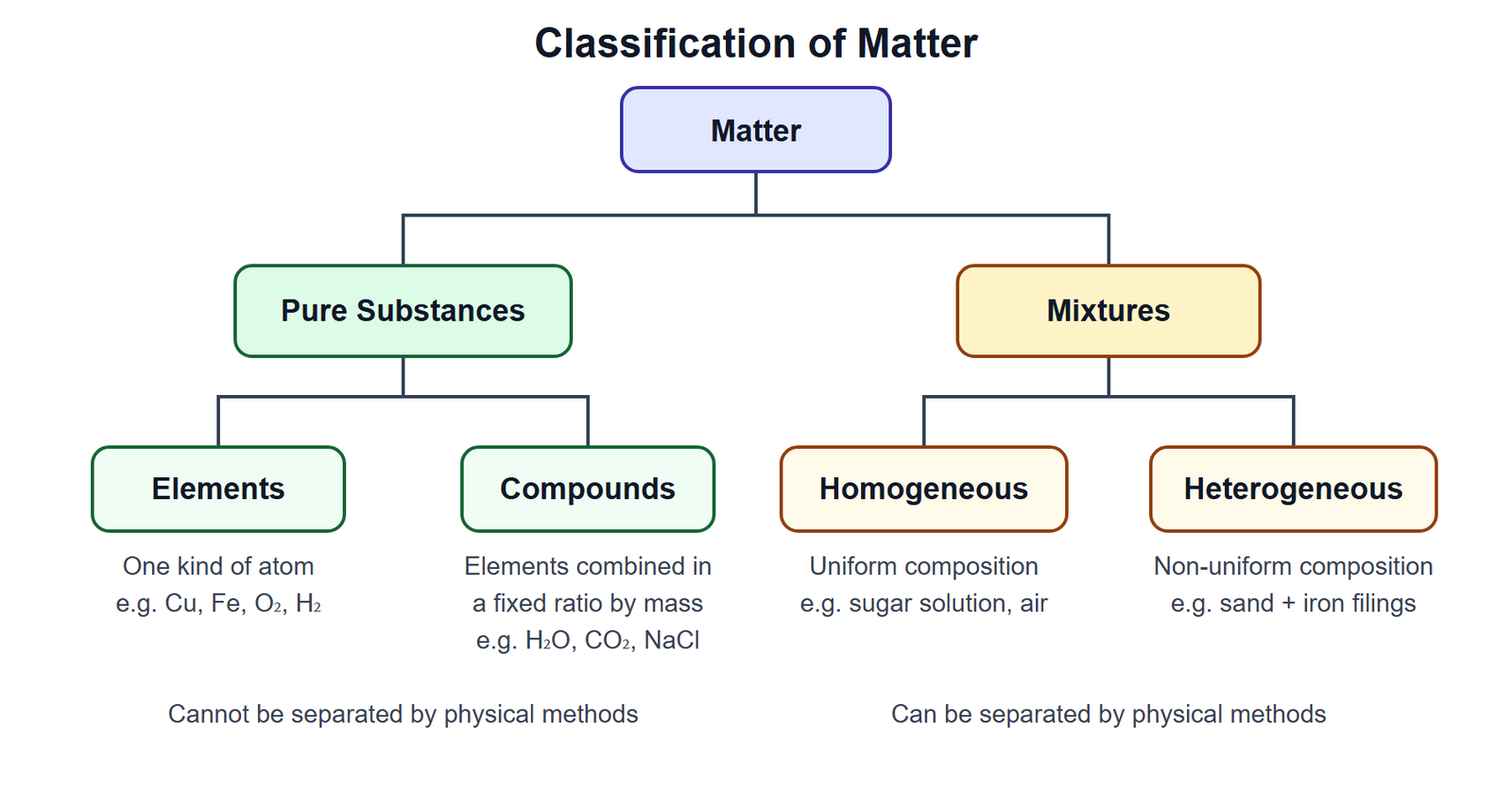
Classification of matter:
- Mixture: Contains two or more substances in any ratio. Its components can be separated by physical methods such as filtration, distillation and crystallisation.
- Homogeneous mixture: Uniform composition throughout. Example: sugar solution, air.
- Heterogeneous mixture: Composition is not uniform. Example: a mixture of salt and sugar, grains with pulses.
- Pure substance: Has a fixed composition.
- Element: Contains only one kind of atoms. Example: sodium, copper, silver, hydrogen, oxygen.
- Compound: Formed when atoms of two or more elements combine in a fixed ratio by mass. Its constituents cannot be separated by physical methods. Example: water (H2O), carbon dioxide (CO2), sodium chloride (NaCl).
Important: The properties of a compound are different from those of its elements. Example: Hydrogen burns and oxygen helps burning, but water, a compound of the two, is used to put out fire.
3. Laws of Chemical Combination
The combination of elements to form compounds is governed by five basic laws.
(a) Law of Conservation of Mass (Antoine Lavoisier, 1789)
Matter can neither be created nor destroyed in a chemical reaction. The total mass of the reactants is equal to the total mass of the products.
Example: 2H2 + O2 → 2H2O. Here 4 g of hydrogen reacts with 32 g of oxygen to give 36 g of water (4 + 32 = 36).
(b) Law of Definite Proportions (Joseph Proust)
A given compound always contains exactly the same proportion of elements by weight, whatever its source.
Example: Water from a river, a well or the sea always contains hydrogen and oxygen in the ratio 1 : 8 by mass. Proust showed that natural and synthetic samples of cupric carbonate had the same composition.
(c) Law of Multiple Proportions (John Dalton, 1803)
If two elements combine to form more than one compound, the masses of one element that combine with a fixed mass of the other element are in a ratio of small whole numbers.
Example: Hydrogen and oxygen form water (H2O) and hydrogen peroxide (H2O2).
- Hydrogen (2 g) + Oxygen (16 g) → Water (18 g)
- Hydrogen (2 g) + Oxygen (32 g) → Hydrogen peroxide (34 g)
The masses of oxygen (16 g and 32 g) that combine with a fixed mass of hydrogen (2 g) are in the simple ratio 16 : 32 = 1 : 2.
(d) Gay Lussac’s Law of Gaseous Volumes (1808)
When gases combine or are produced in a chemical reaction, they do so in a simple ratio by volume, provided all gases are at the same temperature and pressure.
Example: 100 mL of hydrogen combines with 50 mL of oxygen to give 100 mL of water vapour. The ratio of volumes is 100 : 50 : 100 = 2 : 1 : 2.
(e) Avogadro’s Law (1811)
Equal volumes of all gases at the same temperature and pressure contain an equal number of molecules.
Example: 2 volumes of hydrogen + 1 volume of oxygen → 2 volumes of water vapour. This means 2 molecules of H2 react with 1 molecule of O2 to give 2 molecules of H2O.
Exam point: Avogadro was the first to make a clear difference between atoms and molecules.
4. Dalton’s Atomic Theory (1808)
John Dalton explained the laws of chemical combination with his atomic theory. Its main postulates are:
- Matter consists of tiny indivisible particles called atoms.
- All atoms of a given element have identical properties, including identical mass. Atoms of different elements differ in mass.
- Compounds are formed when atoms of different elements combine in a fixed ratio.
- Chemical reactions involve only the reorganisation of atoms. Atoms are neither created nor destroyed in a chemical reaction.
Limitations of Dalton’s theory:
- Atoms are divisible. They are made of electrons, protons and neutrons.
- Atoms of the same element can have different masses (isotopes).
- Atoms of different elements can have the same mass (isobars).
- It could not explain the law of gaseous volumes.
Concept of elements, atoms and molecules:
- Atom: The smallest particle of an element that takes part in a chemical reaction. It may or may not exist independently.
- Molecule: The smallest particle of an element or compound that can exist independently and shows all the properties of that substance. Example: O2, H2O, CO2.
- Atomicity: The number of atoms in a molecule. Example: He is monoatomic, O2 is diatomic, O3 is triatomic, P4 is tetra-atomic and S8 is polyatomic.
5. Atomic and Molecular Masses
(a) Atomic mass
Atoms are extremely small, so their masses are expressed relative to a standard. Today the standard is the carbon-12 isotope.
One atomic mass unit (amu) is defined as exactly one-twelfth of the mass of one carbon-12 atom. Today amu is written as u (unified mass).
1 u = 1.66056 × 10⁻²⁴ g
Example: The mass of a hydrogen atom is 1.6736 × 10⁻²⁴ g. So its atomic mass = 1.6736 × 10⁻²⁴ ÷ 1.66056 × 10−24 = 1.0078 u ≈ 1.008 u.
(b) Average atomic mass
Most elements occur as a mixture of isotopes. The average atomic mass is calculated from the mass and relative abundance of each isotope.
Average atomic mass = Σ (fractional abundance × isotopic mass)
Example: Chlorine has two isotopes: 35Cl (abundance 75.77%, mass 34.9689 u) and 37Cl (abundance 24.23%, mass 36.9659 u).
Average atomic mass = (0.7577 × 34.9689) + (0.2423 × 36.9659) = 26.4959 + 8.9568 = 35.4527 u ≈ 35.45 u
(c) Molecular mass
Molecular mass is the sum of the atomic masses of all the atoms present in a molecule.
- Water (H2O) = 2 × 1 + 16 = 18 u
- Carbon dioxide (CO2) = 12 + 2 × 16 = 44 u
- Glucose (C6H12O6) = 6 × 12 + 12 × 1 + 6 × 16 = 180 u
(d) Formula mass
Ionic compounds such as NaCl do not exist as separate molecules. They form a three-dimensional network of ions. For them, the term formula mass is used.
Example: Formula mass of NaCl = 23.0 + 35.5 = 58.5 u
6. Mole Concept and Molar Mass
The mole is the SI unit of the amount of substance.
One mole is the amount of a substance that contains as many particles (atoms, molecules or ions) as there are atoms in exactly 12 g of carbon-12. This number is 6.022 × 10²³.
Avogadro constant (NA): 6.022 × 10²³ mol−1
- 1 mole of hydrogen atoms = 6.022 × 10²³ hydrogen atoms
- 1 mole of water molecules = 6.022 × 10²³ water molecules
- 1 mole of sodium chloride = 6.022 × 10²³ formula units of NaCl
Molar mass: The mass of one mole of a substance in grams. It is numerically equal to the atomic, molecular or formula mass in u.
- Molar mass of water = 18 g mol−1
- Molar mass of sodium chloride = 58.5 g mol−1
Important formulas:
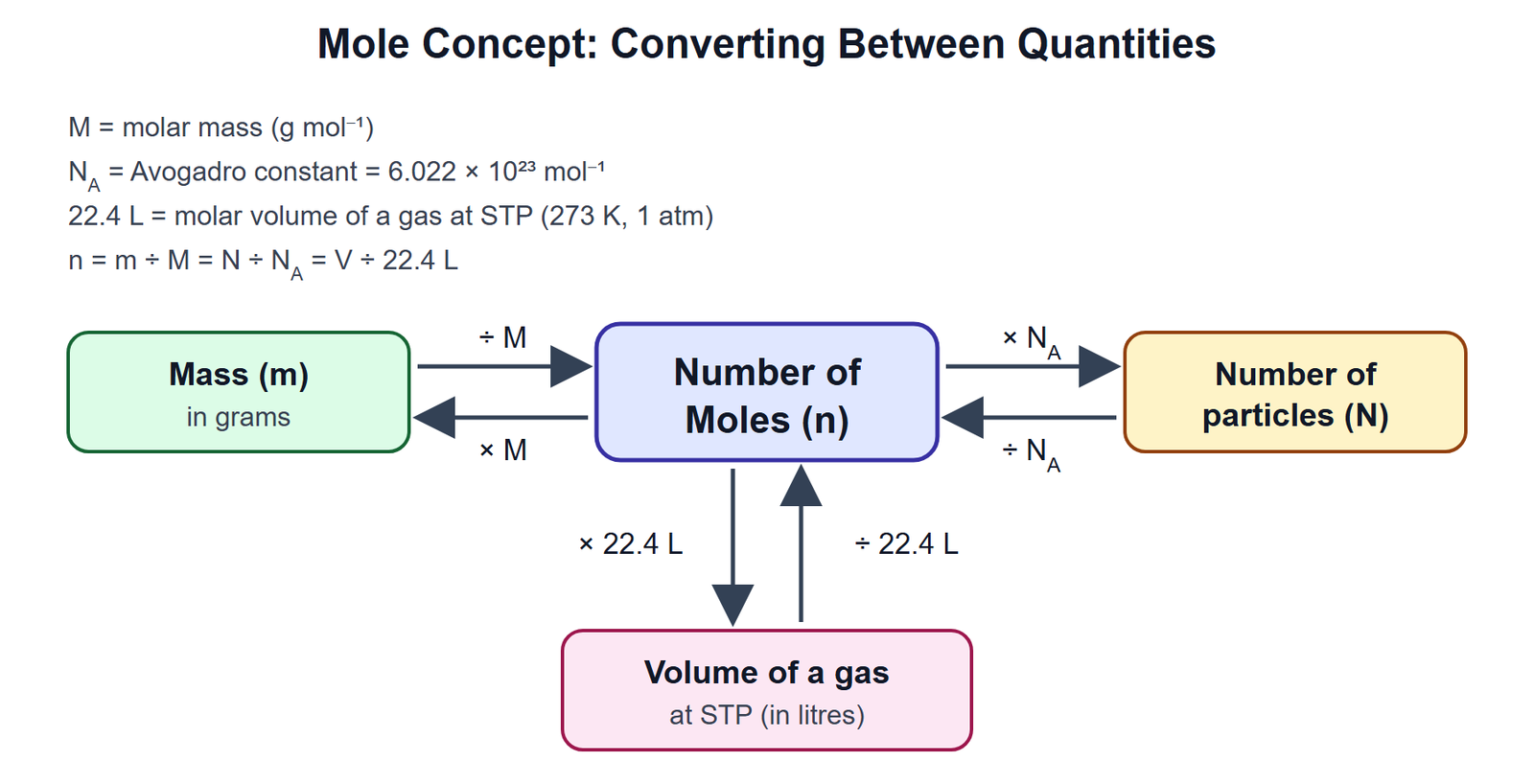
- Number of moles (n) = Given mass (m) ÷ Molar mass (M)
- Number of particles (N) = n × NA
- Volume of a gas at STP = n × 22.4 L (STP = 273 K and 1 atm pressure)
Example: Find the number of moles and molecules in 36 g of water.
Moles = 36 ÷ 18 = 2 mol
Molecules = 2 × 6.022 × 1023 = 1.2044 × 1024 molecules
Example: Find the volume occupied by 8.8 g of CO2 at STP.
Moles = 8.8 ÷ 44 = 0.2 mol
Volume = 0.2 × 22.4 L = 4.48 L
Easy Memory Trick: “Mass goes to moles by dividing with M; moles go to particles by multiplying with NA.”
7. Percentage Composition
Percentage composition tells the mass percent of each element present in a compound.
Mass % of an element = (Mass of that element in 1 mole of compound ÷ Molar mass of compound) × 100
Example: Find the percentage composition of ethanol (C2H5OH). (C = 12, H = 1, O = 16)
Molar mass = 2 × 12 + 6 × 1 + 16 = 46 g mol−1
- % C = (24 ÷ 46) × 100 = 52.17%
- % H = (6 ÷ 46) × 100 = 13.04%
- % O = (16 ÷ 46) × 100 = 34.78%
Remember: The sum of all percentages must be 100 (52.17 + 13.04 + 34.78 ≈ 100).
8. Empirical and Molecular Formula
- Empirical formula: The simplest whole number ratio of atoms present in a compound. Example: CH for benzene.
- Molecular formula: The exact number of each type of atom present in a molecule. Example: C6H6 for benzene.
Molecular formula = n × Empirical formula, where n = Molar mass ÷ Empirical formula mass
Compound | Empirical formula | Molecular formula | n |
|---|---|---|---|
Benzene | CH | C6H6 | 6 |
Glucose | CH2O | C6H12O6 | 6 |
Hydrogen peroxide | HO | H2O2 | 2 |
Water | H2O | H2O | 1 |
Steps to find the empirical formula:
- Write the mass percent of each element (take 100 g of compound, so % becomes grams).
- Divide the mass of each element by its atomic mass to get the number of moles.
- Divide all mole values by the smallest value to get the simplest ratio.
- If needed, multiply by a small whole number to make all values whole numbers.
Example: A compound contains 4.07% hydrogen, 24.27% carbon and 71.65% chlorine. Its molar mass is 98.96 g. Find its empirical and molecular formula. (H = 1.008, C = 12.01, Cl = 35.453)
Element | Mass in 100 g | Moles | Simplest ratio |
|---|---|---|---|
H | 4.07 g | 4.07 ÷ 1.008 = 4.04 | 4.04 ÷ 2.021 = 2 |
C | 24.27 g | 24.27 ÷ 12.01 = 2.021 | 2.021 ÷ 2.021 = 1 |
Cl | 71.65 g | 71.65 ÷ 35.453 = 2.021 | 2.021 ÷ 2.021 = 1 |
Empirical formula = CH2Cl
Empirical formula mass = 12.01 + 2 × 1.008 + 35.453 = 49.48 g
n = 98.96 ÷ 49.48 = 2
Molecular formula = 2 × CH2Cl = C2H4Cl2
9. Chemical Reactions and Chemical Equations
A chemical reaction is a process in which one or more substances (reactants) change into new substances (products).
A chemical equation is the short way of writing a chemical reaction using symbols and formulas. A balanced equation has the same number of atoms of each element on both sides.
Example: CH4(g) + 2O2(g) → CO2(g) + 2H2O(g)
This balanced equation tells us that:
- 1 molecule of CH4 reacts with 2 molecules of O2 to give 1 molecule of CO2 and 2 molecules of H2O.
- 1 mole of CH4 reacts with 2 moles of O2 to give 1 mole of CO2 and 2 moles of H2O.
- 16 g of CH4 reacts with 64 g of O2 to give 44 g of CO2 and 36 g of H2O (16 + 64 = 44 + 36 = 80 g).
- 22.4 L of CH4 reacts with 44.8 L of O2 at STP to give 22.4 L of CO2.
Remember: The physical states are written as (s) solid, (l) liquid, (g) gas and (aq) aqueous solution.
10. Stoichiometry and Calculations Based on Stoichiometry
Stoichiometry deals with the calculation of the masses (and sometimes volumes) of reactants and products in a chemical reaction. The word comes from the Greek words stoicheion (element) and metron (measure).
The coefficients in a balanced equation are called stoichiometric coefficients. They give the mole ratio of reactants and products.
Example: Calculate the amount of water (g) produced by the combustion of 16 g of methane.
CH4(g) + 2O2(g) → CO2(g) + 2H2O(g)
16 g CH4 = 1 mol. 1 mol of CH4 gives 2 mol of H2O.
Mass of water = 2 × 18 = 36 g
Example: How many moles of methane are required to produce 22 g of CO2?
Moles of CO2 = 22 ÷ 44 = 0.5 mol. From the equation, 1 mol CO2 needs 1 mol CH4.
Moles of CH4 required = 0.5 mol
Limiting reagent: The reactant that is completely used up first in a reaction is called the limiting reagent. It limits the amount of product formed. The other reactant is left over (excess reagent).
Example: 50.0 kg of N2 and 10.0 kg of H2 are mixed to produce NH3. Find the limiting reagent and the amount of NH3 formed.
N2(g) + 3H2(g) → 2NH3(g)
- Moles of N2 = 50.0 × 1000 g ÷ 28.0 g mol−1 = 1.786 × 10³ mol
- Moles of H2 = 10.0 × 1000 g ÷ 2.016 g mol−1 = 4.96 × 10³ mol
- H2 needed for all the N2 = 3 × 1.786 × 103 = 5.36 × 10³ mol
Only 4.96 × 10³ mol of H2 is available, so H2 is the limiting reagent.
Moles of NH3 = (2 ÷ 3) × 4.96 × 103 = 3.31 × 10³ mol
Mass of NH3 = 3.307 × 103 × 17.0 g = 56.2 × 10³ g = 56.2 kg
11. Reactions in Solutions: Concentration Terms
When reactions take place in solutions, the amount of substance is expressed by its concentration.
- Mass percent: (Mass of solute ÷ Mass of solution) × 100
- Mole fraction: Moles of a component ÷ Total moles of all components. The sum of mole fractions of all components is 1.
- Molarity (M): Moles of solute ÷ Volume of solution in litres. Unit: mol L−1
- Molality (m): Moles of solute ÷ Mass of solvent in kg. Unit: mol kg−1
Example: 4 g of NaOH is dissolved in water to make 250 mL of solution. Find its molarity. (NaOH = 40 g mol−1)
Moles of NaOH = 4 ÷ 40 = 0.1 mol
Molarity = 0.1 mol ÷ 0.250 L = 0.4 M
Example: 2 g of a solute (molar mass 40 g mol−1) is dissolved in 500 g of water. Find its molality.
Moles = 2 ÷ 40 = 0.05 mol
Molality = 0.05 ÷ 0.500 kg = 0.1 mol kg−1
Important: Molarity changes with temperature because volume changes with temperature. Molality does not change with temperature because it depends on mass.
Exam point: For dilution, use M1V1 = M2V2.
Conclusion: The laws of chemical combination, Dalton’s atomic theory and the mole concept form the foundation of chemistry. With the mole concept and balanced equations, we can calculate the exact amounts of substances that react and the products formed.