Chapter – 10
Marketing
1. Marketing: Meaning, Functions and Role
Marketing is a social process by which individuals and groups obtain what they need and want through creating, offering and freely exchanging products and services of value with others. It begins with identifying customer needs and continues after the sale (customer satisfaction).
Functions of marketing:
- Gathering and analysing market information
- Marketing planning
- Product designing and development
- Standardisation and grading
- Packaging and labelling
- Branding
- Customer support services
- Pricing of products
- Promotion
- Physical distribution
- Transportation
- Storage or warehousing
Role of marketing: helps customers by providing want-satisfying goods, helps firms grow and earn profits, generates employment and helps in economic development of the country.
2. Distinction between Marketing and Selling
Basis | Marketing | Selling |
|---|---|---|
Scope | Wider; includes selling, product development, pricing, promotion and after-sales service | Narrow; only a part of marketing |
Focus | Customer needs and satisfaction | Transfer of title of goods (completing the sale) |
Starting point | Begins before production (identifying needs) and continues after sale | Begins after production and ends with sale |
Objective | Profit through customer satisfaction | Profit through maximum sales volume |
Emphasis | Needs of the buyer | Needs of the seller |
3. Marketing Mix: Concept and Elements
The marketing mix is the set of marketing tools that a firm uses to pursue its marketing objectives in the target market. Its four elements are the 4 Ps: product, price, place and promotion.

4. Product: Nature, Classification, Branding, Labelling and Packaging
A product is anything of value that can be offered to a market to satisfy a need. It includes physical goods, services, ideas and experiences.
Classification | Types and examples |
|---|---|
Consumer products (by shopping effort) | Convenience products (bread, soap); shopping products (clothes, furniture); speciality products (designer watches, rare items) |
Consumer products (by durability) | Non-durable (toothpaste, milk); durable (refrigerator, car); services |
Industrial products | Materials and parts (raw materials); capital items (machinery, buildings); supplies and business services |
Branding is giving a name, sign or symbol to a product. Brand name is the part that can be spoken (e.g., a brand name of a fruit juice); brand mark is a symbol or design; a brand registered under law is a trademark. Characteristics of a good brand name: short, easy to pronounce and remember, suggestive of benefits, distinctive, adaptable to new products, capable of legal registration.
Labelling means putting identification marks on the package. Functions: describes the product and its contents, identifies the product or brand, grades the product, helps in promotion, provides information required by law (e.g., statutory warnings).
Packaging means designing and producing the container or wrapper. Levels: primary package (immediate container, e.g., a bottle), secondary package (additional layer, e.g., a cardboard box), transportation package (for storage and transport, e.g., corrugated boxes). Functions: product identification, product protection, facilitating use, product promotion.
Example: Himachal apples are graded, packed in printed cardboard cartons with the grower’s brand name and labelled with variety and weight before being sent to markets.
5. Physical Distribution and Channels of Distribution
Physical distribution covers all activities required to physically move goods from manufacturers to customers. Its components are: order processing, transportation, warehousing and inventory control.
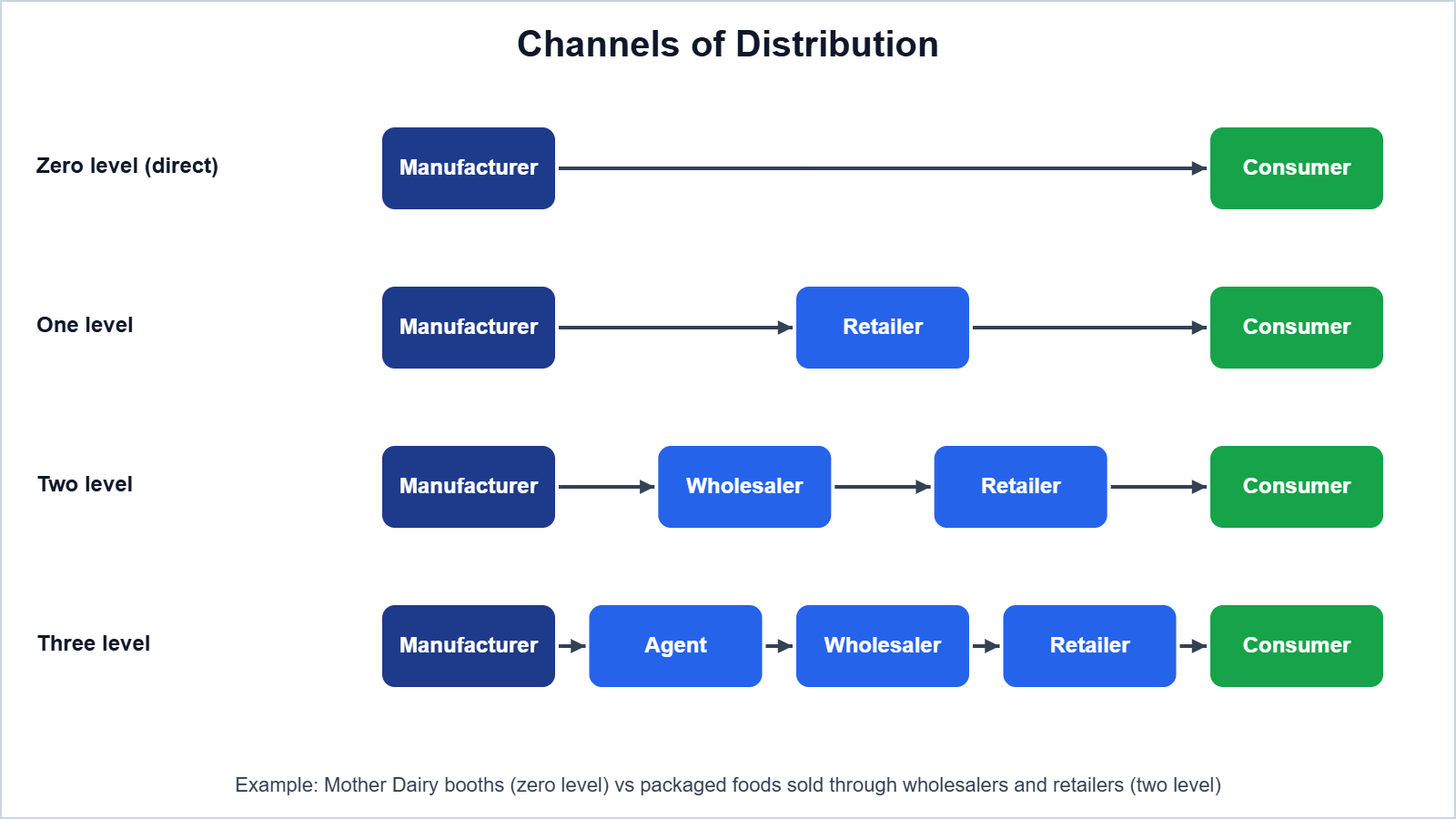
Channels of distribution are the persons or firms through which goods pass from the producer to the consumer.
Factor | Examples |
|---|---|
Product-related | Perishable or bulky goods need shorter channels; industrial products use direct channels |
Company characteristics | Financial strength and degree of control desired |
Competitive factors | Channels used by competitors |
Market factors | Size of market, geographical concentration, quantity purchased |
Environmental factors | Economic conditions and legal constraints |
6. Promotion: Meaning, Role and Promotion Mix
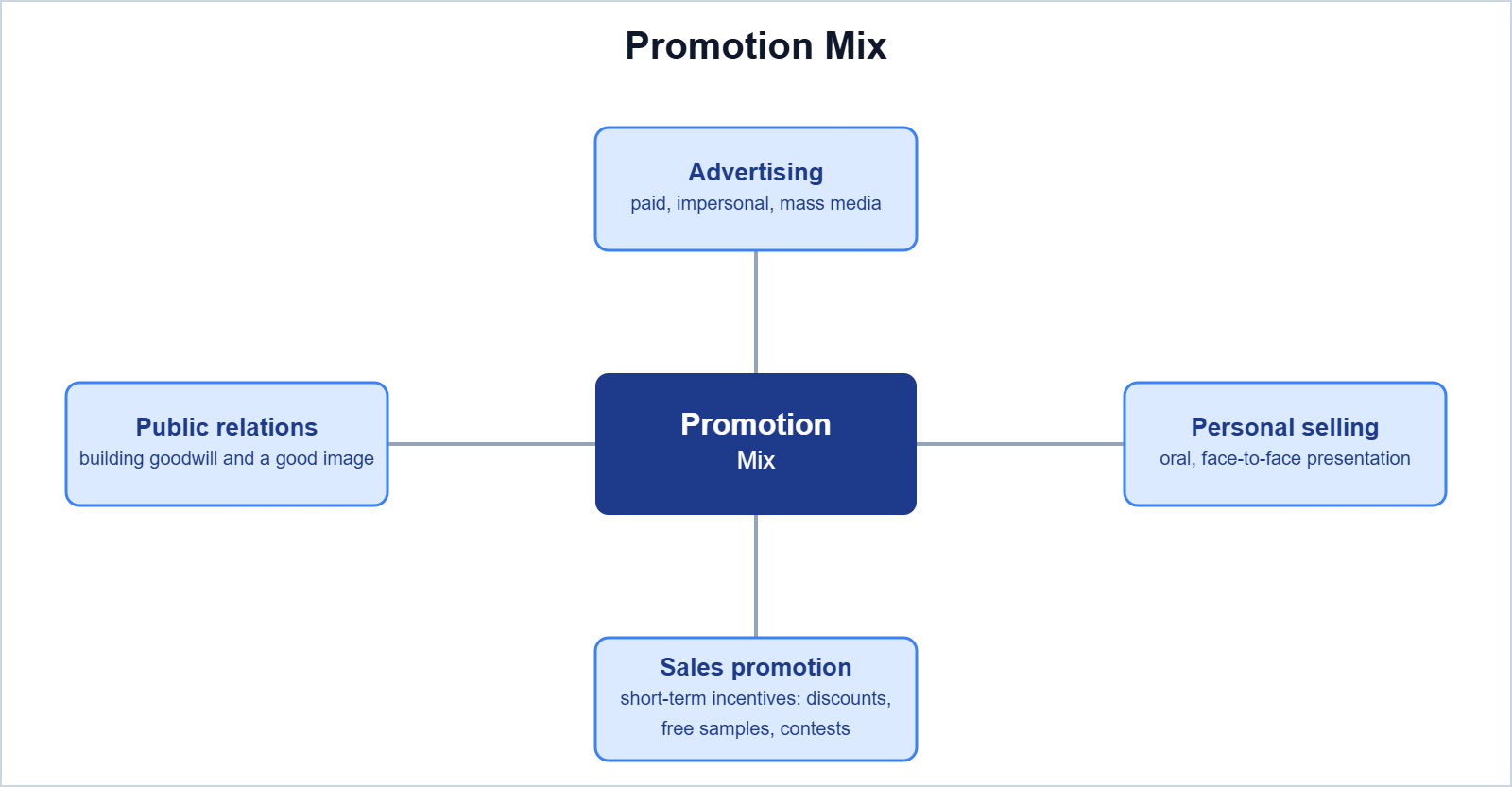
Promotion means communicating with customers to inform, persuade and remind them about products. It increases demand and builds brand image.
Basis | Advertising | Personal selling |
|---|---|---|
Form | Impersonal communication | Personal, face-to-face communication |
Flexibility | Inflexible (standard message) | Flexible (adjusted to each buyer) |
Reach | Large number of people | Limited number of people |
Cost per person | Low | High |
Feedback | Slow and difficult | Immediate |
Media | Newspapers, TV, radio, internet | Salespersons |
Role of advertising: mass reach, enhancing customer satisfaction and confidence, expressiveness, economical per person reached.
Role of personal selling: flexibility, direct feedback, minimum wastage, and building long-term relationships with customers.
Objections to advertising (and their answers):
Objection | Counter-argument |
|---|---|
Adds to cost | Increases demand, reduces per-unit cost through large-scale production |
Undermines social values (promotes materialism) | It informs buyers; buying is their choice |
Confuses the buyers | Gives information that helps comparison and better choice |
Encourages sale of inferior products | Quality is relative; a product cannot survive long on false claims |
Some ads are in bad taste | Regulated by self-regulatory bodies and laws |
7. Price: Factors Influencing Pricing
- Product cost (fixed, variable and semi-variable costs)
- Utility and demand (price elasticity)
- Extent of competition
- Government and legal regulations (e.g., price control of essential medicines)
- Pricing objectives (profit maximisation, market share, survival)
- Marketing methods used (distribution, advertising, after-sales services)
Exam point: In marketing mix questions, identify which P a situation describes: product features (Product), discounts (Price), retailers and transport (Place), advertisement (Promotion).
Easy Memory Trick: Physical distribution components “O-T-W-I”: Order processing, Transportation, Warehousing, Inventory control.
8. Important Questions
Q1. Define marketing.
Ans. A social process by which individuals and groups obtain what they need and want through creating, offering and exchanging products of value with others.
Q2. Give two differences between marketing and selling.
Ans. Marketing is wider and focuses on customer satisfaction; selling is narrower and focuses on transferring ownership of goods.
Q3. Name the four elements of the marketing mix.
Ans. Product, price, place and promotion.
Q4. Distinguish between convenience and shopping products.
Ans. Convenience products are bought frequently with little effort (bread); shopping products are bought after comparison (clothes).
Q5. What is a trademark?
Ans. A brand or part of a brand that is legally registered and protected.
Q6. Name the three levels of packaging.
Ans. Primary, secondary and transportation packaging.
Q7. What is a zero-level channel?
Ans. Direct sale from manufacturer to consumer without intermediaries.
Q8. Name the components of physical distribution.
Ans. Order processing, transportation, warehousing and inventory control.
Q9. Name the elements of the promotion mix.
Ans. Advertising, personal selling, sales promotion and public relations.
Q10. State two factors affecting the price of a product.
Ans. Product cost and extent of competition.
9. Case Study / Application Questions
Case 1. A Kullu shawl maker sells shawls only through his own showroom to tourists. Identify the channel.
Ans. Zero-level (direct) channel.
Case 2. A company offers “buy two, get one free” on soap for one month. Identify the promotion tool.
Ans. Sales promotion.
Case 3. A firm prints the ingredients, price, date of manufacture and expiry on its jam bottles. Which function is this?
Ans. Labelling.
Conclusion: Marketing focuses on customer needs. With the right product, price, place and promotion, firms can satisfy customers, increase sales and build long-term success.