Planning – Class 12 Business Studies Notes
Chapter – 4
Planning
1. Meaning of Planning
Planning means deciding in advance what to do and how to do it. It bridges the gap between where we are and where we want to be. It is the primary function of management.
2. Features of Planning
- Focuses on achieving objectives.
- Primary function of management (it comes first).
- Pervasive: required at all levels and in all departments.
- Continuous process.
- Futuristic: looks ahead.
- Involves decision-making (choosing among alternatives).
- Mental exercise (requires thinking and foresight).
3. Importance of Planning
- Provides direction.
- Reduces the risks of uncertainty.
- Reduces overlapping and wasteful activities.
- Promotes innovative ideas.
- Facilitates decision-making.
- Establishes standards for controlling.
4. Limitations of Planning
- Leads to rigidity.
- May not work in a dynamic environment.
- Reduces creativity.
- Involves huge costs.
- Is a time-consuming process.
- Does not guarantee success.
Example: A tour operator in Kullu planned all its trips months in advance. When a sudden landslide closed the highway, the fixed plan failed, showing that planning may not work in a dynamic environment.
5. Planning Process
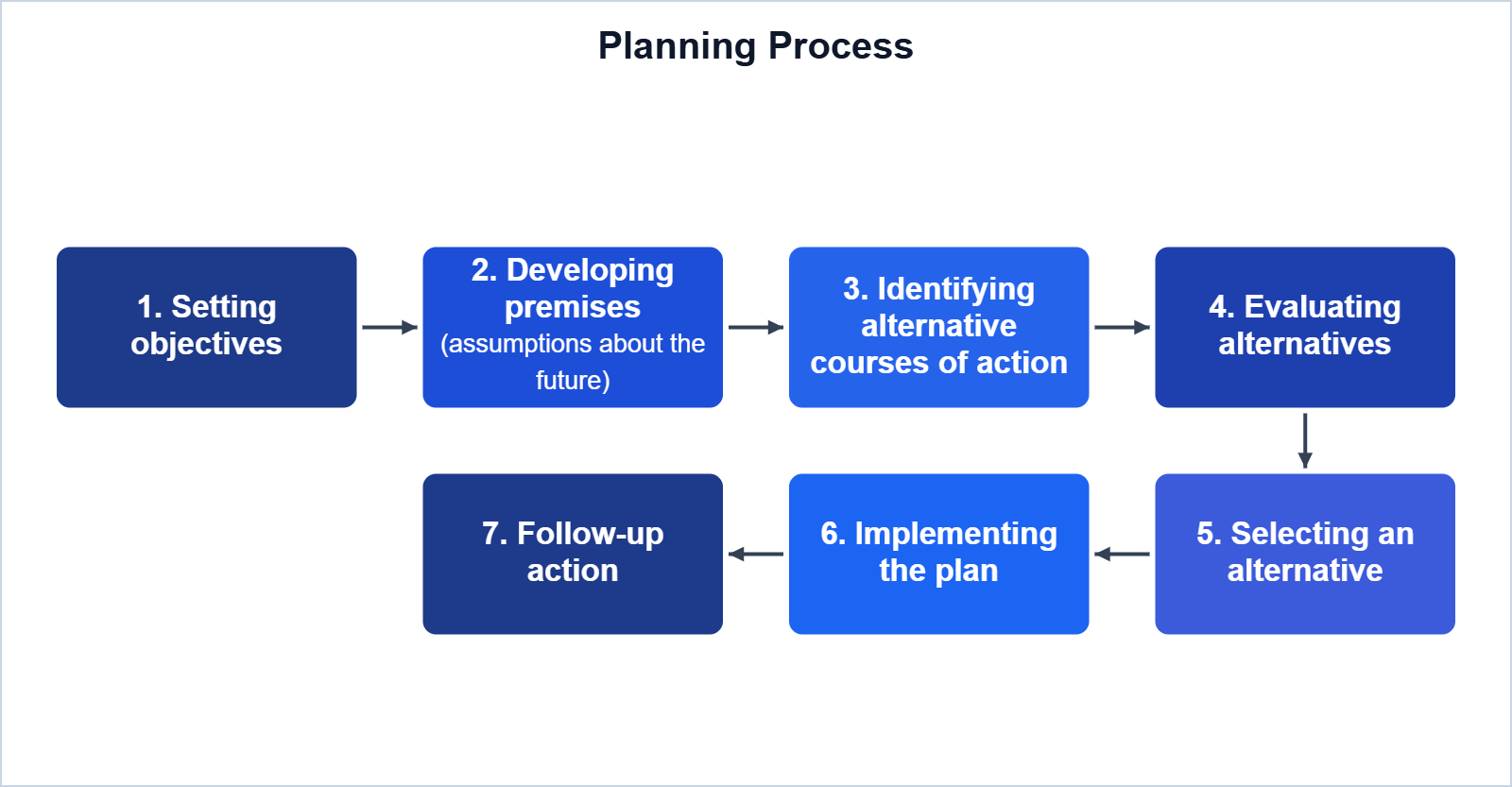
Remember: Premises are assumptions about the future, such as expected demand, government policy and interest rates.
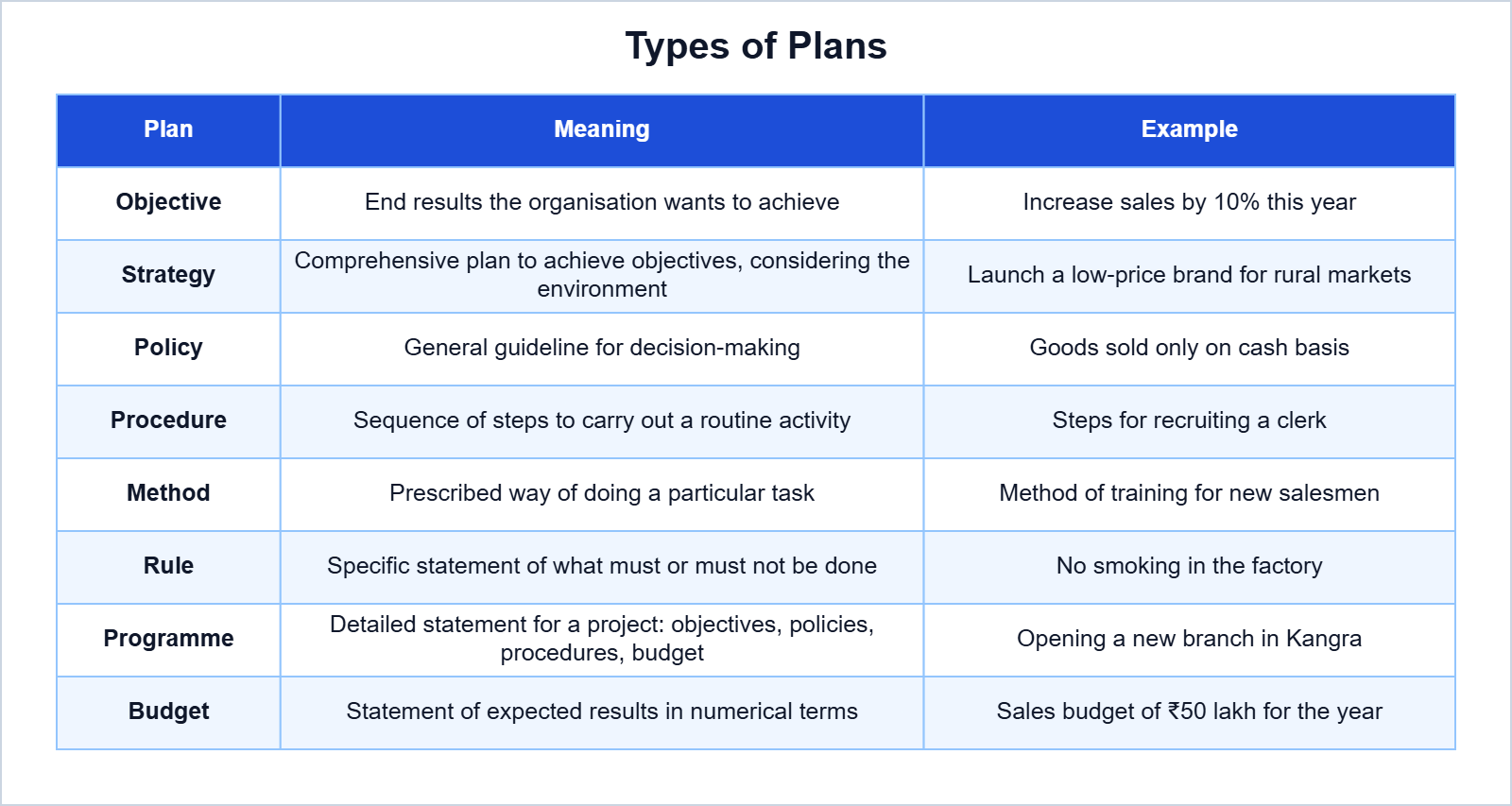
6. Types of Plans
Plans can be single-use plans (for a one-time event, such as a programme or budget) or standing plans (used repeatedly, such as policies, procedures, methods and rules).
Basis | Policy | Procedure |
|---|---|---|
Meaning | General guideline | Sequence of steps |
Nature | Allows some discretion | Specific and detailed |
Example | Recruit only graduates for clerical posts | Steps to issue an appointment letter |
Exam point: A rule allows no discretion and has a penalty for violation; a method is the best way of doing a single step of a procedure.
Easy Memory Trick: Types of plans “O-S-P-P-M-R-P-B”: Objective, Strategy, Policy, Procedure, Method, Rule, Programme, Budget.
7. Important Questions
Q1. Why is planning called the primary function of management?
Ans. Because it lays the foundation for all other functions; organising, staffing, directing and controlling are carried out within the framework of plans.
Q2. “Planning is a mental exercise.” Explain.
Ans. It requires thinking, foresight and judgement rather than physical activity.
Q3. How does planning reduce the risks of uncertainty?
Ans. By anticipating future changes and preparing to deal with them.
Q4. Why does planning lead to rigidity?
Ans. Once plans are fixed, managers may not be able to change them easily when the situation changes.
Q5. What are planning premises?
Ans. Assumptions about the future on which plans are based.
Q6. Distinguish between single-use and standing plans.
Ans. Single-use plans are made for one-time events (programmes, budgets); standing plans are used repeatedly (policies, procedures, rules).
Q7. What is a budget?
Ans. A statement of expected results expressed in numerical terms, such as a sales budget.
Q8. Define strategy.
Ans. A comprehensive plan for achieving organisational objectives, taking into account the business environment.
Q9. What is a programme?
Ans. A detailed statement about a project, outlining objectives, policies, procedures, rules, tasks and resources needed.
8. Case Study / Application Questions
Case 1. A company decided that “employees must wear safety helmets in the plant; violation will lead to a fine.” Identify the type of plan.
Ans. Rule.
Case 2. A firm prepared a statement showing expected sales of ₹1 crore and expenses of ₹70 lakh for next year. Identify the type of plan.
Ans. Budget.
Case 3. A manager said, “We assume demand will rise by 8% and interest rates will remain stable.” Which step of planning is this?
Ans. Developing premises.
Conclusion: Planning sets the direction of the organisation. Despite its limitations, a sound planning process and the right types of plans help businesses reduce uncertainty and achieve objectives.