Directing – Class 12 Business Studies Notes
Chapter – 7
Directing
1. Meaning, Importance and Principles of Directing
Directing means instructing, guiding, communicating and inspiring people in the organisation to achieve its objectives. It initiates action and takes place at every level of management.
Importance: initiates action, integrates employees’ efforts, guides employees to realise their potential, facilitates introduction of changes, and brings stability and balance in the organisation.
Principles of directing:
- Maximum individual contribution
- Harmony of objectives
- Unity of command
- Appropriateness of direction technique
- Managerial communication
- Use of informal organisation
- Leadership
- Follow through (monitoring and guiding)
2. Elements of Directing
The four elements of directing are supervision, motivation, leadership and communication.
3. Supervision
Supervision means overseeing what is being done by subordinates and giving instructions to ensure optimum use of resources and achievement of targets. It is mostly done at the first-line level by supervisors and foremen.
Importance: maintains day-to-day contact and friendly relations with workers; acts as a link between workers and management; maintains group unity; ensures performance of work as per targets; provides on-the-job training; builds morale; gives feedback.
4. Motivation
Motivation is the process of stimulating people to act to achieve desired goals. Related terms: motive (an inner state that energises behaviour), motivators (techniques used to motivate, like pay, promotion, recognition).
Importance: improves performance, changes negative attitudes to positive, reduces employee turnover and absenteeism, and helps introduce changes smoothly.
Incentives:
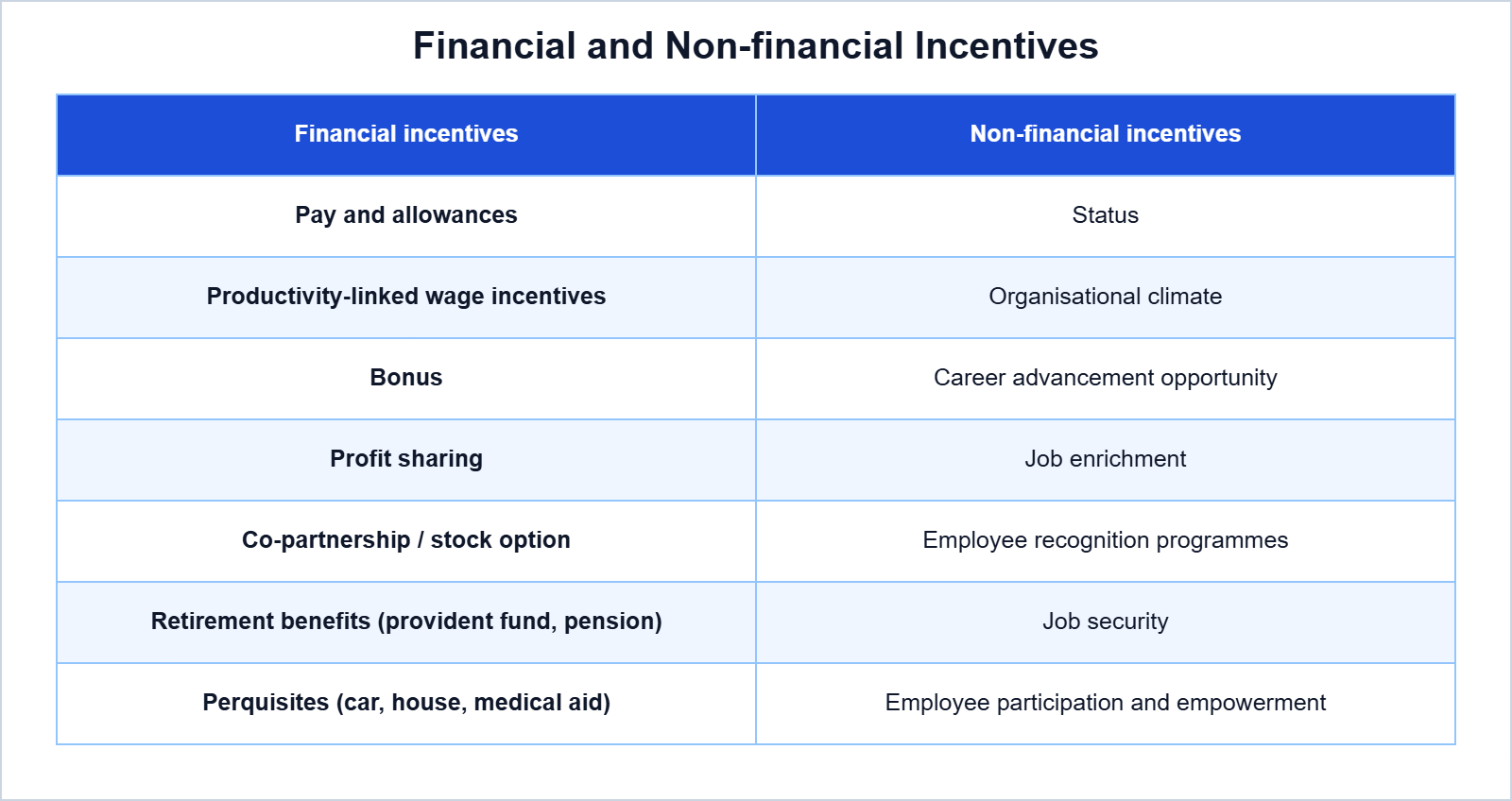
Example: A Himachal fruit processing unit gives a bonus at the end of the apple season (financial) and an “employee of the month” award (non-financial).
5. Leadership
Leadership is the process of influencing the behaviour of people so that they work willingly and enthusiastically to achieve group objectives.
Importance: influences people positively; maintains personal relations and helps followers fulfil needs; introduces required changes; handles conflicts effectively; trains subordinates and builds successors.
Qualities of a good leader: physical features, knowledge, integrity, initiative, communication skills, motivation skills, self-confidence, decisiveness and social skills.
6. Communication
Communication is the process of exchange of ideas, views, facts and feelings between two or more persons to create common understanding.
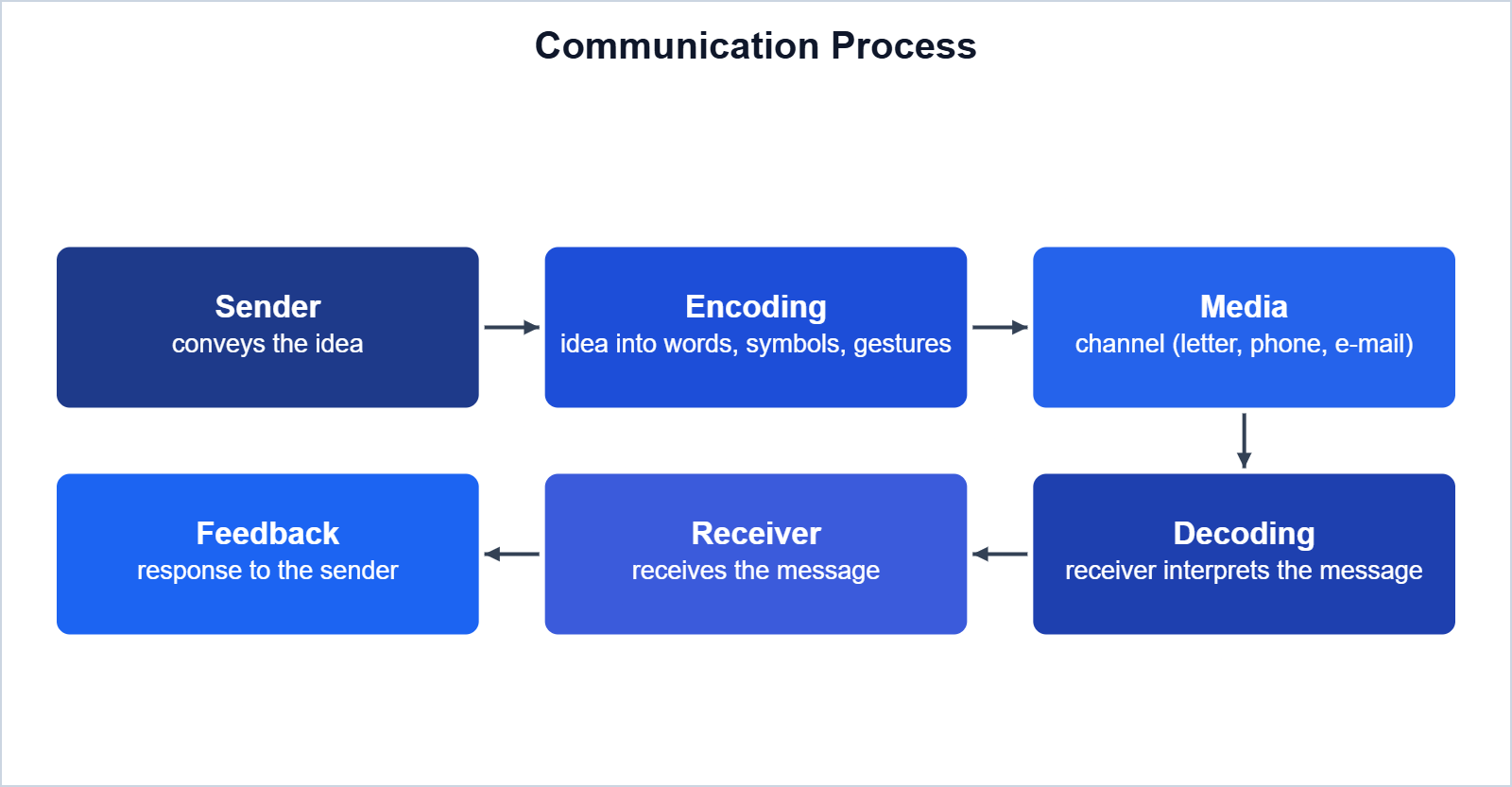
Noise is any obstruction to communication, such as a poor telephone line or an inattentive receiver.
Importance: acts as the basis of coordination; helps smooth working; acts as the basis of decision-making; increases managerial efficiency; promotes cooperation and industrial peace; establishes effective leadership; boosts morale.
Basis | Formal communication | Informal communication |
|---|---|---|
Meaning | Follows the official chain of command | Arises from social interactions (grapevine) |
Direction | Vertical (upward, downward) or horizontal | In any direction |
Speed | Slow | Fast |
Reliability | Reliable and documented | May spread rumours; not documented |
Networks | Single chain, wheel, circular, free flow, inverted V | Single strand, gossip, probability, cluster |
Improving communication: clarify ideas before communicating, communicate according to the needs of the receiver, consult others, be aware of language and tone, convey useful information, ensure proper feedback, follow up and listen attentively.
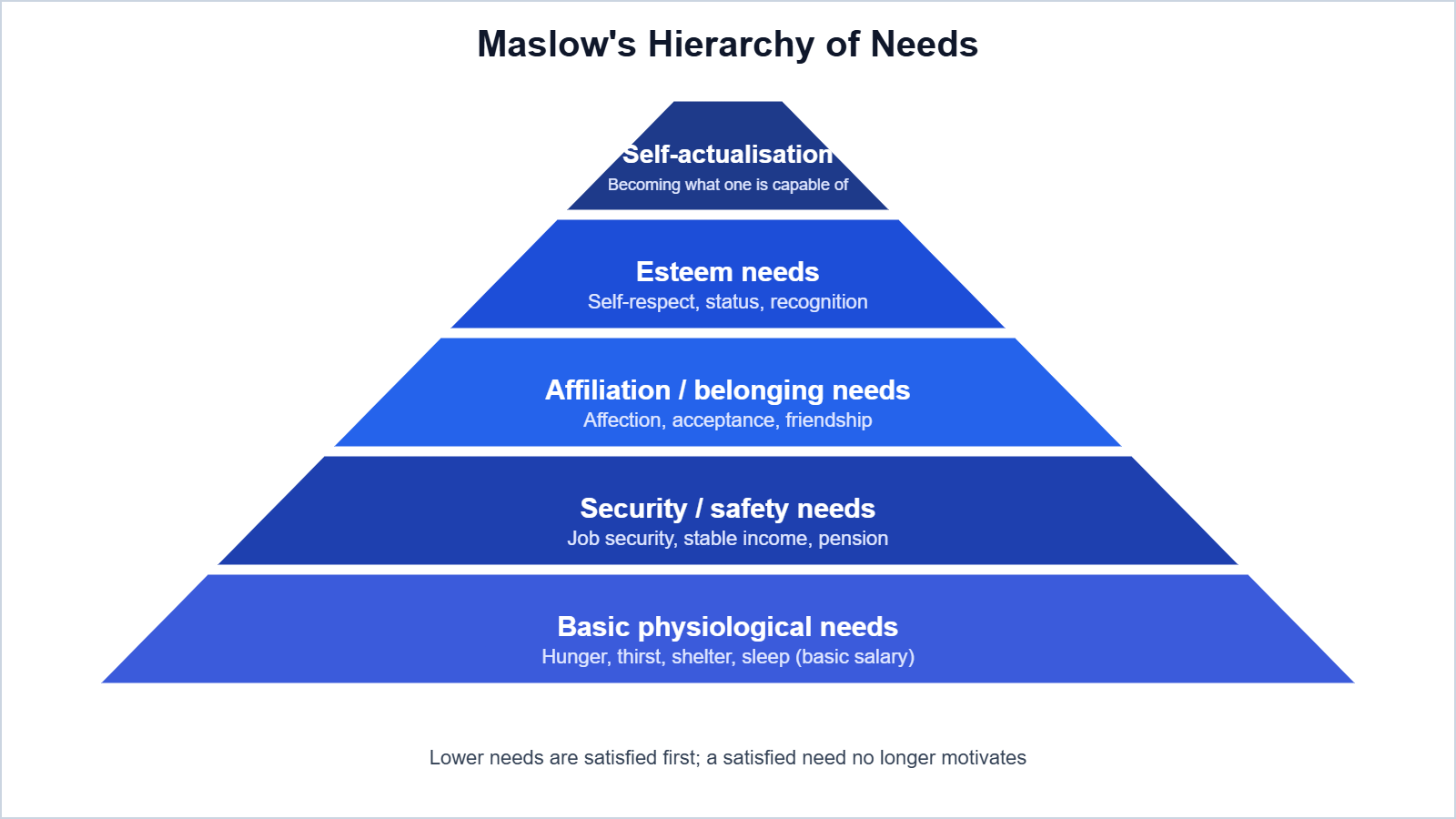
Exam point: Maslow’s needs in order from the bottom: Physiological, Safety, Affiliation, Esteem, Self-actualisation.
Easy Memory Trick: Elements of directing “S-M-L-C”: Supervision, Motivation, Leadership, Communication.
7. Important Questions
Q1. Define directing.
Ans. Instructing, guiding, communicating and inspiring people to achieve organisational objectives.
Q2. Name the four elements of directing.
Ans. Supervision, motivation, leadership and communication.
Q3. What is the principle of harmony of objectives?
Ans. Individual and organisational objectives should be in harmony, so that employees work for both.
Q4. Name the needs in Maslow’s hierarchy.
Ans. Physiological, safety, affiliation (belonging), esteem and self-actualisation.
Q5. What is job enrichment?
Ans. Designing jobs to include greater variety, responsibility and opportunity for growth, which motivates employees.
Q6. Give two examples of financial incentives.
Ans. Bonus and profit sharing.
Q7. What is grapevine?
Ans. The informal channel of communication.
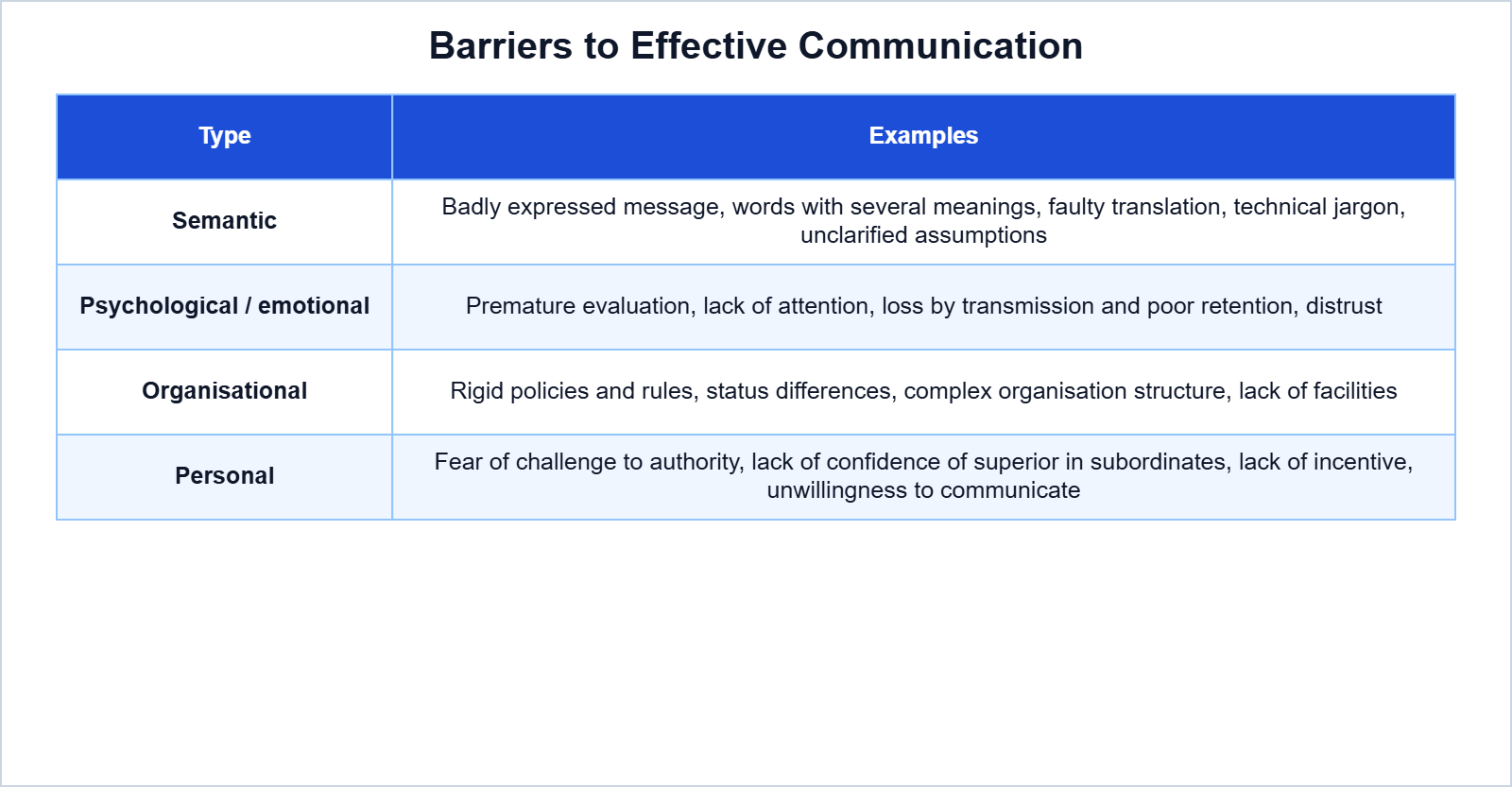
Q8. Name the four categories of communication barriers.
Ans. Semantic, psychological, organisational and personal barriers.
Q9. What is a semantic barrier? Give an example.
Ans. A barrier related to the meaning of words and language, such as technical jargon or faulty translation.
Q10. What is the role of a supervisor?
Ans. To oversee workers, maintain discipline, guide and train them, and act as a link between workers and management.
8. Case Study / Application Questions
Case 1. A company gave its employees shares at a price lower than the market price. Identify the incentive.
Ans. Co-partnership / employee stock option (financial incentive).
Case 2. A worker who has a secure job and good salary now wants recognition from his seniors. Which need is he trying to satisfy?
Ans. Esteem need.
Case 3. A manager’s English notice was misunderstood by workers in a factory near Una who mostly speak Hindi. Identify the barrier.
Ans. Semantic barrier (language).
Conclusion: Directing brings plans to life. Through supervision, motivation, leadership and effective communication, managers guide employees to work willingly towards organisational goals.