Staffing – Class 12 Business Studies Notes
Chapter – 6
Staffing
1. Meaning, Need and Importance of Staffing
Staffing is the managerial function of filling and keeping filled the positions in the organisation structure. It means putting the right person in the right job.
Need and importance:
- Helps in discovering and obtaining competent personnel.
- Ensures higher performance by putting the right person in the right job.
- Ensures continuous survival and growth through succession planning.
- Ensures optimum utilisation of human resources (avoids overmanning and shortage).
- Improves job satisfaction and morale through fair rewards.
2. Staffing as a Part of Human Resource Management
Human Resource Management (HRM) includes recruitment, selection, training, compensation, performance appraisal, maintaining labour relations, welfare and personnel records. Staffing is the managerial (people-related) part of HRM performed by every manager; in large firms, a separate HR department supports managers.
3. Steps in the Staffing Process
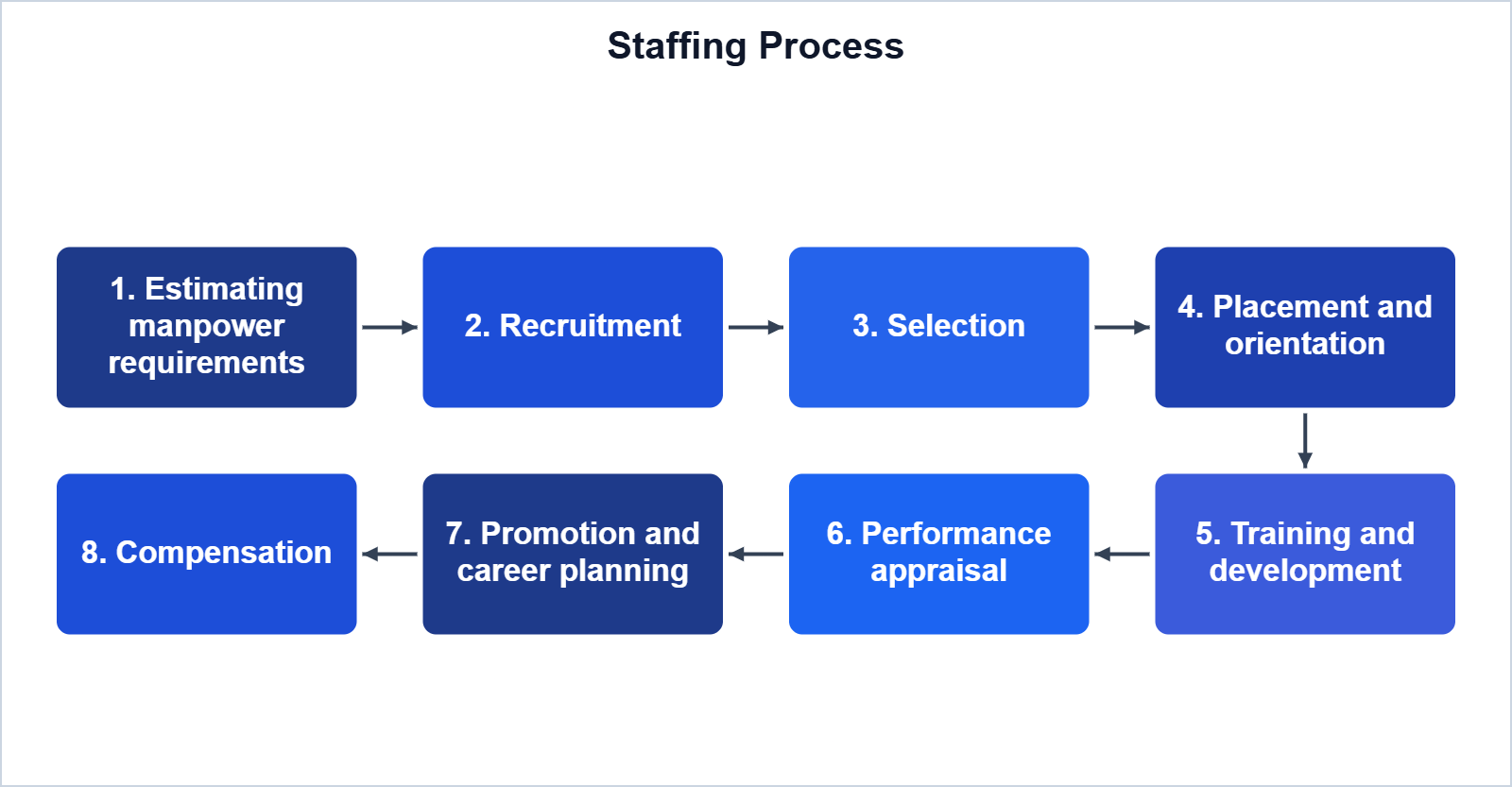
Remember: Workload analysis estimates the number and type of people needed; workforce analysis estimates the number and type of people available.
4. Recruitment: Meaning and Sources
Recruitment is the process of searching for prospective employees and stimulating them to apply for jobs in the organisation. It is a positive process (attracts many applicants).
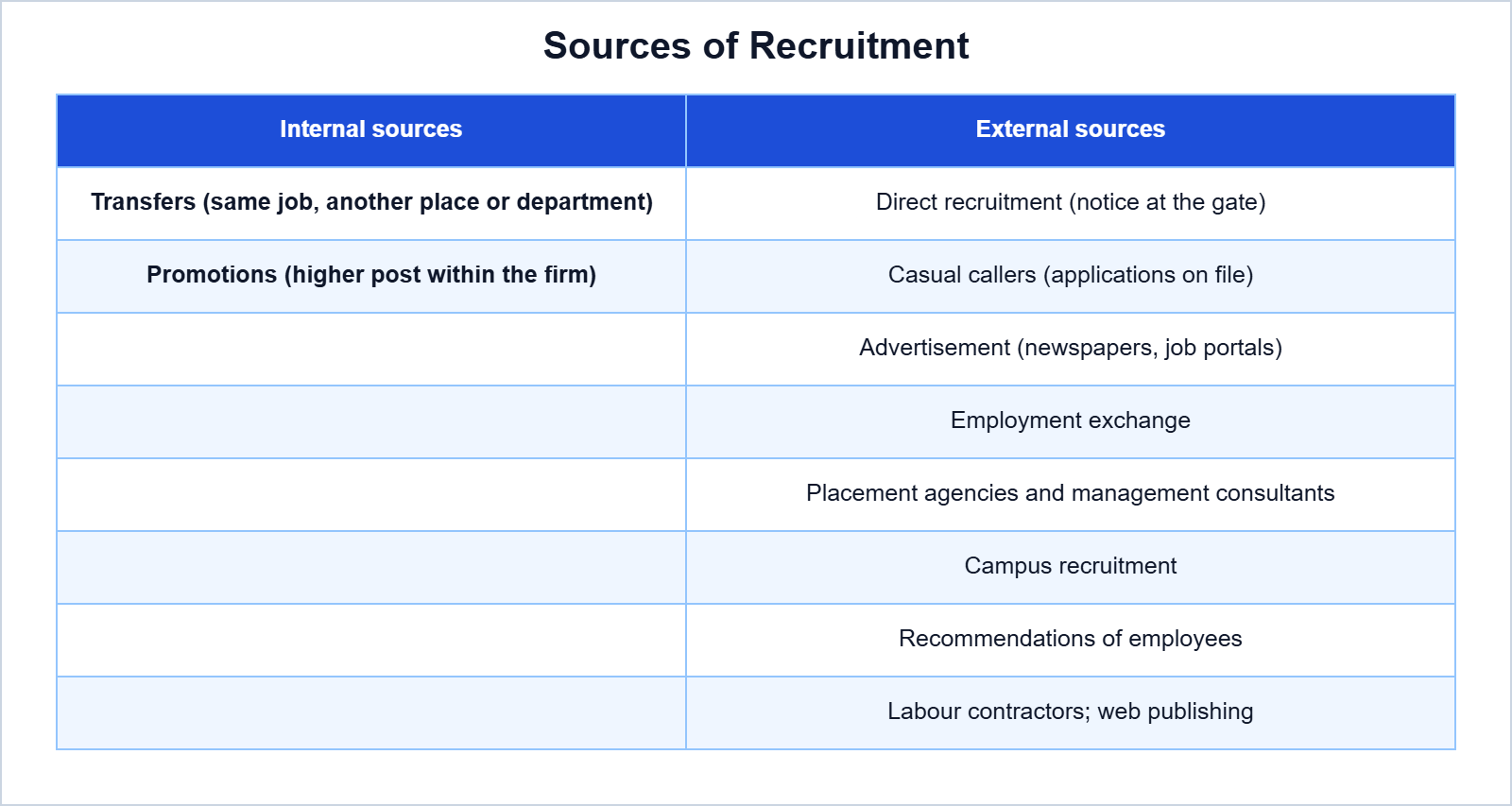
Basis | Internal sources | External sources |
|---|---|---|
Speed and cost | Quick and economical | Time-consuming and costly |
Motivation | Motivates existing employees (promotion) | May demotivate existing employees |
Fresh talent | No new blood | Brings fresh talent and ideas |
Choice | Limited | Wide choice |
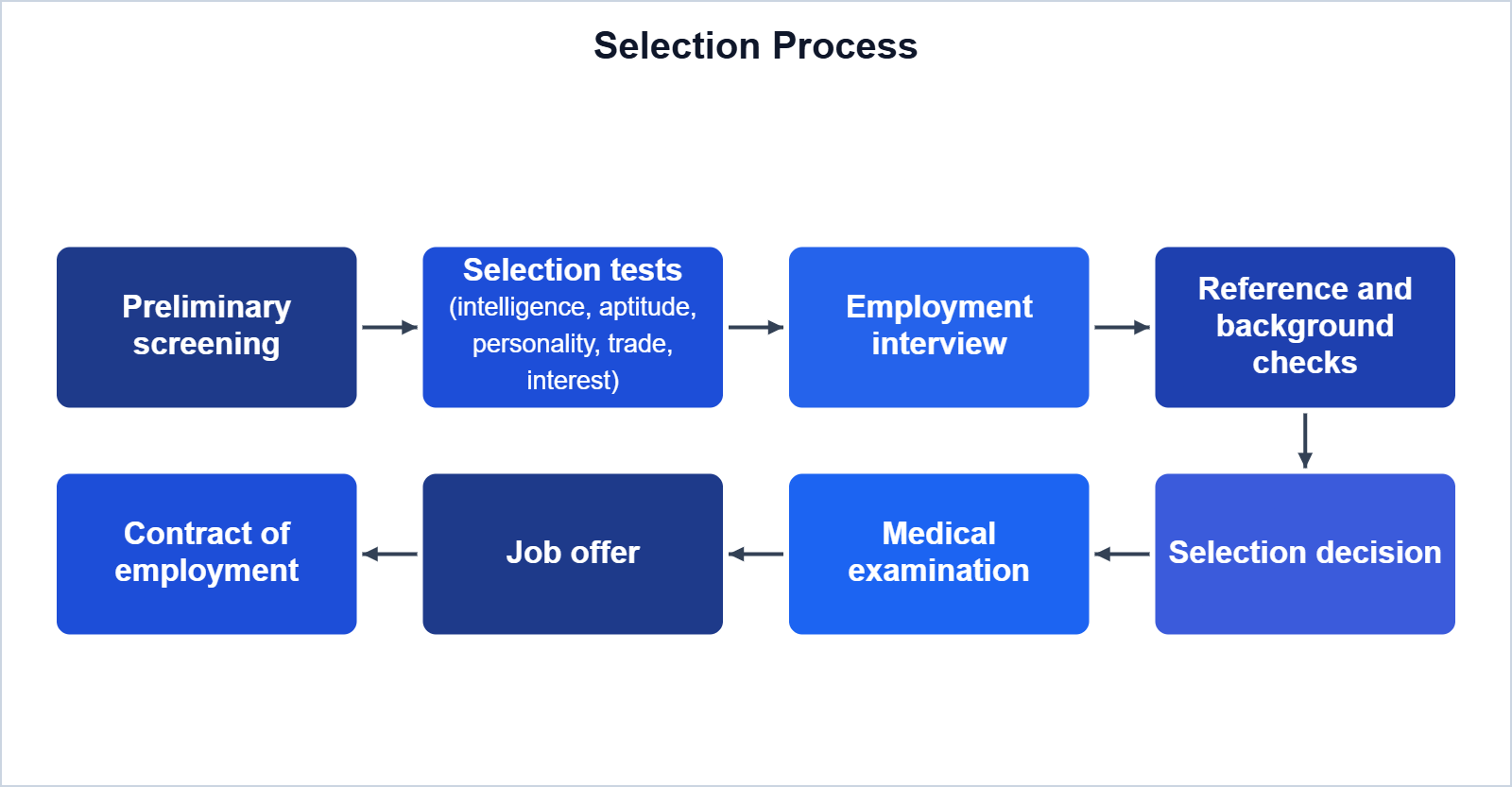
5. Selection: Meaning and Process
Selection is the process of identifying and choosing the best person from among the prospective candidates. It is a negative process (rejects unsuitable candidates).
Basis | Recruitment | Selection |
|---|---|---|
Meaning | Searching and attracting candidates | Choosing the best candidate |
Nature | Positive process | Negative process |
Sequence | Comes before selection | Comes after recruitment |
Contract | No contract is made | Ends in a contract of employment |
6. Training and Development
Training is a process of increasing the knowledge and skills of an employee for doing a particular job. Development is a broader process of overall growth of an individual, preparing for higher jobs. Training is job-oriented; development is career-oriented.
Need: improves skills and productivity, reduces wastage and accidents, increases job satisfaction and morale, helps adapt to new technology, and prepares employees for promotion.
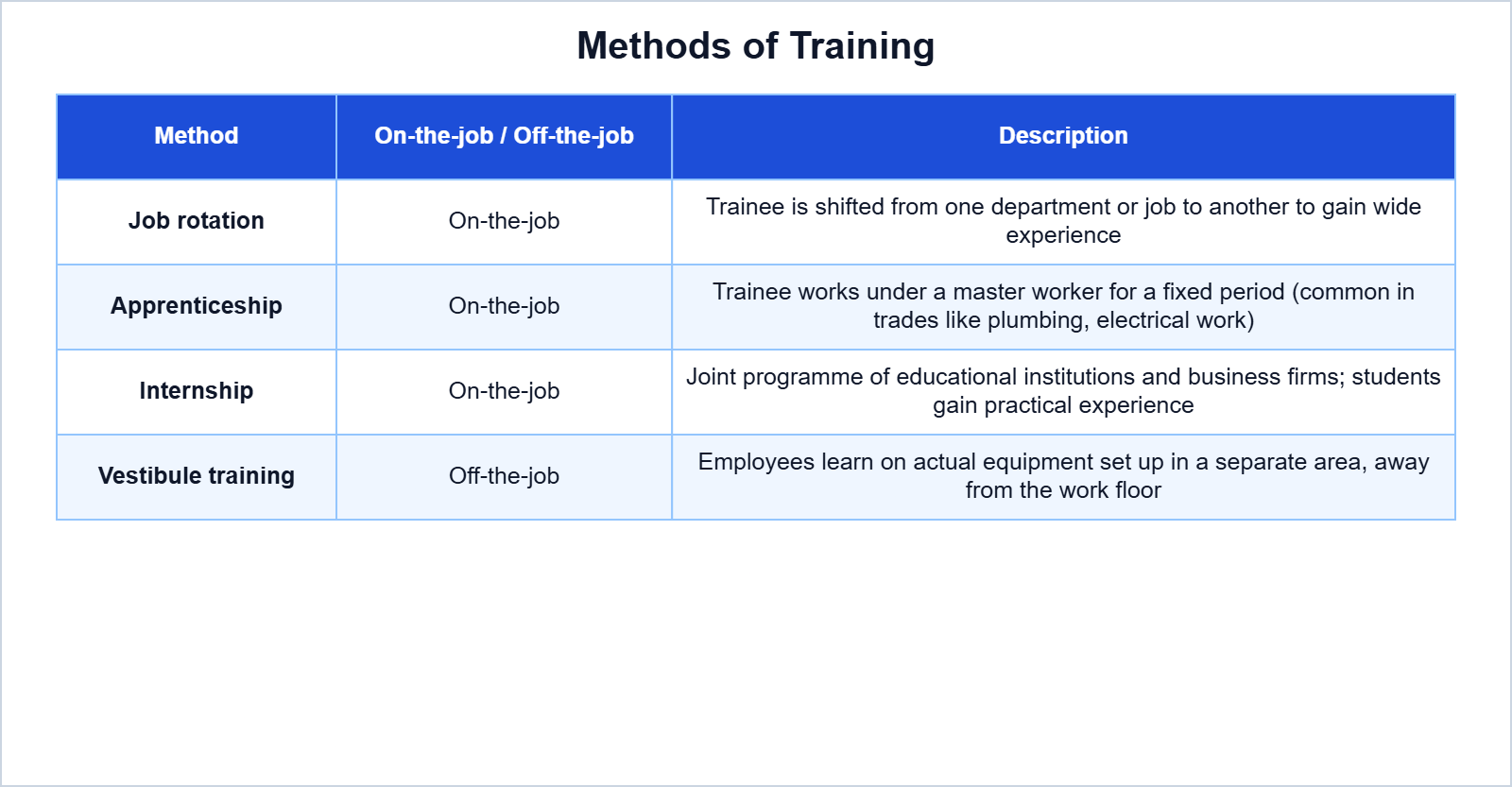
Exam point: Vestibule training is used when employees must handle sophisticated machines and equipment, so that production is not disturbed during training.
Easy Memory Trick: “Recruitment invites, Selection eliminates.”
7. Important Questions
Q1. What is staffing?
Ans. The function of filling and keeping filled the positions in the organisation with the right people.
Q2. Why is recruitment called a positive process?
Ans. Because it attracts as many candidates as possible to apply.
Q3. Why is selection called a negative process?
Ans. Because it involves rejecting unsuitable candidates.
Q4. Name two internal sources of recruitment.
Ans. Transfers and promotions.
Q5. What is campus recruitment?
Ans. Recruitment of students directly from colleges and institutes by employers.
Q6. Name any three selection tests.
Ans. Intelligence test, aptitude test and personality test.
Q7. What is the purpose of a reference check?
Ans. To verify the information given by the candidate and learn about past conduct and performance.
Q8. Distinguish between training and development.
Ans. Training increases skills for a specific job; development is overall growth preparing a person for future roles.
Q9. What is vestibule training?
Ans. Off-the-job training in which employees learn on actual equipment set up away from the actual work floor.
Q10. What is job rotation?
Ans. Shifting a trainee from one job or department to another to give a wide range of experience.
8. Case Study / Application Questions
Case 1. A Shimla-based hotel group appointed its assistant manager as the manager of its new Kasauli branch. Identify the source of recruitment.
Ans. Internal source: promotion (and transfer to a new place).
Case 2. Students of a polytechnic worked in a Baddi pharma factory for six weeks as part of their course. Identify the training method.
Ans. Internship training.
Case 3. Before final appointment, a company checked the health of the selected candidate. Identify the step of selection.
Ans. Medical examination.
Conclusion: Staffing ensures that the organisation has the right people in the right jobs at the right time. Recruitment, selection and training together build a competent and motivated workforce.