Financial Management – Class 12 Business Studies Notes
Chapter – 9
Financial Management
1. Meaning of Financial Management
Business finance means the money required for carrying out business activities. Financial management is concerned with the optimal procurement as well as the usage of finance.
2. Role of Financial Management
Financial management affects the size and composition of fixed assets, the amount and composition of current assets, the amount of long-term and short-term financing, the break-up of long-term financing into debt and equity, and all items in the profit and loss account (interest, expenses, depreciation).
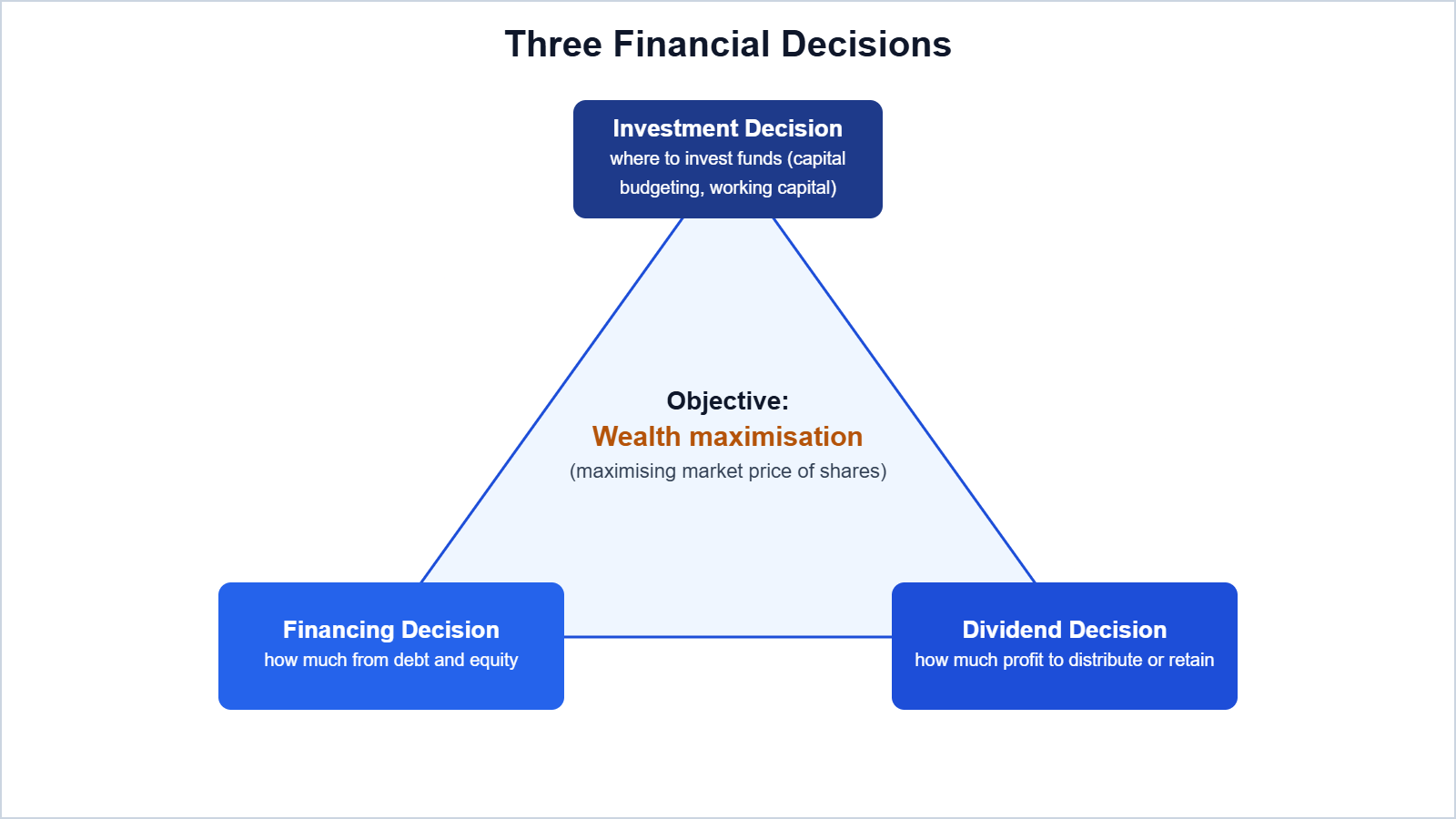
3. Objectives of Financial Management
The primary objective is wealth maximisation of shareholders, which means maximising the market price of equity shares. All financial decisions should increase the value of shares.
Remember: Investment decision includes long-term (capital budgeting) and short-term (working capital) decisions. Factors affecting capital budgeting: cash flows of the project, rate of return, investment criteria involved.
4. Financial Planning: Meaning and Importance
Financial planning is the preparation of a financial blueprint of an organisation’s future operations. Its twin objectives are: (1) to ensure the availability of funds whenever required, and (2) to see that the firm does not raise resources unnecessarily.
Importance: helps forecast and prepare for different situations; avoids business shocks and surprises; helps coordinate various business functions; reduces waste and duplication; links the present with the future; links investment and financing decisions; makes evaluation of performance easier.
5. Capital Structure: Meaning and Factors
Capital structure refers to the mix between owners’ funds (equity) and borrowed funds (debt). Debt is cheaper (interest is tax deductible) but riskier. Using more debt to increase return to equity shareholders is called financial leverage or trading on equity.
Example (trading on equity): A company needs ₹10,00,000. EBIT is ₹2,00,000 (return on investment 20%), interest on debt is 10% and tax is 30%.
Particulars | Plan A: all equity | Plan B: 50% debt |
|---|---|---|
Equity share capital (₹10 shares) | ₹10,00,000 (1,00,000 shares) | ₹5,00,000 (50,000 shares) |
10% Debt | – | ₹5,00,000 |
EBIT | ₹2,00,000 | ₹2,00,000 |
Less: Interest | – | ₹50,000 |
EBT | ₹2,00,000 | ₹1,50,000 |
Less: Tax @ 30% | ₹60,000 | ₹45,000 |
EAT | ₹1,40,000 | ₹1,05,000 |
EPS | ₹1.40 | ₹2.10 |
Since ROI (20%) is higher than the cost of debt (10%), using debt increases EPS from ₹1.40 to ₹2.10. If ROI were lower than the interest rate, debt would reduce EPS.

6. Fixed and Working Capital
Fixed capital refers to investment in long-term assets (land, buildings, machinery). Working capital refers to investment in current assets (inventory, debtors, cash). Net working capital = current assets – current liabilities.
Basis | Fixed capital | Working capital |
|---|---|---|
Meaning | Investment in long-term assets | Investment in current assets for day-to-day operations |
Period | Long term | Short term |
Decision type | Capital budgeting (irreversible, large amounts) | Working capital management |
Sources | Long-term sources (equity, debentures) | Short-term sources (bank credit, trade credit) |

Example: A hotel in Manali needs large fixed capital for its building but little working capital, while an apple trader needs large working capital during the harvest season (seasonal factor).
Exam point: A trading concern needs less fixed capital but more working capital; a manufacturing concern needs more of both.
Easy Memory Trick: Three decisions “I-F-D”: Investment, Financing, Dividend.
7. Important Questions
Q1. What is the primary objective of financial management?
Ans. Wealth maximisation, i.e., maximising the market price of equity shares.
Q2. Name the three financial decisions.
Ans. Investment, financing and dividend decisions.
Q3. State the twin objectives of financial planning.
Ans. Ensuring availability of funds when required, and avoiding raising funds unnecessarily.
Q4. What is capital structure?
Ans. The mix of owners’ funds (equity) and borrowed funds (debt) in a business.
Q5. What is trading on equity?
Ans. Increasing the return to equity shareholders by using fixed-cost debt when the return on investment is higher than the cost of debt.
Q6. Why is debt considered cheaper than equity?
Ans. Because interest on debt is tax deductible and lenders bear less risk, so they expect a lower return.
Q7. Give two factors affecting the dividend decision.
Ans. Amount of earnings, stability of earnings, cash flow position, growth opportunities (any two).
Q8. Why does a business with a long production cycle need more working capital?
Ans. Because funds remain blocked in raw materials and work-in-progress for a longer time.
Q9. Distinguish between fixed and working capital.
Ans. Fixed capital is invested in long-term assets; working capital is invested in current assets for daily operations.
8. Case Study / Application Questions
Case 1. A company decided to buy new machinery worth ₹2 crore for a new plant in Nalagarh. Which financial decision is this?
Ans. Investment decision (capital budgeting).
Case 2. A firm with ROI of 18% raised funds through 9% debentures to increase EPS. Identify the concept.
Ans. Trading on equity (financial leverage).
Case 3. An umbrella manufacturer keeps a large stock before the monsoon. Which factor affects its working capital?
Ans. Seasonal factor.
Conclusion: Financial management ensures that funds are raised and used optimally. Sound investment, financing and dividend decisions, careful financial planning and the right capital structure increase the wealth of shareholders.