Nature and Significance of Management – Class 12 Business Studies Notes
Chapter – 1
Nature and Significance of Management
1. Concept of Management
Management is the process of getting things done with the aim of achieving goals effectively and efficiently. Effectiveness means completing the job on time (doing the right task); efficiency means doing it with minimum cost and resources (doing the task right).
Example: A Shimla apple-packing unit that ships all its orders before the season ends is effective; if it also reduces wastage of boxes and labour, it is efficient.
Characteristics of management:
- Goal-oriented process
- All-pervasive (in every type and level of organisation)
- Multi-dimensional: management of work, people and operations
- Continuous process
- Group activity
- Dynamic function (adapts to the environment)
- Intangible force (its presence is felt in results)
2. Objectives of Management
Objective | Meaning |
|---|---|
Organisational | Survival, profit and growth of the business |
Social | Creating benefits for society: quality goods, employment, environment-friendly methods |
Personal | Meeting the financial, social and higher-level needs of employees |
3. Importance of Management
- Helps in achieving group goals.
- Increases efficiency (reduces costs, increases productivity).
- Creates a dynamic organisation that adapts to change.
- Helps in achieving personal objectives of employees.
- Helps in the development of society.
4. Nature of Management: Science, Art and Profession
Basis | Science | Art | Profession |
|---|---|---|---|
Feature | Systematic body of knowledge with principles of universal validity | Personal skill, creativity and practice | Well-defined knowledge, restricted entry, professional association, ethical code, service motive |
Is management one? | Yes, but an inexact (behavioural) science | Yes; success depends on creativity and practice | Not a full profession: no restricted entry, membership of bodies like AIMA is not compulsory |
Remember: Management is best described as both a science and an art, and it is moving towards becoming a profession.
5. Levels of Management

Level | Main functions |
|---|---|
Top | Integrating diverse elements, coordinating activities, setting objectives and strategies, responsible for welfare and survival of the organisation |
Middle | Interpreting policies of top management, assigning duties, motivating, cooperating with other departments, ensuring adequate staff |
Supervisory | Overseeing workers, maintaining discipline, ensuring quality and minimising wastage, linking management and workers |
6. Functions of Management
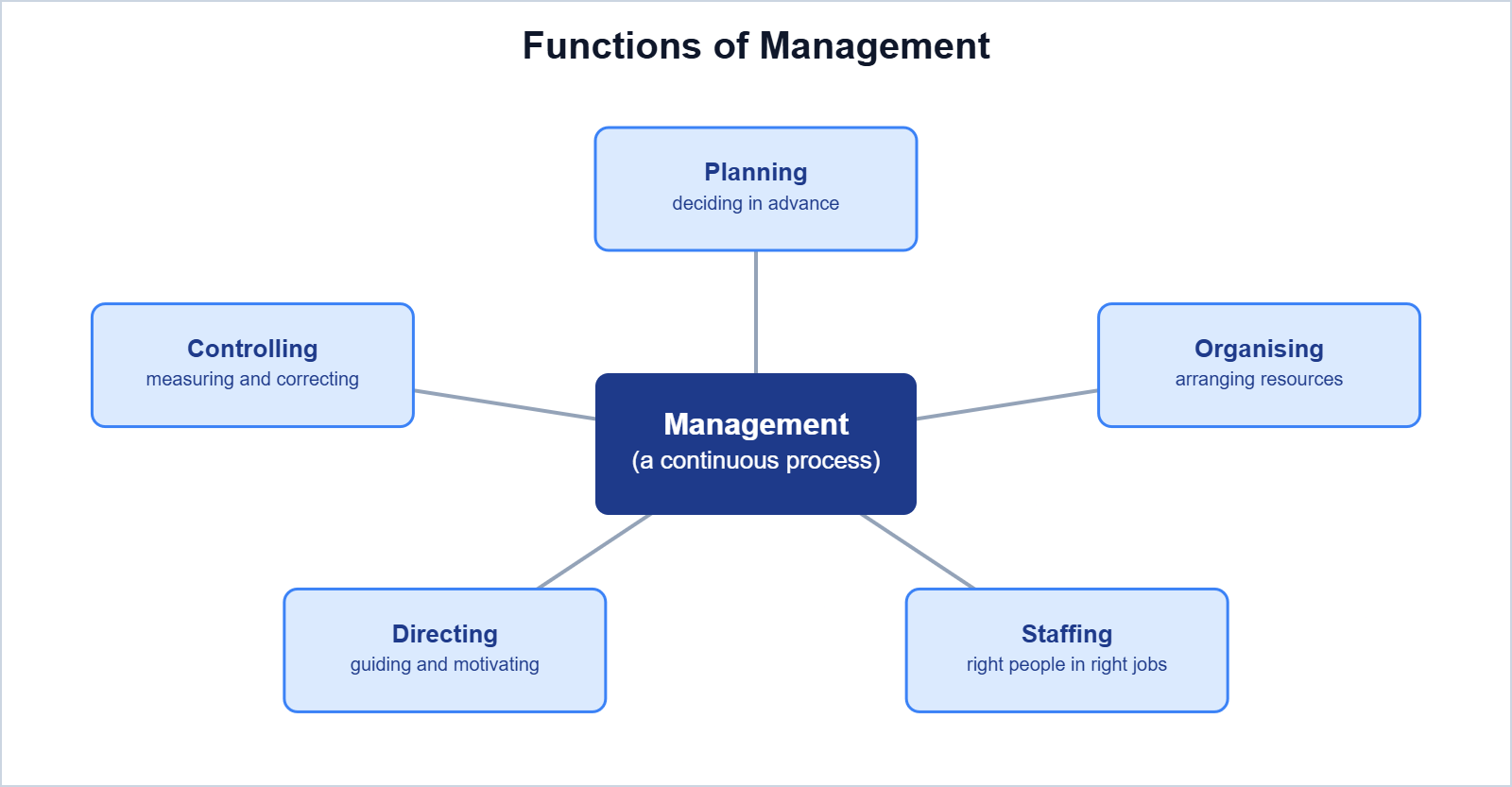
- Planning: deciding in advance what to do and how to do it.
- Organising: assigning duties, grouping tasks, establishing authority and allocating resources.
- Staffing: finding the right people for the right job.
- Directing: leading, influencing, motivating and communicating with employees.
- Controlling: monitoring performance and correcting deviations from plans.
7. Coordination: Nature and Importance
Coordination is the process by which a manager synchronises the activities of different departments. It is called the essence of management because it is needed at every level and in every function.
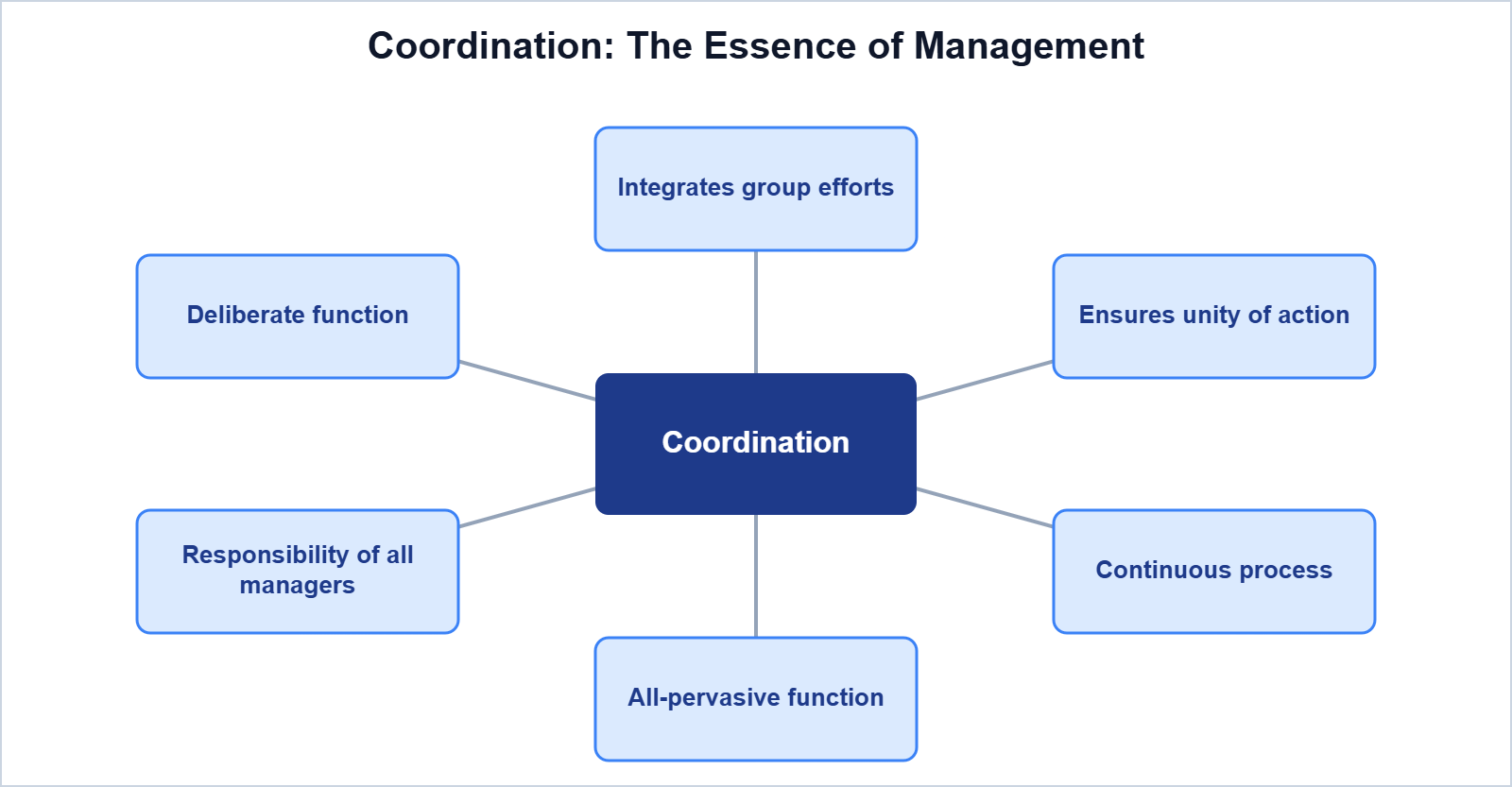
Importance: it is needed because of the growth in size of organisations, functional differentiation (departments may pursue their own goals) and specialisation (specialists may not consult others).
Exam point: Coordination is not a separate function of management; it is the force that binds all functions together.
Easy Memory Trick: Functions of management “POSDC”: Planning, Organising, Staffing, Directing, Controlling.
8. Important Questions
Q1. Distinguish between effectiveness and efficiency.
Ans. Effectiveness is completing the task and achieving the goal on time; efficiency is doing the task with minimum cost and resources.
Q2. Why is management called a multi-dimensional activity?
Ans. Because it includes management of work, management of people and management of operations.
Q3. Name the three objectives of management.
Ans. Organisational, social and personal objectives.
Q4. Is management a profession? Give two reasons.
Ans. Not fully: there is no restriction on entry (no compulsory degree) and membership of a professional association is not compulsory.
Q5. Give two functions of top-level management.
Ans. Formulating overall objectives and strategies, and coordinating the activities of all departments.
Q6. Who works at the supervisory level?
Ans. Foremen and supervisors, who directly oversee the workforce.
Q7. Why is coordination called the essence of management?
Ans. Because it is needed in all functions and at all levels to integrate the efforts of different people and departments towards common goals.
Q8. State two features of coordination.
Ans. It is a continuous process and it is the responsibility of all managers.
Q9. What does “management is an intangible force” mean?
Ans. It cannot be seen but its presence is felt in orderly working, achieved targets and satisfied employees.
9. Case Study / Application Questions
Case 1. A dairy in Mandi produced 10,000 litres of milk products in a day as targeted, but used extra fuel and labour to do so. Which concept is it lacking?
Ans. Efficiency. The dairy was effective (it met its target) but not efficient (resources were wasted).
Case 2. The marketing department of a firm promised quick delivery, but the production department could not produce in time. Which concept of management is missing?
Ans. Coordination between departments.
Case 3. Rohit, a manager, also ensures that the firm uses eco-friendly packaging and provides jobs to local youth. Which objective of management is he fulfilling?
Ans. Social objectives.
Conclusion: Management is a goal-oriented, continuous and all-pervasive process. Through its functions and coordination at all levels, it ensures that organisational, social and personal objectives are achieved effectively and efficiently.