Controlling – Class 12 Business Studies Notes
Chapter – 8
Controlling
1. Meaning of Controlling
Controlling means ensuring that activities in an organisation are performed as per the plans. It involves comparing actual performance with planned standards and taking corrective action where needed. It is both a primary (all managers do it) and a continuous function, and it is both backward-looking and forward-looking.
2. Importance of Controlling
- Accomplishing organisational goals.
- Judging accuracy of standards.
- Making efficient use of resources.
- Improving employee motivation.
- Ensuring order and discipline.
- Facilitating coordination in action.
Limitations: difficulty in setting quantitative standards for some activities; little control on external factors; resistance from employees; costly affair.
3. Relationship between Planning and Controlling

Planning and controlling are inseparable twins. Planning is a prerequisite for controlling, and controlling is meaningless without planning. Planning is prescriptive, controlling is evaluative.
4. Steps in the Process of Control
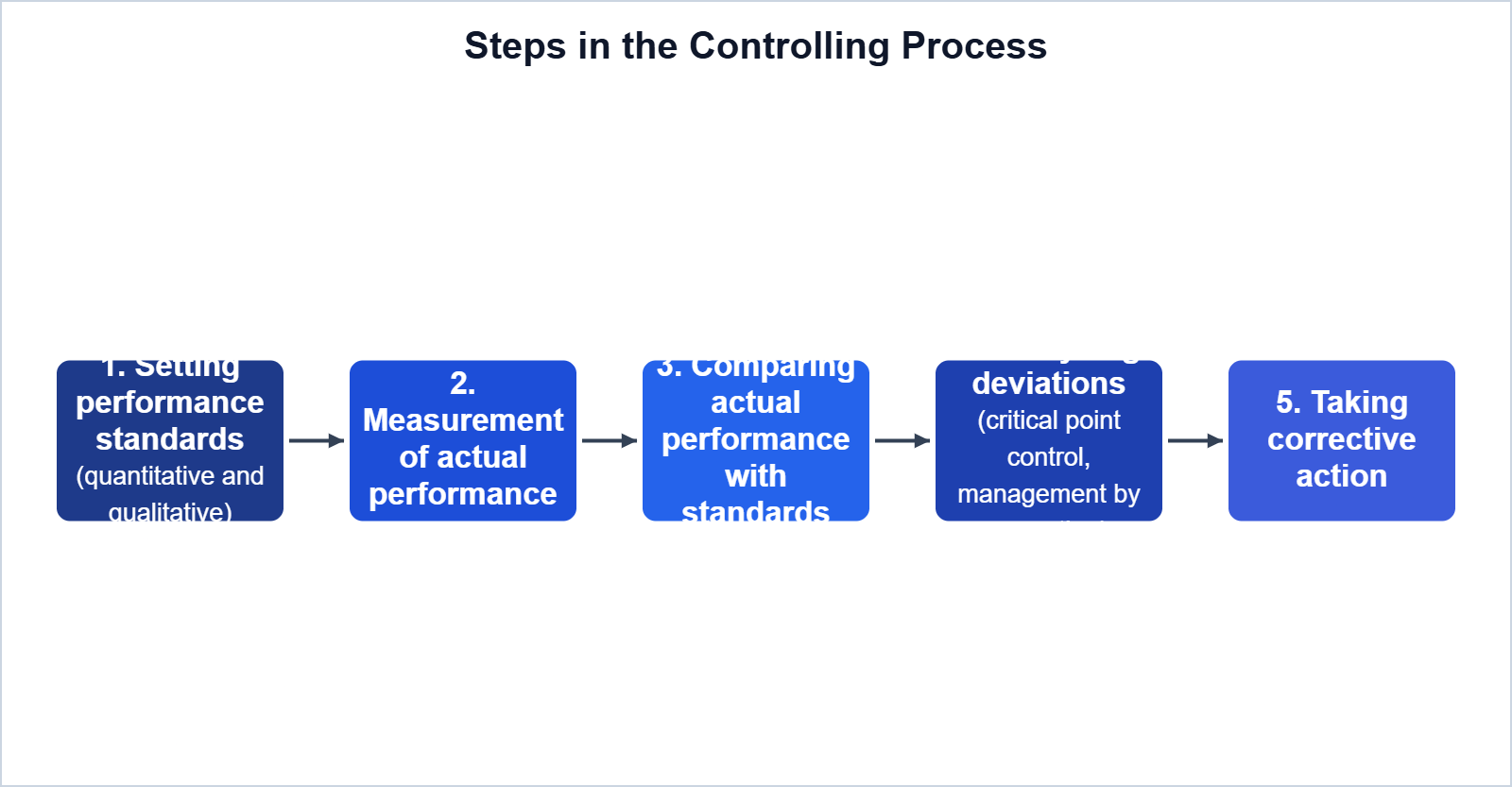
Critical point control: focus on key result areas (KRAs) that are critical to success, as it is neither economical nor easy to check everything.
Management by exception: only significant deviations beyond an acceptable limit should be brought to the notice of management.
Example (analysing deviation): The standard cost of production is ₹1,000 per unit and the actual cost is ₹1,050. Deviation = 50 / 1,000 x 100 = 5%. If the acceptable limit is 2%, this deviation must be reported to management (management by exception).
Corrective actions: training workers when output is low due to lack of skill; repairing or replacing machinery when it is faulty; changing suppliers when raw material is defective.
Exam point: Controlling is the last function of management, but it leads back to planning, making management a continuous cycle.
Easy Memory Trick: Control steps “S-M-C-A-T”: Set standards, Measure, Compare, Analyse, Take action.
5. Important Questions
Q1. Define controlling.
Ans. Ensuring that activities are performed according to plans by comparing actual performance with standards and taking corrective action.
Q2. Why is controlling called both backward-looking and forward-looking?
Ans. It reviews past performance and also helps improve future performance and plans.
Q3. State two points of importance of controlling.
Ans. It helps accomplish organisational goals and ensures efficient use of resources.
Q4. “Planning and controlling are inseparable twins.” Explain.
Ans. Planning sets standards that controlling checks; without plans there is nothing to control, and without control plans cannot be achieved.
Q5. What is critical point control?
Ans. Focusing control on key result areas that are critical to the success of the organisation.
Q6. What is management by exception?
Ans. Bringing only significant deviations (beyond acceptable limits) to the attention of management.
Q7. Name the steps of the controlling process.
Ans. Setting standards, measuring actual performance, comparing, analysing deviations and taking corrective action.
Q8. Give one limitation of controlling.
Ans. It is difficult to set quantitative standards for some activities, such as employee morale.
6. Case Study / Application Questions
Case 1. A tea estate in Palampur decided that only a fall in output of more than 10% would be reported to the general manager. Identify the principle.
Ans. Management by exception.
Case 2. A company found that actual sales were 20% below target and started a training programme for its salesmen. Which step of controlling is this?
Ans. Taking corrective action.
Case 3. A firm controls only the quality of its key raw material, as it affects the whole product. Identify the concept.
Ans. Critical point control.
Conclusion: Controlling ensures that plans are carried out as intended. With clear standards, accurate measurement and timely corrective action, it completes the management cycle and leads back to better planning.