Organising – Class 12 Business Studies Notes
Chapter – 5
Organising
1. Meaning and Importance of Organising
Organising is the process of identifying and grouping the activities to be performed, defining authority and responsibility, and establishing relationships so that people can work together effectively to achieve objectives. It translates plans into action.
Importance:
- Benefits of specialisation.
- Clarity in working relationships.
- Optimum utilisation of resources.
- Adaptation to change.
- Effective administration.
- Development of personnel.
- Expansion and growth.
2. Steps in the Process of Organising

3. Organisation Structure: Functional and Divisional
Organisation structure is the framework within which managerial and operating tasks are performed. The span of management (number of subordinates a manager can effectively manage) determines the levels of management.
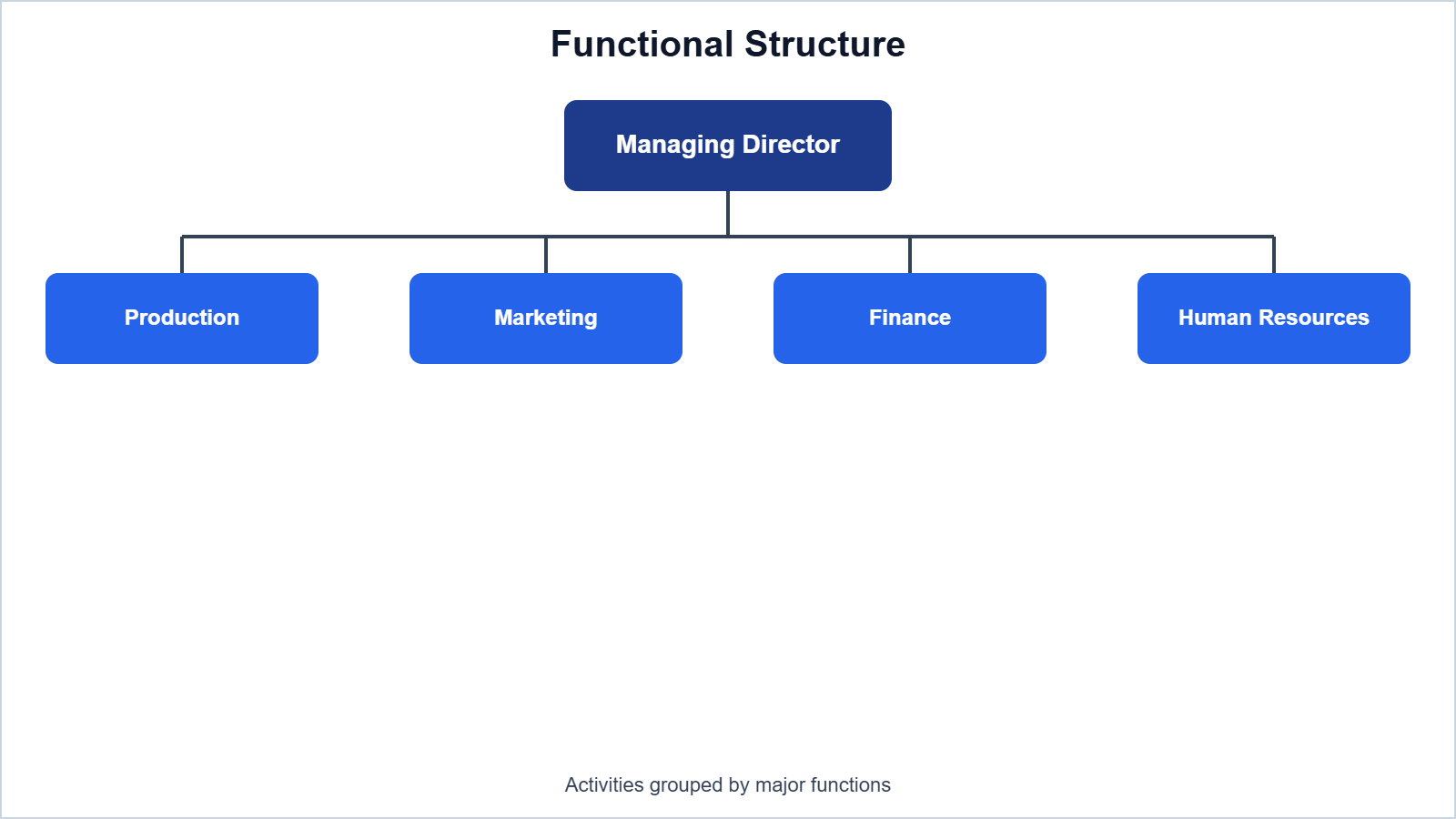
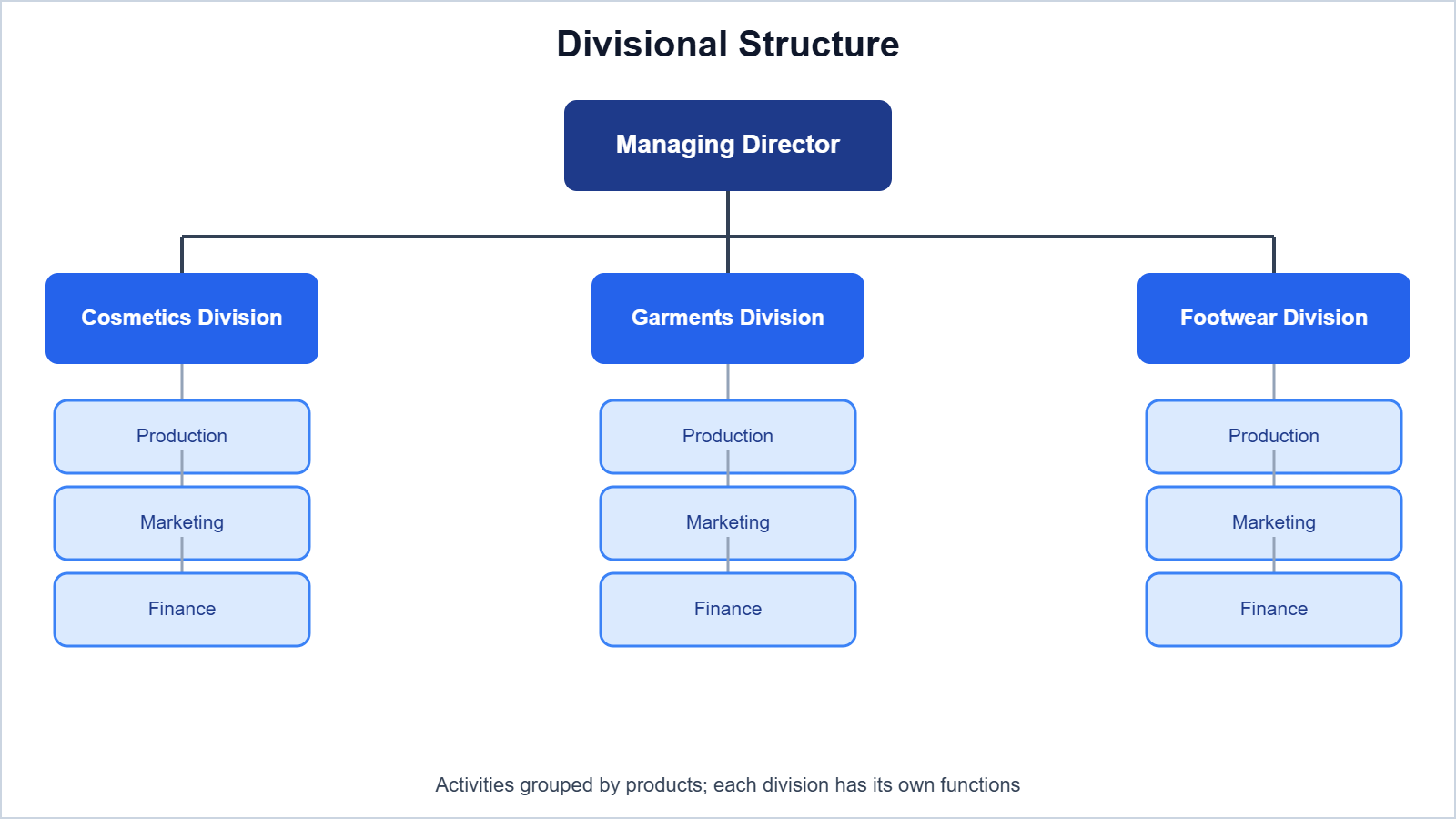
Basis | Functional structure | Divisional structure |
|---|---|---|
Formation | Based on functions | Based on product lines |
Specialisation | Functional specialisation | Product specialisation |
Responsibility | Difficult to fix for a product | Easy to fix for each division |
Managerial development | Difficult, as each manager knows one function | Easier, as divisional heads gain wide experience |
Cost | Economical (no duplication) | Costly (duplication of functions) |
Suitable for | Large firms with one product line | Large firms with diversified products |
4. Formal and Informal Organisation
Basis | Formal organisation | Informal organisation |
|---|---|---|
Meaning | Structure of authority relationships created by management | Network of social relationships arising from interaction among employees |
Origin | Arises from rules and policies | Arises from social interaction |
Authority | Arises from position | Arises from personal qualities |
Behaviour | Directed by rules | No set behaviour pattern |
Flow of communication | Through the scalar chain | Not through a planned route (grapevine) |
Nature | Rigid | Flexible |
Leadership | Managers are leaders | Leaders chosen voluntarily by members |
Remember: Informal organisation helps in faster spread of information and fulfils social needs, but it may also spread rumours and resist change.
5. Delegation: Meaning, Elements and Importance
Delegation is the downward transfer of authority from a superior to a subordinate. The manager still remains accountable for the final result.
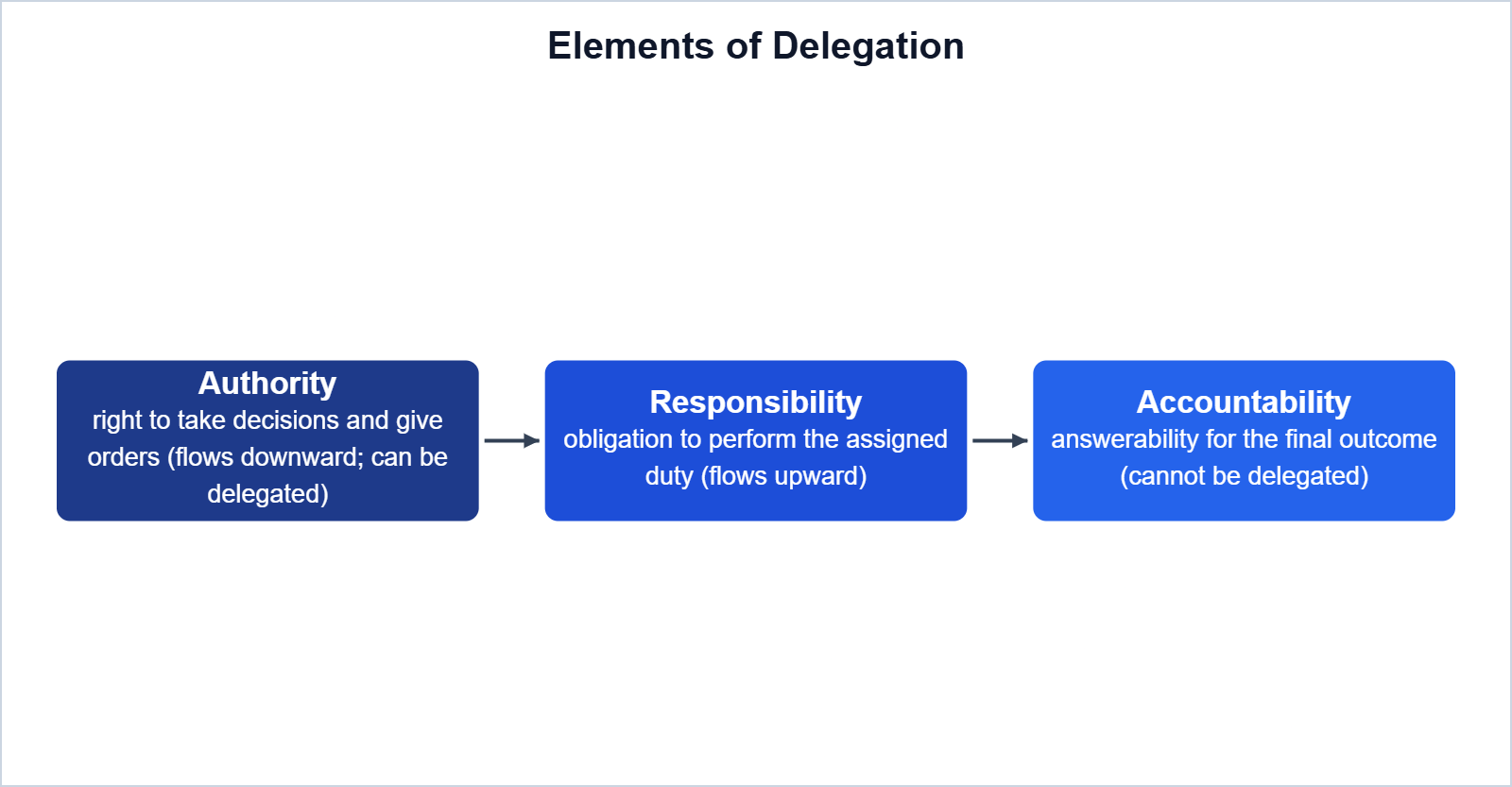
Importance of delegation: effective management (managers free for important work), employee development, motivation of employees, facilitation of growth, basis of management hierarchy, better coordination.
Exam point: Authority can be delegated, responsibility is assumed, and accountability cannot be delegated.
6. Decentralisation: Meaning and Importance
Decentralisation means systematic dispersal of decision-making authority to the lower levels of the organisation, keeping only important decisions at the top. Every organisation has some degree of both centralisation and decentralisation.
Importance: develops initiative among subordinates, develops managerial talent for the future, quick decision-making, relief to top management, facilitates growth, better control.
7. Difference between Delegation and Decentralisation
Basis | Delegation | Decentralisation |
|---|---|---|
Nature | Compulsory act (no one can do everything alone) | Optional policy decision of top management |
Freedom of action | More control by superiors | Less control; more freedom to subordinates |
Status | A process of transferring authority | Result of the policy (delegation extended to the lowest level) |
Scope | Narrow (superior and immediate subordinate) | Wide (across the whole organisation) |
Purpose | To lessen the burden on the manager | To increase the role of subordinates |
Easy Memory Trick: Delegation elements “A-R-A”: Authority, Responsibility, Accountability (Authority goes down, Accountability goes up and stays).
8. Important Questions
Q1. Define organising.
Ans. The process of identifying and grouping activities, defining authority and responsibility, and establishing relationships to achieve objectives.
Q2. What is departmentalisation?
Ans. Grouping of similar activities into departments, units or sections.
Q3. What is span of management?
Ans. The number of subordinates that can be effectively managed by a superior.
Q4. Which structure is suitable for a company with many product lines?
Ans. Divisional structure.
Q5. State two disadvantages of functional structure.
Ans. It may lead to conflict between departments and difficulty in fixing responsibility for a product.
Q6. What is grapevine?
Ans. The informal channel of communication in an informal organisation.
Q7. Can accountability be delegated? Why?
Ans. No. The manager remains answerable to his superior for the final outcome even after delegating authority.
Q8. Is decentralisation compulsory?
Ans. No, it is an optional policy decision of top management.
Q9. Give two points of importance of decentralisation.
Ans. It develops managerial talent and enables quick decision-making.
9. Case Study / Application Questions
Case 1. A company manufacturing soaps, garments and shoes has a separate manager for each product, each with production and marketing staff. Identify the structure.
Ans. Divisional structure.
Case 2. Employees of a hotel in Dharamshala who play cricket together after work share information faster than official notices. Identify the concept.
Ans. Informal organisation (grapevine communication).
Case 3. The sales manager gave a salesman authority to offer discounts up to 5%, but the sales manager still answers to the director for total sales. Identify the concept.
Ans. Delegation; accountability remains with the sales manager.
Conclusion: Organising turns plans into action by grouping work, assigning duties and setting up authority relationships. The right structure, delegation and decentralisation help organisations grow efficiently.