Principles of Management – Class 12 Business Studies Notes
Chapter – 2
Principles of Management
1. Principles of Management: Meaning
A principle of management is a broad and general guideline for decision-making and behaviour. Principles are not rigid like the laws of physics; they are applied with judgement according to the situation.
2. Nature of Principles
- Universal applicability: apply to all kinds of organisations.
- General guidelines: not ready-made solutions.
- Formed by practice and experimentation.
- Flexible: can be modified as needed.
- Mainly behavioural: aim to influence human behaviour.
- Cause and effect relationship.
- Contingent: depend on the situation.
3. Significance of Principles
- Provide managers with useful insights into reality.
- Optimum utilisation of resources and effective administration.
- Scientific decisions based on facts.
- Help meet changing environmental requirements.
- Help fulfil social responsibility.
- Useful in management training, education and research.
4. Fayol’s Principles of Management
Henri Fayol (1841-1925), a French mining engineer, gave 14 principles of general management in his book on general and industrial administration. He is called the father of general management.

Principle | Meaning in brief |
|---|---|
Division of work | Work divided into small tasks, done by specialists |
Authority and responsibility | Balance between the right to command and the obligation to perform |
Discipline | Obedience to rules and agreements; good superiors and fair agreements |
Unity of command | Each employee receives orders from only one superior |
Unity of direction | One head and one plan for a group of activities with the same objective |
Subordination of individual interest | Interests of the organisation come before individual interests |
Remuneration | Fair and reasonable pay for employees |
Centralisation and decentralisation | Balance between concentration and dispersal of decision-making |
Scalar chain | Formal line of authority from top to bottom; gang plank allows direct communication between same-level employees in emergencies |
Order | A place for everything and everyone, and everything in its place |
Equity | Kindliness and justice in treating employees |
Stability of tenure | Employees should not be moved frequently |
Initiative | Workers should be encouraged to develop and carry out plans |
Esprit de corps | Team spirit and harmony (“we” instead of “I”) |
Exam point: Unity of command relates to one superior for each employee; unity of direction relates to one plan for each group of activities with the same objective.
5. Taylor’s Scientific Management
F.W. Taylor (1856-1915), an American engineer, is called the father of scientific management. Scientific management means knowing exactly what you want people to do and seeing that they do it in the best and cheapest way.
Principles of scientific management:
- Science, not rule of thumb: use scientific methods instead of trial and error.
- Harmony, not discord: cooperation between management and workers; requires a “mental revolution” in both.
- Cooperation, not individualism: management and workers work together.
- Development of each and every person to his or her greatest efficiency and prosperity.
Techniques of scientific management:
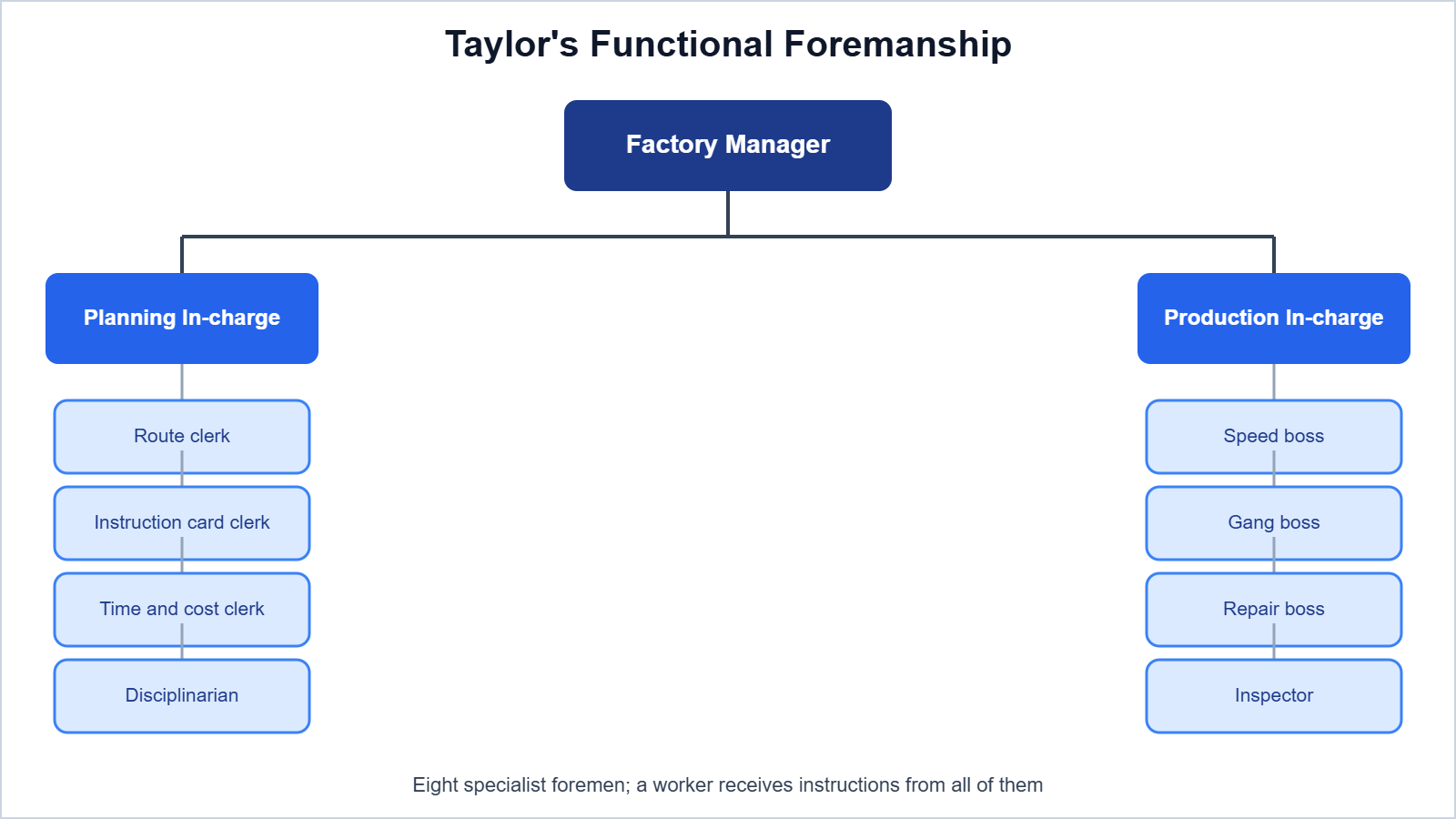
- Functional foremanship: separation of planning and execution, with eight specialist foremen.
- Standardisation and simplification of work: setting standards and eliminating unnecessary varieties of products.
- Method study: finding the best way of doing a job.
- Motion study: eliminating unnecessary movements.
- Time study: finding the standard time for a job.
- Fatigue study: deciding rest intervals.
- Differential piece wage system: higher rate for efficient workers who meet the standard, lower rate for those below it.
Example (differential piece wage): Standard output is 10 units a day. The rate is ₹50 per unit for workers who meet the standard and ₹40 per unit for those below it. Worker A makes 11 units and earns 11 x 50 = ₹550; worker B makes 9 units and earns 9 x 40 = ₹360. The difference of ₹190 motivates B to improve.
6. Fayol vs Taylor

Easy Memory Trick: “Fayol = Office (general administration); Taylor = Factory (shop floor).”
7. Important Questions
Q1. Why are principles of management called flexible?
Ans. Because they can be modified by managers according to the requirements of a situation.
Q2. State the principle of unity of command.
Ans. An employee should receive orders from one superior only.
Q3. What is a gang plank?
Ans. A short cut in the scalar chain that allows employees at the same level to communicate directly in an emergency.
Q4. What is esprit de corps?
Ans. Team spirit and unity among employees, encouraged by the manager.
Q5. What is meant by “mental revolution”?
Ans. A change in attitudes of both management and workers towards each other, from competition to cooperation.
Q6. Explain functional foremanship.
Ans. Separation of planning and execution, with four specialists under the planning in-charge and four under the production in-charge, each a specialist in one area.
Q7. Distinguish between time study and motion study.
Ans. Time study finds the standard time to do a job; motion study eliminates unnecessary movements in doing it.
Q8. What is the purpose of fatigue study?
Ans. To decide the amount and frequency of rest intervals for workers to restore efficiency.
Q9. Give two differences between Fayol and Taylor.
Ans. Fayol focused on top-level management and believed in unity of command; Taylor focused on shop floor and did not follow unity of command (functional foremanship).
8. Case Study / Application Questions
Case 1. In a company in Baddi, the production manager asks a worker to speed up output, while the quality manager asks him to slow down for quality. Which principle is violated?
Ans. Unity of command (the worker receives orders from two superiors).
Case 2. A factory pays ₹60 per unit to workers who produce the standard 20 units a day and ₹50 per unit to those who produce less. Which technique is used?
Ans. Differential piece wage system (Taylor).
Case 3. A hotel in Manali gives each department one head and one plan for its activities. Which principle is followed?
Ans. Unity of direction.
Conclusion: Fayol’s principles guide general administration, while Taylor’s scientific management improves productivity at the shop floor. Together they form the foundation of modern management.