Cash Flow Statement – Class 12 Accountancy Notes
Chapter – 10
Cash Flow Statement
1. Objectives of Cash Flow Statement
A Cash Flow Statement shows the inflows and outflows of cash and cash equivalents of a business during a period, classified into operating, investing and financing activities. It is prepared as per AS-3 (Revised). Its objective is to provide information about the historical changes in cash and cash equivalents of an enterprise.
2. Benefits of Cash Flow Statement
- Shows how cash was generated and used.
- Helps in assessing the ability to pay debts and dividends.
- Helps in short-term planning and cash management.
- Helps compare the performance of different firms, as it removes the effect of different accounting policies on profit.
- Shows the reasons for differences between profit and cash.
3. Cash and Cash Equivalents
Cash includes cash in hand and demand deposits with banks. Cash equivalents are short-term, highly liquid investments that are readily convertible into known amounts of cash and have an insignificant risk of change in value, usually with a maturity of three months or less from the date of acquisition (for example, short-term deposits, treasury bills, commercial paper).
4. Cash Flows
Cash flows are inflows and outflows of cash and cash equivalents. Movements between cash and cash equivalents (such as depositing cash in a bank or buying a 2-month treasury bill) are not cash flows.
5. Classification of Activities
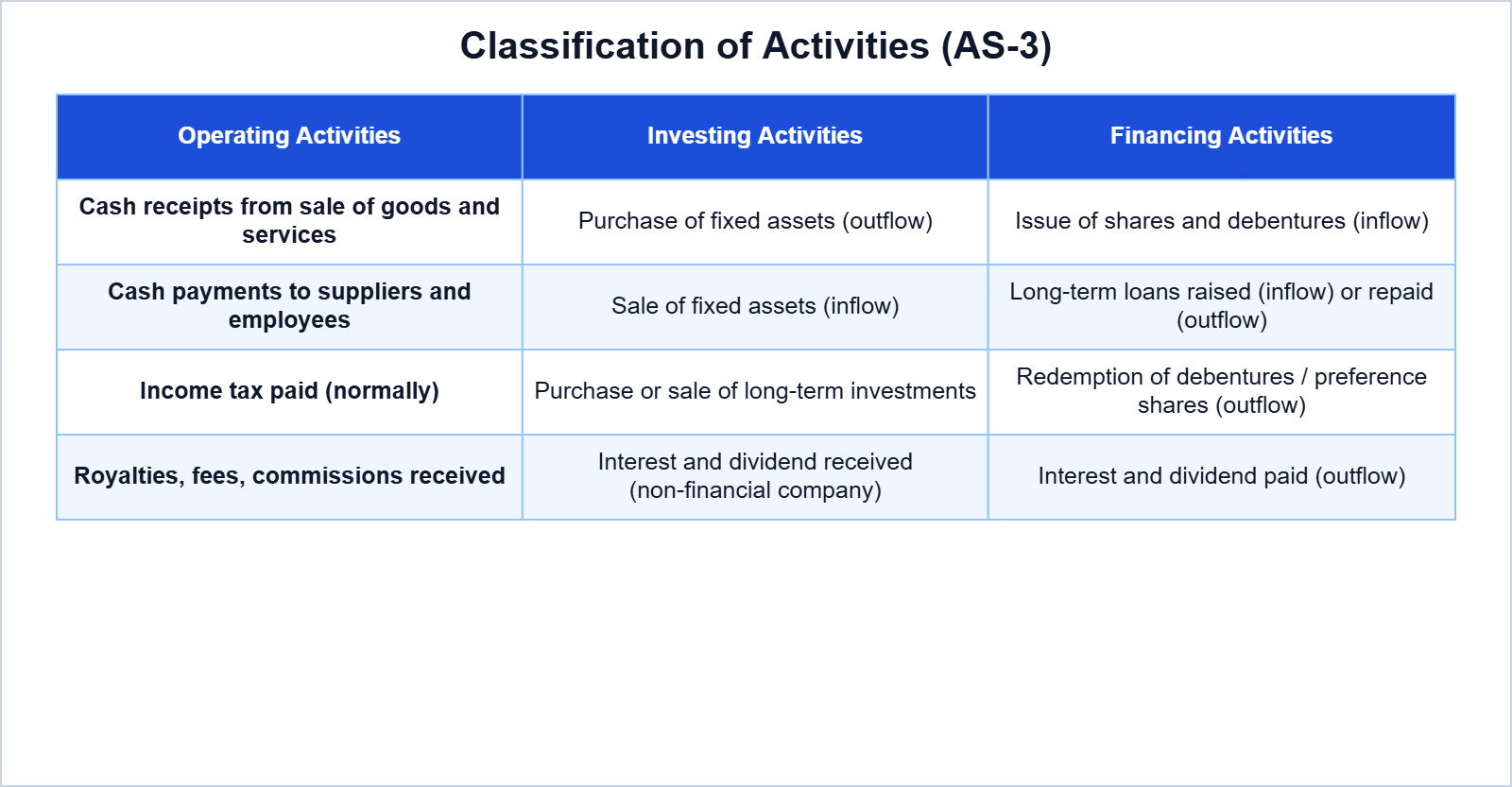
Remember: For a financial enterprise (such as a bank), interest and dividend received and paid are operating activities.
6. Cash Flow from Operating Activities (Indirect Method)
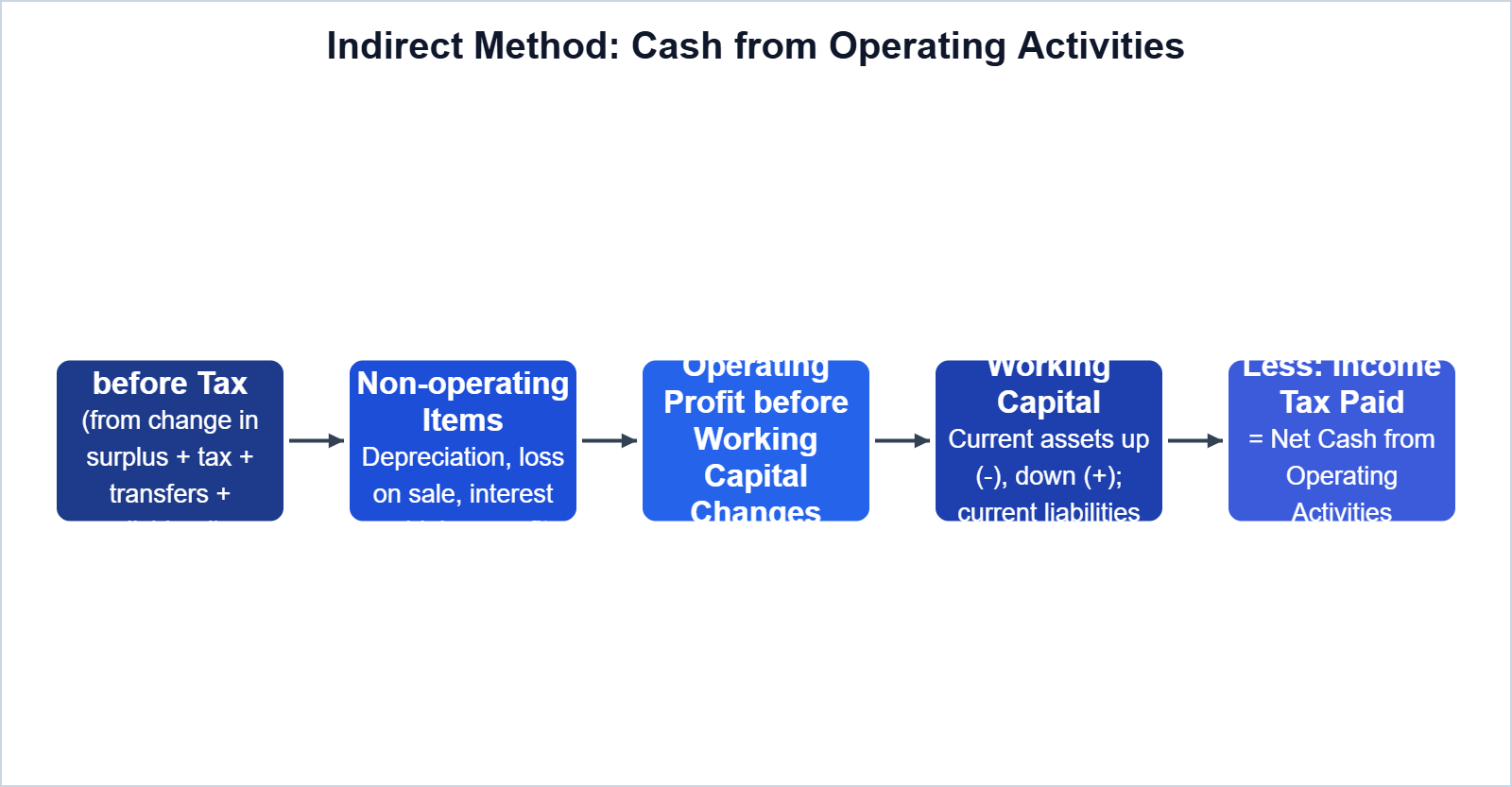
Illustration 1 (Adjustments): Net profit ₹50,000; depreciation ₹10,000; increase in debtors ₹5,000; increase in creditors ₹3,000.
Solution: Cash from operating activities = 50,000 + 10,000 – 5,000 + 3,000 = ₹58,000.
Illustration 2 (Classification): (a) Purchase of goodwill – investing; (b) dividend paid – financing; (c) interest received by a manufacturing company – investing; (d) income tax paid – operating; (e) sale of long-term investments – investing; (f) issue of debentures – financing.
7. Cash Flows from Investing and Financing Activities
Investing activities relate to acquisition and disposal of long-term assets and investments. Financing activities change the size and composition of owners’ capital and borrowings. Ledger accounts of assets, investments and provisions are prepared to find hidden figures such as purchases, sales and tax paid.
8. Preparation of Cash Flow Statement
Illustration 3 (Full statement): From the following Balance Sheets of ABC Ltd., prepare a Cash Flow Statement for the year ended 31 March 2025. Depreciation charged during the year was ₹40,000. Debentures of ₹50,000 were redeemed at par at the end of the year; interest @ 10% was paid on the debentures outstanding during the year. No tax was provided.
Particulars | 31.3.2024 (₹) | 31.3.2025 (₹) |
|---|---|---|
I. Equity and Liabilities |
|
|
Share Capital | 5,00,000 | 6,00,000 |
Reserves and Surplus (Surplus) | 1,00,000 | 1,60,000 |
10% Debentures | 2,00,000 | 1,50,000 |
Trade Payables | 80,000 | 1,00,000 |
Total | 8,80,000 | 10,10,000 |
II. Assets |
|
|
Property, Plant and Equipment (net) | 5,00,000 | 6,10,000 |
Inventories | 1,20,000 | 1,40,000 |
Trade Receivables | 1,60,000 | 1,40,000 |
Cash and Cash Equivalents | 1,00,000 | 1,20,000 |
Total | 8,80,000 | 10,10,000 |
Working Note: Property, Plant and Equipment Account
Dr. Particulars | ₹ | Cr. Particulars | ₹ |
|---|---|---|---|
To Balance b/d | 5,00,000 | By Depreciation | 40,000 |
To Bank A/c (purchase, balancing figure) | 1,50,000 | By Balance c/d | 6,10,000 |
Total | 6,50,000 | Total | 6,50,000 |
Particulars | ₹ | ₹ |
|---|---|---|
A. Cash Flows from Operating Activities |
|
|
Net Profit before Tax (1,60,000 – 1,00,000) | 60,000 |
|
Add: Depreciation | 40,000 |
|
Add: Interest on Debentures (finance cost) | 20,000 |
|
Operating Profit before Working Capital Changes | 1,20,000 |
|
Less: Increase in Inventories | (20,000) |
|
Add: Decrease in Trade Receivables | 20,000 |
|
Add: Increase in Trade Payables | 20,000 |
|
Cash Generated from Operations | 1,40,000 |
|
Less: Income Tax Paid | Nil |
|
Net Cash from Operating Activities |
| 1,40,000 |
B. Cash Flows from Investing Activities |
|
|
Purchase of PPE (Working Note) | (1,50,000) |
|
Net Cash used in Investing Activities |
| (1,50,000) |
C. Cash Flows from Financing Activities |
|
|
Issue of Share Capital | 1,00,000 |
|
Redemption of Debentures | (50,000) |
|
Interest Paid on Debentures | (20,000) |
|
Net Cash from Financing Activities |
| 30,000 |
Net Increase in Cash and Cash Equivalents (A + B + C) |
| 20,000 |
Add: Opening Cash and Cash Equivalents |
| 1,00,000 |
Closing Cash and Cash Equivalents |
| 1,20,000 |
Illustration 4 (Full statement with adjustments): From the following Balance Sheets of XYZ Ltd., prepare a Cash Flow Statement for the year ended 31 March 2025. Additional information: (i) depreciation on machinery ₹1,00,000; (ii) machinery with book value ₹60,000 was sold for ₹50,000; (iii) investments costing ₹40,000 were sold at a profit of ₹8,000; (iv) tax provided during the year ₹60,000; (v) the bank loan of ₹1,00,000 was repaid at the end of the year and interest @ 10% was paid on ₹3,00,000; (vi) a dividend of ₹50,000 was paid during the year and ₹30,000 was transferred to general reserve.
Particulars | 31.3.2024 (₹) | 31.3.2025 (₹) |
|---|---|---|
I. Equity and Liabilities |
|
|
Share Capital | 8,00,000 | 10,00,000 |
General Reserve | 50,000 | 80,000 |
Surplus (Statement of P&L) | 1,50,000 | 2,10,000 |
Long-term Borrowings (10% Bank Loan) | 3,00,000 | 2,00,000 |
Trade Payables | 1,20,000 | 1,10,000 |
Short-term Provisions (Provision for Tax) | 40,000 | 50,000 |
Total | 14,60,000 | 16,50,000 |
II. Assets |
|
|
Machinery (net) | 9,00,000 | 10,20,000 |
Non-current Investments | 1,00,000 | 60,000 |
Inventories | 2,00,000 | 2,30,000 |
Trade Receivables | 1,80,000 | 2,10,000 |
Cash and Cash Equivalents | 80,000 | 1,30,000 |
Total | 14,60,000 | 16,50,000 |
Working Note 3: Net Profit before Tax | ₹ |
|---|---|
Closing surplus | 2,10,000 |
Less: Opening surplus | (1,50,000) |
Add: Transfer to general reserve | 30,000 |
Add: Dividend paid | 50,000 |
Net profit after tax | 1,40,000 |
Add: Provision for tax made | 60,000 |
Net profit before tax | 2,00,000 |
Working Note 1: Machinery Account
Dr. Particulars | ₹ | Cr. Particulars | ₹ |
|---|---|---|---|
To Balance b/d | 9,00,000 | By Bank A/c (sale) | 50,000 |
To Bank A/c (purchase, balancing figure) | 2,80,000 | By Statement of P&L (loss on sale) | 10,000 |
|
| By Depreciation | 1,00,000 |
|
| By Balance c/d | 10,20,000 |
Total | 11,80,000 | Total | 11,80,000 |
Working Note 2: Provision for Tax Account
Dr. Particulars | ₹ | Cr. Particulars | ₹ |
|---|---|---|---|
To Bank A/c (tax paid, balancing figure) | 50,000 | By Balance b/d | 40,000 |
To Balance c/d | 50,000 | By Statement of P&L (provision made) | 60,000 |
Total | 1,00,000 | Total | 1,00,000 |
Particulars | ₹ | ₹ |
|---|---|---|
A. Cash Flows from Operating Activities |
|
|
Net Profit before Tax (WN 3) | 2,00,000 |
|
Add: Depreciation on machinery | 1,00,000 |
|
Add: Loss on sale of machinery | 10,000 |
|
Add: Interest on bank loan | 30,000 |
|
Less: Profit on sale of investments | (8,000) |
|
Operating Profit before Working Capital Changes | 3,32,000 |
|
Less: Increase in Inventories | (30,000) |
|
Less: Increase in Trade Receivables | (30,000) |
|
Less: Decrease in Trade Payables | (10,000) |
|
Cash Generated from Operations | 2,62,000 |
|
Less: Income Tax Paid (WN 2) | (50,000) |
|
Net Cash from Operating Activities |
| 2,12,000 |
B. Cash Flows from Investing Activities |
|
|
Purchase of Machinery (WN 1) | (2,80,000) |
|
Sale of Machinery | 50,000 |
|
Sale of Investments (40,000 + 8,000) | 48,000 |
|
Net Cash used in Investing Activities |
| (1,82,000) |
C. Cash Flows from Financing Activities |
|
|
Issue of Share Capital | 2,00,000 |
|
Repayment of Bank Loan | (1,00,000) |
|
Interest Paid | (30,000) |
|
Dividend Paid | (50,000) |
|
Net Cash from Financing Activities |
| 20,000 |
Net Increase in Cash and Cash Equivalents (A + B + C) |
| 50,000 |
Add: Opening Cash and Cash Equivalents |
| 80,000 |
Closing Cash and Cash Equivalents |
| 1,30,000 |
Illustration 5 (Operating activities with appropriations): Surplus (Statement of P&L) increased from ₹40,000 to ₹70,000 after transferring ₹10,000 to general reserve and paying a dividend of ₹20,000. Provision for tax made ₹25,000; tax paid ₹20,000; depreciation ₹15,000; goodwill written off ₹5,000; increase in inventories ₹8,000; decrease in trade receivables ₹6,000; increase in trade payables ₹4,000. Calculate cash from operating activities.
Particulars | ₹ |
|---|---|
Net profit (70,000 – 40,000) | 30,000 |
Add: Transfer to general reserve | 10,000 |
Add: Dividend paid | 20,000 |
Add: Provision for tax | 25,000 |
Net profit before tax | 85,000 |
Add: Depreciation | 15,000 |
Add: Goodwill written off | 5,000 |
Operating profit before working capital changes | 1,05,000 |
Less: Increase in inventories | (8,000) |
Add: Decrease in trade receivables | 6,000 |
Add: Increase in trade payables | 4,000 |
Cash generated from operations | 1,07,000 |
Less: Income tax paid | (20,000) |
Net cash from operating activities | 87,000 |
Exam point: Under the indirect method, start from net profit before tax, not net profit after tax. Interest paid is added back in operating activities and shown as an outflow in financing activities.
Easy Memory Trick for working capital: “Assets up, cash down; Liabilities up, cash up.”
9. Practice Problems (Answers Only)
- Net profit ₹80,000; depreciation ₹15,000; decrease in inventory ₹5,000; decrease in creditors ₹8,000. Ans: Cash from operating activities ₹92,000.
- Machinery: opening ₹2,00,000, closing ₹2,60,000, depreciation ₹30,000, no sale. Ans: Purchase ₹90,000 (investing outflow).
- Provision for tax: opening ₹20,000, closing ₹30,000, provided ₹35,000. Ans: Tax paid ₹25,000.
- Machinery with book value ₹40,000 sold at a loss of ₹5,000. Ans: Investing inflow ₹35,000; loss ₹5,000 added back in operating activities.
- Classify interest received by a bank. Ans: Operating activity.
10. Important Questions
Q1. What is a Cash Flow Statement?
Ans. A statement showing inflows and outflows of cash and cash equivalents during a period, classified into operating, investing and financing activities (AS-3).
Q2. What are cash equivalents?
Ans. Short-term, highly liquid investments readily convertible into known amounts of cash with insignificant risk, usually maturing within three months.
Q3. Name the three categories of activities in a Cash Flow Statement.
Ans. Operating, investing and financing activities.
Q4. Why is depreciation added back to net profit?
Ans. Because it is a non-cash expense that reduces profit but does not involve an outflow of cash.
Q5. How is interest paid on debentures treated?
Ans. Added back in operating activities and shown as an outflow in financing activities (for a non-financial company).
Q6. Is purchase of a 2-month treasury bill a cash flow?
Ans. No, it is a movement within cash and cash equivalents.
Conclusion: The Cash Flow Statement explains how cash and cash equivalents changed during the year. Using the indirect method, profit is adjusted for non-cash items and working capital changes to find operating cash, and investing and financing flows complete the picture.