Issue and Redemption of Debentures – Class 12 Accountancy Notes
Chapter – 6
Issue and Redemption of Debentures
1. Meaning of Debentures
A debenture is a written instrument acknowledging a debt by the company, under its common seal (if any), containing the terms of repayment of the principal and interest. Debentureholders are creditors of the company and get a fixed rate of interest.
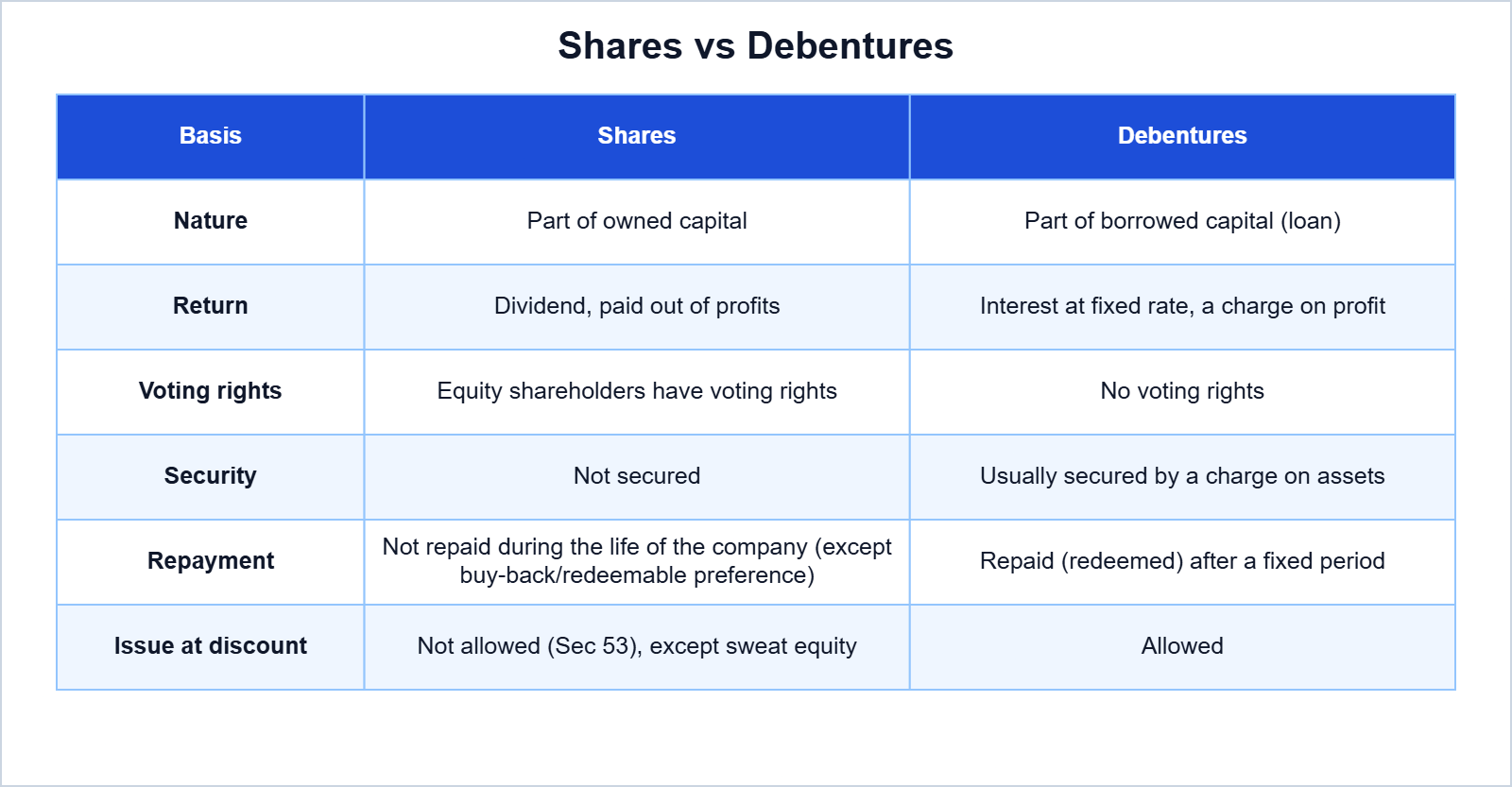
2. Distinction between Shares and Debentures
3. Types of Debentures

- Secured / unsecured: secured debentures carry a charge on the company’s assets.
- Redeemable / irredeemable: redeemable debentures are repaid after a fixed period.
- Convertible / non-convertible: convertible debentures can be changed into shares; may be fully or partly convertible.
- Specific coupon rate / zero coupon rate: zero coupon debentures carry no interest but are issued at a large discount.
- Registered / bearer: registered debentures are recorded in the company’s register; bearer debentures are transferable by delivery.
4. Issue of Debentures
Debentures may be issued for cash (in lump sum or instalments), for consideration other than cash, or as collateral security. They can be issued at par, at a premium or at a discount.
Illustration 1: X Ltd. issued 1,000 9% debentures of ₹100 each at par, payable ₹40 on application and ₹60 on allotment. All money was received.
Journal Entries (Illustration 1)
Particulars | Dr (₹) | Cr (₹) |
|---|---|---|
Bank A/c …Dr. | 40,000 |
|
To Debenture Application A/c |
| 40,000 |
(Application money on 1,000 debentures @ ₹40) |
|
|
Debenture Application A/c …Dr. | 40,000 |
|
To 9% Debentures A/c |
| 40,000 |
(Application money transferred) |
|
|
Debenture Allotment A/c …Dr. | 60,000 |
|
To 9% Debentures A/c |
| 60,000 |
(Allotment due @ ₹60) |
|
|
Bank A/c …Dr. | 60,000 |
|
To Debenture Allotment A/c |
| 60,000 |
(Allotment money received) |
|
|
Terms of issue (Illustration 2): The six possible conditions of issue and redemption for 1,000 debentures of ₹100 each are shown below.
Journal Entries (Illustration 2: 1,000 debentures of ₹100 each)
Particulars | Dr (₹) | Cr (₹) |
|---|---|---|
Bank A/c …Dr. | 1,00,000 |
|
To Debentures A/c |
| 1,00,000 |
((a) Issued at par, redeemable at par) |
|
|
Bank A/c …Dr. | 95,000 |
|
Discount on Issue of Debentures A/c …Dr. | 5,000 |
|
To Debentures A/c |
| 1,00,000 |
((b) Issued at 5% discount, redeemable at par) |
|
|
Bank A/c …Dr. | 1,05,000 |
|
To Debentures A/c |
| 1,00,000 |
To Securities Premium A/c |
| 5,000 |
((c) Issued at 5% premium, redeemable at par) |
|
|
Bank A/c …Dr. | 1,00,000 |
|
Loss on Issue of Debentures A/c …Dr. | 10,000 |
|
To Debentures A/c |
| 1,00,000 |
To Premium on Redemption of Debentures A/c |
| 10,000 |
((d) Issued at par, redeemable at 10% premium) |
|
|
Bank A/c …Dr. | 95,000 |
|
Loss on Issue of Debentures A/c …Dr. | 10,000 |
|
To Debentures A/c |
| 1,00,000 |
To Premium on Redemption of Debentures A/c |
| 5,000 |
((e) Issued at 5% discount, redeemable at 5% premium) |
|
|
Bank A/c …Dr. | 1,05,000 |
|
Loss on Issue of Debentures A/c …Dr. | 10,000 |
|
To Debentures A/c |
| 1,00,000 |
To Securities Premium A/c |
| 5,000 |
To Premium on Redemption of Debentures A/c |
| 10,000 |
((f) Issued at 5% premium, redeemable at 10% premium) |
|
|
Remember: When debentures are redeemable at a premium, the premium is a liability (Premium on Redemption A/c) and is recorded at the time of issue, with a corresponding loss on issue.
5. Over-subscription
Illustration 3: Y Ltd. offered 5,000 debentures of ₹100, payable ₹50 on application and ₹50 on allotment. Applications were received for 6,000 debentures; applications for 1,000 were rejected and money refunded.
Journal Entries (Illustration 3: over-subscription)
Particulars | Dr (₹) | Cr (₹) |
|---|---|---|
Bank A/c …Dr. | 3,00,000 |
|
To Debenture Application A/c |
| 3,00,000 |
(Applications for 6,000 debentures @ ₹50) |
|
|
Debenture Application A/c …Dr. | 3,00,000 |
|
To Debentures A/c |
| 2,50,000 |
To Bank A/c |
| 50,000 |
(5,000 debentures allotted; money on 1,000 rejected applications refunded) |
|
|
6. Issue of Debentures for Consideration other than Cash
Illustration 4: Z Ltd. purchased machinery for ₹4,75,000 and paid by issuing 10% debentures of ₹100 each at a discount of 5%. Number of debentures = 4,75,000 / 95 = 5,000.
Journal Entries (Illustration 4: consideration other than cash)
Particulars | Dr (₹) | Cr (₹) |
|---|---|---|
Machinery A/c …Dr. | 4,75,000 |
|
To Vendor A/c |
| 4,75,000 |
(Machinery purchased) |
|
|
Vendor A/c …Dr. | 4,75,000 |
|
Discount on Issue of Debentures A/c …Dr. | 25,000 |
|
To 10% Debentures A/c |
| 5,00,000 |
(5,000 debentures of ₹100 issued at 5% discount to the vendor) |
|
|
7. Issue of Debentures as Collateral Security
Debentures may be issued as additional (collateral) security for a loan. The lender can use them only if the company fails to repay the loan.
Illustration 5: A company took a bank loan of ₹2,00,000 and issued 2,500 9% debentures of ₹100 each as collateral security.
First method: No entry is passed; a note is given below the bank loan in the Balance Sheet: “Secured by issue of 2,500 9% debentures of ₹100 each as collateral security.”
Second method:
Journal Entry (Illustration 5: collateral security, second method)
Particulars | Dr (₹) | Cr (₹) |
|---|---|---|
Debenture Suspense A/c …Dr. | 2,50,000 |
|
To 9% Debentures A/c |
| 2,50,000 |
(2,500 debentures issued as collateral security for a bank loan of ₹2,00,000) |
|
|
Under the second method, the debentures are shown under Long-term Borrowings and the Debenture Suspense A/c is deducted from them.
8. Terms of Issue of Debentures
The terms decide whether debentures are issued at par, premium or discount, and whether they are redeemable at par or premium (see Illustration 2).
9. Interest on Debentures
Interest is paid at a fixed rate on the face value of debentures, usually half-yearly or yearly. It is a charge against profit. Tax is deducted at source (TDS) as per the Income Tax Act.
Illustration 6: A company has ₹5,00,000 10% debentures. Annual interest is paid with TDS @ 10%.
Journal Entries (Illustration 6: interest on debentures)
Particulars | Dr (₹) | Cr (₹) |
|---|---|---|
Debenture Interest A/c …Dr. | 50,000 |
|
To Debentureholders A/c |
| 45,000 |
To TDS Payable A/c |
| 5,000 |
(Interest due on ₹5,00,000 10% debentures; tax deducted @ 10%) |
|
|
Debenture holders A/c …Dr. | 45,000 |
|
To Bank A/c |
| 45,000 |
(Interest paid) |
|
|
TDS Payable A/c …Dr. | 5,000 |
|
To Bank A/c |
| 5,000 |
(TDS deposited with government) |
|
|
Statement of Profit and Loss …Dr. | 50,000 |
|
To Debenture Interest A/c |
| 50,000 |
(Interest transferred) |
|
|
10. Writing off Discount/Loss on Issue of Debentures
Discount or loss on issue of debentures is a capital loss. It is written off first from Securities Premium (if available) and the balance from the Statement of Profit and Loss, in the year of issue.
Illustration 7: Loss on issue of debentures was ₹10,000 (Illustration 2(d)). The company had a balance of ₹6,000 in Securities Premium.
Journal Entry (Illustration 7: writing off loss on issue)
Particulars | Dr (₹) | Cr (₹) |
|---|---|---|
Securities Premium A/c …Dr. | 6,000 |
|
Statement of Profit and Loss …Dr. | 4,000 |
|
To Loss on Issue of Debentures A/c |
| 10,000 |
(Loss on issue written off, first from securities premium and the balance from Statement of P&L) |
|
|
11. Redemption of Debentures
Redemption means repayment of the debenture amount. Debentures can be redeemed (a) in lump sum at maturity, (b) in instalments, (c) by purchase in the open market, or (d) by conversion into shares or new debentures.
Important: Debenture Redemption Reserve (DRR) and investment rules. Under Section 71 of the Companies Act, 2013 and the rules made under it, companies that are required to do so must create a DRR (at present 10% of the value of outstanding debentures, where applicable) out of profits available for dividend, and must invest or deposit at least 15% of the amount of debentures maturing during the year, on or before 30 April of that year, in specified securities. Certain classes of companies (for example, listed companies and some financial companies) have been exempted from creating DRR under the amended rules, so students should apply the rule stated in the question.
12. Redemption by Payment in Lump Sum
Illustration 8: A Ltd. had 5,000 10% debentures of ₹100 each, redeemable at par on 31 March 2026. The company is required to create DRR and to invest 15% as per rules.
Journal Entries (Illustration 8: redemption in lump sum)
Particulars | Dr (₹) | Cr (₹) |
|---|---|---|
Surplus i.e. Balance in Statement of P&L …Dr. | 50,000 |
|
To Debenture Redemption Reserve A/c |
| 50,000 |
(DRR created @ 10% of ₹5,00,000 (where required)) |
|
|
Debenture Redemption Investment A/c …Dr. | 75,000 |
|
To Bank A/c |
| 75,000 |
(15% of debentures maturing during the year invested on or before 30 April) |
|
|
Bank A/c …Dr. | 75,000 |
|
To Debenture Redemption Investment A/c |
| 75,000 |
(Investment encashed at maturity) |
|
|
10% Debentures A/c …Dr. | 5,00,000 |
|
To Debenture holders A/c |
| 5,00,000 |
(Amount due on redemption at par) |
|
|
Debenture holders A/c …Dr. | 5,00,000 |
|
To Bank A/c |
| 5,00,000 |
(Debenture holders paid) |
|
|
Debenture Redemption Reserve A/c …Dr. | 50,000 |
|
To General Reserve A/c |
| 50,000 |
(DRR transferred after redemption) |
|
|
Working: DRR = 10% of 5,00,000 = ₹50,000; Investment = 15% of 5,00,000 = ₹75,000.
Illustration 11 (Redemption at a premium):
Journal Entries (Illustration 11: redemption at premium)
Particulars | Dr (₹) | Cr (₹) |
|---|---|---|
Debentures A/c …Dr. | 1,00,000 |
|
Premium on Redemption of Debentures A/c …Dr. | 10,000 |
|
To Debenture holders A/c |
| 1,10,000 |
(Debentures of Illustration 2(d) due for redemption at 10% premium) |
|
|
Debenture holders A/c …Dr. | 1,10,000 |
|
To Bank A/c |
| 1,10,000 |
(Debenture holders paid) |
|
|
13. Redemption by Purchase in Open Market
A company may buy its own debentures from the market when they are available below face value, either for immediate cancellation or as an investment. Profit on cancellation is a capital profit and is transferred to Capital Reserve.
Illustration 9: B Ltd. purchased 1,000 of its own 9% debentures of ₹100 each from the market @ ₹96 for immediate cancellation.
Journal Entries (Illustration 9: purchase in open market)
Particulars | Dr (₹) | Cr (₹) |
|---|---|---|
Own Debentures A/c …Dr. | 96,000 |
|
To Bank A/c |
| 96,000 |
(1,000 own debentures of ₹100 purchased @ ₹96 for immediate cancellation) |
|
|
9% Debentures A/c …Dr. | 1,00,000 |
|
To Own Debentures A/c |
| 96,000 |
To Gain on Cancellation of Own Debentures A/c |
| 4,000 |
(Own debentures cancelled) |
|
|
Gain on Cancellation of Own Debentures A/c …Dr. | 4,000 |
|
To Capital Reserve A/c |
| 4,000 |
(Gain transferred to capital reserve) |
|
|
14. Redemption by Conversion
Debentureholders may be given the option to convert their debentures into equity shares or new debentures.
Illustration 10: 1,000 10% debentures of ₹100 each were converted into equity shares of ₹10 each issued at ₹25 (premium ₹15). Number of shares = 1,00,000 / 25 = 4,000.
Journal Entries (Illustration 10: redemption by conversion)
Particulars | Dr (₹) | Cr (₹) |
|---|---|---|
10% Debentures A/c …Dr. | 1,00,000 |
|
To Debenture holders A/c |
| 1,00,000 |
(Amount due on 1,000 debentures) |
|
|
Debenture holders A/c …Dr. | 1,00,000 |
|
To Equity Share Capital A/c |
| 40,000 |
To Securities Premium A/c |
| 60,000 |
(4,000 equity shares of ₹10 issued at ₹25 on conversion) |
|
|
Easy Memory Trick: Loss on issue is written off from “Premium first, then Profit”.
15. Practice Problems (Answers Only)
- 2,000 debentures of ₹100 issued at 10% discount, redeemable at 5% premium. Ans: Loss on issue ₹30,000.
- Interest @ 10% on ₹3,00,000 debentures with TDS @ 10%. Ans: Net amount paid to debenture holders ₹27,000.
- 500 own debentures of ₹100 purchased @ ₹98 for cancellation. Ans: Gain on cancellation ₹1,000, transferred to capital reserve.
- Debentures of ₹2,00,000 converted into equity shares of ₹10 issued at ₹20. Ans: 10,000 shares.
- Machinery of ₹2,85,000 purchased; debentures of ₹100 issued at 5% discount. Ans: 3,000 debentures.
16. Important Questions
Q1. What is a debenture?
Ans. A written acknowledgement of debt by a company, carrying a fixed rate of interest and repayable after a fixed period.
Q2. Give two differences between shares and debentures.
Ans. Shares are owned capital and get dividend; debentures are borrowed capital and get fixed interest. Shares cannot be issued at a discount, while debentures can.
Q3. What is meant by issue of debentures as collateral security?
Ans. Debentures issued as additional security for a loan, which the lender can use only if the loan is not repaid.
Q4. How is loss on issue of debentures written off?
Ans. First from securities premium, and the balance from the Statement of Profit and Loss in the year of issue.
Q5. Where is the gain on cancellation of own debentures transferred?
Ans. To Capital Reserve.
Q6. What is the investment requirement at the time of redemption?
Ans. At least 15% of the debentures maturing during the year must be invested or deposited in specified securities on or before 30 April of that year, as per the rules.
Q7. Name four methods of redemption of debentures.
Ans. Lump sum payment, instalments, purchase in the open market and conversion.
Conclusion: Debentures are a major source of borrowed funds. Their issue on different terms, payment of interest and redemption must be recorded carefully, following the Companies Act, 2013 and the rules for DRR and investment.