Dissolution of Partnership Firm – Class 12 Accountancy Notes
Chapter – 4
Dissolution of Partnership Firm
1. Dissolution of Partnership
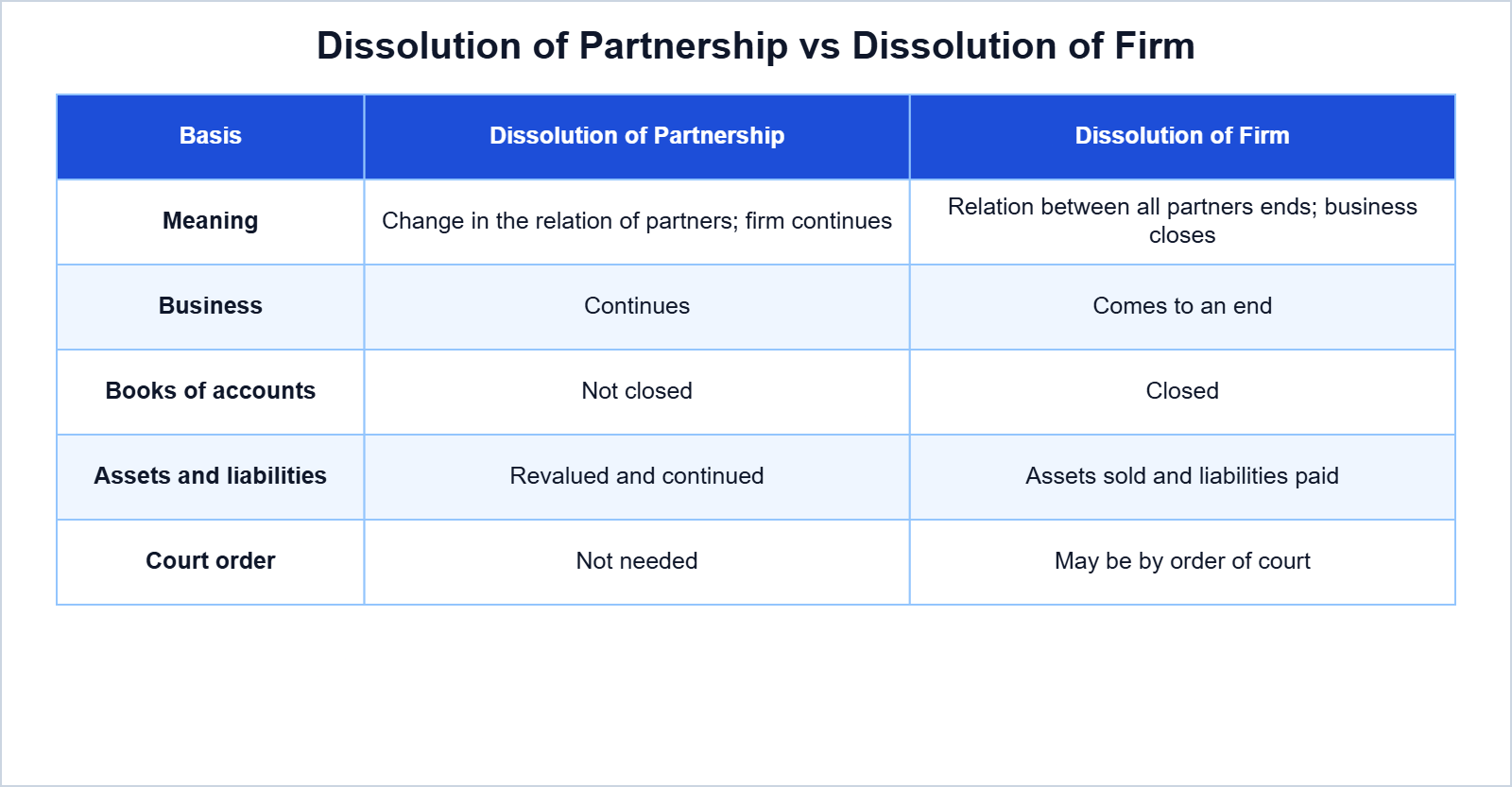
Dissolution of partnership means a change in the relationship among partners, such as on admission, retirement, death, insolvency of a partner or change in profit sharing ratio. The firm continues under a new agreement.
2. Dissolution of a Firm
Dissolution of a firm means the end of the partnership relation among all partners (Section 39). The business closes, assets are sold, liabilities are paid and the books are closed.
Modes of dissolution of a firm:
- By agreement of all partners (Section 40).
- Compulsory dissolution (Section 41): when all or all but one partner become insolvent, or the business becomes illegal.
- On the happening of certain contingencies (Section 42): expiry of the fixed term, completion of the venture, death or insolvency of a partner (subject to contract).
- By notice in a partnership at will (Section 43).
- By the court (Section 44): for example insanity, permanent incapacity or misconduct of a partner, or when the business can only be carried on at a loss.
3. Settlement of Accounts (Section 48)
In settling accounts on dissolution:
- Losses, including deficiency of capital, are paid first out of profits, then out of capital, and lastly by the partners individually in their profit sharing ratio.
- Assets (including amounts contributed by partners to make up deficiencies) are applied in the following order: (i) paying debts of the firm to third parties; (ii) paying each partner his loans and advances to the firm; (iii) paying each partner his capital; (iv) the residue, if any, is divided among partners in their profit sharing ratio.
Illustration 1 (Order of payment): On dissolution, assets realised ₹1,50,000. Outside liabilities ₹90,000; P’s loan ₹20,000; capitals P ₹30,000 and Q ₹20,000; ratio 3:2.
Order | Payment (₹) |
|---|---|
(i) Outside liabilities | 90,000 |
(ii) Partner’s loan (P) | 20,000 |
(iii) Capitals after loss of ₹10,000 (50,000 – 40,000 available) shared 3:2: P 30,000 – 6,000 = 24,000; Q 20,000 – 4,000 = 16,000 | 40,000 |
Total | 1,50,000 |
4. Accounting Treatment
A Realisation Account is opened to find the profit or loss on sale of assets and payment of liabilities. It is debited with all assets (except cash/bank and fictitious assets) and payments of liabilities and expenses, and credited with outside liabilities and amounts realised from assets.
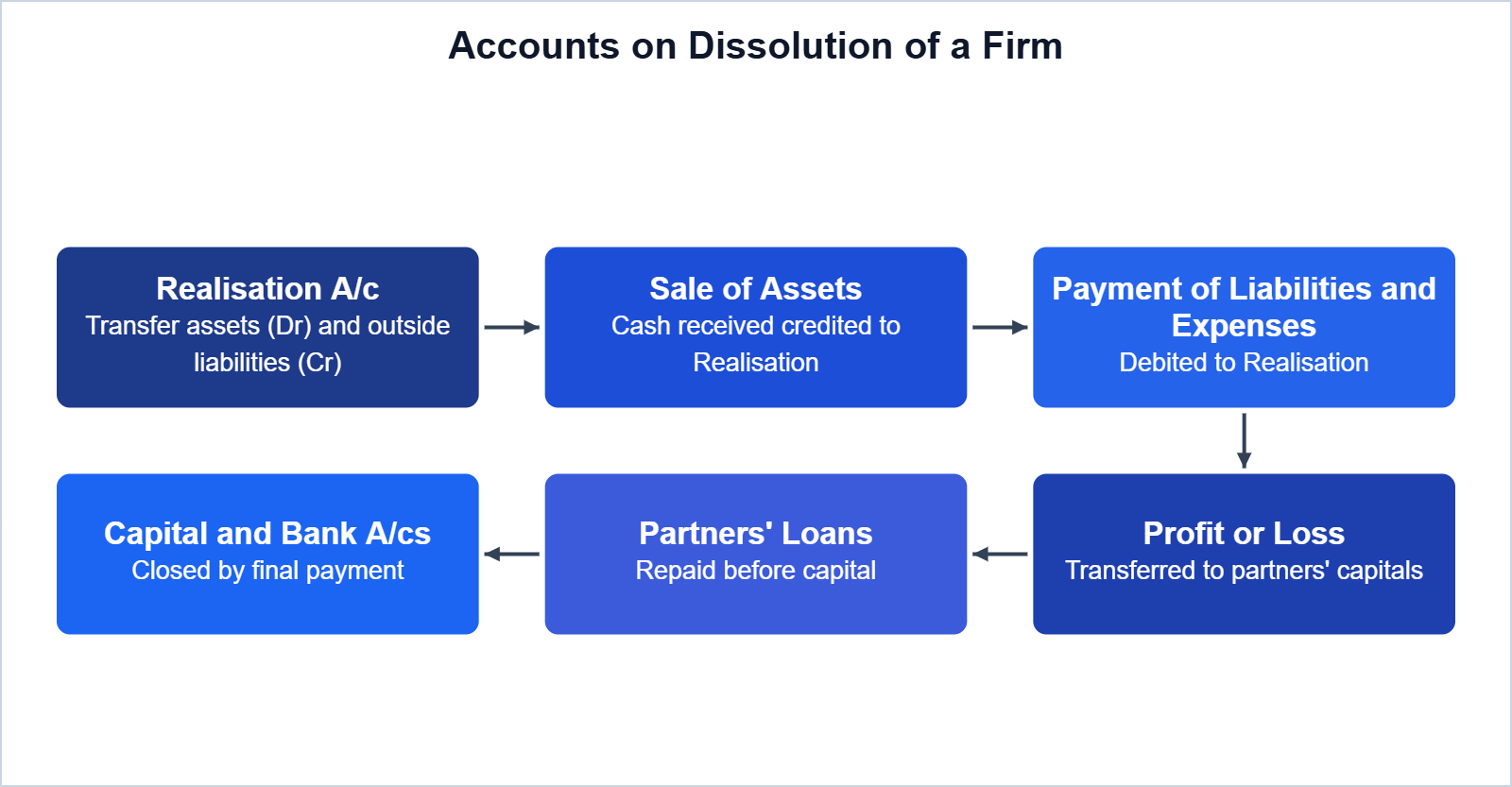
Remember: Partners’ loans are not transferred to the Realisation Account; they are paid separately through the Bank Account after outside liabilities. Accumulated profits/reserves and losses are transferred to partners’ capital accounts.
Illustration 2 (Complete dissolution): P and Q share profits 3:2. They dissolve their firm on 31 March 2025, when their Balance Sheet was as follows. Assets realised: debtors ₹42,000; stock ₹47,000; furniture ₹12,000. P took over machinery at ₹65,000. Creditors were paid ₹39,000 in full settlement and bills payable were paid in full. Realisation expenses were ₹2,000. Prepare the necessary accounts and journal entries.
Balance Sheet of P and Q as at 31 March 2025
Liabilities | ₹ | Assets | ₹ |
|---|---|---|---|
Creditors | 40,000 | Bank | 15,000 |
Bills Payable | 10,000 | Debtors | 45,000 |
Q’s Loan | 20,000 | Stock | 50,000 |
P’s Capital | 80,000 | Furniture | 20,000 |
Q’s Capital | 50,000 | Machinery | 70,000 |
Total | 2,00,000 | Total | 2,00,000 |
Realisation Account
Dr. Particulars | ₹ | Cr. Particulars | ₹ |
|---|---|---|---|
To Debtors | 45,000 | By Creditors | 40,000 |
To Stock | 50,000 | By Bills Payable | 10,000 |
To Furniture | 20,000 | By Bank A/c (debtors) | 42,000 |
To Machinery | 70,000 | By Bank A/c (stock) | 47,000 |
To Bank A/c (creditors paid) | 39,000 | By Bank A/c (furniture) | 12,000 |
To Bank A/c (bills payable paid) | 10,000 | By P’s Capital A/c (machinery taken) | 65,000 |
To Bank A/c (realisation expenses) | 2,000 | By Loss: P’s Capital A/c (3/5) | 12,000 |
|
| By Loss: Q’s Capital A/c (2/5) | 8,000 |
Total | 2,36,000 | Total | 2,36,000 |
Partners’ Capital Accounts
Dr. Particulars | P | Q | Cr. Particulars | P | Q |
|---|---|---|---|---|---|
To Realisation A/c (machinery) | 65,000 | – | By Balance b/d | 80,000 | 50,000 |
To Realisation A/c (loss) | 12,000 | 8,000 |
|
|
|
To Bank A/c (final payment) | 3,000 | 42,000 |
|
|
|
Total | 80,000 | 50,000 | Total | 80,000 | 50,000 |
Bank Account
Dr. Particulars | ₹ | Cr. Particulars | ₹ |
|---|---|---|---|
To Balance b/d | 15,000 | By Realisation A/c (creditors) | 39,000 |
To Realisation A/c (debtors) | 42,000 | By Realisation A/c (bills payable) | 10,000 |
To Realisation A/c (stock) | 47,000 | By Realisation A/c (expenses) | 2,000 |
To Realisation A/c (furniture) | 12,000 | By Q’s Loan A/c | 20,000 |
|
| By P’s Capital A/c | 3,000 |
|
| By Q’s Capital A/c | 42,000 |
Total | 1,16,000 | Total | 1,16,000 |
Journal Entries on Dissolution (Illustration 2)
Particulars | Dr (₹) | Cr (₹) |
|---|---|---|
Realisation A/c …Dr. | 1,85,000 |
|
To Debtors A/c |
| 45,000 |
To Stock A/c |
| 50,000 |
To Furniture A/c |
| 20,000 |
To Machinery A/c |
| 70,000 |
(Assets other than cash transferred to Realisation A/c) |
|
|
Creditors A/c …Dr. | 40,000 |
|
Bills Payable A/c …Dr. | 10,000 |
|
To Realisation A/c |
| 50,000 |
(Outside liabilities transferred to Realisation A/c) |
|
|
Bank A/c …Dr. | 1,01,000 |
|
To Realisation A/c |
| 1,01,000 |
(Debtors, stock and furniture realised (42,000 + 47,000 + 12,000)) |
|
|
P’s Capital A/c …Dr. | 65,000 |
|
To Realisation A/c |
| 65,000 |
(Machinery taken over by P) |
|
|
Realisation A/c …Dr. | 49,000 |
|
To Bank A/c |
| 49,000 |
(Creditors (39,000) and bills payable (10,000) paid) |
|
|
Realisation A/c …Dr. | 2,000 |
|
To Bank A/c |
| 2,000 |
(Realisation expenses paid) |
|
|
Q’s Loan A/c …Dr. | 20,000 |
|
To Bank A/c |
| 20,000 |
(Q’s loan repaid) |
|
|
P’s Capital A/c …Dr. | 12,000 |
|
Q’s Capital A/c …Dr. | 8,000 |
|
To Realisation A/c |
| 20,000 |
(Loss on realisation shared 3:2) |
|
|
P’s Capital A/c …Dr. | 3,000 |
|
Q’s Capital A/c …Dr. | 42,000 |
|
To Bank A/c |
| 45,000 |
(Final payment to partners) |
|
|
Illustration 3 (Special cases): (a) An unrecorded investment was sold for ₹6,000. (b) An unrecorded liability of ₹4,000 was paid. (c) Partner R took over creditors of ₹15,000. (d) Realisation expenses of ₹1,500 were paid by partner S on behalf of the firm.
Journal Entries for Special Cases (Illustration 3)
Particulars | Dr (₹) | Cr (₹) |
|---|---|---|
Bank A/c …Dr. | 6,000 |
|
To Realisation A/c |
| 6,000 |
(Unrecorded investment realised) |
|
|
Realisation A/c …Dr. | 4,000 |
|
To Bank A/c |
| 4,000 |
(Unrecorded liability paid) |
|
|
Realisation A/c …Dr. | 15,000 |
|
To R’s Capital A/c |
| 15,000 |
(Creditors taken over by partner R) |
|
|
Realisation A/c …Dr. | 1,500 |
|
To S’s Capital A/c |
| 1,500 |
(Realisation expenses paid by partner S on behalf of the firm) |
|
|
Illustration 4 (Remuneration to a partner): Q was appointed to carry out the dissolution for a remuneration of ₹5,000 and agreed to bear all expenses. Actual expenses of ₹3,000 were paid by Q.
Journal Entry (Illustration 4)
Particulars | Dr (₹) | Cr (₹) |
|---|---|---|
Realisation A/c …Dr. | 5,000 |
|
To Q’s Capital A/c |
| 5,000 |
(Remuneration allowed to Q for doing the dissolution work; Q bears the expenses himself) |
|
|
Important: No entry is passed for the expenses of ₹3,000, because Q bears them himself.
Exam point: When a creditor accepts an asset in full settlement, no entry is passed, because both the asset and the creditor are already in the Realisation Account.
Illustration 5 (Profit on realisation with an unrecorded asset): R and S share profits equally. On dissolution, stock (book value ₹30,000) realised ₹32,000 and debtors (₹20,000) realised ₹18,000. Creditors of ₹25,000 were paid ₹24,000. An unrecorded typewriter was sold for ₹3,000. Realisation expenses were ₹1,000. Prepare the Realisation Account.
Realisation Account (Illustration 5)
Dr. Particulars | ₹ | Cr. Particulars | ₹ |
|---|---|---|---|
To Stock | 30,000 | By Creditors | 25,000 |
To Debtors | 20,000 | By Bank A/c (stock) | 32,000 |
To Bank A/c (creditors paid) | 24,000 | By Bank A/c (debtors) | 18,000 |
To Bank A/c (expenses) | 1,000 | By Bank A/c (unrecorded typewriter) | 3,000 |
To Profit: R’s Capital A/c (1/2) | 1,500 |
|
|
To Profit: S’s Capital A/c (1/2) | 1,500 |
|
|
Total | 78,000 | Total | 78,000 |
Easy Memory Trick: Order of payment “Outsiders, Loans, Capital, Surplus”.
5. Practice Problems (Answers Only)
- Assets (other than cash) of book value ₹1,50,000 realised ₹1,30,000; liabilities of ₹60,000 settled for ₹58,000; expenses ₹2,000. Ans: Loss on realisation ₹20,000.
- A partner took over furniture (book value ₹20,000) at ₹15,000. Ans: Partner’s Capital A/c Dr. ₹15,000 To Realisation A/c ₹15,000.
- Creditors of ₹40,000 accepted machinery valued at ₹35,000 in full settlement. Ans: No entry.
- Realisation expenses of ₹1,500 paid by partner A on behalf of the firm. Ans: Realisation A/c Dr. ₹1,500 To A’s Capital A/c ₹1,500.
- An unrecorded computer was sold for ₹4,000. Ans: Bank A/c Dr. ₹4,000 To Realisation A/c ₹4,000.
6. Important Questions
Q1. Distinguish between dissolution of partnership and dissolution of firm.
Ans. In dissolution of partnership, the firm continues with a new agreement; in dissolution of a firm, the business closes and all relations among partners end.
Q2. Give the order of settlement of accounts under Section 48.
Ans. Outside liabilities first, then partners’ loans, then partners’ capitals, and the surplus among partners in profit sharing ratio.
Q3. Why is a Realisation Account prepared?
Ans. To find the profit or loss arising on sale of assets and payment of liabilities at dissolution.
Q4. Is a partner’s loan transferred to the Realisation Account?
Ans. No. It is paid separately after outside liabilities and before capitals.
Q5. State two cases of compulsory dissolution.
Ans. When all partners or all but one become insolvent, and when the business becomes illegal.
Q6. How is an unrecorded liability treated when paid?
Ans. Realisation A/c is debited and Bank A/c is credited.
Conclusion: On dissolution, the Realisation Account, partners’ capital accounts and Bank Account close the books. Payments follow the order laid down in Section 48 of the Partnership Act.