Reconstitution of a Partnership Firm – Retirement/Death of a Partner – Class 12 Accountancy Notes
Chapter – 3
Reconstitution of a Partnership Firm – Retirement/Death of a Partner
1. Ascertaining the Amount Due to a Retiring/Deceased Partner
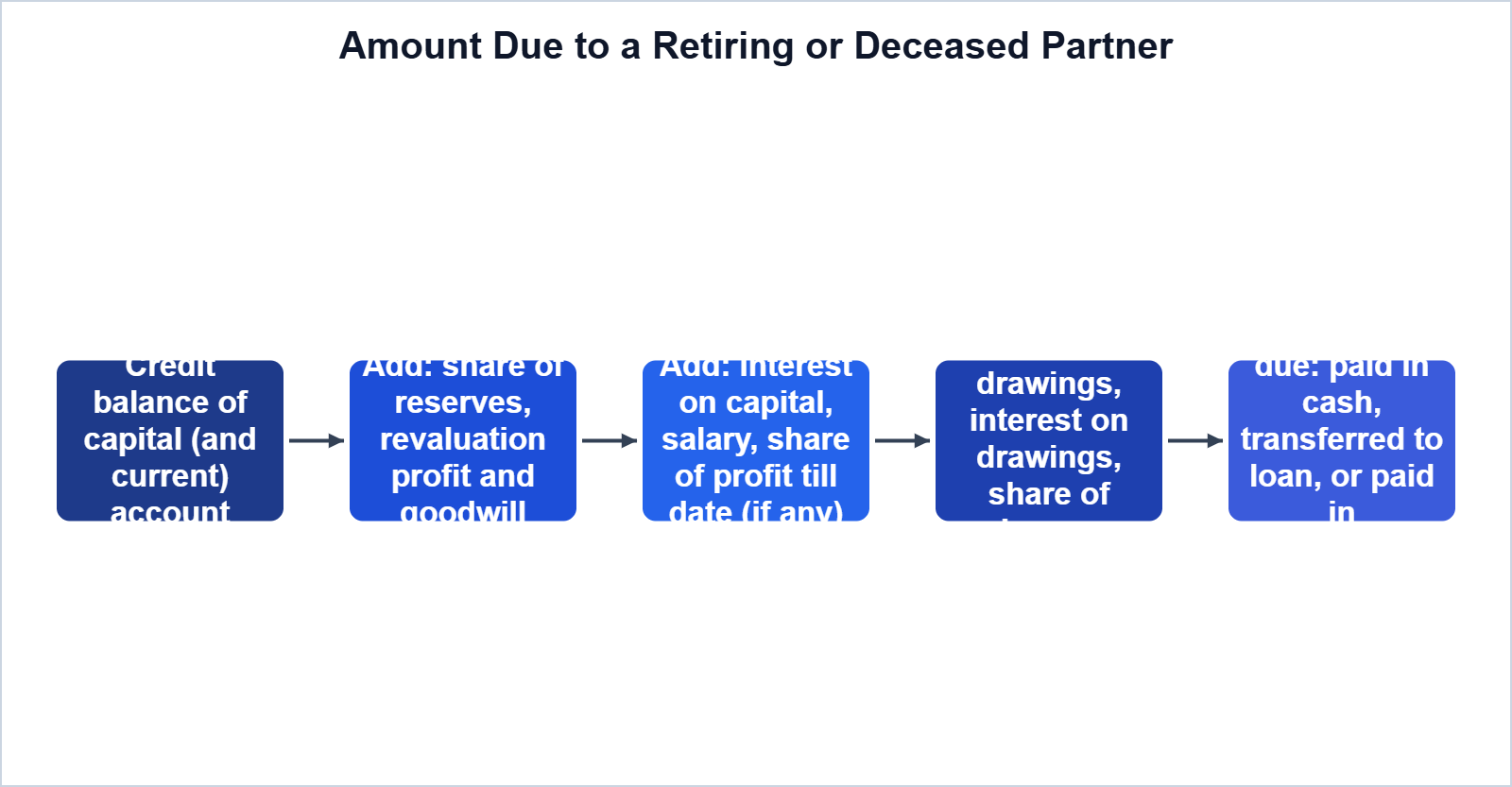
When a partner retires or dies, the firm must settle the amount due to him (or to his executors). The accounting steps are similar to admission: new ratio, gaining ratio, goodwill, revaluation, reserves, and settlement of the amount due.
2. New Profit Sharing Ratio
The new ratio of the remaining partners is normally given. If not given, the remaining partners continue to share in their old ratio.
3. Gaining Ratio
Gaining ratio = New ratio – Old ratio. It shows the share gained by each remaining partner from the retiring partner. It is used to adjust the retiring partner’s share of goodwill.
Illustration 1: A, B and C share 3:2:1. B retires. A and C continue in their old ratio (3:1).
Solution: A gains 3/4 – 3/6 = 3/12; C gains 1/4 – 1/6 = 1/12. Gaining ratio = 3:1 (same as their old ratio).
Illustration 2: A, B and C share 5:3:2. C retires; A and B will share 2:1.
Solution: A gains 2/3 – 5/10 = 5/30; B gains 1/3 – 3/10 = 1/30. Gaining ratio = 5:1.
4. Treatment of Goodwill
The retiring partner is compensated for his share of goodwill by the gaining partners in their gaining ratio, through capital accounts (AS-26: goodwill is not raised). Any existing goodwill in the books is first written off in the old ratio.
Illustration 3: Continuing Illustration 2, the firm’s goodwill is valued at ₹1,20,000. C’s share = 2/10 x 1,20,000 = ₹24,000, borne by A and B in 5:1 (A ₹20,000, B ₹4,000).
Journal Entry (Illustration 3)
Particulars | Dr (₹) | Cr (₹) |
|---|---|---|
A’s Capital A/c …Dr. | 20,000 |
|
B’s Capital A/c …Dr. | 4,000 |
|
To C’s Capital A/c |
| 24,000 |
(C’s share of goodwill adjusted in gaining ratio 5:1) |
|
|
5. Adjustment for Revaluation of Assets and Liabilities
As on admission, a Revaluation Account is prepared and the profit or loss is shared by all partners including the retiring partner in the old ratio.
6. Adjustment of Accumulated Profits and Losses
Reserves and accumulated profits or losses are distributed among all partners (including the retiring one) in the old ratio.
7. Disposal of Amount Due to a Retiring Partner
The amount due may be (a) paid immediately in cash, (b) transferred to the retiring partner’s Loan Account, or (c) partly paid and the balance transferred to loan, to be paid in instalments with interest.
Illustration 4 (Complete retirement problem): X, Y and Z share profits 2:2:1. Their Balance Sheet is given below. Z retires on this date on the terms: (i) building is appreciated by 20%; (ii) stock is reduced by ₹5,000; (iii) a provision for doubtful debts of ₹3,000 is created; (iv) goodwill of the firm is valued at ₹75,000; (v) Z is paid ₹30,000 in cash and the balance is transferred to his loan account. X and Y will share future profits equally.
Balance Sheet of X, Y and Z as at 31 March 2025
Liabilities | ₹ | Assets | ₹ |
|---|---|---|---|
Creditors | 50,000 | Bank | 35,000 |
General Reserve | 25,000 | Debtors | 60,000 |
X’s Capital | 1,00,000 | Stock | 50,000 |
Y’s Capital | 80,000 | Building | 1,40,000 |
Z’s Capital | 60,000 | Furniture | 30,000 |
Total | 3,15,000 | Total | 3,15,000 |
Working notes: Building +28,000 (20% of 1,40,000). Gaining ratio of X and Y = 1/2 – 2/5 = 1/10 each, i.e. 1:1. Z’s share of goodwill = 75,000 x 1/5 = ₹15,000 (X 7,500, Y 7,500). General Reserve 25,000 shared 2:2:1.
Revaluation Account
Dr. Particulars | ₹ | Cr. Particulars | ₹ |
|---|---|---|---|
To Stock | 5,000 | By Building | 28,000 |
To Provision for Doubtful Debts | 3,000 |
|
|
To Profit: X’s Capital (2/5) | 8,000 |
|
|
To Profit: Y’s Capital (2/5) | 8,000 |
|
|
To Profit: Z’s Capital (1/5) | 4,000 |
|
|
Total | 28,000 | Total | 28,000 |
Partners’ Capital Accounts
Dr. Particulars | X | Y | Z | Cr. Particulars | X | Y | Z |
|---|---|---|---|---|---|---|---|
To Z’s Capital A/c (goodwill) | 7,500 | 7,500 | – | By Balance b/d | 1,00,000 | 80,000 | 60,000 |
To Bank A/c | – | – | 30,000 | By Revaluation A/c | 8,000 | 8,000 | 4,000 |
To Z’s Loan A/c | – | – | 54,000 | By General Reserve | 10,000 | 10,000 | 5,000 |
To Balance c/d | 1,10,500 | 90,500 | – | By X’s Capital A/c | – | – | 7,500 |
|
|
|
| By Y’s Capital A/c | – | – | 7,500 |
Total | 1,18,000 | 98,000 | 84,000 | Total | 1,18,000 | 98,000 | 84,000 |
Balance Sheet of X and Y after Z’s retirement
Liabilities | ₹ | Assets | ₹ |
|---|---|---|---|
Creditors | 50,000 | Bank (35,000 – 30,000) | 5,000 |
Z’s Loan | 54,000 | Debtors 60,000 less Provision 3,000 | 57,000 |
X’s Capital | 1,10,500 | Stock | 45,000 |
Y’s Capital | 90,500 | Building | 1,68,000 |
|
| Furniture | 30,000 |
Total | 3,05,000 | Total | 3,05,000 |
8. Adjustment of Partners’ Capitals
After retirement, the remaining partners may adjust their capitals in the new ratio by bringing in or withdrawing cash, on the basis of the total capital of the new firm.
9. Death of a Partner
On death, the amount due is paid to the deceased partner’s executors. Besides the usual adjustments, the deceased partner is entitled to his share of profit from the beginning of the year to the date of death, calculated on a time basis or turnover (sales) basis, and recorded through a Profit and Loss Suspense A/c.
Illustration 5 (Profit up to date of death): P, Q and R share 2:2:1. R died on 30 June 2025. Profit of the last year (2024-25) was ₹1,20,000 on sales of ₹8,00,000. Sales from 1 April to 30 June 2025 were ₹2,40,000. Calculate R’s share of profit on (a) time basis and (b) turnover basis.
(a) Time basis: 1,20,000 x 3/12 x 1/5 = ₹6,000.
(b) Turnover basis: Rate of profit = 1,20,000 / 8,00,000 x 100 = 15%; Profit till death = 2,40,000 x 15% = ₹36,000; R’s share = 36,000 x 1/5 = ₹7,200.
Journal Entry (Illustration 5, turnover basis)
Particulars | Dr (₹) | Cr (₹) |
|---|---|---|
Profit and Loss Suspense A/c …Dr. | 7,200 |
|
To Deceased Partner’s Capital A/c |
| 7,200 |
(Share of profit up to the date of death) |
|
|
Illustration 6 (Deceased partner’s capital account): D, a partner, died. His capital was ₹50,000; his share of general reserve ₹6,000; share of goodwill (from gaining partners) ₹12,000; share of profit till death ₹7,200; interest on capital ₹1,000; drawings ₹4,000. Prepare D’s Capital Account.
D’s Capital Account (deceased partner)
Dr. Particulars | ₹ | Cr. Particulars | ₹ |
|---|---|---|---|
To Drawings | 4,000 | By Balance b/d | 50,000 |
To D’s Executors’ A/c | 72,200 | By General Reserve | 6,000 |
|
| By Partners’ Capital A/cs (goodwill) | 12,000 |
|
| By Profit and Loss Suspense A/c | 7,200 |
|
| By Interest on Capital | 1,000 |
Total | 76,200 | Total | 76,200 |
Illustration 7 (Executors’ Loan Account with instalments): The amount of ₹1,20,000 due to D’s executors on 1 April 2025 is to be paid in three equal annual instalments of ₹40,000 plus interest @ 10% p.a. on the outstanding balance, payable on 31 March each year.
D’s Executors’ Loan Account (Year 1: 2025-26)
Dr. Particulars | ₹ | Cr. Particulars | ₹ |
|---|---|---|---|
To Bank (40,000 + 12,000) | 52,000 | By D’s Capital A/c | 1,20,000 |
To Balance c/d | 80,000 | By Interest @ 10% | 12,000 |
Total | 1,32,000 | Total | 1,32,000 |
D’s Executors’ Loan Account (Year 2: 2026-27)
Dr. Particulars | ₹ | Cr. Particulars | ₹ |
|---|---|---|---|
To Bank (40,000 + 8,000) | 48,000 | By Balance b/d | 80,000 |
To Balance c/d | 40,000 | By Interest @ 10% | 8,000 |
Total | 88,000 | Total | 88,000 |
D’s Executors’ Loan Account (Year 3: 2027-28)
Dr. Particulars | ₹ | Cr. Particulars | ₹ |
|---|---|---|---|
To Bank (40,000 + 4,000) | 44,000 | By Balance b/d | 40,000 |
|
| By Interest @ 10% | 4,000 |
Total | 44,000 | Total | 44,000 |
Illustration 8 (Joint Life Policy): P, Q and R (2:2:1) took a joint life policy of ₹1,00,000; premiums were treated as a business expense. R died and the policy amount was received. The amount is credited to all partners in the old ratio.
Journal Entries (Illustration 8, Joint Life Policy)
Particulars | Dr (₹) | Cr (₹) |
|---|---|---|
Bank A/c …Dr. | 1,00,000 |
|
To Joint Life Policy A/c |
| 1,00,000 |
(Policy amount received on the death of a partner) |
|
|
Joint Life Policy A/c …Dr. | 1,00,000 |
|
To P’s Capital A/c |
| 40,000 |
To Q’s Capital A/c |
| 40,000 |
To R’s Capital A/c (deceased) |
| 20,000 |
(Policy amount credited to all partners in the old ratio 2:2:1) |
|
|
Easy Memory Trick: “Admission – Sacrifice; Retirement – Gain.”
10. Practice Problems (Answers Only)
- A, B and C share 5:3:2. B retires; A and C continue in the old ratio. Ans: New ratio and gaining ratio 5:2.
- A, B and C share 3:2:1. A retires; B and C will share 3:2. Ans: Gaining ratio 8:7.
- Goodwill of a firm is ₹60,000; the retiring partner’s share is 1/3. Ans: ₹20,000, borne by remaining partners in gaining ratio.
- A partner with 1/3 share died on 31 July; last year’s profit was ₹90,000. Share of profit on time basis. Ans: ₹10,000.
- ₹90,000 is payable to an executor in 3 equal annual instalments with 10% interest on balance. Ans: Payments ₹39,000, ₹36,000 and ₹33,000.
11. Important Questions
Q1. What is the gaining ratio?
Ans. The ratio in which the remaining partners acquire the share of the retiring or deceased partner; New ratio – Old ratio.
Q2. Who bears the retiring partner’s share of goodwill?
Ans. The remaining (gaining) partners, in their gaining ratio.
Q3. How is the profit up to the date of death calculated?
Ans. On a time basis (proportionate to the period) or on a turnover basis (rate of profit applied to sales up to the date of death).
Q4. Why is a Profit and Loss Suspense A/c opened?
Ans. To credit the deceased partner with his share of profit up to the date of death without closing the books.
Q5. In which ratio is revaluation profit shared on retirement?
Ans. Among all partners, including the retiring partner, in the old ratio.
Q6. Name three ways of settling the amount due to a retiring partner.
Ans. Payment in cash, transfer to loan account, or payment in instalments with interest.
Conclusion: On retirement or death, the outgoing partner (or his executors) must receive his full share of capital, reserves, revaluation profit, goodwill and current profit. Gaining partners compensate him for goodwill.