Accounting for Share Capital – Class 12 Accountancy Notes
Chapter – 5
Accounting for Share Capital
1. Features of a Company
A company is an artificial person created by law (Companies Act, 2013), having a separate legal entity, perpetual succession and a common seal (optional now).
- Separate legal entity distinct from its members.
- Limited liability of members (in a company limited by shares).
- Perpetual succession: it continues even if members change.
- Transferability of shares (freely in a public company).
- Management by elected directors, separate from ownership.
2. Kinds of Companies
Basis | Kinds |
|---|---|
Number of members | Private company, public company, one person company (OPC) |
Liability | Limited by shares, limited by guarantee, unlimited company |
Control | Holding company, subsidiary company |
Ownership | Government company, non-government company |
Listing | Listed company, unlisted company |
3. Share Capital of a Company
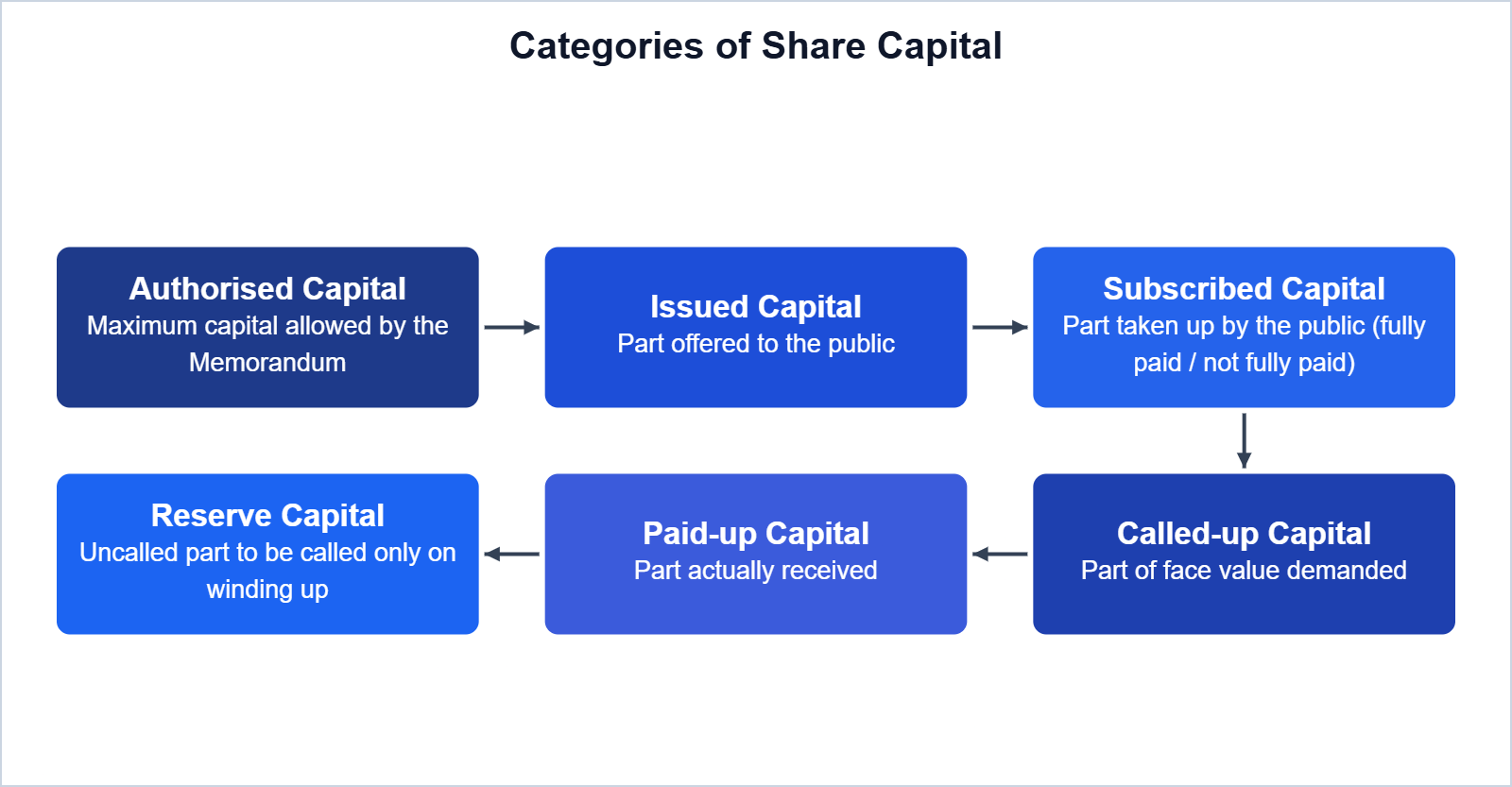
Important: Reserve capital is the part of uncalled capital which the company decides, by special resolution, to call only on its winding up.
4. Nature and Classes of Shares
A share is a fractional part of the share capital. Shares are of two kinds:
- Preference shares: have a preferential right to dividend at a fixed rate and to repayment of capital on winding up. They may be cumulative or non-cumulative, participating or non-participating, convertible or non-convertible, and redeemable.
- Equity shares: shares that are not preference shares. Equity shareholders bear the main risk, get dividend after preference shareholders and have voting rights.
5. Issue of Shares
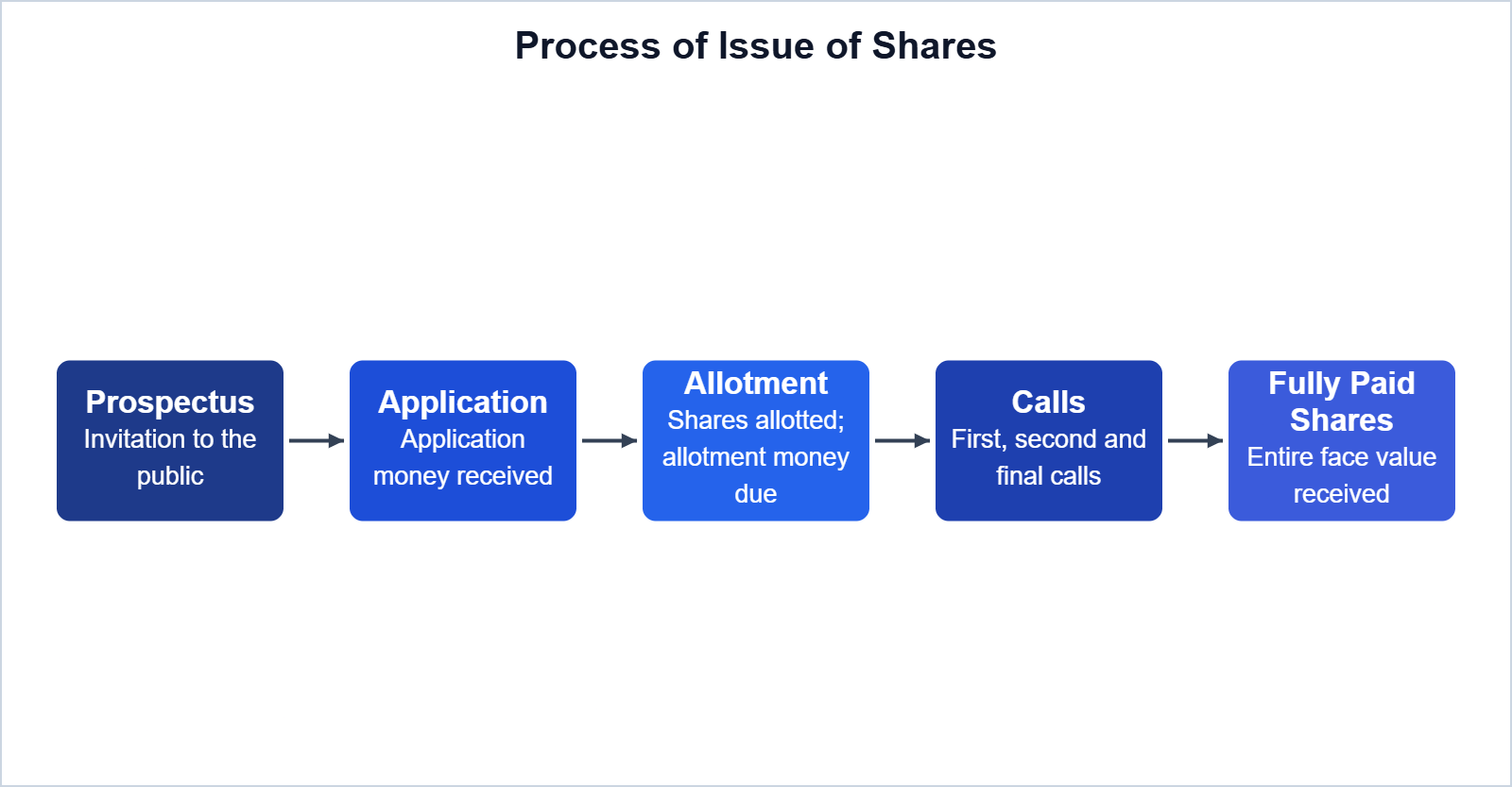
Shares can be issued (a) for cash, payable in lump sum or in instalments, (b) for consideration other than cash, and (c) as sweat equity. They can be issued at par (face value) or at a premium (above face value).
Important: Under Section 53 of the Companies Act, 2013, a company cannot issue shares at a discount; any such issue is void. The only exception is sweat equity shares issued under Section 54.
Uses of Securities Premium (Section 52): issuing fully paid bonus shares; writing off preliminary expenses; writing off expenses, commission or discount on issue of shares or debentures; providing for premium payable on redemption of preference shares or debentures; and buy-back of its own shares (Section 68).
Minimum subscription: As per SEBI rules, a company must receive minimum subscription (90% of the issue) before it can allot shares.
6. Accounting Treatment
Illustration 1 (Issue at par): A Ltd. issued 10,000 equity shares of ₹10 each, payable ₹3 on application, ₹4 on allotment and ₹3 on first and final call. All shares were subscribed and all money was received.
Journal Entries (Illustration 1: issue at par)
Particulars | Dr (₹) | Cr (₹) |
|---|---|---|
Bank A/c …Dr. | 30,000 |
|
To Equity Share Application A/c |
| 30,000 |
(Application money received on 10,000 shares @ ₹3) |
|
|
Equity Share Application A/c …Dr. | 30,000 |
|
To Equity Share Capital A/c |
| 30,000 |
(Application money transferred to share capital) |
|
|
Equity Share Allotment A/c …Dr. | 40,000 |
|
To Equity Share Capital A/c |
| 40,000 |
(Allotment money due @ ₹4) |
|
|
Bank A/c …Dr. | 40,000 |
|
To Equity Share Allotment A/c |
| 40,000 |
(Allotment money received) |
|
|
Equity Share First and Final Call A/c …Dr. | 30,000 |
|
To Equity Share Capital A/c |
| 30,000 |
(Call money due @ ₹3) |
|
|
Bank A/c …Dr. | 30,000 |
|
To Equity Share First and Final Call A/c |
| 30,000 |
(Call money received) |
|
|
Illustration 2 (Issue at premium): B Ltd. issued 20,000 equity shares of ₹10 each at a premium of ₹2, payable ₹3 on application, ₹5 on allotment (including premium) and ₹4 on first and final call. All money was received.
Journal Entries (Illustration 2: issue at premium)
Particulars | Dr (₹) | Cr (₹) |
|---|---|---|
Bank A/c …Dr. | 60,000 |
|
To Equity Share Application A/c |
| 60,000 |
(Application money on 20,000 shares @ ₹3) |
|
|
Equity Share Application A/c …Dr. | 60,000 |
|
To Equity Share Capital A/c |
| 60,000 |
(Application money transferred) |
|
|
Equity Share Allotment A/c …Dr. | 1,00,000 |
|
To Equity Share Capital A/c |
| 60,000 |
To Securities Premium A/c |
| 40,000 |
(Allotment due @ ₹5 including premium ₹2) |
|
|
Bank A/c …Dr. | 1,00,000 |
|
To Equity Share Allotment A/c |
| 1,00,000 |
(Allotment money received) |
|
|
Equity Share First and Final Call A/c …Dr. | 80,000 |
|
To Equity Share Capital A/c |
| 80,000 |
(Call due @ ₹4) |
|
|
Bank A/c …Dr. | 80,000 |
|
To Equity Share First and Final Call A/c |
| 80,000 |
(Call money received) |
|
|
Illustration 3 (Over-subscription): B Ltd. (same terms as Illustration 2) received applications for 35,000 shares. Applications for 5,000 shares were rejected and money refunded; the remaining applicants were allotted shares on a pro-rata basis (30,000 applied : 20,000 allotted). Excess application money was adjusted towards allotment. Entries up to allotment are shown.
Journal Entries (Illustration 3: over-subscription, pro-rata)
Particulars | Dr (₹) | Cr (₹) |
|---|---|---|
Bank A/c …Dr. | 1,05,000 |
|
To Equity Share Application A/c |
| 1,05,000 |
(Application money on 35,000 shares @ ₹3) |
|
|
Equity Share Application A/c …Dr. | 1,05,000 |
|
To Equity Share Capital A/c |
| 60,000 |
To Equity Share Allotment A/c |
| 30,000 |
To Bank A/c |
| 15,000 |
(Application money: 20,000 shares to capital; excess on 10,000 shares adjusted to allotment; 5,000 applications rejected and refunded) |
|
|
Equity Share Allotment A/c …Dr. | 1,00,000 |
|
To Equity Share Capital A/c |
| 60,000 |
To Securities Premium A/c |
| 40,000 |
(Allotment due @ ₹5 including premium ₹2) |
|
|
Bank A/c …Dr. | 70,000 |
|
To Equity Share Allotment A/c |
| 70,000 |
(Balance allotment money received (1,00,000 – 30,000)) |
|
|
Working: Application money received on 30,000 shares = ₹90,000; required on 20,000 shares = ₹60,000; excess ₹30,000 adjusted to allotment.
Under-subscription: If fewer shares are applied for than offered (but minimum subscription is received), shares are allotted only to the applicants and entries are made for the actual number of shares.
7. Calls in Arrears, Calls in Advance and Forfeiture of Shares
Calls in arrears is the amount called up but not paid by shareholders. Calls in advance is money received before it is called; it is a liability until the call is made. As per Table F (if the articles are silent), interest on calls in arrears may be charged up to 10% p.a. and interest on calls in advance may be paid up to 12% p.a.
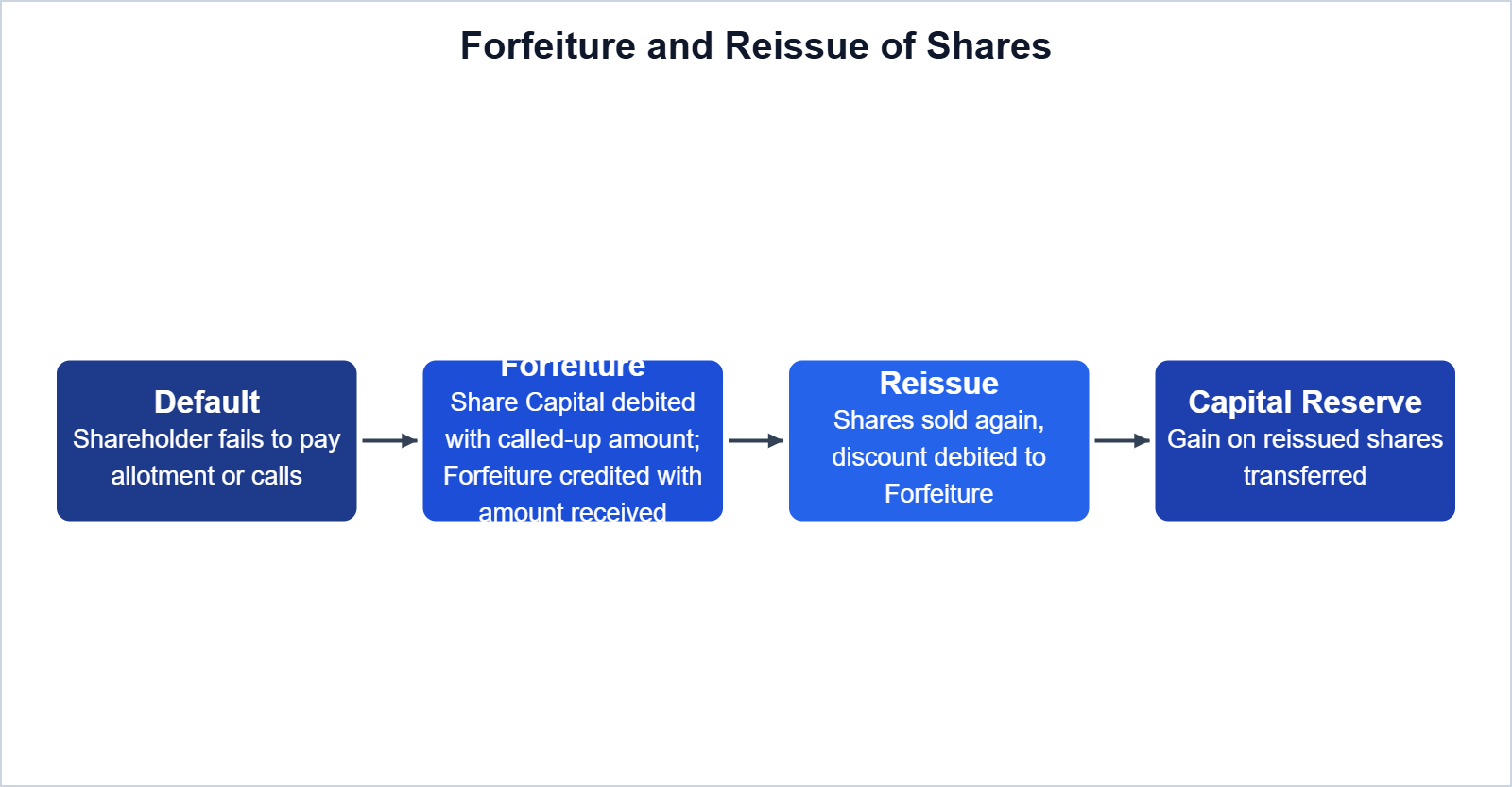
Illustration 4: C Ltd. issued 5,000 shares of ₹10 each, payable ₹2 on application, ₹3 on allotment and ₹5 on first and final call. All shares were subscribed. Ram, holding 200 shares, did not pay allotment and call money. His shares were forfeited. Later 150 of these shares were reissued at ₹9 per share as fully paid.
Journal Entries (Illustration 4: calls in arrears, forfeiture and reissue)
Particulars | Dr (₹) | Cr (₹) |
|---|---|---|
Bank A/c …Dr. | 10,000 |
|
To Share Application A/c |
| 10,000 |
(Application money on 5,000 shares @ ₹2) |
|
|
Share Application A/c …Dr. | 10,000 |
|
To Share Capital A/c |
| 10,000 |
(Transferred to share capital) |
|
|
Share Allotment A/c …Dr. | 15,000 |
|
To Share Capital A/c |
| 15,000 |
(Allotment due @ ₹3) |
|
|
Bank A/c …Dr. | 14,400 |
|
Calls in Arrears A/c …Dr. | 600 |
|
To Share Allotment A/c |
| 15,000 |
(Allotment received except on Ram’s 200 shares) |
|
|
Share First and Final Call A/c …Dr. | 25,000 |
|
To Share Capital A/c |
| 25,000 |
(Call due @ ₹5) |
|
|
Bank A/c …Dr. | 24,000 |
|
Calls in Arrears A/c …Dr. | 1,000 |
|
To Share First and Final Call A/c |
| 25,000 |
(Call received except on Ram’s 200 shares) |
|
|
Share Capital A/c …Dr. | 2,000 |
|
To Calls in Arrears A/c |
| 1,600 |
To Share Forfeiture A/c |
| 400 |
(200 shares of Ram forfeited) |
|
|
Bank A/c …Dr. | 1,350 |
|
Share Forfeiture A/c …Dr. | 150 |
|
To Share Capital A/c |
| 1,500 |
(150 forfeited shares reissued @ ₹9 as fully paid) |
|
|
Share Forfeiture A/c …Dr. | 150 |
|
To Capital Reserve A/c |
| 150 |
(Gain on reissue of 150 shares transferred (300 – 150)) |
|
|
Working: Amount received from Ram = 200 x ₹2 = ₹400 (forfeiture). Forfeited amount on 150 reissued shares = 150 x 2 = ₹300; discount on reissue = 150 x 1 = ₹150; capital reserve = ₹150. Balance in Share Forfeiture A/c = ₹100 (on 50 shares not reissued).
Note to Accounts: Share Capital (Illustration 4) | ₹ |
|---|---|
Authorised Capital: …… equity shares of ₹10 each | …… |
Issued Capital: 5,000 equity shares of ₹10 each | 50,000 |
Subscribed Capital: Subscribed and fully paid: 4,950 shares of ₹10 each | 49,500 |
Add: Forfeited shares (amount originally paid on 50 shares) | 100 |
Total | 49,600 |
Illustration 5 (Forfeiture with pro-rata allotment): D Ltd. issued 10,000 shares of ₹10 each at ₹12, payable ₹5 on application (including premium ₹2), ₹3 on allotment and ₹4 on first and final call. Applications were received for 15,000 shares and allotment was made pro-rata. Excess application money was adjusted towards allotment. Hari, who applied for 300 shares (allotted 200), failed to pay allotment and call money. His shares were forfeited and reissued @ ₹8 per share as fully paid.
Working for Hari | ₹ |
|---|---|
Application money paid on 300 shares @ ₹5 | 1,500 |
Application money required on 200 shares @ ₹5 (₹3 capital + ₹2 premium) | 1,000 |
Excess adjusted to allotment | 500 |
Allotment due on 200 shares @ ₹3 | 600 |
Allotment unpaid (600 – 500) | 100 |
Call unpaid (200 x ₹4) | 800 |
Amount received towards capital (200 x 3 + 500) = Forfeiture | 1,100 |
Journal Entries (Illustration 5: forfeiture of pro-rata shares)
Particulars | Dr (₹) | Cr (₹) |
|---|---|---|
Share Capital A/c …Dr. | 2,000 |
|
To Share Allotment A/c |
| 100 |
To Share First and Final Call A/c |
| 800 |
To Share Forfeiture A/c |
| 1,100 |
(200 shares of Hari forfeited) |
|
|
Bank A/c …Dr. | 1,600 |
|
Share Forfeiture A/c …Dr. | 400 |
|
To Share Capital A/c |
| 2,000 |
(200 forfeited shares reissued @ ₹8 as fully paid) |
|
|
Share Forfeiture A/c …Dr. | 700 |
|
To Capital Reserve A/c |
| 700 |
(Balance of forfeiture on reissued shares transferred) |
|
|
Exam point: Securities premium already received is not cancelled on forfeiture.
Illustration 6 (Calls in advance): E Ltd. has 10,000 shares on which allotment of ₹3 per share was due. Sita, holding 500 shares, paid the final call of ₹4 per share along with allotment. The call was made later and all money was received.
Journal Entries (Illustration 6: calls in advance)
Particulars | Dr (₹) | Cr (₹) |
|---|---|---|
Bank A/c …Dr. | 32,000 |
|
To Share Allotment A/c |
| 30,000 |
To Calls in Advance A/c |
| 2,000 |
(Allotment money received along with call money in advance on 500 shares @ ₹4) |
|
|
Share First and Final Call A/c …Dr. | 40,000 |
|
To Share Capital A/c |
| 40,000 |
(Call due on 10,000 shares @ ₹4) |
|
|
Bank A/c …Dr. | 38,000 |
|
Calls in Advance A/c …Dr. | 2,000 |
|
To Share First and Final Call A/c |
| 40,000 |
(Call money received; calls in advance adjusted) |
|
|
8. Issue of Shares for Consideration other than Cash
Illustration 7: F Ltd. purchased assets worth ₹2,20,000 from a vendor and paid by issuing equity shares of ₹10 each at a premium of 10%. Number of shares = 2,20,000 / 11 = 20,000 shares.
Journal Entries (Illustration 7: consideration other than cash)
Particulars | Dr (₹) | Cr (₹) |
|---|---|---|
Sundry Assets A/c …Dr. | 2,20,000 |
|
To Vendor A/c |
| 2,20,000 |
(Assets purchased from vendor) |
|
|
Vendor A/c …Dr. | 2,20,000 |
|
To Equity Share Capital A/c |
| 2,00,000 |
To Securities Premium A/c |
| 20,000 |
(20,000 shares of ₹10 issued at 10% premium to vendor) |
|
|
Easy Memory Trick: “Forfeiture = what was received; reissue discount comes out of it; the rest of it goes to Capital Reserve.”
9. Practice Problems (Answers Only)
- 5,000 shares of ₹10 at 20% premium; ₹4 on application, ₹5 on allotment (including premium), ₹3 on call. Ans: Securities premium ₹10,000; total amount ₹60,000.
- 100 shares of ₹10 (fully called) on which ₹6 was paid were forfeited and reissued at ₹8 fully paid. Ans: Forfeiture ₹600; discount ₹200; capital reserve ₹400.
- Applications for 15,000 shares were received for 10,000 shares offered; application money ₹3; pro-rata allotment. Ans: Excess ₹15,000 adjusted towards allotment.
- Assets of ₹1,10,000 purchased; shares of ₹100 issued at 10% premium. Ans: 1,000 shares.
- Can a company issue shares at a discount? Ans: No (Section 53), except sweat equity shares (Section 54).
10. Important Questions
Q1. What is reserve capital?
Ans. The part of uncalled capital which can be called only on the winding up of the company, as decided by a special resolution.
Q2. State any three uses of securities premium under Section 52.
Ans. Issuing fully paid bonus shares, writing off preliminary expenses, and providing premium on redemption of debentures.
Q3. What are calls in arrears?
Ans. The amount called up on shares but not yet paid by shareholders.
Q4. What is forfeiture of shares?
Ans. Cancellation of shares for non-payment of allotment or call money; the amount already paid is forfeited.
Q5. How is the balance of Share Forfeiture A/c on reissued shares treated?
Ans. It is transferred to Capital Reserve.
Q6. What is over-subscription? How is it dealt with?
Ans. When applications exceed the shares offered; by rejecting some applications, pro-rata allotment, or a combination of both.
Q7. Where is Share Forfeiture A/c shown in the Balance Sheet?
Ans. It is added to the paid-up capital in the note on Share Capital under Shareholders’ Funds.
Conclusion: Share capital is recorded stage by stage (application, allotment and calls). Premium, over-subscription, calls in arrears or advance, forfeiture and reissue each need careful entries that follow the Companies Act, 2013.