Chapter – 7
Financial Statements of a Company
1. Meaning of Financial Statements
Financial statements are the end products of the accounting process. They show the financial position (Balance Sheet) and the results of operations (Statement of Profit and Loss) of a company for a period. As per Section 2(40) of the Companies Act, 2013, financial statements include the Balance Sheet, Statement of Profit and Loss, Cash Flow Statement, Statement of Changes in Equity (if applicable) and explanatory notes.
2. Nature of Financial Statements
Financial statements are based on: (1) recorded facts (historical cost), (2) accounting conventions (such as conservatism and consistency), (3) postulates (such as going concern and money measurement) and (4) personal judgements (such as the method of depreciation and valuation of inventory).
3. Objectives of Financial Statements
- To provide information about economic resources and obligations of the business.
- To provide information about the earning capacity of the business.
- To provide information about cash flows.
- To judge the effectiveness of management.
- To disclose accounting policies.
4. Types of Financial Statements
(a) Balance Sheet shows the financial position on a particular date. (b) Statement of Profit and Loss shows revenues, expenses and profit for the period. Both must be prepared in the format given in Schedule III of the Companies Act, 2013.
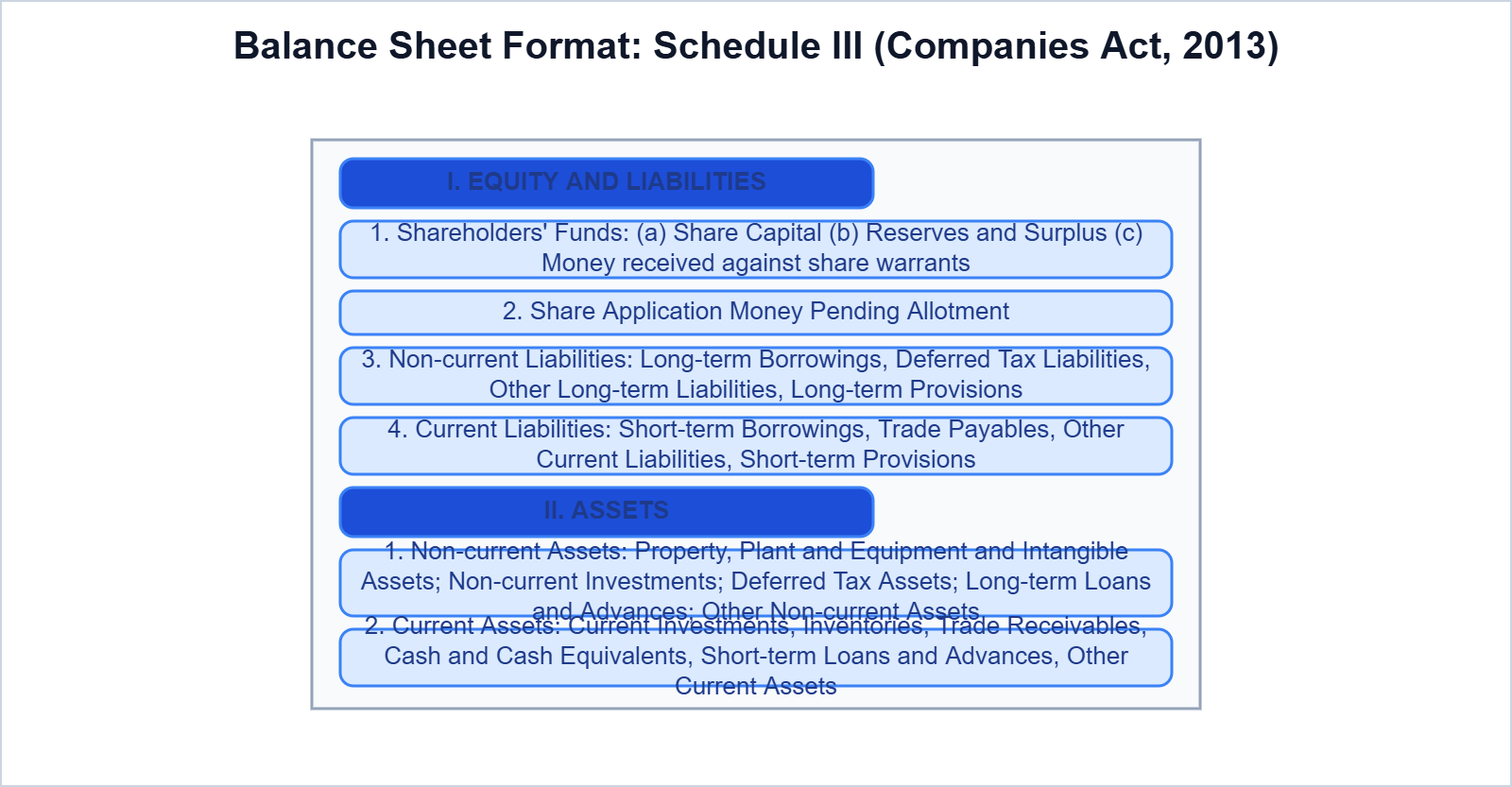
Illustration 1 (Classification of items under Schedule III):
Item | Main head | Sub-head |
|---|---|---|
Calls in advance | Current Liabilities | Other Current Liabilities |
Debentures (redeemable after 5 years) | Non-current Liabilities | Long-term Borrowings |
Securities Premium | Shareholders’ Funds | Reserves and Surplus |
Bills Receivable | Current Assets | Trade Receivables |
Goodwill | Non-current Assets | Intangible Assets |
Provision for tax | Current Liabilities | Short-term Provisions |
Loose tools | Current Assets | Inventories |
Unpaid dividend | Current Liabilities | Other Current Liabilities |
Bank overdraft | Current Liabilities | Short-term Borrowings |
Capital work-in-progress | Non-current Assets | Property, Plant and Equipment and Intangible Assets |
Illustration 2 (Preparation of Balance Sheet): From the following information, prepare the Balance Sheet of XYZ Ltd. as at 31 March 2025: equity share capital ₹10,00,000; general reserve ₹1,00,000; securities premium ₹50,000; surplus ₹1,50,000; 10% debentures ₹4,00,000; trade payables ₹2,40,000; provision for tax ₹60,000; PPE ₹10,00,000; goodwill ₹2,00,000; non-current investments ₹2,00,000; inventories ₹3,00,000; debtors ₹1,50,000; bills receivable ₹50,000; cash and cash equivalents ₹1,00,000.
Particulars | Note No. | ₹ |
|---|---|---|
I. EQUITY AND LIABILITIES |
|
|
1. Shareholders’ Funds |
|
|
(a) Share Capital | 1 | 10,00,000 |
(b) Reserves and Surplus | 2 | 3,00,000 |
2. Non-current Liabilities |
|
|
Long-term Borrowings (10% Debentures) |
| 4,00,000 |
3. Current Liabilities |
|
|
(a) Trade Payables |
| 2,40,000 |
(b) Short-term Provisions (provision for tax) |
| 60,000 |
Total |
| 20,00,000 |
II. ASSETS |
|
|
1. Non-current Assets |
|
|
(a) Property, Plant and Equipment and Intangible Assets |
|
|
(i) Property, Plant and Equipment |
| 10,00,000 |
(ii) Intangible Assets (goodwill) |
| 2,00,000 |
(b) Non-current Investments |
| 2,00,000 |
2. Current Assets |
|
|
(a) Inventories |
| 3,00,000 |
(b) Trade Receivables | 3 | 2,00,000 |
(c) Cash and Cash Equivalents |
| 1,00,000 |
Total |
| 20,00,000 |
Notes to Accounts | ₹ |
|---|---|
1. Share Capital |
|
Authorised: 2,00,000 equity shares of ₹10 each | 20,00,000 |
Issued, subscribed and fully paid: 1,00,000 equity shares of ₹10 each | 10,00,000 |
2. Reserves and Surplus |
|
General Reserve | 1,00,000 |
Securities Premium | 50,000 |
Surplus (balance in Statement of Profit and Loss) | 1,50,000 |
Total | 3,00,000 |
3. Trade Receivables |
|
Sundry Debtors | 1,50,000 |
Bills Receivable | 50,000 |
Total | 2,00,000 |
Illustration 3 (Statement of Profit and Loss): From the following, prepare the Statement of Profit and Loss of XYZ Ltd. for the year ended 31 March 2025: revenue from operations ₹12,50,000; other income ₹40,000; purchases (net of change in inventories) ₹6,00,000; employee benefits ₹1,20,000; finance costs ₹40,000; depreciation ₹50,000; other expenses ₹30,000; tax @ 30%.
Particulars | ₹ |
|---|---|
I. Revenue from Operations | 12,50,000 |
II. Other Income | 40,000 |
III. Total Income (I + II) | 12,90,000 |
IV. Expenses: |
|
Purchases of Stock-in-Trade (net of change in inventories) | 6,00,000 |
Employee Benefits Expense | 1,20,000 |
Finance Costs | 40,000 |
Depreciation and Amortisation Expense | 50,000 |
Other Expenses | 30,000 |
Total Expenses | 8,40,000 |
V. Profit before Tax (III – IV) | 4,50,000 |
VI. Tax Expense @ 30% | 1,35,000 |
VII. Profit for the Period (V – VI) | 3,15,000 |
5. Uses and Importance of Financial Statements
User | Use |
|---|---|
Shareholders | To judge profitability and safety of investment |
Creditors and lenders | To judge the ability to repay loans and interest |
Management | For planning, control and decision-making |
Government | For tax, regulation and policy |
Employees | For wages, bonus and job security |
6. Limitations of Financial Statements
- Based on historical cost; do not show current values.
- Ignore qualitative information (such as staff efficiency and reputation).
- Affected by personal judgement of accountants.
- Show interim results; the true result is known only at the end of the business.
- May be affected by window dressing (presenting a better picture than the real one).
Exam point: In Schedule III, bank overdraft is shown under Short-term Borrowings, and calls in advance under Other Current Liabilities.
Easy Memory Trick: Balance Sheet heads “S-N-C / N-C”: Shareholders’ funds, Non-current liabilities, Current liabilities; Non-current assets, Current assets.
7. Practice Problems (Answers Only)
- Under which head and sub-head is “Interest accrued but not due on debentures” shown? Ans: Current Liabilities; Other Current Liabilities.
- Where is “Share Forfeiture A/c” shown? Ans: Shareholders’ Funds; Share Capital (added to paid-up capital).
- Where are “Trade marks” shown? Ans: Non-current Assets; Intangible Assets.
- Revenue ₹8,00,000; total expenses ₹6,50,000; tax 30%. Find profit for the period. Ans: ₹1,05,000.
- Where is “Stores and spares” shown? Ans: Current Assets; Inventories.
8. Important Questions
Q1. What are financial statements?
Ans. Statements showing the financial position and performance of a company, mainly the Balance Sheet and the Statement of Profit and Loss, with notes.
Q2. Name the main heads of the equity and liabilities side of a company’s Balance Sheet.
Ans. Shareholders’ funds, share application money pending allotment, non-current liabilities and current liabilities.
Q3. Under which Schedule of the Companies Act, 2013 are financial statements prepared?
Ans. Schedule III.
Q4. State any two limitations of financial statements.
Ans. They are based on historical cost and ignore qualitative factors.
Q5. What is meant by personal judgement in financial statements?
Ans. Choices made by accountants, such as the method of depreciation or inventory valuation, which affect the figures.
Q6. Name two users of financial statements and their uses.
Ans. Shareholders, to judge returns and safety; creditors, to judge repayment capacity.
Conclusion: Financial statements prepared in the Schedule III format give a standard, clear picture of a company’s position and performance, but their limitations must be kept in mind while using them.