Chapter – 1
Accounting for Partnership: Basic Concepts
1. Nature of Partnership
Section 4 of the Indian Partnership Act, 1932 defines partnership as “the relation between persons who have agreed to share the profits of a business carried on by all or any of them acting for all”. The persons are individually called partners and collectively a firm.
Features:
- Two or more persons: At least two; the maximum is 50 as per the Companies (Miscellaneous) Rules, 2014.
- Agreement: Partnership arises from an agreement, oral or written.
- Business: The agreement must be to carry on a lawful business.
- Sharing of profits: Partners agree to share profits (and losses).
- Mutual agency: Each partner is an agent of the firm and of the other partners.
- Unlimited liability: Partners are jointly and individually liable for the debts of the firm.
2. Partnership Deed
The Partnership Deed is a written agreement containing the terms and conditions of the partnership. It should be signed by all partners and properly stamped.
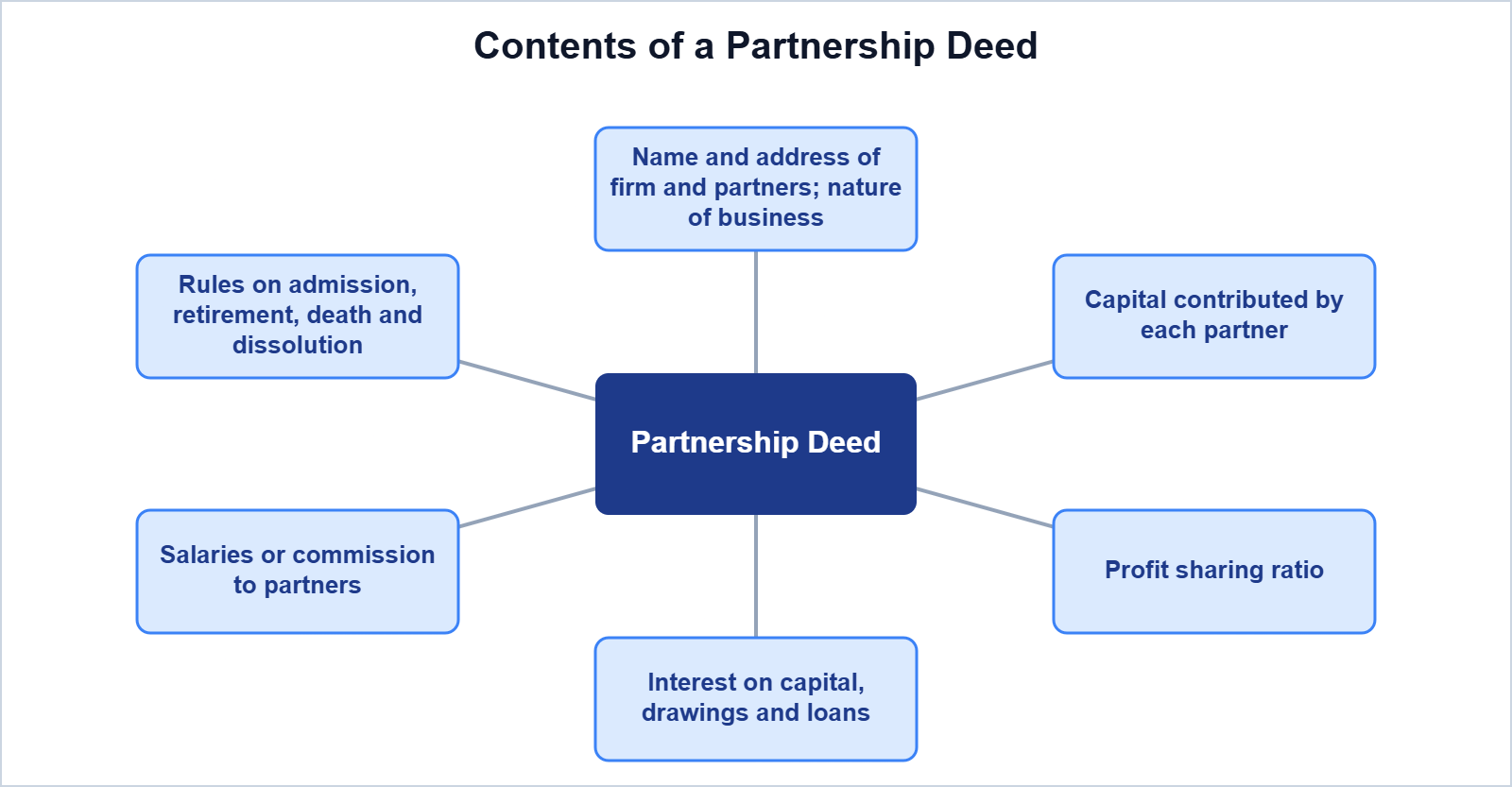
Rules applicable in the absence of a deed (Partnership Act, 1932):
Point | Rule |
|---|---|
Profit sharing ratio | Equally |
Interest on capital | No interest is allowed |
Interest on drawings | No interest is charged |
Salary or commission to partners | Not allowed |
Interest on partner’s loan to the firm | 6% per annum (charged to Profit and Loss A/c) |
Exam point: Interest on a partner’s loan is a charge against profit (debited to Profit and Loss A/c) and must be given even if there is a loss; interest on capital is an appropriation of profit.
3. Special Aspects of Partnership Accounts
- Maintenance of partners’ capital accounts.
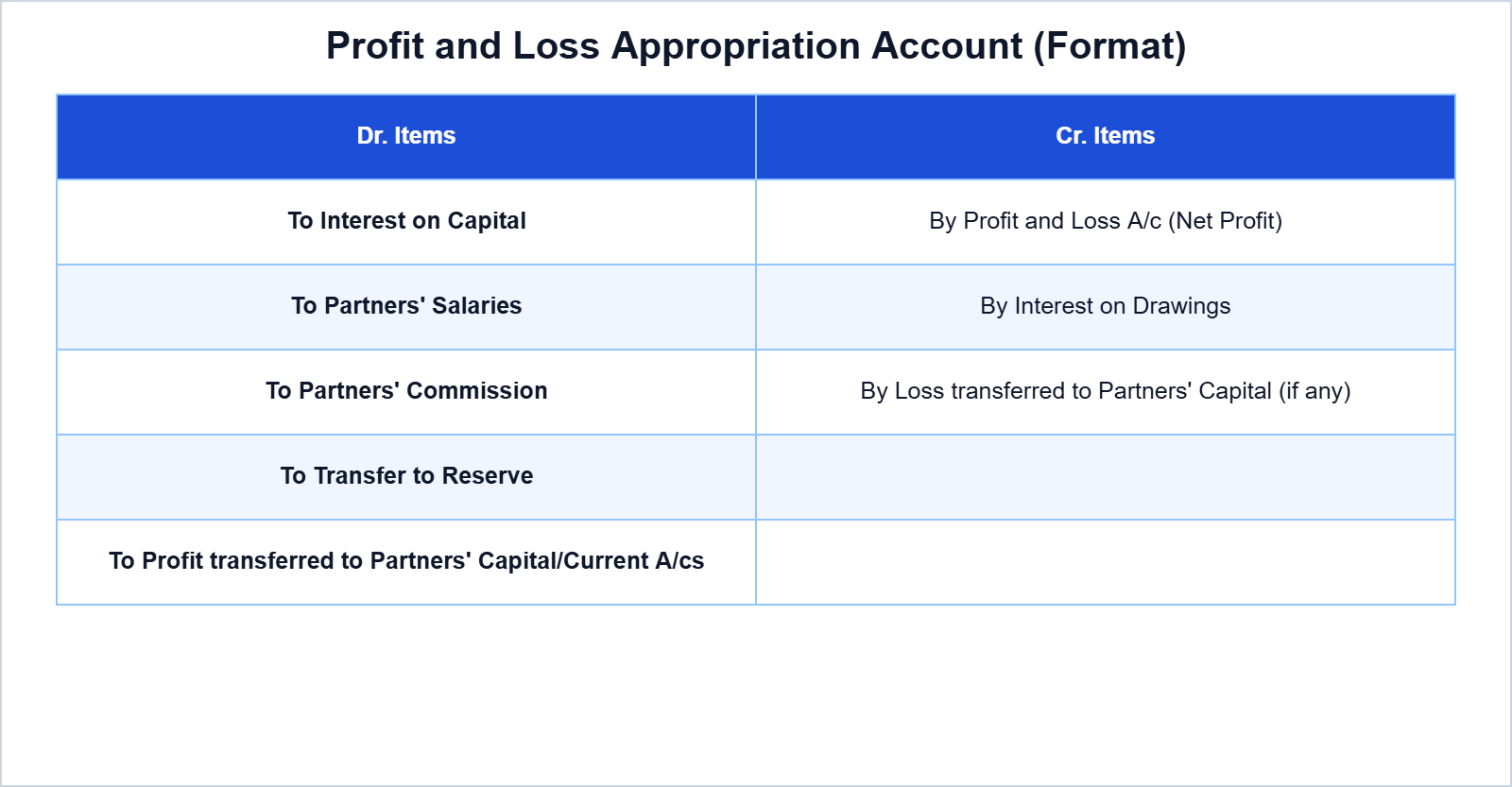
- Distribution of profit or loss through the Profit and Loss Appropriation Account.
- Adjustments for wrong appropriation of profits in the past (past adjustments).
- Reconstitution (admission, retirement, death) and dissolution of the firm.
4. Maintenance of Capital Accounts of Partners
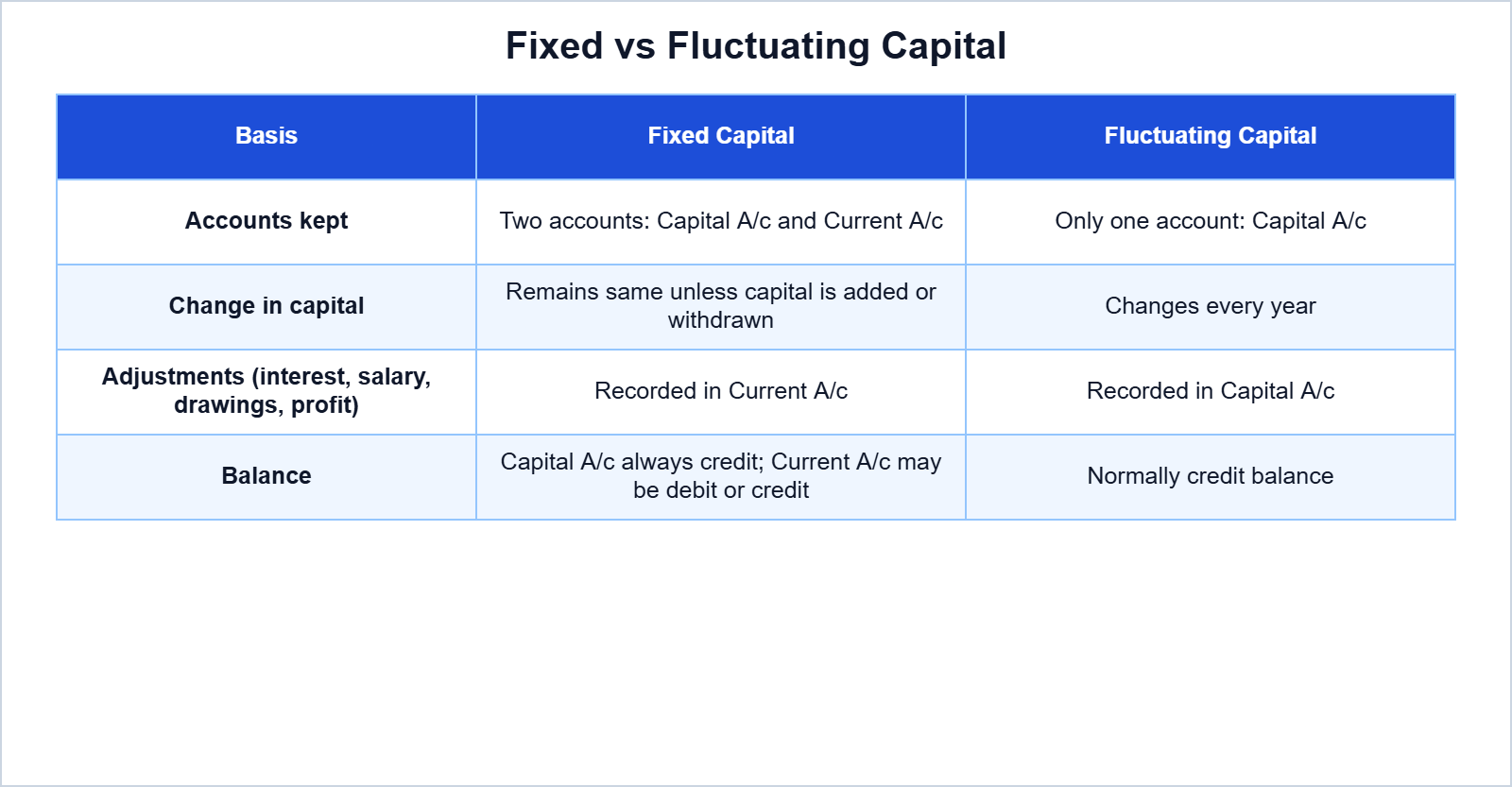
Remember: Under the fixed capital method, drawings, interest, salary and profit go to the Current Account; under the fluctuating capital method, all items go to the Capital Account.
5. Distribution of Profit among Partners: Interest on Capital and Drawings
Interest on capital is calculated on the opening capital for the full year, and on additional capital from the date it is introduced. Interest on capital is allowed only if the deed provides for it, and normally only out of profits.
Interest on drawings is charged only if the deed provides it. It can be calculated by three methods: (1) when dates are given, on each amount for the period it remained withdrawn (simple or product method), (2) product method, and (3) average period method when equal amounts are drawn at regular intervals.
Drawings of equal amount | Average period (12 months, year end) |
|---|---|
At the beginning of each month | 6.5 months |
In the middle of each month | 6 months |
At the end of each month | 5.5 months |
At the beginning of each quarter | 7.5 months |
At the end of each quarter | 4.5 months |
Illustration 1 (Interest on capital): A and B started a business on 1 April 2024 with capitals of ₹2,00,000 and ₹1,50,000. On 1 October 2024, B introduced additional capital of ₹50,000. Interest on capital is allowed @ 10% p.a. Calculate interest on capital for the year ended 31 March 2025.
Solution: A = 2,00,000 x 10% = ₹20,000. B = (1,50,000 x 10%) + (50,000 x 10% x 6/12) = 15,000 + 2,500 = ₹17,500.
Illustration 2 (Interest on drawings, dates given): A withdrew ₹10,000 on 1 July 2024 and ₹20,000 on 1 January 2025. Interest @ 6% p.a.; year ends 31 March 2025.
Date | Amount (₹) | Months to 31 March | Interest @ 6% (₹) |
|---|---|---|---|
1 July 2024 | 10,000 | 9 | 450 |
1 January 2025 | 20,000 | 3 | 300 |
Total | 30,000 |
| 750 |
Illustration 3 (Product method): B’s drawings during 2024-25 were: 1 May ₹8,000; 31 August ₹12,000; 30 November ₹5,000; 1 February ₹10,000. Interest @ 12% p.a.
Date | Amount (₹) | Months to 31 March | Product (₹) |
|---|---|---|---|
1 May | 8,000 | 11 | 88,000 |
31 August | 12,000 | 7 | 84,000 |
30 November | 5,000 | 4 | 20,000 |
1 February | 10,000 | 2 | 20,000 |
Total | 35,000 |
| 2,12,000 |
Interest = 2,12,000 x 12/100 x 1/12 = ₹2,120.
Illustration 4 (Average period method): C withdrew ₹6,000 every month (₹72,000 in the year). Interest @ 8% p.a. Calculate interest if drawings were made (a) at the beginning, (b) at the end, (c) in the middle of each month.
Case | Average period | Interest (₹) |
|---|---|---|
(a) Beginning of month | 6.5 months | 72,000 x 8% x 6.5/12 = 3,120 |
(b) End of month | 5.5 months | 72,000 x 8% x 5.5/12 = 2,640 |
(c) Middle of month | 6 months | 72,000 x 8% x 6/12 = 2,880 |
Illustration 5 (P&L Appropriation, fixed capital): X and Y share profits 3:2. Fixed capitals: X ₹3,00,000, Y ₹2,00,000. Interest on capital @ 10%; Y gets salary ₹3,000 per month; X gets commission ₹10,000; interest on drawings: X ₹2,000, Y ₹1,500. Drawings: X ₹40,000, Y ₹30,000. Net profit ₹1,50,000. Prepare the P&L Appropriation A/c and partners’ Current A/cs.
Working note: Divisible profit = 1,50,000 + 3,500 – (50,000 + 36,000 + 10,000) = ₹57,500; X = 34,500, Y = 23,000.
Profit and Loss Appropriation Account for the year ended 31 March 2025
Dr. Particulars | ₹ | Cr. Particulars | ₹ |
|---|---|---|---|
To Interest on Capital: X | 30,000 | By Profit and Loss A/c (Net Profit) | 1,50,000 |
To Interest on Capital: Y | 20,000 | By Interest on Drawings: X | 2,000 |
To Salary to Y | 36,000 | By Interest on Drawings: Y | 1,500 |
To Commission to X | 10,000 |
|
|
To Profit transferred to X’s Current A/c (3/5) | 34,500 |
|
|
To Profit transferred to Y’s Current A/c (2/5) | 23,000 |
|
|
Total | 1,53,500 | Total | 1,53,500 |
X’s Current Account
Dr. Particulars | ₹ | Cr. Particulars | ₹ |
|---|---|---|---|
To Drawings | 40,000 | By Interest on Capital | 30,000 |
To Interest on Drawings | 2,000 | By Commission | 10,000 |
To Balance c/d | 32,500 | By P&L Appropriation (share of profit) | 34,500 |
Total | 74,500 | Total | 74,500 |
Y’s Current Account
Dr. Particulars | ₹ | Cr. Particulars | ₹ |
|---|---|---|---|
To Drawings | 30,000 | By Interest on Capital | 20,000 |
To Interest on Drawings | 1,500 | By Salary | 36,000 |
To Balance c/d | 47,500 | By P&L Appropriation (share of profit) | 23,000 |
Total | 79,000 | Total | 79,000 |
Illustration 6 (Same data, fluctuating capital method):
X’s Capital Account (fluctuating method)
Dr. Particulars | ₹ | Cr. Particulars | ₹ |
|---|---|---|---|
To Drawings | 40,000 | By Balance b/d | 3,00,000 |
To Interest on Drawings | 2,000 | By Interest on Capital | 30,000 |
To Balance c/d | 3,32,500 | By Commission | 10,000 |
|
| By P&L Appropriation | 34,500 |
Total | 3,74,500 | Total | 3,74,500 |
Y’s Capital Account (fluctuating method)
Dr. Particulars | ₹ | Cr. Particulars | ₹ |
|---|---|---|---|
To Drawings | 30,000 | By Balance b/d | 2,00,000 |
To Interest on Drawings | 1,500 | By Interest on Capital | 20,000 |
To Balance c/d | 2,47,500 | By Salary | 36,000 |
|
| By P&L Appropriation | 23,000 |
Total | 2,79,000 | Total | 2,79,000 |
6. Guarantee of Profit to a Partner
Sometimes a partner is guaranteed a minimum amount of profit. If the actual share is less, the deficiency is borne by the guaranteeing partner(s) in the agreed ratio (or in their profit sharing ratio if not specified).
Illustration 7: A, B and C share profits 3:2:1. C is guaranteed a minimum profit of ₹40,000; the deficiency is to be borne by A and B in 3:2. Profit for the year is ₹1,80,000.
Particulars | A (₹) | B (₹) | C (₹) |
|---|---|---|---|
Share of profit (3:2:1) | 90,000 | 60,000 | 30,000 |
Deficiency of C borne by A and B (3:2) | (6,000) | (4,000) | 10,000 |
Final share | 84,000 | 56,000 | 40,000 |
7. Past Adjustments
If errors or omissions in previous years’ distribution (such as interest on capital omitted) are found after accounts are closed, they are corrected by an adjustment entry through partners’ capital/current accounts, without reopening the P&L Appropriation A/c.
Illustration 8: P and Q share profits equally. Their fixed capitals were ₹1,00,000 and ₹60,000. Interest on capital @ 10% p.a. was omitted after the profit of the year had been distributed.
Particulars | P (₹) | Q (₹) | Total (₹) |
|---|---|---|---|
Interest on capital omitted (Cr.) | 10,000 | 6,000 | 16,000 |
Less: Profit wrongly given (Dr.) in 1:1 | (8,000) | (8,000) | (16,000) |
Net effect | 2,000 Cr. | 2,000 Dr. | Nil |
Adjustment Entry
Particulars | Dr (₹) | Cr (₹) |
|---|---|---|
Q’s Current A/c …Dr. | 2,000 |
|
To P’s Current A/c |
| 2,000 |
(Being interest on capital omitted, now adjusted) |
|
|
8. Final Accounts of a Partnership Firm
The final accounts of a firm include the Trading and Profit and Loss Account, the Profit and Loss Appropriation Account and the Balance Sheet. They are prepared like those of a sole trader, with the addition of the appropriation account and partners’ capital/current accounts.
Easy Memory Trick: “Loan interest is a charge, capital interest is an appropriation.”
9. Practice Problems (Answers Only)
- Capitals A ₹1,50,000 and B ₹1,00,000; interest on capital @ 8%. Ans: A ₹12,000, B ₹8,000.
- A partner drew ₹5,000 at the end of every month. Interest @ 6% p.a. Ans: ₹1,650.
- A partner drew ₹2,000 at the beginning of every quarter. Interest @ 10% p.a. Ans: ₹500.
- X, Y and Z share 2:2:1. Z is guaranteed ₹30,000, deficiency borne by X and Y equally. Profit ₹1,00,000. Ans: X ₹35,000, Y ₹35,000, Z ₹30,000.
- P and Q (equal sharing) had capitals ₹80,000 and ₹40,000; interest on capital @ 5% omitted. Ans: Q’s Current A/c Dr. ₹1,000 To P’s Current A/c ₹1,000.
10. Important Questions
Q1. Define partnership.
Ans. As per Section 4 of the Partnership Act, 1932, partnership is the relation between persons who have agreed to share the profits of a business carried on by all or any of them acting for all.
Q2. State the rules for interest on capital and on a partner’s loan in the absence of a deed.
Ans. No interest on capital is allowed; interest on a partner’s loan is allowed @ 6% p.a.
Q3. Give two differences between fixed and fluctuating capital.
Ans. Fixed capital needs two accounts (capital and current) and the capital balance remains unchanged; fluctuating capital has only one account whose balance changes every year.
Q4. What is the average period for drawings made at the beginning of each quarter?
Ans. 7.5 months.
Q5. What is a guarantee of profit?
Ans. An agreement that a partner will receive at least a fixed minimum share of profit; any deficiency is borne by the guaranteeing partners.
Q6. What are past adjustments?
Ans. Corrections of errors in the distribution of profits of earlier years, made through partners’ capital or current accounts without reopening the old accounts.
Q7. Why is the P&L Appropriation Account prepared?
Ans. To show how the net profit is distributed among partners as interest on capital, salaries, commission and share of profit.
Conclusion: Partnership accounts follow the partnership deed, or the Partnership Act when there is no deed. Interest, salaries and profit shares are distributed through the P&L Appropriation Account and recorded in capital or current accounts.