Reconstitution of a Partnership Firm – Admission of a Partner – Class 12 Accountancy Notes
Chapter – 2
Reconstitution of a Partnership Firm – Admission of a Partner
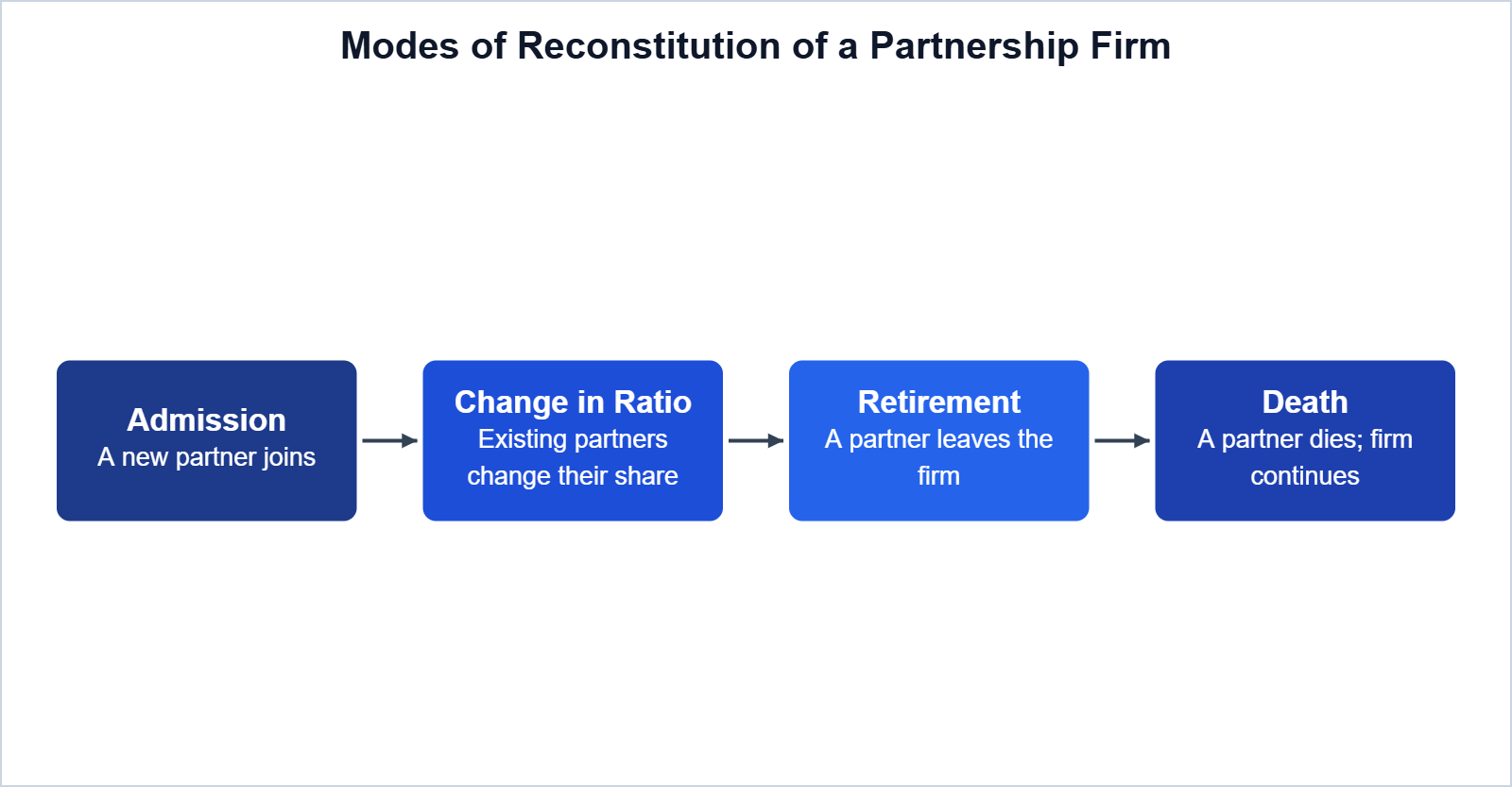
1. Modes of Reconstitution of a Partnership Firm
Reconstitution means a change in the existing agreement among partners. The old agreement ends and a new one comes into existence, but the firm continues.
2. Admission of a New Partner
A new partner can be admitted with the consent of all existing partners (Section 31, Partnership Act). The new partner gets two main rights: a right to share the assets of the firm and a right to share future profits. In return, he or she brings capital and usually a premium for goodwill.
Adjustments required on admission: (1) new profit sharing ratio, (2) sacrificing ratio, (3) goodwill, (4) revaluation of assets and reassessment of liabilities, (5) accumulated profits, reserves and losses, (6) adjustment of capitals.
3. New Profit Sharing Ratio
Illustration 1: A and B share profits 3:2. C is admitted for 1/5 share, which he takes from A and B in their old ratio. Find the new ratio.
Solution: Remaining share = 1 – 1/5 = 4/5. A = 3/5 x 4/5 = 12/25; B = 2/5 x 4/5 = 8/25; C = 1/5 = 5/25. New ratio = 12:8:5.
Illustration 2: A and B share 3:2. C is admitted for 1/5 share, taking 1/10 from A and 1/10 from B.
Solution: A = 3/5 – 1/10 = 5/10; B = 2/5 – 1/10 = 3/10; C = 2/10. New ratio = 5:3:2. Sacrificing ratio = 1/10 : 1/10 = 1:1.
4. Sacrificing Ratio
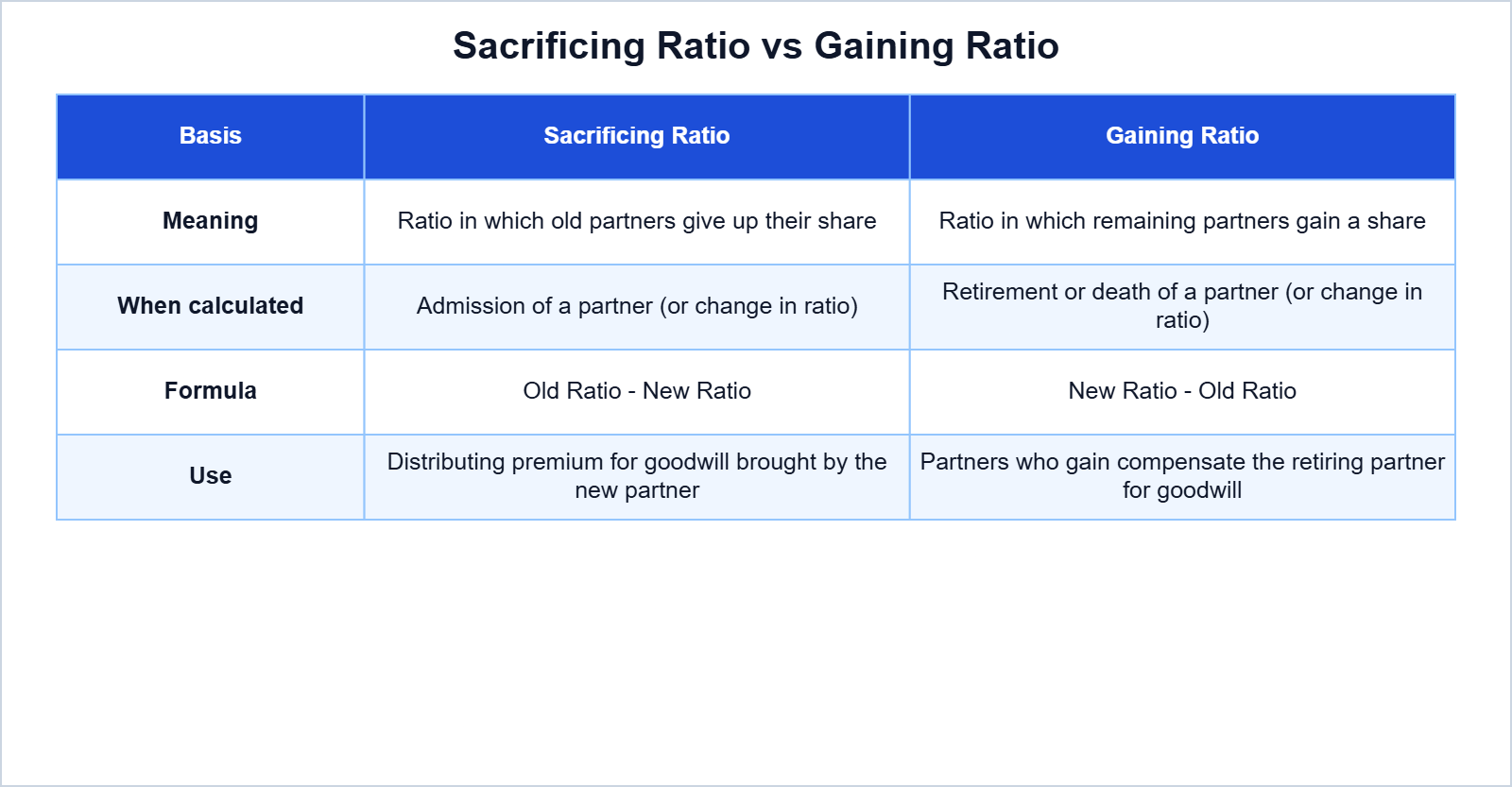
Sacrificing ratio = Old ratio – New ratio. It shows how much share each old partner gives up in favour of the new partner. When the new partner takes his share from the old partners in their old ratio, the sacrificing ratio is the same as the old ratio.
5. Goodwill (AS-26)
Goodwill is the value of the reputation of a business that enables it to earn more than normal profits. As per AS-26, only purchased goodwill is recorded in the books; goodwill raised internally is not recorded. Therefore, on admission, goodwill is adjusted through the partners’ capital accounts by the premium brought in by the new partner, or through his capital account if he cannot bring it.
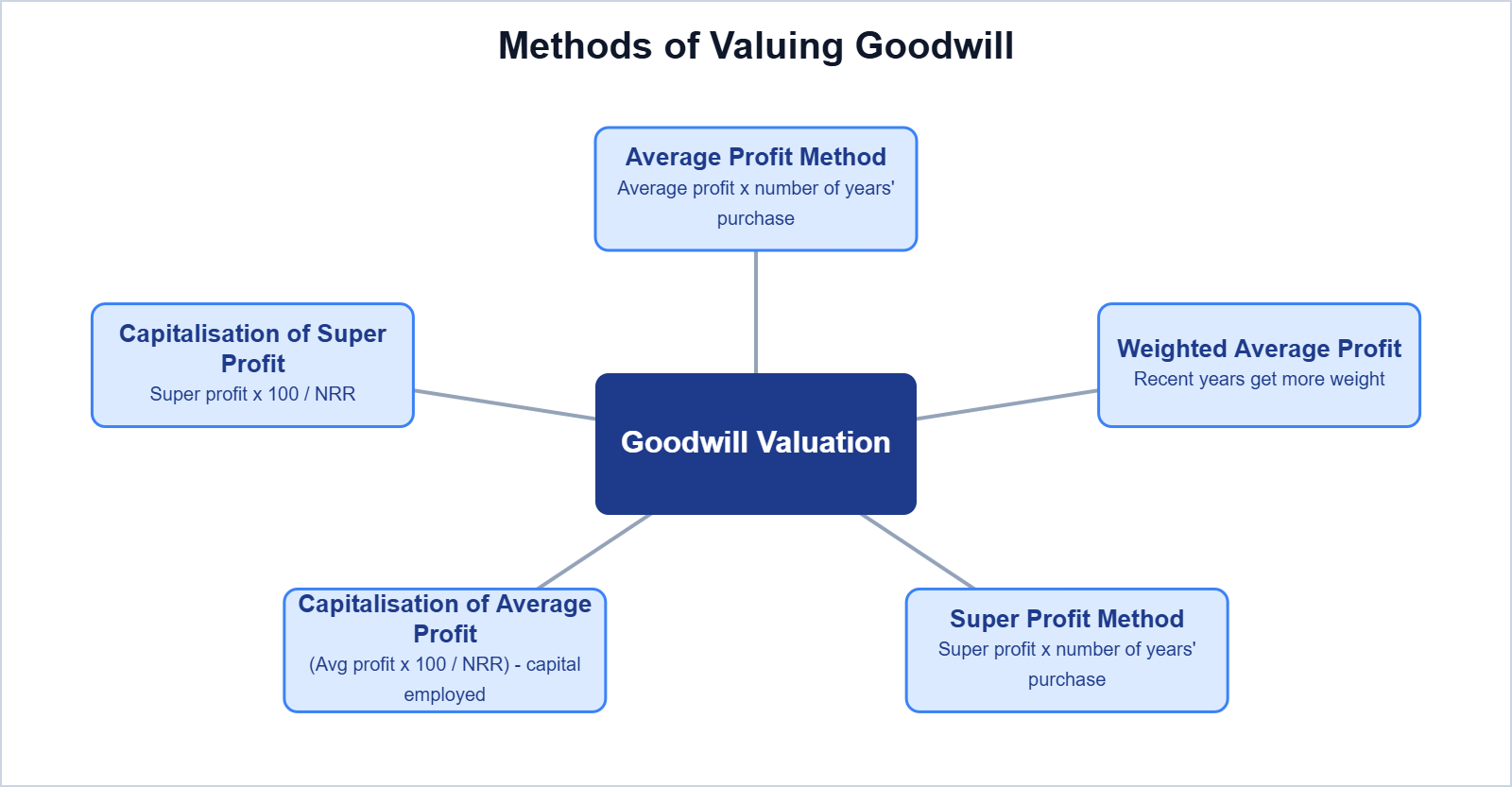
Illustration 3 (Average and weighted average profit): Profits of a firm for the last four years were: 2021-22 ₹80,000; 2022-23 ₹1,00,000; 2023-24 ₹90,000 (after charging an abnormal loss by fire of ₹10,000); 2024-25 ₹1,30,000. Calculate goodwill at 2 years’ purchase of (a) average profit, (b) weighted average profit with weights 1, 2, 3, 4.
Working: Normal profit of 2023-24 = 90,000 + 10,000 = ₹1,00,000.
Year | Profit (₹) | Weight | Product (₹) |
|---|---|---|---|
2021-22 | 80,000 | 1 | 80,000 |
2022-23 | 1,00,000 | 2 | 2,00,000 |
2023-24 | 1,00,000 | 3 | 3,00,000 |
2024-25 | 1,30,000 | 4 | 5,20,000 |
Total | 4,10,000 | 10 | 11,00,000 |
(a) Average profit = 4,10,000 / 4 = ₹1,02,500; Goodwill = 1,02,500 x 2 = ₹2,05,000.
(b) Weighted average profit = 11,00,000 / 10 = ₹1,10,000; Goodwill = 1,10,000 x 2 = ₹2,20,000.
Illustration 4 (Super profit and capitalisation): Average profit ₹90,000; capital employed ₹6,00,000; normal rate of return 10%. Find goodwill by (a) 3 years’ purchase of super profit, (b) capitalisation of super profit, (c) capitalisation of average profit.
Working: Normal profit = 6,00,000 x 10% = ₹60,000; Super profit = 90,000 – 60,000 = ₹30,000.
(a) Goodwill = 30,000 x 3 = ₹90,000.
(b) Goodwill = 30,000 x 100/10 = ₹3,00,000.
(c) Capitalised value = 90,000 x 100/10 = ₹9,00,000; Goodwill = 9,00,000 – 6,00,000 = ₹3,00,000.
Remember: Both capitalisation methods always give the same answer.
Illustration 5 (Hidden goodwill): A and B (3:2) have capitals of ₹1,20,000 and ₹80,000. C is admitted for 1/4 share and brings ₹1,00,000 as capital but no separate premium. Calculate hidden goodwill and pass the entry.
Working: Total capital implied by C’s contribution = 1,00,000 x 4/1 = ₹4,00,000. Actual combined capital = 1,20,000 + 80,000 + 1,00,000 = ₹3,00,000. Hidden goodwill = ₹1,00,000. C’s share = 1/4 x 1,00,000 = ₹25,000, credited to A and B in sacrificing ratio 3:2.
Journal Entry (Illustration 5)
Particulars | Dr (₹) | Cr (₹) |
|---|---|---|
C’s Capital A/c …Dr. | 25,000 |
|
To A’s Capital A/c |
| 15,000 |
To B’s Capital A/c |
| 10,000 |
(C’s share of hidden goodwill adjusted in sacrificing ratio 3:2) |
|
|
Illustration 6 (Premium for goodwill in cash, existing goodwill): A and B (3:2) admit C for 1/4 share. C brings ₹1,00,000 as capital and ₹40,000 as premium for goodwill. Goodwill already appears in the books at ₹50,000.
Journal Entries (Illustration 6)
Particulars | Dr (₹) | Cr (₹) |
|---|---|---|
A’s Capital A/c …Dr. | 30,000 |
|
B’s Capital A/c …Dr. | 20,000 |
|
To Goodwill A/c |
| 50,000 |
(Existing goodwill written off in old ratio 3:2) |
|
|
Bank A/c …Dr. | 1,40,000 |
|
To C’s Capital A/c |
| 1,00,000 |
To Premium for Goodwill A/c |
| 40,000 |
(Capital and premium for goodwill brought in by C) |
|
|
Premium for Goodwill A/c …Dr. | 40,000 |
|
To A’s Capital A/c |
| 24,000 |
To B’s Capital A/c |
| 16,000 |
(Premium distributed in sacrificing ratio 3:2) |
|
|
6. Adjustment for Accumulated Profits and Losses
Reserves, accumulated profits (credit balance of P&L) and accumulated losses existing at the time of admission belong to the old partners. They are transferred to the old partners’ capital accounts in the old ratio.
7. Revaluation of Assets and Reassessment of Liabilities
Assets and liabilities are revalued at admission, so that the gain or loss up to that date goes to the old partners. A Revaluation Account is debited with decreases in assets and increases in liabilities, and credited with increases in assets and decreases in liabilities. The balance (profit or loss) is shared by the old partners in the old ratio.
Illustration 7 (Complete problem): A and B share profits 3:2. Their Balance Sheet on 31 March 2025 is given below. C is admitted for 1/5 share on the following terms: (i) C brings ₹80,000 as capital and ₹25,000 as premium for goodwill; (ii) provision for doubtful debts is raised to 6% of debtors; (iii) stock is appreciated by 10%; (iv) furniture is depreciated by ₹3,000; (v) machinery is reduced by 5%; (vi) creditors include ₹2,000 not payable. Prepare the Revaluation A/c, Partners’ Capital A/cs, Bank A/c and the new Balance Sheet.
Balance Sheet of A and B as at 31 March 2025
Liabilities | ₹ | Assets | ₹ |
|---|---|---|---|
Creditors | 60,000 | Cash at Bank | 40,000 |
Bills Payable | 20,000 | Debtors 80,000 less Provision 4,000 | 76,000 |
General Reserve | 30,000 | Stock | 64,000 |
A’s Capital | 1,50,000 | Furniture | 30,000 |
B’s Capital | 1,00,000 | Machinery | 1,50,000 |
Total | 3,60,000 | Total | 3,60,000 |
Working notes: Provision 6% of 80,000 = 4,800 (increase 800); Stock 64,000 x 10% = +6,400; Machinery 1,50,000 x 5% = 7,500. Premium shared in sacrificing ratio = old ratio 3:2 (A 15,000, B 10,000). General reserve 30,000 shared 3:2.
Revaluation Account
Dr. Particulars | ₹ | Cr. Particulars | ₹ |
|---|---|---|---|
To Provision for Doubtful Debts | 800 | By Stock | 6,400 |
To Furniture | 3,000 | By Creditors | 2,000 |
To Machinery | 7,500 | By Loss transferred to A’s Capital A/c (3/5) | 1,740 |
|
| By Loss transferred to B’s Capital A/c (2/5) | 1,160 |
Total | 11,300 | Total | 11,300 |
Partners’ Capital Accounts
Dr. Particulars | A | B | C | Cr. Particulars | A | B | C |
|---|---|---|---|---|---|---|---|
To Revaluation A/c (loss) | 1,740 | 1,160 | – | By Balance b/d | 1,50,000 | 1,00,000 | – |
To Balance c/d | 1,81,260 | 1,20,840 | 80,000 | By General Reserve | 18,000 | 12,000 | – |
|
|
|
| By Premium for Goodwill A/c | 15,000 | 10,000 | – |
|
|
|
| By Bank A/c | – | – | 80,000 |
Total | 1,83,000 | 1,22,000 | 80,000 | Total | 1,83,000 | 1,22,000 | 80,000 |
Bank Account
Dr. Particulars | ₹ | Cr. Particulars | ₹ |
|---|---|---|---|
To Balance b/d | 40,000 | By Balance c/d | 1,45,000 |
To C’s Capital A/c | 80,000 |
|
|
To Premium for Goodwill A/c | 25,000 |
|
|
Total | 1,45,000 | Total | 1,45,000 |
Balance Sheet of A, B and C after admission
Liabilities | ₹ | Assets | ₹ |
|---|---|---|---|
Creditors | 58,000 | Cash at Bank | 1,45,000 |
Bills Payable | 20,000 | Debtors 80,000 less Provision 4,800 | 75,200 |
A’s Capital | 1,81,260 | Stock | 70,400 |
B’s Capital | 1,20,840 | Furniture | 27,000 |
C’s Capital | 80,000 | Machinery | 1,42,500 |
Total | 4,60,100 | Total | 4,60,100 |
New ratio: A 12/25, B 8/25, C 5/25 = 12:8:5.
8. Adjustment of Capitals
Sometimes partners agree that their capitals should be in the new profit sharing ratio. The deficit is brought in and the surplus is withdrawn (or adjusted through current accounts).
Illustration 8 (continuing Illustration 7): The capitals of A and B are to be adjusted on the basis of C’s capital, in the new ratio 12:8:5.
Particulars | A (₹) | B (₹) |
|---|---|---|
Total capital of firm = 80,000 x 25/5 = ₹4,00,000 |
|
|
Required capital (12/25 and 8/25 of 4,00,000) | 1,92,000 | 1,28,000 |
Existing capital after adjustments | 1,81,260 | 1,20,840 |
Amount to be brought in | 10,740 | 7,160 |
9. Change in Profit Sharing Ratio among Existing Partners
When existing partners change their ratio, the gaining partner compensates the sacrificing partner for goodwill, and reserves and revaluation profits are distributed in the old ratio.
Illustration 9: A, B and C share 2:2:1. They decide to share 1:2:2 from 1 April 2025. Goodwill is valued at ₹1,00,000.
Partner | Old share | New share | Gain (+) / Sacrifice (-) | Amount (₹) |
|---|---|---|---|---|
A | 2/5 | 1/5 | -1/5 (sacrifice) | 20,000 |
B | 2/5 | 2/5 | Nil | Nil |
C | 1/5 | 2/5 | +1/5 (gain) | 20,000 |
Journal Entry (Illustration 9)
Particulars | Dr (₹) | Cr (₹) |
|---|---|---|
C’s Capital A/c …Dr. | 20,000 |
|
To A’s Capital A/c |
| 20,000 |
(Adjustment of goodwill on change in profit sharing ratio) |
|
|
Easy Memory Trick: “Sacrifice = Old – New; Gain = New – Old.”
10. Practice Problems (Answers Only)
- A and B share 5:3. C is admitted for 1/4 share, taking 1/8 from each. Ans: New ratio 2:1:1; sacrificing ratio 1:1.
- Profits of three years: ₹60,000, ₹70,000, ₹80,000. Goodwill at 3 years’ purchase of average profit. Ans: ₹2,10,000.
- Average profit ₹50,000; capital employed ₹4,00,000; NRR 10%. Goodwill at 4 years’ purchase of super profit, and by capitalisation of super profit. Ans: ₹40,000; ₹1,00,000.
- A and B have capitals ₹60,000 and ₹40,000. C brings ₹60,000 for 1/3 share. Find hidden goodwill. Ans: ₹20,000.
- On admission: stock up ₹5,000, building up ₹20,000, new provision for doubtful debts ₹2,000, unrecorded liability ₹1,000. Ans: Revaluation profit ₹22,000.
11. Important Questions
Q1. What is the sacrificing ratio?
Ans. The ratio in which the old partners give up their share of profit in favour of the new partner; Old ratio – New ratio.
Q2. How is goodwill treated on admission as per AS-26?
Ans. Goodwill is not raised in the books; the premium brought by the new partner is credited to the sacrificing partners, or the new partner’s capital is debited for his share if he does not bring premium.
Q3. What is hidden goodwill?
Ans. Goodwill that is not stated but is worked out from the capital brought in by the new partner compared with the total capital of the firm.
Q4. Why is a Revaluation Account prepared?
Ans. To record changes in the values of assets and liabilities, so that profit or loss up to the date of admission is shared by the old partners in the old ratio.
Q5. How are accumulated profits treated on admission?
Ans. They are transferred to the old partners’ capital accounts in the old ratio.
Q6. Name two rights acquired by a new partner.
Ans. The right to share the assets of the firm and the right to share its future profits.
Conclusion: Admission of a partner requires a new ratio, treatment of goodwill, revaluation and transfer of reserves, so that the old partners get the benefit of the past and the new partner starts on a fair basis.