Grammar – English Class 12 Notes
Grammar | Chapter – 1
Grammar: Tenses, Passive Voice, Transformation of Sentences and Modals
1. Tense Forms for Different Kinds of Narration
Kind of writing | Tense usually used | Example |
|---|---|---|
Commentary (sports, live events) | Simple present / present continuous | Kohli hits the ball, and it races to the boundary. |
Newspaper headlines | Simple present (for past events); “to” + verb for future | PM inaugurates new tunnel; Govt to open 100 schools |
News reports | Simple past and present perfect | The bridge was opened yesterday. Traffic has become smoother. |
Stories and narratives | Simple past, past continuous, past perfect | She was reading when the bell rang; the guests had already left. |
Instructions, recipes, rules | Imperative / simple present | Boil the water. Add the tea leaves. |
Scientific facts and processes | Simple present (often passive) | Water boils at 100 °C. The solution is heated. |
Plans and programmes | Simple present / future | The train leaves at 6 a.m. We will visit Kullu next week. |
Exercise 1: Fill in the blanks with the correct tense forms.
Question | Answer |
|---|---|
(a) The striker ______ (take) the ball, ______ (beat) two defenders and shoots! (commentary) | takes; beats |
(b) Yesterday the students ______ (visit) the museum. | visited |
(c) When I reached the station, the train ______ already ______ (leave). | had … left |
(d) Headline: Heavy rain ______ (lash) Shimla; schools closed. | lashes |
(e) Water ______ (freeze) at 0 °C. | freezes |
2. Passive Voice in Scientific and Formal Writing
In scientific writing, the action and result are more important than the doer, so the passive voice is commonly used. Rule: object of the active sentence becomes the subject; use the correct form of “be” + past participle; the doer is added with “by” only if necessary.
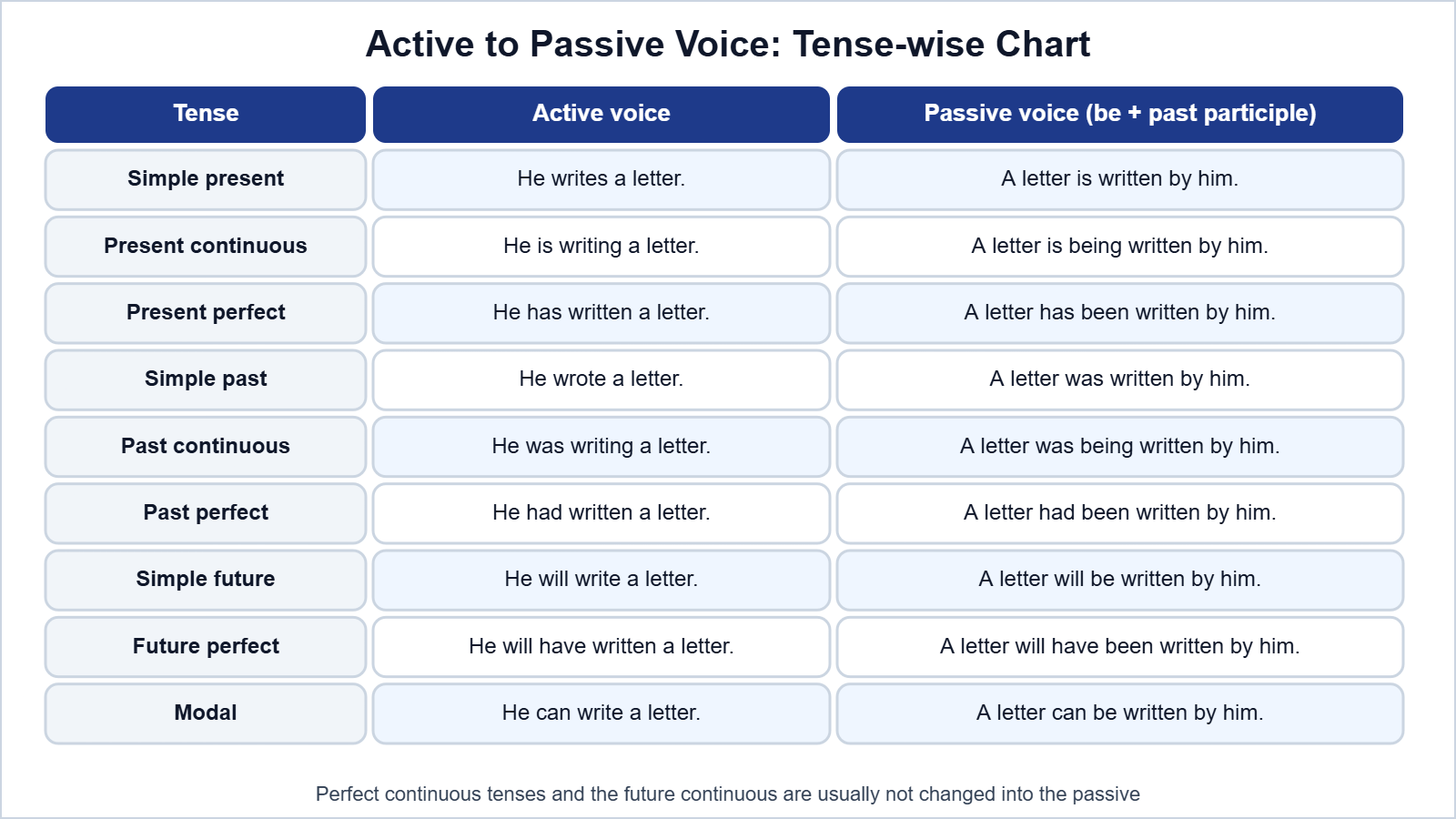
Example (process): The solution was heated to 60 °C. Then a few drops of acid were added and the colour change was noted.
Exercise 2: Change into passive voice.
Question | Answer |
|---|---|
(a) We heat the mixture gently. | The mixture is heated gently. |
(b) The scientist is testing the samples. | The samples are being tested by the scientist. |
(c) They have completed the experiment. | The experiment has been completed. |
(d) Someone stole my bicycle. | My bicycle was stolen. |
(e) We must save water. | Water must be saved. |
(f) Who wrote this poem? | By whom was this poem written? |
(g) Open the window. | Let the window be opened. |
3. Transformation of Sentences (Stylistic Variation)
Type of change | Example 1 | Example 2 (same meaning) |
|---|---|---|
Simple to complex | In spite of his illness, he came. | Although he was ill, he came. |
Complex to compound | As he was tired, he went to bed. | He was tired, so he went to bed. |
Too … to / so … that | The box is too heavy for me to lift. | The box is so heavy that I cannot lift it. |
No sooner … than | As soon as the bell rang, the students ran out. | No sooner did the bell ring than the students ran out. |
Affirmative / negative | Only the brave deserve the fair. | None but the brave deserve the fair. |
Degrees of comparison | Mount Everest is the highest mountain in the world. | No other mountain in the world is as high as Mount Everest. |
Interrogative / assertive | Who does not love his country? | Everyone loves his country. |
Exclamatory / assertive | What a beautiful sight it is! | It is a very beautiful sight. |
Exercise 3: Transform as directed.
Question | Answer |
|---|---|
(a) He is too weak to walk. (use so…that) | He is so weak that he cannot walk. |
(b) Being poor, he could not buy the book. (complex) | As he was poor, he could not buy the book. |
(c) She worked hard and passed. (simple) | By working hard, she passed. |
(d) As soon as he saw the police, he ran away. (no sooner…than) | No sooner did he see the police than he ran away. |
(e) Gold is the most precious metal. (comparative) | Gold is more precious than any other metal. |
(f) What a lovely garden! (assertive) | It is a very lovely garden. |
4. Modal Auxiliaries (based on meaning)
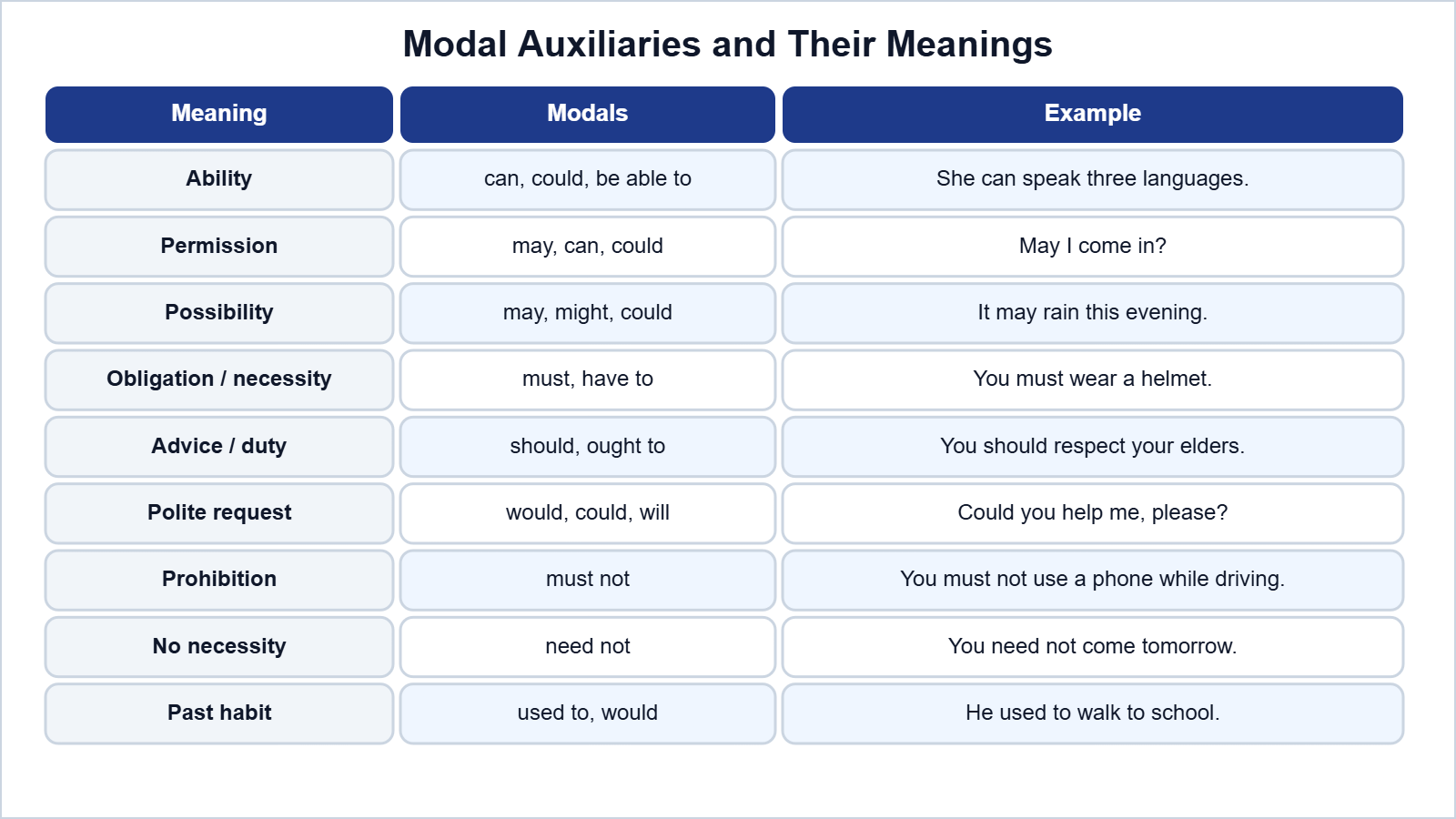
Modals are helping verbs that express ability, permission, possibility, obligation, advice and so on. They are followed by the base form of the verb and do not change with the subject.
Exercise 4: Fill in with suitable modals.
Question | Answer |
|---|---|
(a) You ______ wear a seat belt while driving. (obligation) | must |
(b) ______ I borrow your pen? (permission) | May |
(c) It ______ snow tonight; the sky is cloudy. (possibility) | may / might |
(d) You ______ consult a doctor. (advice) | should |
(e) You ______ not hurry; we have plenty of time. (no necessity) | need |
(f) When I was a child, I ______ play in the fields. (past habit) | used to |
(g) ______ you please pass the salt? (polite request) | Could / Would |
(h) She ______ swim when she was five. (past ability) | could |
5. Important Questions
Q1. Which tense is used in sports commentary? Why?
Ans. Simple present (and present continuous), because the action is happening at the moment of speaking.
Q2. Why is the passive voice used in scientific writing?
Ans. Because the process and result are more important than the person who performs the action.
Q3. What is the passive form of “They are building a bridge”?
Ans. A bridge is being built by them.
Q4. Name two modals that express possibility.
Ans. May and might (also could).
Q5. What is the difference between “must not” and “need not”?
Ans. “Must not” shows prohibition; “need not” shows that something is not necessary.
Q6. Transform: “Though he is rich, he is unhappy.” (simple)
Ans. In spite of being rich, he is unhappy.
Q7. Which tense is used in newspaper headlines for past events?
Ans. The simple present.
Q8. Why are sentences transformed?
Ans. To vary style and express the same idea in different ways in different kinds of writing.
Easy Memory Trick: Passive = “Object first, be + V3, by + doer (if needed)”.
Conclusion: Correct use of tenses, the passive voice, varied sentence structures and modals makes writing accurate, formal and stylish, especially in reports, scientific writing and narration.