Writing: Essays and Articles – English Class 12 Notes
Writing Skills | Chapter – 1
Writing: Essays and Articles
1. What is an Essay / Article?
An essay is a well-organised piece of writing on a topic. An article is a piece written for a newspaper, magazine or school journal; it has a title and the writer’s name (byline). At this level, essays and articles of 250-500 words are expected.
Type | Purpose | Example topics |
|---|---|---|
Expository | To explain, inform or describe a topic clearly | The role of youth in nation building; importance of trees |
Argumentative | To present both sides of an issue and argue for a point of view | Should mobile phones be allowed in schools?; Is online learning better? |
Descriptive / narrative | To describe a place or event, or narrate an experience | A visit to a hill station; my first day in college |
2. Format and Structure
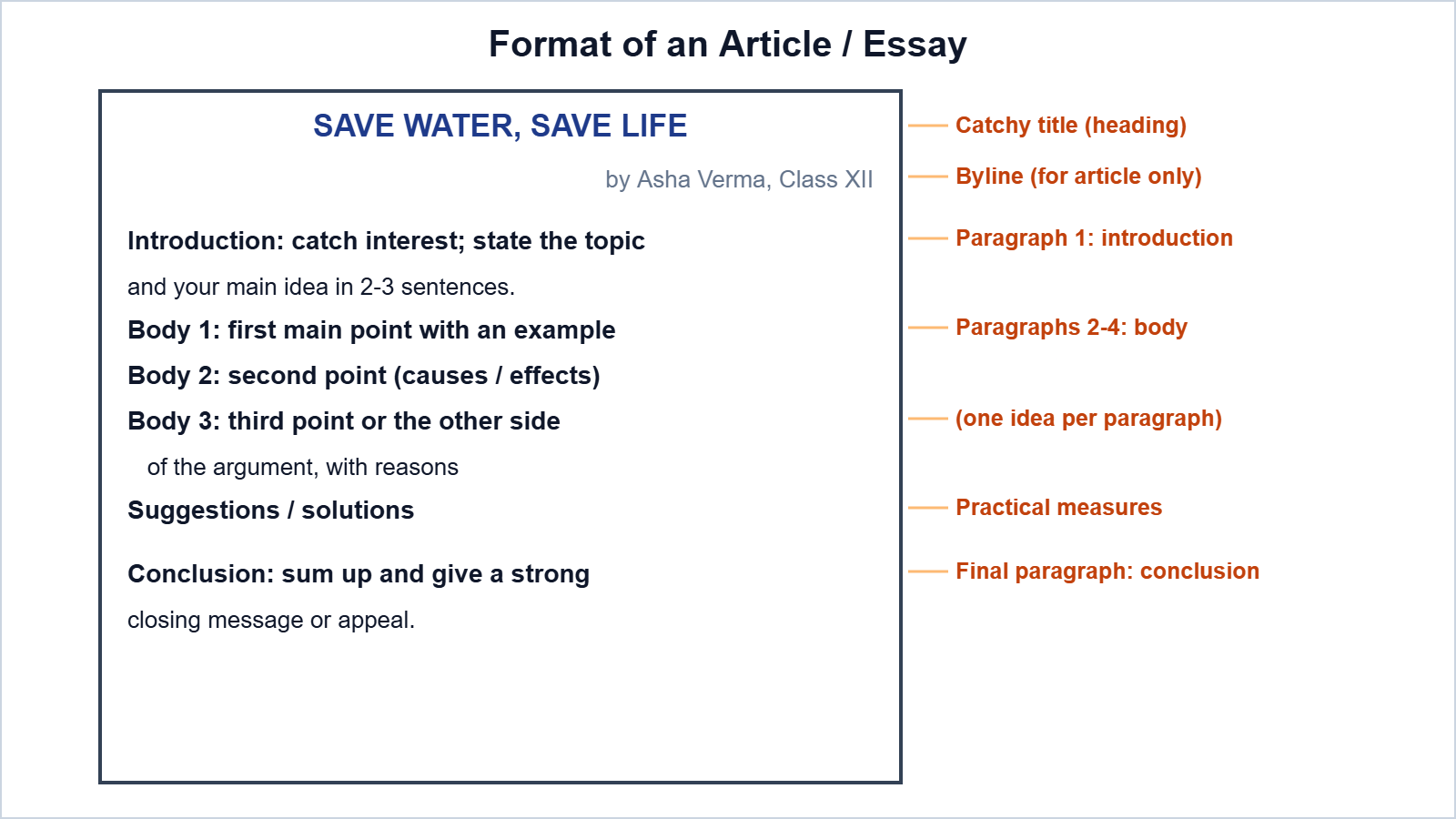
- Title: short and catchy.
- Byline: writer’s name (for articles).
- Introduction: 2-3 sentences that introduce the topic and attract interest.
- Body: 2-4 paragraphs, each with one main idea supported by facts, examples or reasons. For argumentative writing, give points for and against.
- Conclusion: sum up and end with your opinion, a suggestion or an appeal.
Tips: plan before writing; use linking words (firstly, moreover, however, therefore, in conclusion); keep sentences clear; avoid repetition; check spelling and grammar.
3. Sample 1: Expository Essay (about 300 words)
The Role of Youth in Nation Building
A nation is not built by its buildings and machines alone but by its people, and among them the young are its greatest strength. India has one of the largest young populations in the world. If this energy is guided in the right direction, it can transform the country.
The first contribution of the youth is through education and skills. A well-educated young person becomes a doctor, engineer, teacher, farmer or entrepreneur who adds to the nation’s wealth. Today, young Indians are starting companies, developing new technologies and creating jobs for others.
Secondly, young people can be agents of social change. They are open to new ideas and less bound by old prejudices. Many young volunteers teach poor children, run cleanliness drives, plant trees and spread awareness about health, road safety and the rights of women. Their enthusiasm inspires others to join.
Thirdly, the youth are the guardians of democracy. By voting responsibly, questioning wrong practices and refusing to accept corruption, they keep the system honest. Sports, art and culture are other fields where young people bring glory to the nation.
However, many young people face unemployment, drug abuse and the pressure of competition. The government, schools and families must provide good education, skill training and guidance, so that the youth do not lose their way.
In conclusion, the youth are not only the future of the nation but also its present. If they combine knowledge with discipline and a sense of duty, they can build a strong, prosperous and just India.
4. Sample 2: Argumentative Article (about 300 words)
Should Mobile Phones Be Allowed in Schools?
by Rohan Thakur, Class XII
Mobile phones have become a part of our lives. Most students now own one, and many schools are debating whether phones should be allowed on the campus. There are strong arguments on both sides.
Those in favour say that phones are useful learning tools. Students can look up information, use educational apps and watch lessons. Phones also help parents stay in touch with their children in an emergency, which gives families peace of mind.
On the other hand, phones can be a serious distraction. Games, social media and messages take attention away from lessons. Some students may use phones to cheat in tests or to bully others online. Constant screen use can also harm eyesight and reduce face-to-face interaction among friends.
In my view, a complete ban is not the best answer, nor is unlimited use. Schools can adopt a balanced policy: phones may be kept switched off and deposited during class hours, while computers in the library and labs can be used for learning. Teachers may allow phones for specific activities under supervision. Students must also be taught digital discipline and online safety.
Thus, with clear rules and responsible use, technology can support education instead of disturbing it. The aim should be to use the phone as a tool, not to let it become a master.
5. Practice Topics
- The importance of reading books in the digital age.
- Plastic pollution: causes and solutions.
- Should homework be banned?
- Tourism in Himachal Pradesh: benefits and problems.
- The role of sports in education.
6. Important Questions
Q1. What is the difference between an essay and an article?
Ans. An article is written for publication and has a title and byline; an essay is a general structured composition on a topic.
Q2. What should an introduction contain?
Ans. It should introduce the topic, catch the reader’s interest and state the main idea briefly.
Q3. How should the body be organised?
Ans. In 2-4 paragraphs, each with one main idea supported by examples or reasons.
Q4. What is an argumentative essay?
Ans. One that presents both sides of an issue and argues for a particular view with reasons.
Q5. Name four useful linking words.
Ans. Firstly, moreover, however, therefore.
Q6. What is the word limit for essays at this level?
Ans. About 250-500 words.
Q7. How should an essay end?
Ans. With a conclusion that sums up the ideas and gives a final opinion, suggestion or message.
Q8. Why is a byline used?
Ans. To show the name of the writer of an article.
Easy Memory Trick: “T-I-B-C” = Title, Introduction, Body, Conclusion.
Conclusion: A good essay or article is well planned, clearly organised and written in simple, correct language, with a strong introduction and conclusion.