Aunt Jennifer’s Tigers – English Class 12 Notes
Flamingo | Poem – 5
Aunt Jennifer’s Tigers
(Adrienne Rich)
1. About the Poet
Adrienne Rich (1929-2012) was an American poet, essayist and feminist. Her poems often deal with the position of women in society, injustice and identity. Aunt Jennifer’s Tigers is one of her early poems, published in her first collection A Change of World (1951).
2. Central Idea
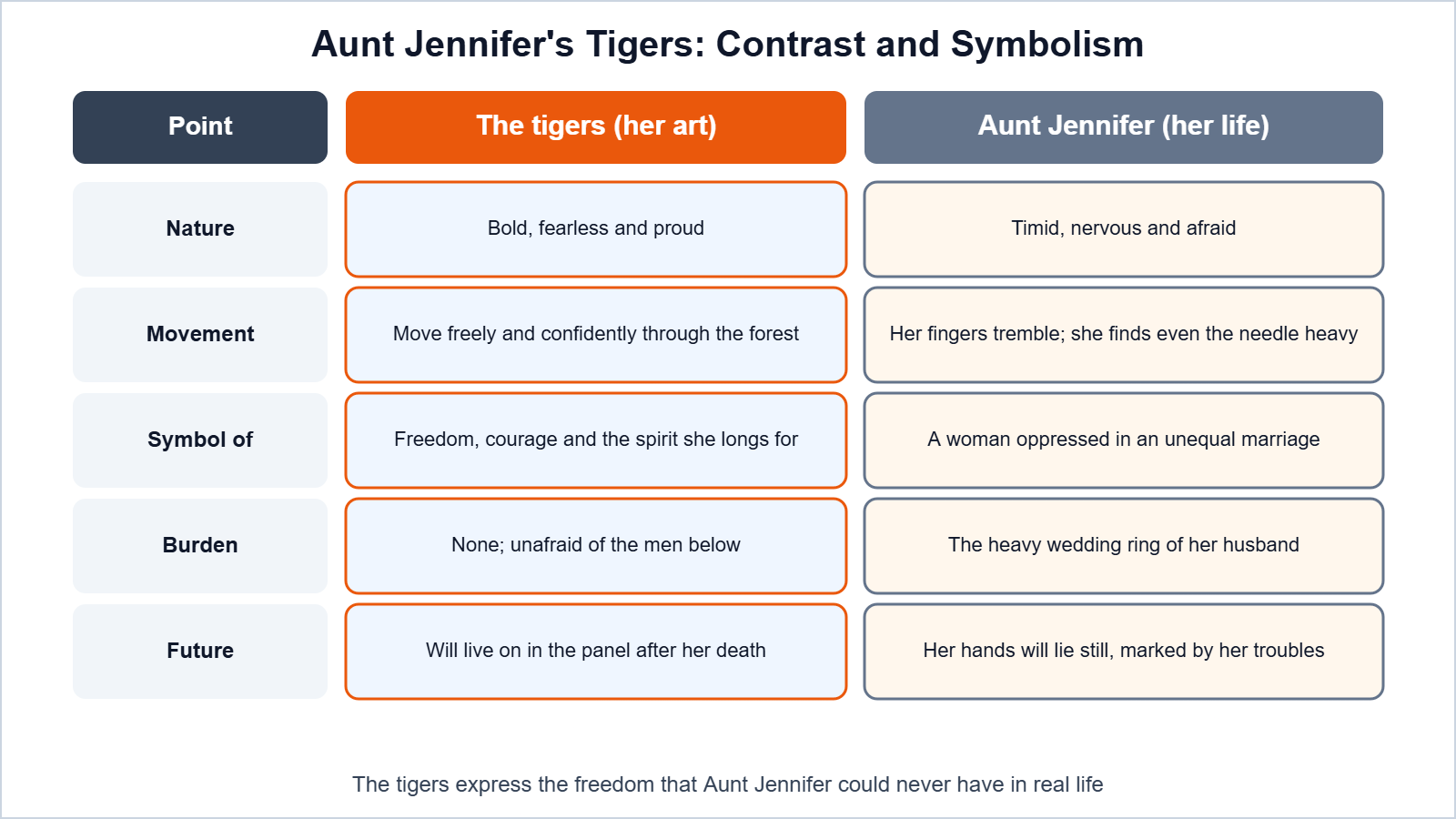
Aunt Jennifer, an oppressed married woman, embroiders bold, fearless tigers on a screen. The tigers are everything she is not – free, proud and unafraid. Through this contrast the poet shows the suffering of women trapped in unequal marriages.
3. Stanza-wise Explanation
Stanza 1 (the tigers): Aunt Jennifer is embroidering a panel showing tigers that leap and move proudly through a green jungle. They shine like bright yellow gems. They are not afraid of the men (hunters) under the trees and move with confidence and dignity. The tigers reflect her hidden desire for freedom and courage.
Stanza 2 (Aunt Jennifer): In contrast, Aunt Jennifer’s fingers flutter nervously through the wool, and she finds even the light ivory needle hard to pull. The heavy wedding ring given by her husband weighs down on her hand, symbolising the burden and restrictions of her married life.
Stanza 3 (after death): The poet imagines that when Aunt Jennifer dies, her frightened hands will lie still, still marked by the ordeals she suffered. But the tigers she created will go on moving proudly and fearlessly on the panel. Her art will outlive her and express the spirit she could not live out.
4. Theme and Message
Oppression of women: the poem shows a woman suppressed by a dominating husband and by marriage as an institution.
Art as escape and expression: through her embroidery Aunt Jennifer expresses the freedom and courage she lacks.
Contrast between appearance and reality: the bold tigers contrast with the timid, suffering creator.
Permanence of art: art survives its creator and keeps speaking for her.
5. Poetic Devices
Device | Explanation (in simple words) |
|---|---|
Symbolism | The tigers symbolise freedom, courage and strength; the wedding ring symbolises the burden of marriage. |
Imagery | Bright, proud tigers in a green world against the trembling hands of Aunt Jennifer. |
Contrast | Fearless tigers versus a frightened woman. |
Alliteration | Repeated sounds (for example in the description of her fingers) add music and emphasis. |
Rhyme scheme | Each stanza rhymes in couplets (aabb). |
Transferred epithet | Her hands are called terrified, though the fear is hers. |
Irony | The timid woman creates fearless animals. |
6. Important Word Meanings
Word / Phrase | Meaning |
|---|---|
Prance | To move with high, proud steps |
Topaz | A yellow precious stone |
Denizens | Inhabitants |
Chivalric | Brave and gallant, like knights |
Ivory | Hard white material from elephant tusks |
Ordeals | Painful experiences |
Panel | A piece of cloth used as a screen or decoration |
7. Short Answer Questions
Q1. How do the tigers appear on the panel?
Ans. Bright, bold and fearless, moving proudly through a green forest without fear of men.
Q2. Why are Aunt Jennifer’s hands described as fluttering?
Ans. Because she is nervous, weak and afraid; years of oppression have made her timid.
Q3. What is suggested by the “weight” of the wedding band?
Ans. The burden of married life and the control and restrictions imposed by her husband.
Q4. What will happen to Aunt Jennifer’s hands after her death?
Ans. They will lie still, still showing the marks of her sufferings.
Q5. Why will the tigers go on prancing?
Ans. Because works of art outlive their creators; the tigers will remain as a lasting expression of her desire for freedom.
Q6. What is the significance of the tigers being unafraid of the men?
Ans. They show the courage and freedom that Aunt Jennifer lacks and longs for.
Q7. What does the needle being hard to pull suggest?
Ans. Her weakness and the heavy pressure she lives under.
Q8. What is the central theme of the poem?
Ans. The oppression of women in marriage and the use of art to express a longing for freedom.
8. Long Answer Questions
Q1. Bring out the contrast between Aunt Jennifer and her tigers.
Ans. The tigers are bright, bold and proud; they move freely and are not afraid of men. Aunt Jennifer is timid and nervous; her fingers flutter and she finds the needle heavy. The tigers are free, while she is weighed down by her husband’s wedding ring. After her death her hands will lie still, marked by suffering, but the tigers will continue to prance. This contrast shows how she expresses through art the freedom and courage that her real life denies her.
Q2. How does the poem reflect the poet’s feminist concerns?
Ans. Through Aunt Jennifer the poet shows women suppressed in a male-dominated marriage. The heavy wedding band symbolises the husband’s domination and the woman’s loss of freedom. Even death does not free her from the marks of suffering. Her only outlet is her art, which shows fearless tigers. The poem thus protests against the unequal position of women and celebrates their creative spirit.
9. Value-based and Extract-based Questions
Q1. (Extract-based) The poet imagines that after Aunt Jennifer’s death the tigers on her panel will continue to move proudly and without fear. (a) What does this show about art? (b) What does it show about Aunt Jennifer?
Ans. (a) That art outlives the artist. (b) That her inner longing for freedom and courage survives through her work.
Q2. (Value-based) How can society ensure equality in marriage?
Ans. By respecting women’s choices, sharing responsibilities, educating girls, opposing domestic abuse and treating marriage as a partnership of equals.
Easy Memory Trick: “T-R-P” = Tigers free, Ring heavy, Panel lasts.
Conclusion: Aunt Jennifer’s Tigers uses the powerful symbol of tigers to show the suffering of an oppressed woman and her longing for freedom, which lives on through her art.