Keeping Quiet – English Class 12 Notes
Flamingo | Poem – 2
Keeping Quiet
(Pablo Neruda)
1. About the Poet
Pablo Neruda (1904-1973) was a Chilean poet and diplomat. He wrote in Spanish and is one of the most widely read poets of the twentieth century. He won the Nobel Prize in Literature in 1971. His poems range from love poetry to political and philosophical poems. Keeping Quiet is an English translation of one of his poems.
2. Central Idea
The poet asks everyone on earth to keep still and silent for a short while, counting to twelve. Such a pause would help people look within, stop harming one another and nature, and understand themselves and life better.
3. Stanza-wise Explanation
Stanza 1: The poet suggests that all of us should count up to twelve and then keep still for a moment.
Stanza 2: For a second we should not speak in any language and not move our arms. This would be a strange, special moment when everyone is together in silence, without rush or noise of machines.
Stanza 3: In that moment fishermen would not harm whales in the cold sea, and the man gathering salt would look at his injured hands. Work that harms nature and people would stop for a while.
Stanza 4: Those who prepare for wars – against people, against nature (green wars) and wars of poison gas and fire – would stop and walk with their brothers in peace.
Stanza 5: The poet clarifies that he does not mean complete inactivity; he does not want any one to be idle. Life is what matters, and he has nothing to do with death.
Stanza 6: Human beings are so busy keeping their lives moving that they do not understand themselves and fear death. A huge silence could break this sadness of never understanding ourselves.
Stanzas 7-8: The earth teaches us a lesson: things that seem dead (like plants in winter) come alive again. Similarly, silence and rest renew life. Now he will count to twelve, and we should keep quiet while he goes.
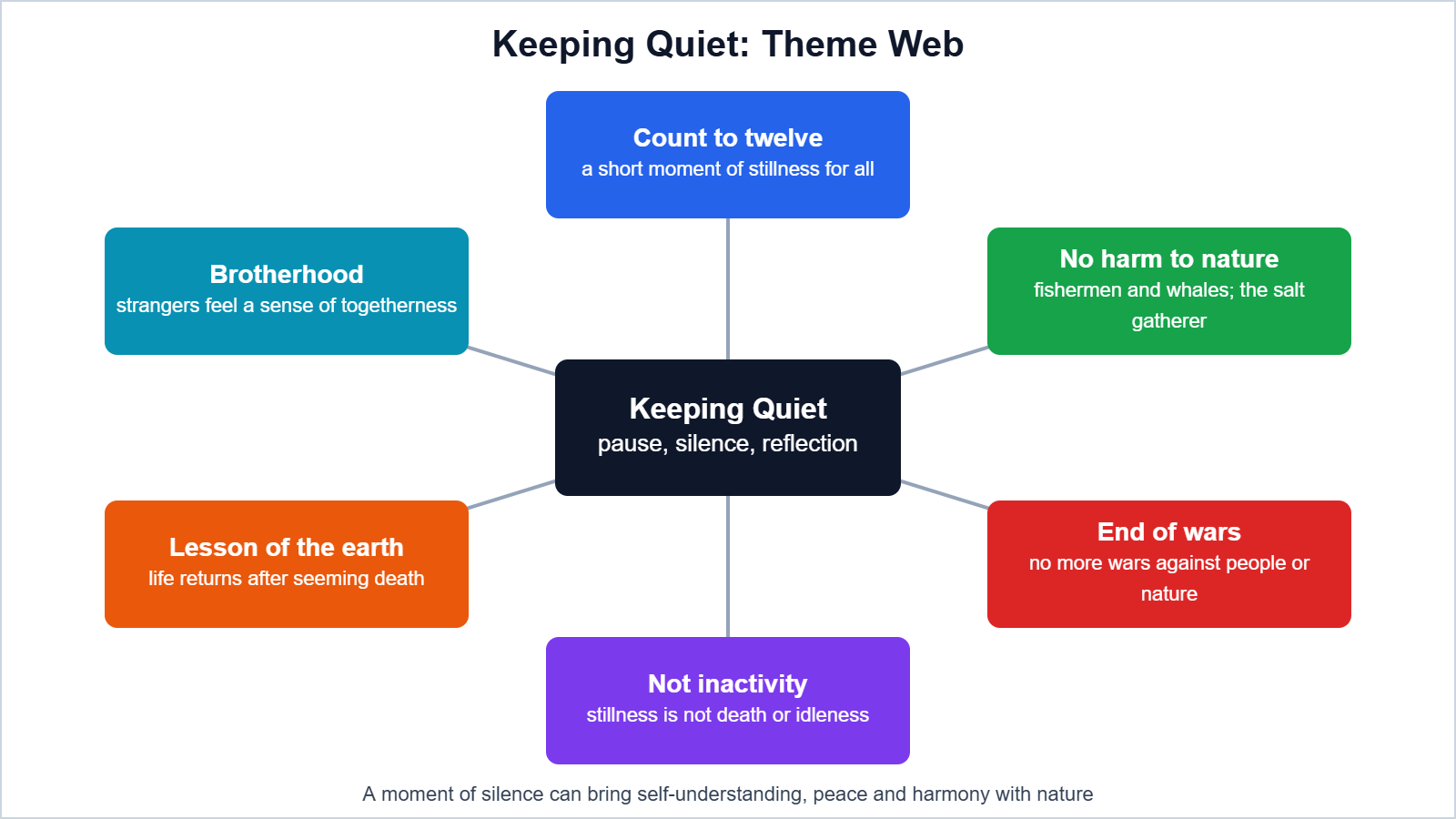
4. Theme and Message
Need for introspection: people must pause and look within to understand themselves.
Peace and brotherhood: silence can unite people and end hatred and war.
Protection of nature: a pause would stop the exploitation of nature (green wars, harming whales).
Silence is not death: stillness is a source of new life, as the earth shows.
5. Poetic Devices
Device | Explanation (in simple words) |
|---|---|
Symbolism | “Twelve” stands for the hours of a clock or months of a year, i.e., a complete cycle of time. |
Imagery | Fishermen and whales, the salt gatherer’s hands and the earth reviving after seeming death. |
Paradox | The idea that silence and stillness can bring life and understanding. |
Contrast | Activity and haste versus stillness and calm. |
Free verse | The poem has no fixed rhyme scheme; it reads like a quiet conversation. |
Personification | The earth is shown as a teacher. |
6. Important Word Meanings
Word / Phrase | Meaning |
|---|---|
Exotic | Strange and unusual |
Salt gatherer | A person who collects salt from the sea |
Green wars | Wars against nature, i.e., destruction of the environment |
Introspection | Looking into one’s own thoughts and feelings |
Clad | Dressed |
7. Short Answer Questions
Q1. What will counting up to twelve and keeping still help us achieve?
Ans. It will help us pause, reflect on our lives, stop harmful activities and feel peace and togetherness.
Q2. Does the poet advocate total inactivity and death?
Ans. No. He says stillness should not be confused with idleness or death; he wants life, not death.
Q3. What is the sadness that the poet refers to?
Ans. The sadness of never understanding ourselves and of fearing death because of constant busyness.
Q4. What symbol from nature does the poet invoke to say there can be life under apparent stillness?
Ans. The earth, where everything seems dead in winter but comes alive again in spring.
Q5. What would the fishermen and the salt gatherer do in that moment?
Ans. Fishermen would not harm whales, and the salt gatherer would look at his hurt hands, i.e., think about his own pain.
Q6. What are “green wars”?
Ans. Wars against nature – the destruction of forests and the environment.
Q7. Why should we not speak in any language?
Ans. Because language divides people; silence would unite all humanity.
Q8. What does the poet say about those who prepare for war?
Ans. They should stop and walk with their brothers in peace.
8. Long Answer Questions
Q1. How does the poet use the idea of silence to suggest a way of peace?
Ans. The poet asks everyone to count to twelve and keep still. In this silence there would be no language to divide people and no machines to make noise. Fishermen would stop harming whales, workers would notice their own pain, and those preparing for wars would walk with their brothers. People would understand themselves, overcome their fear of death and feel brotherhood. Thus silence becomes a way to inner peace, harmony with nature and peace among nations.
Q2. “Keeping Quiet does not mean inactivity.” Explain with reference to the poem.
Ans. The poet clearly says that he does not want people to be idle or to confuse stillness with death. He wants a short pause for reflection. Just as the earth seems lifeless in winter but is full of life inside and blooms again, a moment of silence would renew human life. It would help people correct their mistakes, stop wars and destruction, and return to activity with better understanding.
9. Value-based and Extract-based Questions
Q1. (Extract-based) The poet says that the earth can teach us, because things that seem dead later prove to be alive. (a) What lesson does the earth teach? (b) How does it support the poet’s message?
Ans. (a) That apparent stillness hides new life. (b) It shows that a moment of silence can renew human life instead of being a kind of death.
Q2. (Value-based) How can moments of silence help students?
Ans. They reduce stress, improve concentration, help us understand our feelings and make better decisions; practices like meditation can help.
Easy Memory Trick: “12-S” = count to 12, Silence, no Speech, no Strife, Self-understanding.
Conclusion: Keeping Quiet calls for a moment of silence to bring self-understanding, peace among people and harmony with nature. It shows that stillness is not death but the beginning of a fuller life.