Indigo – English Class 12 Notes
Flamingo | Chapter – 5
Indigo
(Louis Fischer)
1. About the Author
Louis Fischer (1896-1970) was an American journalist and writer. He met Mahatma Gandhi and wrote The Life of Mahatma Gandhi (1950), on which the film Gandhi (1982) was partly based. This lesson is an extract from that book. Gandhi narrated the story of Champaran to Fischer when Fischer visited him at his ashram in Sevagram in 1942.
2. Introduction
The lesson describes how Gandhi helped the poor indigo-growing peasants of Champaran in Bihar against the injustice of British landlords in 1917. It was his first major act of civil disobedience in India and a turning point in the freedom struggle.
3. Summary
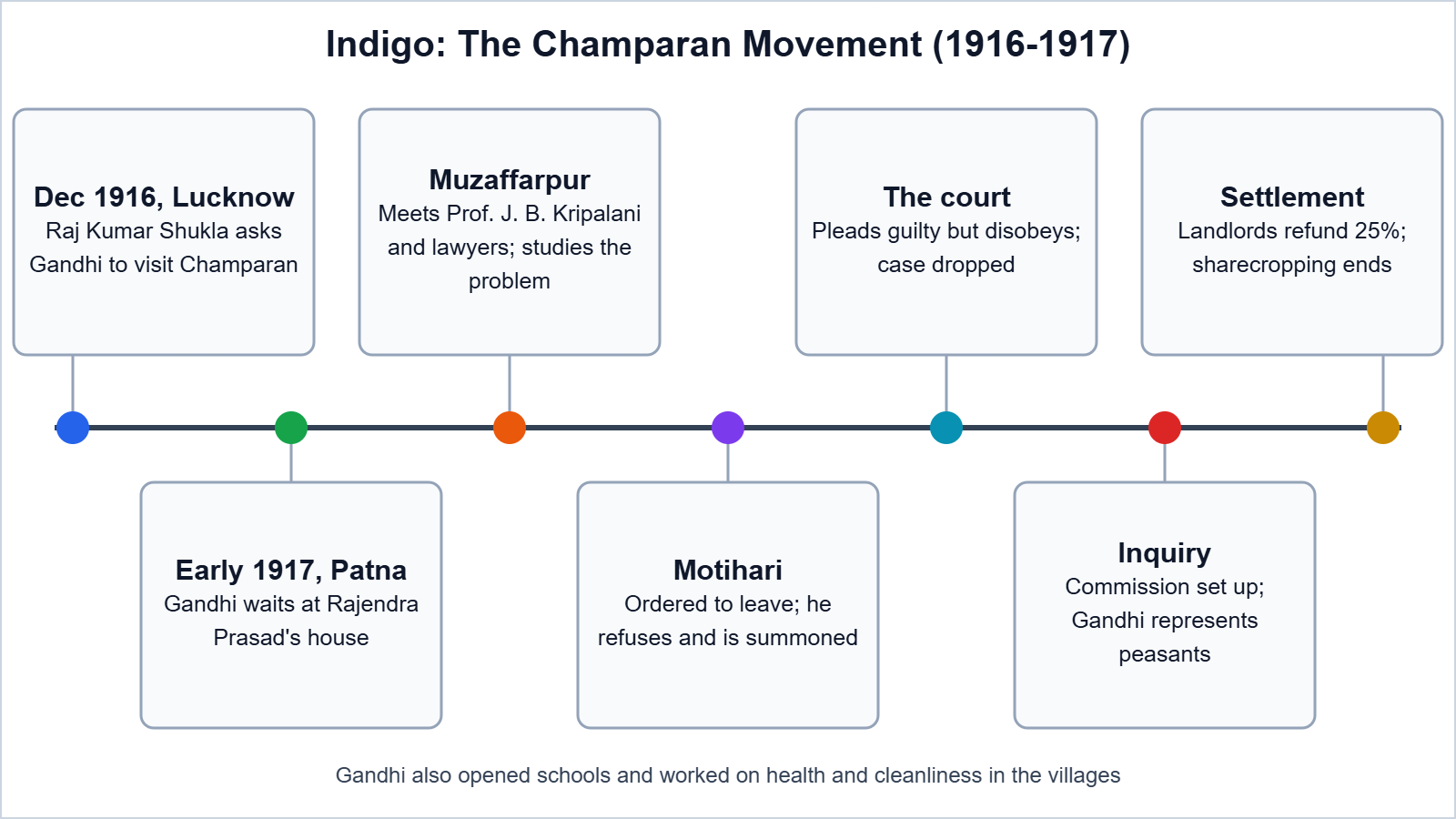
- Raj Kumar Shukla: At the annual session of the Indian National Congress at Lucknow in December 1916, a poor, thin peasant named Raj Kumar Shukla came to Gandhi. He was a sharecropper from Champaran and wanted Gandhi to come there to help the peasants. He followed Gandhi everywhere until Gandhi agreed.
- The journey: Early in 1917 they went to Patna. Shukla took Gandhi to the house of the lawyer Rajendra Prasad (later President of India), who was out of town. The servants, thinking Gandhi a poor peasant, did not let him use the well.
- Muzaffarpur: Gandhi went to Muzaffarpur to learn more. Professor J. B. Kripalani met him at the station with a large group of students. Lawyers there told him about the peasants’ problems. Gandhi scolded the lawyers for charging poor peasants high fees and said the real need was to free the peasants from fear.
- The problem: Most of the land in Champaran was divided into large estates owned by Englishmen and worked by Indian tenants. Under a long-term agreement the tenants had to plant 15% of their land with indigo and give the whole indigo crop to the landlords as rent. When Germany developed synthetic indigo, the landlords asked the peasants to pay compensation for being released from this agreement. Some paid; others refused and engaged lawyers.
- Motihari: Gandhi reached Motihari, the main town of Champaran, and set out to visit a peasant who had been ill-treated. A police messenger stopped him and served an order to leave Champaran at once. Gandhi signed the receipt and wrote that he would disobey the order.
- The trial: Thousands of peasants gathered at the court the next day, showing that they were no longer afraid of the British. Gandhi said he had disobeyed the order not out of disrespect for the law but in obedience to a higher law of conscience. He was released without bail, and later the case against him was dropped. This was the first triumph of civil disobedience in modern India.
- Self-reliance: When C. F. Andrews, an English pacifist and friend of India, offered to stay and help, Gandhi asked him to leave. He said that the people must learn to rely on themselves and not on an Englishman.
- The settlement: Gandhi and his helpers recorded the statements of thousands of peasants. An official commission of inquiry was set up with Gandhi as the representative of the peasants. The commission decided that the landlords should repay money to the peasants. Gandhi agreed to a refund of 25%, saying that the amount was less important than the fact that the landlords had been forced to give up money and prestige. Within a few years the landlords left their estates, which went back to the peasants, and indigo sharecropping ended.
- Social work: Gandhi also started schools in six villages, with volunteers including his wife Kasturba, Mahadev Desai and Narhari Parikh. He worked to improve health and cleanliness in the villages.
4. Character Sketches
Mahatma Gandhi: Simple, fearless, practical and full of sympathy for the poor. He believed in non-violence, truth and self-reliance. He fought injustice through peaceful civil disobedience and also worked for the social and cultural uplift of the villagers.
Raj Kumar Shukla: A poor, illiterate but determined peasant of Champaran. His persistence in following Gandhi everywhere brought Gandhi to Champaran and started a historic movement.
5. Theme and Message
Freedom from fear: Gandhi taught the peasants to overcome fear of the British; this was the first step to freedom.
Non-violence and civil disobedience: injustice can be resisted peacefully by refusing to obey unjust orders.
Self-reliance: Indians must solve their own problems without depending on others.
Social upliftment: political freedom must go with education, health and cleanliness.
6. Important Word Meanings
Word / Phrase | Meaning |
|---|---|
Sharecropper | A tenant farmer who gives a part of the crop as rent |
Indigo | A plant that gives a blue dye |
Synthetic | Made artificially by chemical processes |
Compensation | Money paid to make up for a loss |
Civil disobedience | Peaceful refusal to obey unjust laws |
Conscience | Inner sense of right and wrong |
Pacifist | A person who opposes war and violence |
Prestige | Respect and importance in the eyes of others |
7. Short Answer Questions
Q1. Why did Raj Kumar Shukla come to Lucknow?
Ans. To meet Gandhi at the Congress session and ask him to come to Champaran to help the indigo sharecroppers.
Q2. Why did Gandhi feel that taking the Champaran case to court was useless?
Ans. Because the peasants were crushed and afraid; what they needed was freedom from fear, not legal cases.
Q3. What was the 15% arrangement?
Ans. The tenants had to plant 15% of their land with indigo and hand over the whole crop to the landlord as rent.
Q4. Why did the landlords want compensation from the peasants?
Ans. Synthetic indigo from Germany had made natural indigo unprofitable, so they wanted money for releasing the peasants from the agreement.
Q5. How did the peasants of Champaran react to Gandhi’s summons?
Ans. Thousands of them gathered outside the court, showing that they were no longer afraid of the British.
Q6. Why did Gandhi agree to a 25% refund?
Ans. He felt the amount was less important than the fact that the landlords had to give up money and prestige; it broke their power.
Q7. Why did Gandhi ask C. F. Andrews to leave?
Ans. To teach the people self-reliance; they should not depend on an Englishman to win their cause.
Q8. How was the episode a turning point in Gandhi’s life?
Ans. It was his first successful civil disobedience in India and showed that peaceful resistance could win against injustice.
8. Long Answer Questions
Q1. “The battle of Champaran was the beginning of the freedom struggle.” Discuss.
Ans. In Champaran Gandhi refused to obey an unjust order and peacefully faced trial. The British had to withdraw the case and set up an inquiry, which led to a refund and the end of forced indigo cultivation. More important, the peasants lost their fear of the British and learnt to stand up for their rights. Gandhi taught self-reliance by refusing outside help and combined political struggle with social work. These ideas – fearlessness, non-violence and self-reliance – became the foundation of India’s freedom movement.
Q2. How did Gandhi help the peasants of Champaran besides solving the indigo problem?
Ans. He found that the villages were backward and unclean. With volunteers like Kasturba, Mahadev Desai and Narhari Parikh, he opened primary schools in six villages. A doctor volunteered to provide medical help, and Gandhi’s team taught cleanliness and hygiene. He tried to remove ignorance and improve health so that the peasants could live with dignity. This shows that for Gandhi freedom meant social as well as political progress.
9. Value-based and Extract-based Questions
Q1. (Extract-based) Gandhi tells the court that he disobeyed the order in obedience to a higher law of his being. (a) What is this “higher law”? (b) What principle does it show?
Ans. (a) The voice of his conscience. (b) Civil disobedience: peacefully refusing to obey unjust laws while accepting the penalty.
Q2. (Value-based) What qualities of Gandhi can students adopt?
Ans. Fearlessness, honesty, simplicity, self-reliance, concern for the poor and peaceful methods of solving problems.
Easy Memory Trick: “F-N-S” = Freedom from fear, Non-violence, Self-reliance.
Conclusion: Indigo shows Gandhi’s method of fighting injustice through truth and non-violence. The Champaran movement freed the peasants from fear and became the first step in India’s struggle for freedom.