The Last Lesson – English Class 12 Notes
Flamingo | Chapter – 1
The Last Lesson
(Alphonse Daudet)
1. About the Author
Alphonse Daudet (1840-1897) was a French novelist and short-story writer. He wrote with warmth and gentle humour about ordinary people. The Last Lesson was first published in French in his collection of stories called Monday Tales (Contes du lundi, 1873).
2. Introduction
The story is set in 1870-71, when Prussia (part of present-day Germany) defeated France and took over the French districts of Alsace and Lorraine. An order came that only German would be taught in the schools there. The story shows, through the eyes of a schoolboy named Franz, what it means to lose one’s language.
3. Summary
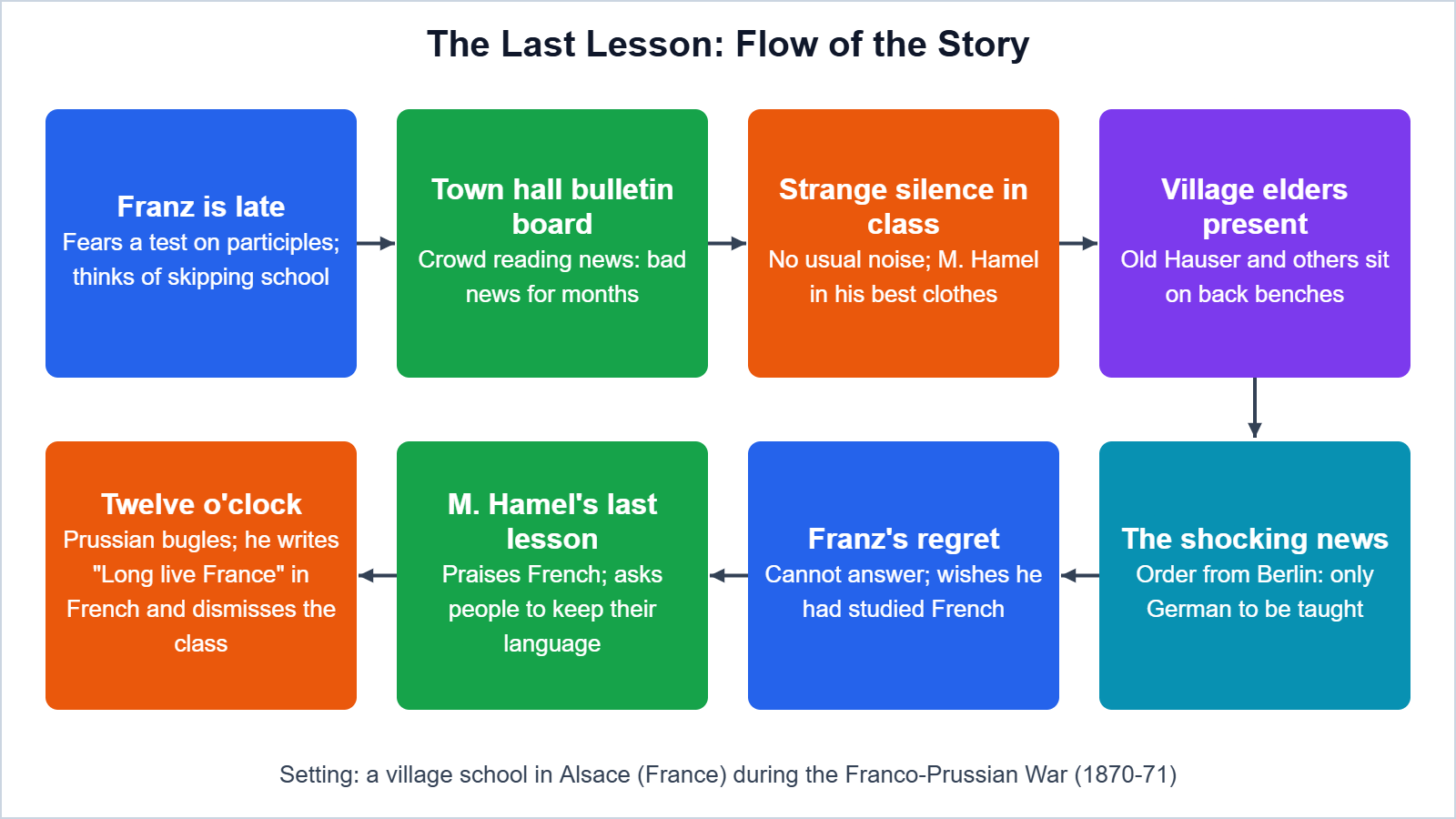
- Franz is late: One morning Franz, a young boy, is late for school. He is afraid of being scolded by his teacher M. Hamel, as he has not learnt the rules of participles. The day is bright and warm, and he is tempted to spend it outdoors, but he hurries to school.
- The bulletin board: On the way he sees a crowd in front of the bulletin board at the town hall. For two years all the bad news – lost battles, orders from the army – had come from there. He does not stop to read it.
- A strange calm: Usually school begins with great noise, and Franz hopes to slip in unseen. That day everything is as quiet as a Sunday. M. Hamel does not scold him; he kindly asks him to sit down.
- Unusual signs: M. Hamel is wearing his best green coat, frilled shirt and embroidered black silk cap, which he wore only on inspection and prize days. The back benches, usually empty, are filled with village people, including old Hauser, the former mayor and the former postmaster.
- The news: M. Hamel announces that an order has come from Berlin to teach only German in the schools of Alsace and Lorraine. This is the last French lesson; the new master comes the next day.
- Franz’s feelings: Franz is shocked. He is sorry that he wasted time instead of learning French. His books, which once seemed a burden, now seem like old friends. He feels sorry for M. Hamel too.
- The lesson: When asked to recite the rule of participles, Franz gets confused. M. Hamel does not scold him. He says that everyone – pupils, parents and even he himself – is to blame for putting off learning. He calls French the most beautiful, clearest and most logical language and asks them to guard it, because a people that holds on to its language holds the key to its freedom.
- Everyone pays attention: Franz understands everything easily that day. The class does grammar, writing and history; even old Hauser reads the alphabet with them.
- The end: The church clock strikes twelve and the trumpets of the Prussian soldiers sound outside. Deeply moved and unable to speak, M. Hamel writes in large letters on the blackboard, in French, “Long live France” and signals with his hand that the school is over.
4. Character Sketches
M. Hamel: He taught French in the village school for forty years. He is strict but devoted, dignified and patriotic. On the last day he is gentle and kind, admits his own faults, praises the French language and urges the people to keep it alive. His emotional farewell shows his deep love for his country and his school.
Franz: A young schoolboy who is careless about studies and likes to play outdoors. He fears M. Hamel’s scolding. The order changes him: he regrets his laziness, feels love for French and sympathy for his teacher. He represents the people who realise the value of their language only when it is taken away.
Old Hauser and the villagers: They sit in the classroom to thank M. Hamel for his forty years of service and to show respect to their country. They also feel sorry that they did not go to school more often.
5. Theme and Message
Linguistic chauvinism of the conquerors: taking away a people’s language is a way of controlling them. The Prussians banned French to cut the people of Alsace and Lorraine off from their identity.
Love for the mother tongue and the country: language is part of a people’s culture and identity; keeping it alive is like holding the key to freedom.
Procrastination: putting things off till tomorrow is a common human failing; we value something only when we are about to lose it.
Sense of loss: the whole story is filled with sadness at the loss of language, freedom and the old way of life.
6. Important Word Meanings
Word / Phrase | Meaning |
|---|---|
Participles | Forms of a verb used as adjectives (e.g., “broken” in “a broken cup”) |
Bulletin board | A notice board where news and orders are put up |
Thimble | A small cap worn on the finger while sewing |
Primer | A first book for learning to read |
Solemn | Serious and formal |
Reproach | To blame or criticise someone |
Murmuring | Speaking in a low voice |
Angelus | A bell rung in churches at noon and in the evening for prayer |
7. Short Answer Questions
Q1. What was Franz expected to be prepared with in school that day?
Ans. He was expected to know the rules of participles, on which M. Hamel had said he would question the class.
Q2. What did Franz notice that was unusual about the school that day?
Ans. There was no noise; it was as quiet as a Sunday. M. Hamel was in his best clothes and the village elders were sitting on the back benches.
Q3. What had been put up on the bulletin board?
Ans. The order from Berlin that only German would be taught in the schools of Alsace and Lorraine.
Q4. What changes did the order cause in school that day?
Ans. M. Hamel was gentle and solemn, the villagers attended the class, and everyone listened very attentively to the last French lesson.
Q5. How did Franz’s feelings about M. Hamel and school change?
Ans. He forgot his fear of the teacher and felt sorry for him; his books seemed like old friends, and he wished he had learnt French properly.
Q6. Why were the elders of the village sitting in the classroom?
Ans. To thank M. Hamel for forty years of faithful service and to show respect for their country and language, which they were losing.
Q7. Franz wonders whether the pigeons too will be made to coo in German. What does this thought show?
Ans. It shows Franz’s feeling that the conquerors would try to control even the most natural things, and the absurdity of forcing a language on people.
Q8. Whom did M. Hamel blame for the neglect of French?
Ans. The pupils, their parents (who sent children to work for money) and himself (who sent pupils to water his flowers or gave holidays).
8. Long Answer Questions
Q1. “The people of Alsace realised the importance of their language only when it was being taken away.” Discuss.
Ans. Franz, the villagers and even M. Hamel had always put off learning French. Franz preferred playing outdoors; parents sent children to farms and mills; M. Hamel gave holidays and asked pupils to water his flowers. When the order banning French came, they all felt sorry. Franz wished he had studied, the elders came to the class to show respect, and M. Hamel urged them to keep French alive, as language is the key to freedom. The story shows that people often value their language, culture and freedom only when they are about to lose them.
Q2. Describe M. Hamel’s last lesson and how he said goodbye.
Ans. M. Hamel came in his best clothes and spoke kindly. He told them about the order, gently corrected Franz and blamed everyone, including himself, for neglecting French. He praised French as the most beautiful and logical language and taught grammar, writing and history with great patience. Everyone listened carefully. When the clock struck twelve and the Prussian trumpets sounded, he grew pale and could not speak. He wrote “Long live France” in French on the board and dismissed the class with a gesture. The farewell was touching and showed his love for his country.
Q3. Write a note on the theme of linguistic chauvinism in the story.
Ans. Linguistic chauvinism means believing that one’s own language is superior and forcing it on others. The Prussians, after conquering Alsace and Lorraine, ordered that only German be taught. Their aim was to wipe out the people’s French identity and make them loyal to the new rulers. The story shows how such an order hurts people deeply and how language is tied to identity, culture and freedom. Similar attempts to impose a language have happened in many places in history and have usually caused resentment.
9. Value-based and Extract-based Questions
Q1. (Extract-based) The narrator sees that the elders of the village are sitting quietly on the back benches with an old primer. (a) Why had they come? (b) What does the primer show?
Ans. (a) To pay respect to their teacher and to their language on the last day of French teaching. (b) That they too wished to learn the language they had neglected, showing regret and love for it.
Q2. (Value-based) What lesson does the story teach about the mother tongue?
Ans. We must respect, learn and use our mother tongue with pride, because it carries our culture and identity; at the same time we should respect other languages and never force a language on others.
Easy Memory Trick: “L-A-S-T” = Language lost, Alsace occupied, Sorrow and regret, Teacher’s farewell.
Conclusion: The Last Lesson is a moving story about the love of one’s language and country. It teaches that we should not put off learning what is precious, and that a people who keep their language alive keep their identity and hope of freedom.