Road Safety: For a Safer Tomorrow – English Class 12 Notes
Vistas | Chapter – 7
Road Safety: For a Safer Tomorrow
1. Introduction
Road safety means following rules and good habits on the road so that accidents are prevented and lives are saved. India has one of the highest numbers of road accident deaths in the world, and many victims are young people. Most accidents are caused by human mistakes and can be avoided if every road user – driver, rider, cyclist and pedestrian – acts responsibly.
2. Main Causes of Road Accidents
- Over-speeding and rash or careless driving.
- Drunken driving and driving under the influence of drugs.
- Using mobile phones while driving or walking on roads.
- Not wearing helmets and seat belts.
- Jumping red lights, wrong-side driving and wrong overtaking.
- Driving when tired or sleepy; driving by people without a licence or training, including minors.
- Bad roads, poor lighting, potholes, bad weather and badly maintained vehicles.
- Carelessness of pedestrians: crossing anywhere, walking on the road and ignoring signals.
3. Important Road Safety Rules
Road user | Rules to follow |
|---|---|
Drivers | Obey speed limits and signals; keep a safe distance; never drink and drive; do not use a mobile phone; wear a seat belt; give way to ambulances and fire engines |
Two-wheeler riders | Always wear a good-quality helmet (rider and pillion); do not carry more than one pillion rider; use indicators |
Pedestrians | Walk on the footpath or the right side of the road facing traffic; cross at zebra crossings, subways or foot-over-bridges; look right, left and right again |
Cyclists | Ride on the left; use lights and reflectors at night; do not hold on to moving vehicles |
Passengers | Wear seat belts in all seats; do not distract the driver; get on and off only when the vehicle has stopped |
Remember: a driving licence is required to drive a motor vehicle, and most licences are issued only to persons of 18 years or above. Driving without a licence, insurance or registration papers is an offence.
4. Road Signs and Markings
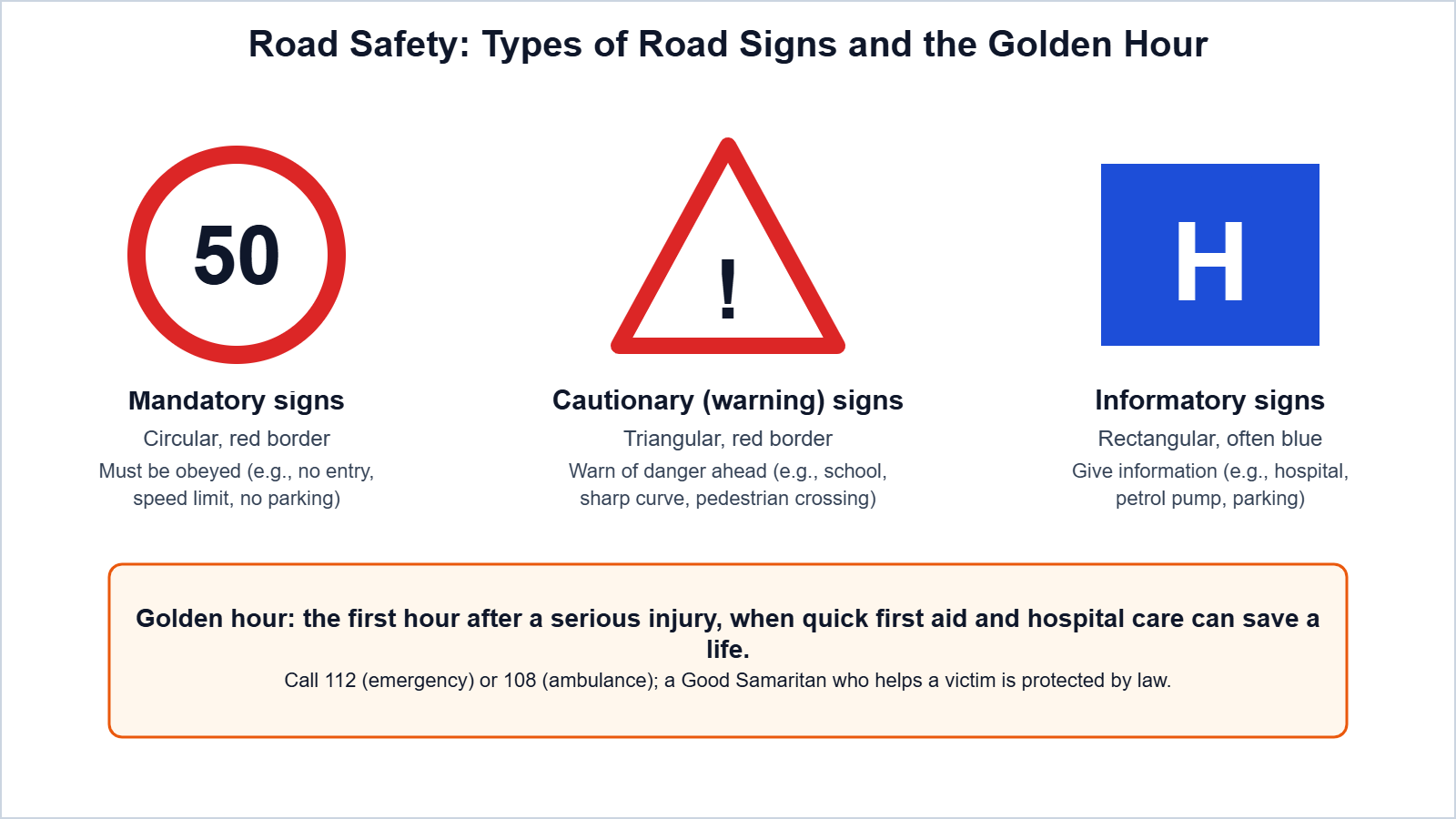
Type | Shape | Examples |
|---|---|---|
Mandatory (regulatory) signs | Mostly circular with red border (STOP is octagonal, GIVE WAY is a triangle pointing down) | Speed limit, no entry, no parking, no horn |
Cautionary (warning) signs | Triangular with red border | School ahead, sharp curve, pedestrian crossing, narrow bridge |
Informatory signs | Rectangular, often blue | Hospital, petrol pump, parking, eating place |
Traffic lights: red means stop, amber (yellow) means get ready or slow down, and green means go if the way is clear. Road markings such as zebra crossings, stop lines and lane lines guide road users.
5. Safety Equipment: Helmets and Seat Belts
A good helmet protects the head, which is the most vulnerable part of the body in two-wheeler accidents. It should fit well and the strap should always be fastened. A seat belt keeps the occupants of a car in their seats during sudden braking or a crash and greatly reduces the chance of serious injury. Airbags work properly only when seat belts are worn. Young children should travel in proper child seats.
6. The Golden Hour
The golden hour is the first hour after a serious injury. If the injured person gets first aid and reaches a hospital within this time, the chances of survival are much higher. That is why bystanders should act quickly: call for help (112 for emergency or 108 for ambulance), keep the victim still if a spinal injury is possible, stop bleeding with pressure and keep the airway clear.
7. The Good Samaritan
A Good Samaritan is a person who helps an accident victim in good faith without expecting anything in return. In India, Good Samaritans are protected by law (the Motor Vehicles Act, as amended in 2019, along with earlier guidelines upheld by the Supreme Court). They cannot be forced to pay hospital charges, need not disclose their identity if they do not wish to, and are protected from harassment. This encourages people to help victims during the golden hour.
8. Role of Students and Citizens
- Follow traffic rules and set an example for others.
- Spread awareness about helmets, seat belts and the dangers of drunk driving and mobile phone use.
- Take part in road safety weeks, rallies and school clubs.
- Learn basic first aid.
- Never pressure friends to drive fast or perform stunts.
9. Important Word Meanings
Word / Phrase | Meaning |
|---|---|
Pedestrian | A person walking on the road |
Pillion rider | A person sitting behind the rider on a two-wheeler |
Zebra crossing | A striped road marking where pedestrians may cross |
Golden hour | The first hour after a serious injury |
Good Samaritan | A person who helps a stranger in need |
Mandatory | Compulsory |
Bystander | A person present at an event but not taking part |
10. Short Answer Questions
Q1. Name three major causes of road accidents.
Ans. Over-speeding, drunken driving and using mobile phones while driving.
Q2. What is the golden hour?
Ans. The first hour after a serious injury, when timely medical help can save a life.
Q3. Who is a Good Samaritan?
Ans. A person who helps an accident victim in good faith without expecting any reward.
Q4. Why should two-wheeler riders wear helmets?
Ans. To protect the head, which is most likely to be fatally injured in a two-wheeler accident.
Q5. What do the three colours of a traffic light mean?
Ans. Red – stop; amber – get ready or slow down; green – go if the way is clear.
Q6. Which shape are cautionary signs?
Ans. Triangular with a red border.
Q7. How should a pedestrian cross a road?
Ans. At a zebra crossing, subway or foot-over-bridge, after looking right, left and right again.
Q8. Which numbers can be dialled in an emergency?
Ans. 112 for emergency services and 108 for an ambulance.
11. Long Answer Questions
Q1. “Most road accidents are caused by human error.” Discuss and suggest ways to make roads safer.
Ans. Accidents are mostly caused by over-speeding, drunken driving, using mobile phones, not wearing helmets and seat belts, jumping signals and careless crossing by pedestrians. To make roads safer, people must follow traffic rules, use safety equipment, avoid alcohol and phones while driving, and respect speed limits. The government should improve roads, lighting and signage and enforce laws strictly. Schools and media should spread awareness. Since road safety is a shared responsibility, every road user must act carefully.
Q2. Write a short article on “Road Safety: A Shared Responsibility”.
Ans. Every day many lives are lost on our roads, though most accidents can be prevented. Drivers must obey speed limits, wear seat belts and never drink and drive. Riders must wear helmets. Pedestrians should use footpaths and zebra crossings. Parents should not allow children to drive without a licence. Bystanders should help victims during the golden hour without fear, as the law protects Good Samaritans. Road safety is not only the duty of the police; it is the responsibility of each one of us.
12. Value-based Questions
Q1. You see an accident on your way to school. What will you do?
Ans. Call 112 or 108, inform the police, keep the victim calm and safe, give basic first aid if possible and stay until help arrives, as a Good Samaritan.
Q2. Your friend wants to ride a motorbike without a licence and helmet. How will you advise him?
Ans. Explain that it is illegal and dangerous, that a helmet can save his life, and that he should wait until he gets proper training and a licence.
Easy Memory Trick: “S-H-S-G” = Speed limits, Helmets and seat belts, Signals and signs, Golden hour help.
Conclusion: Road safety depends on the behaviour of every road user. By following rules, using safety equipment and helping victims quickly, we can build a safer tomorrow.