Framing the Constitution – History Class 12 Notes
Part-III | Chapter – 12
Framing the Constitution
(The Beginning of a New Era)
1. Introduction
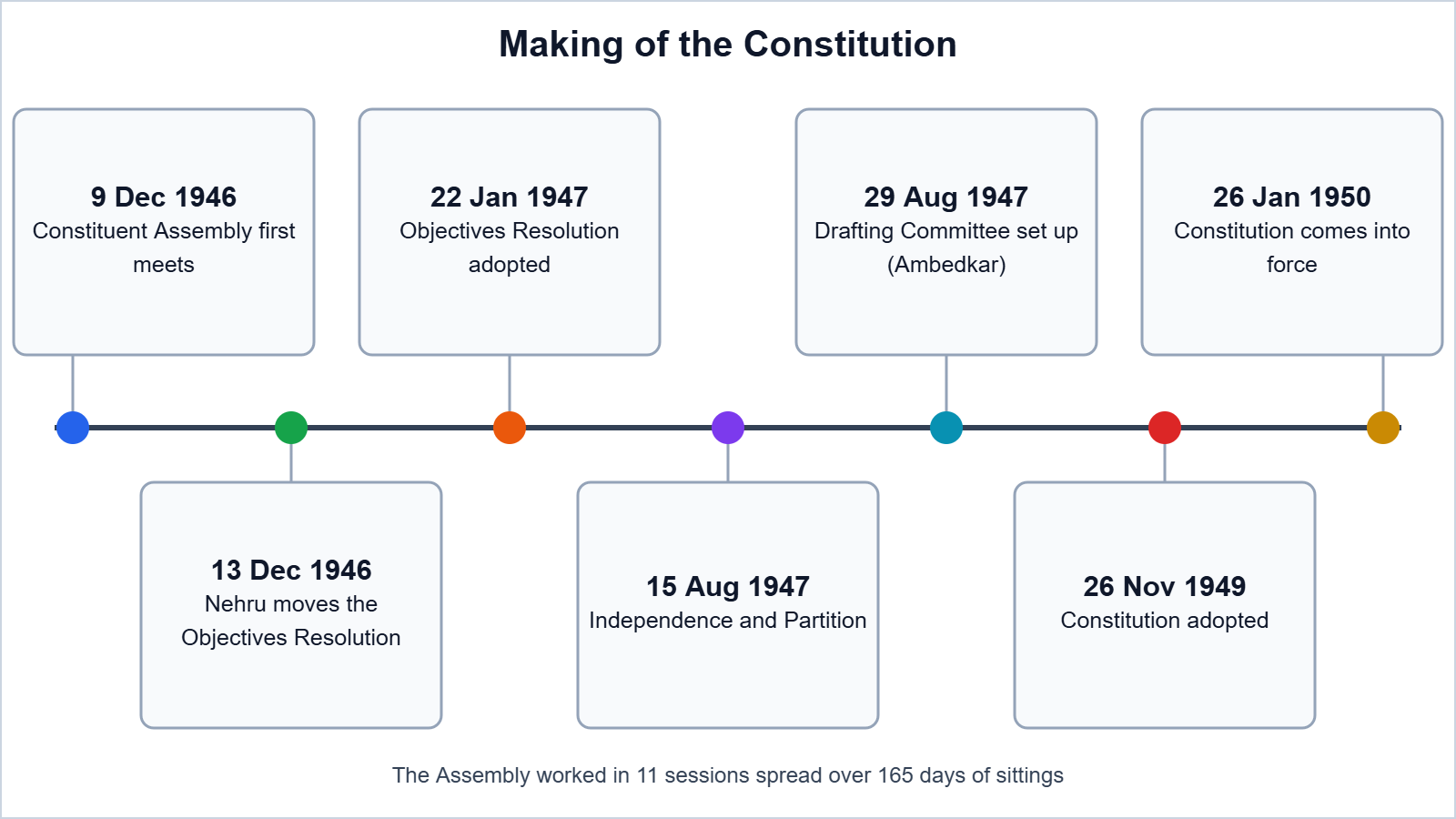
The Constitution of India was framed by the Constituent Assembly between December 1946 and November 1949. It was adopted on 26 November 1949 and came into force on 26 January 1950. It was written in a time of great turmoil – Partition, communal violence, the integration of princely states and the needs of millions of refugees.
2. A Tumultuous Time and the Making of the Assembly
The members of the Constituent Assembly were not elected by universal adult franchise. Under the Cabinet Mission plan of 1946, they were elected by the members of the provincial legislatures. The Assembly had about 300 members after Partition. The Congress dominated it, but its members held a wide range of views. The Muslim League boycotted it. The Assembly held eleven sessions, with sittings spread over 165 days.
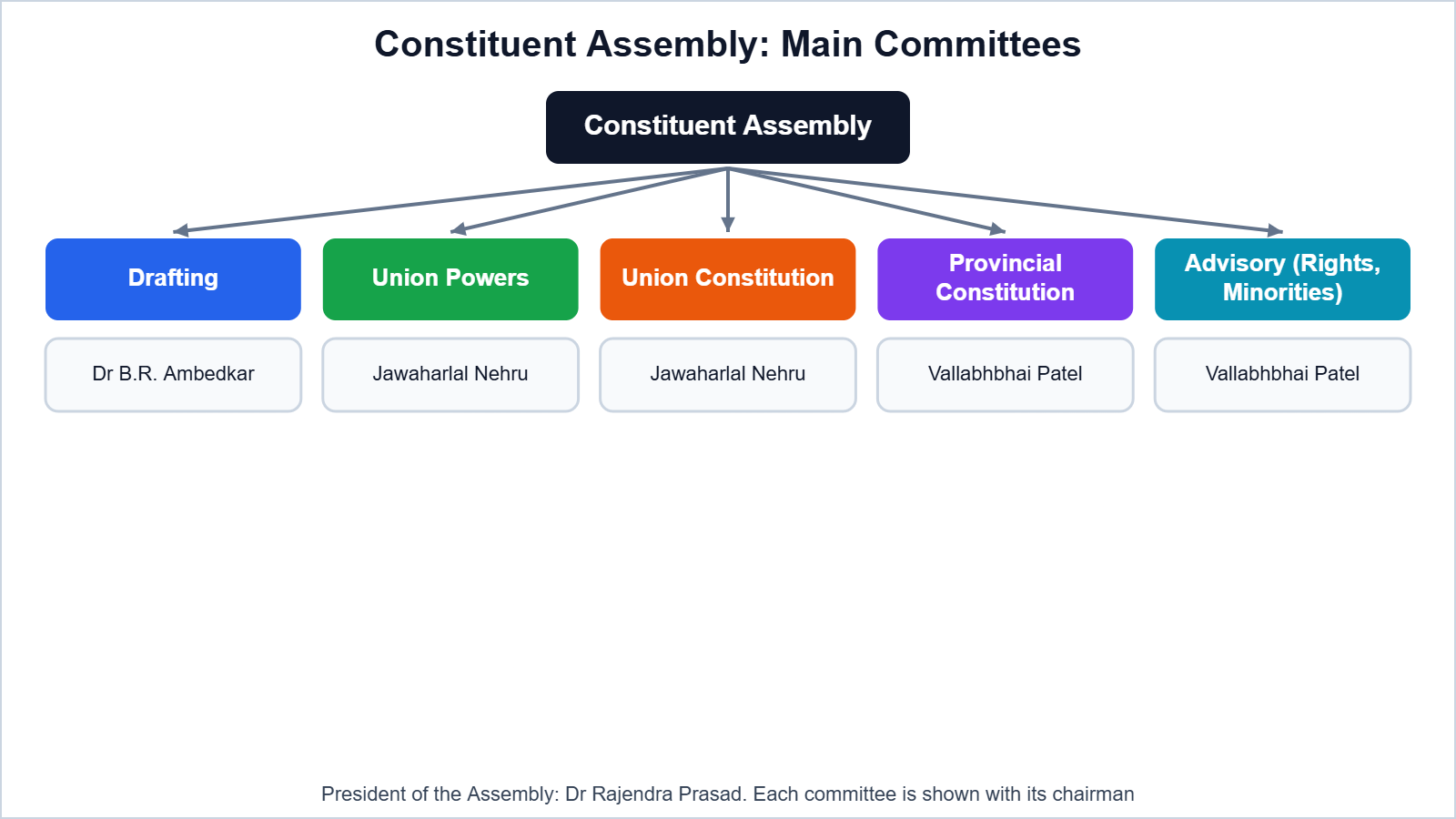
Dr Rajendra Prasad was the President of the Assembly. Jawaharlal Nehru, Vallabhbhai Patel and Rajendra Prasad were leading figures, along with Dr B.R. Ambedkar, who chaired the Drafting Committee. K.M. Munshi and Alladi Krishnaswamy Ayyar were among its other members. The Constitutional Adviser B.N. Rau and the chief draughtsman S.N. Mukherjee also played important roles. Public opinion was invited, and debates were reported in newspapers.
3. The Vision of the Constitution
On 13 December 1946 Nehru moved the Objectives Resolution, which declared India an independent sovereign republic and promised its people justice, equality and freedom, with safeguards for minorities, backward and tribal areas, and depressed classes. It was adopted on 22 January 1947. Nehru linked the vision to the history of democratic struggles in the world, while arguing that India must find a path suited to its own people.
4. Defining Rights
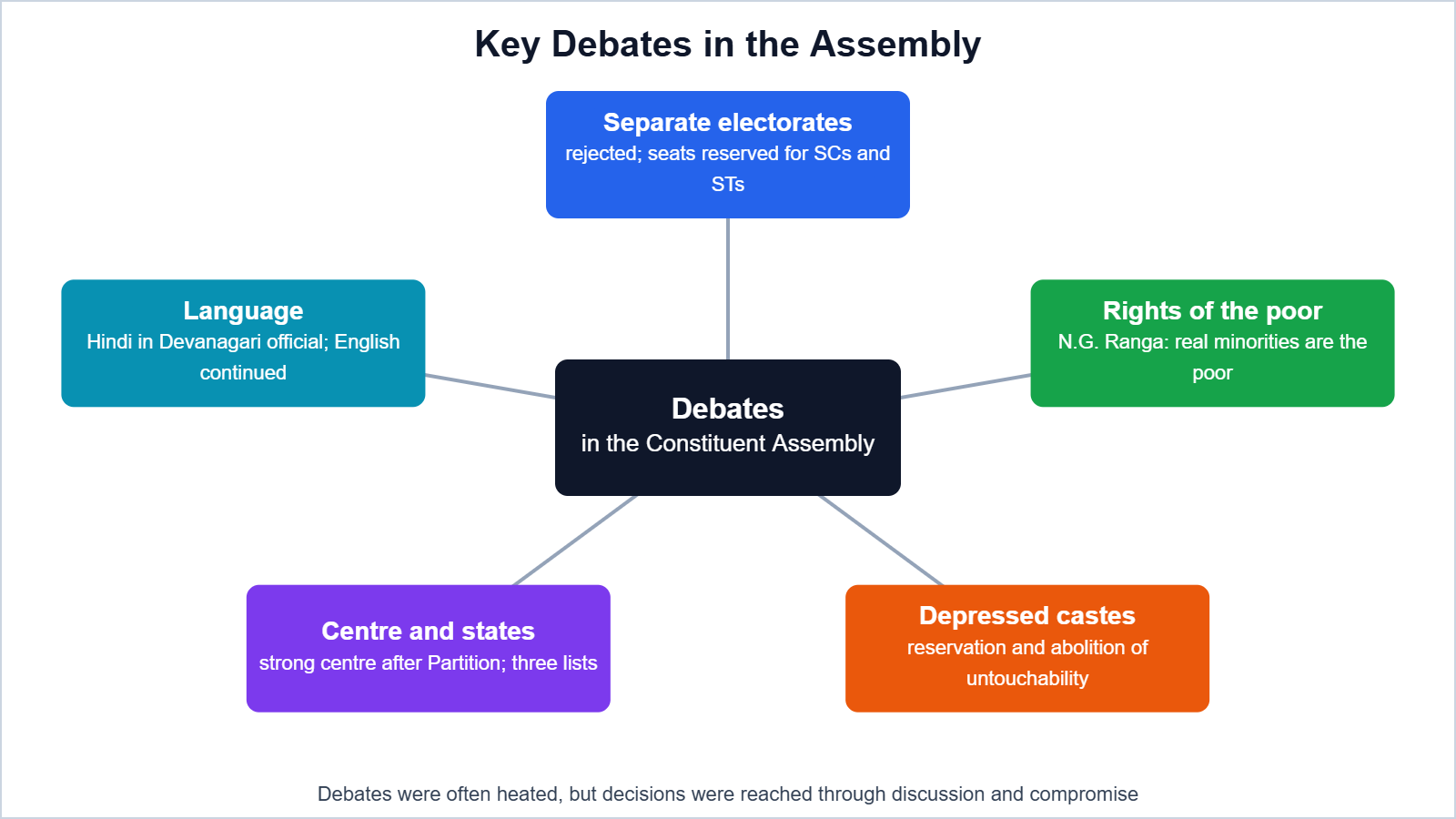
Separate electorates: some members, such as B. Pocker Bahadur, argued for separate electorates for Muslims. Most members, including Govind Ballabh Pant, opposed them, fearing they would divide the nation. Separate electorates were rejected.
The poor and the tribals: N.G. Ranga argued that the real minorities were the poor and the downtrodden, who needed economic and social rights to benefit from legal rights. Jaipal Singh spoke for the tribal peoples, asking for protection and representation.
The depressed castes: members such as Ambedkar argued that untouchability and social discrimination could not be removed only by protective legislation. The Constitution abolished untouchability, opened temples to all, and provided reservation of seats in legislatures and jobs in government for the depressed castes.
5. The Powers of the State
There was a debate on the powers of the centre and the states. K. Santhanam argued that the states should also be strong. But the violence of Partition made most members favour a strong centre. The Constitution provided three lists: the Union List, the State List and the Concurrent List. The centre was given more powers, including control over residuary subjects and the power to take over a state administration in certain conditions.
6. The Language of the Nation
Gandhi had favoured Hindustani, a mix of Hindi and Urdu, as the national language. In the Assembly, R.V. Dhulekar pressed strongly for Hindi, while members from the south such as Shrimati G. Durgabai objected to Hindi being imposed. A compromise was reached: Hindi in the Devanagari script would be the official language of the Union, while English would continue to be used for official purposes for fifteen years. Provinces could choose their own languages.
7. Present State of Research
Historians study the Constituent Assembly Debates to understand how the Constitution was shaped by argument and compromise. They examine how different groups – minorities, depressed castes, tribals, states and language groups – were represented, and how far the Constitution reflected the vision of the national movement.
8. How Historians Acquired This Knowledge
The main source is the Constituent Assembly Debates, the official record of the speeches and discussions, published in many volumes. Historians also use the reports of the committees, the drafts of the Constitution, newspapers of the time, and the letters and writings of members.
9. Primary Source and How Historians Use It
The Constituent Assembly Debates (1946-49). In simple words, they record speeches such as N.G. Ranga’s argument that rights mean little to the poor unless they have the means to use them, and the debate between members who wanted separate electorates and those who wanted a single electorate for all citizens.
How historians use them: the debates show the reasons behind each provision and the range of opinion among members. Historians remember that members spoke for public record and that the Assembly was not elected by adult franchise, so they compare the debates with other sources of public opinion.
10. Timeline
Date / Period | Event |
|---|---|
1946 | Cabinet Mission plan; elections to the Assembly |
9 Dec 1946 | Constituent Assembly first meets |
13 Dec 1946 | Objectives Resolution moved by Nehru |
22 Jan 1947 | Objectives Resolution adopted |
15 Aug 1947 | Independence and Partition |
29 Aug 1947 | Drafting Committee set up under Ambedkar |
26 Nov 1949 | Constitution adopted |
26 Jan 1950 | Constitution comes into force |
11. Important Terms
Term | Meaning |
|---|---|
Constituent Assembly | Body that framed the Constitution |
Objectives Resolution | Resolution setting out the ideals of the Constitution (1946) |
Separate electorate | System in which a community elects its own representatives separately |
Union List | Subjects on which only the centre can make laws |
Concurrent List | Subjects on which both centre and states can make laws |
Residuary powers | Powers over subjects not listed, given to the centre |
12. Short Answer Questions
Q1. When did the Constituent Assembly first meet?
Ans. On 9 December 1946.
Q2. Who chaired the Drafting Committee?
Ans. Dr B.R. Ambedkar.
Q3. Who was the President of the Constituent Assembly?
Ans. Dr Rajendra Prasad.
Q4. Who moved the Objectives Resolution and when?
Ans. Jawaharlal Nehru, on 13 December 1946.
Q5. When was the Constitution adopted and when did it come into force?
Ans. Adopted on 26 November 1949; in force from 26 January 1950.
Q6. Name the three lists of subjects.
Ans. Union List, State List and Concurrent List.
Q7. Who argued that the real minorities were the poor?
Ans. N.G. Ranga.
Q8. What was decided about the national language?
Ans. Hindi in Devanagari became the official language of the Union; English continued for fifteen years.
13. Long Answer Questions
Q1. Why were separate electorates rejected by the Constituent Assembly?
Ans. Most members felt separate electorates had divided communities and contributed to Partition. They believed separate electorates would isolate minorities, weaken national unity and prevent minorities from winning the goodwill of the majority. Instead, a single electorate was adopted, with reservation of seats for Scheduled Castes and Scheduled Tribes.
Q2. Why did the Constitution create a strong centre?
Ans. The violence of Partition, communal riots, the integration of princely states and the need for planned economic development convinced most members that only a strong central government could keep the country united and stable. So the Union List was longer, the centre had residuary powers and could act in emergencies.
14. Source-based Questions
Q1. (Source) A member argues that rights mean nothing to the poor unless they have the economic means to use them. (a) Who said this? (b) What does it show?
Ans. (a) N.G. Ranga. (b) That members wanted social and economic justice, not only legal rights.
Q2. (Source) A southern member objects to Hindi being imposed as the national language. (a) Name such a member. (b) How was the issue resolved?
Ans. (a) Shrimati G. Durgabai. (b) Hindi in Devanagari became the official language, with English continuing for fifteen years.
Easy Memory Trick: “9-12, 26-11, 26-1”: Assembly met 9 Dec 1946, Constitution adopted 26 Nov 1949, came into force 26 Jan 1950.
Conclusion: The Constitution was the result of nearly three years of debate and compromise among people with very different views. It laid the foundation of a democratic, secular republic committed to justice, equality and the rights of all citizens.