Colonialism and the Countryside – History Class 12 Notes
Part-III | Chapter – 9
Colonialism and the Countryside
(Exploring Official Archives)
1. Introduction
This theme studies how colonial rule changed rural life in Bengal, the Rajmahal hills and the Bombay Deccan. It is based on official archives – revenue records, surveyors’ reports and commission reports – produced by British officials.
2. Bengal and the Zamindars
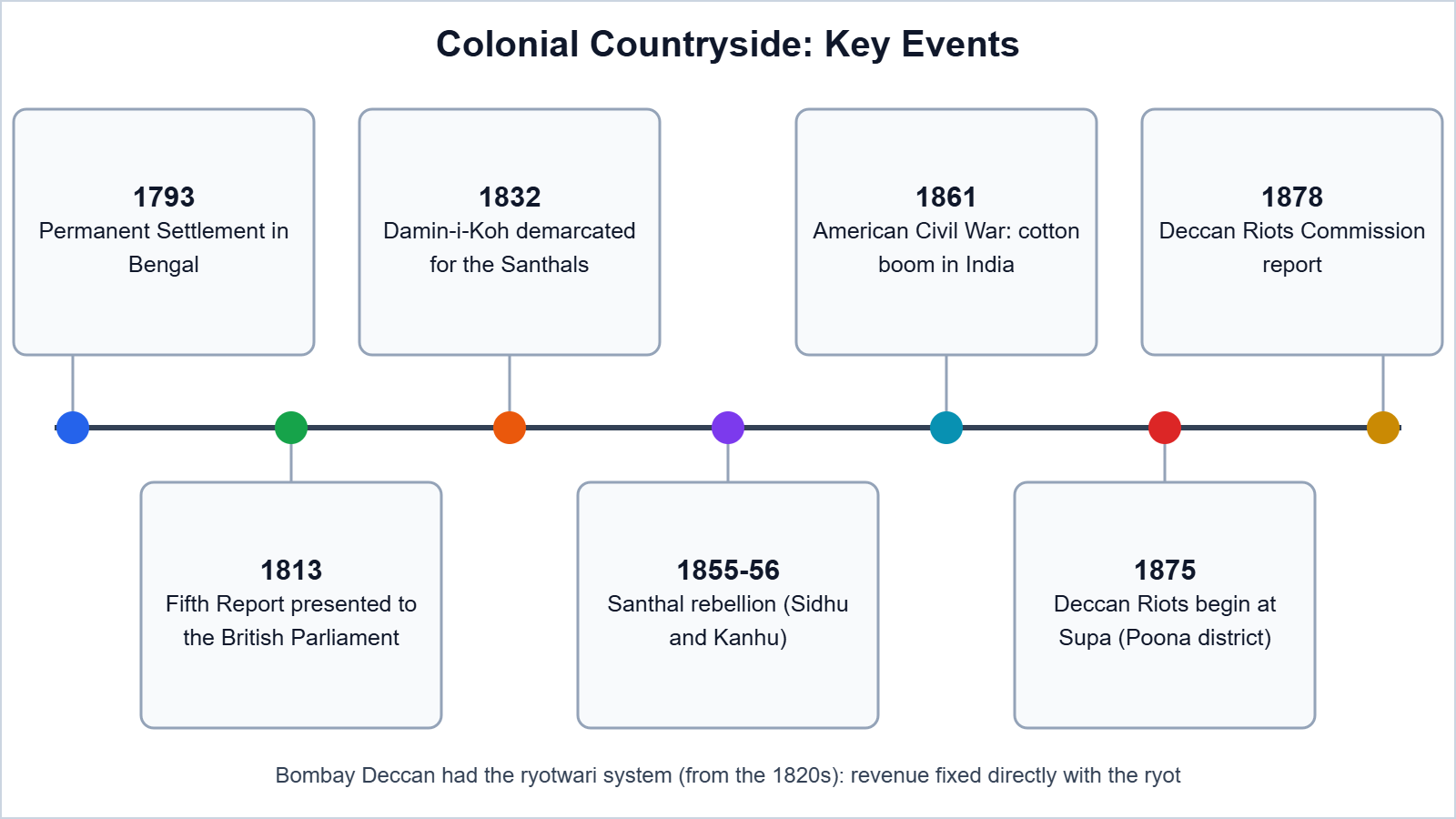
In 1793, under Governor-General Lord Cornwallis, the East India Company introduced the Permanent Settlement in Bengal. Revenue was fixed permanently with zamindars, who had to pay it to the Company. The Company hoped this would ensure a regular revenue and create a class of landlords who would invest in improving land.
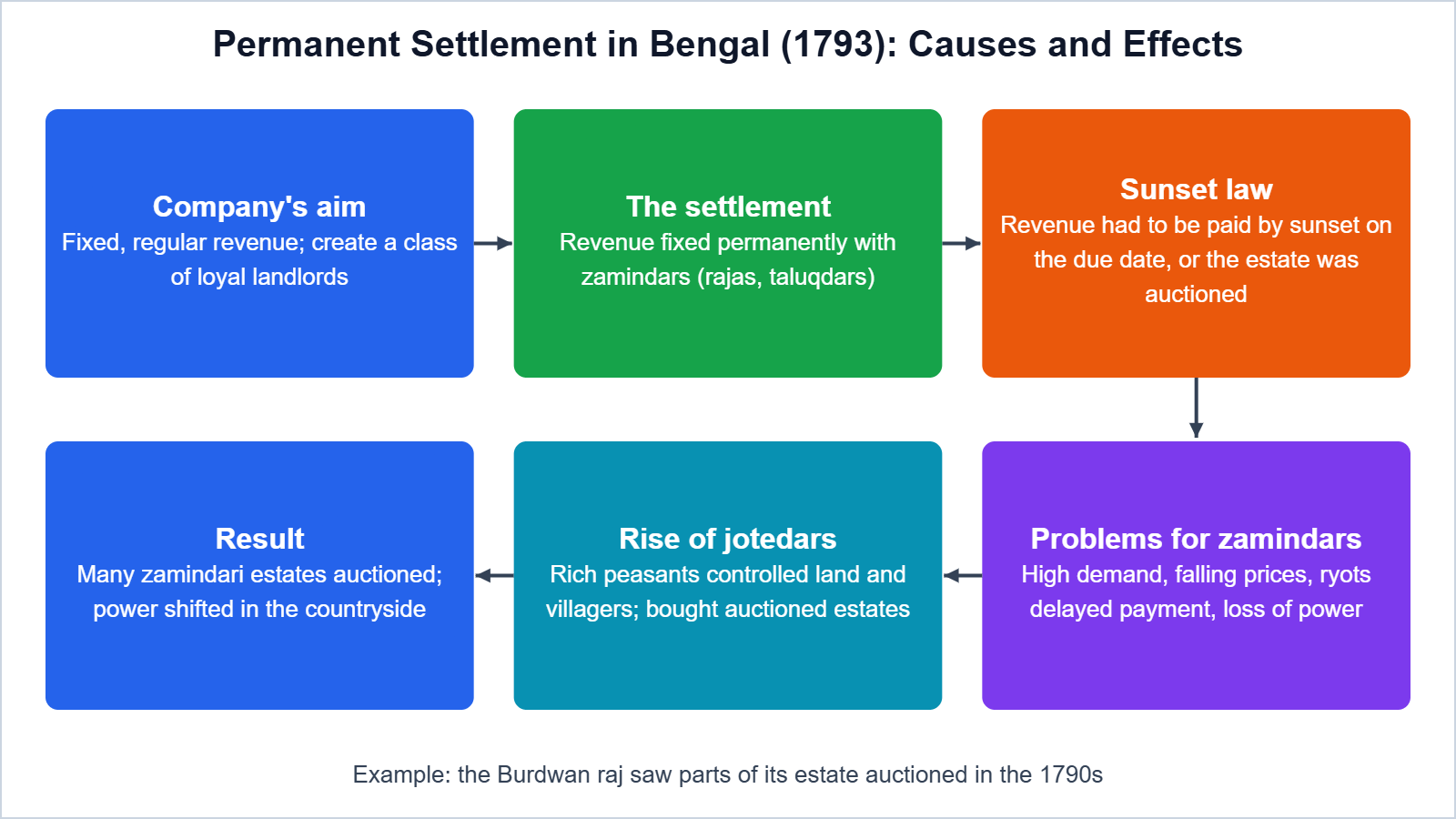
Why zamindars defaulted: the initial demand was very high; it was imposed when agricultural prices were depressed; revenue was invariable regardless of harvest; zamindars lost their troops and judicial powers; and ryots often delayed payment. Under the sunset law, if payment was not made by sunset of the due date, the zamindari was auctioned. For example, parts of the estate of the raja of Burdwan were auctioned in 1797.
Rise of the jotedars: rich peasants called jotedars acquired large areas of land and controlled local trade and moneylending; their power was often greater than that of zamindars. Zamindars resisted by using benami purchases (buying their own auctioned estates through agents) and by fictitious sales.
3. The Hill People: Paharias and Santhals
The Paharias lived in the Rajmahal hills, practising shifting cultivation, hunting and gathering. They raided the plains, and the British tried to subdue them. In the 1780s the British first tried extermination and then a policy of paying allowances to chiefs.
The Santhals came to the area as settled cultivators; the British encouraged them to clear forests and settle. In 1832 an area called Damin-i-Koh was demarcated as Santhal land. But high revenue demands, moneylenders (dikus) and loss of land led to the Santhal rebellion of 1855-56, led by Sidhu and Kanhu. After it was suppressed, the Santhal Pargana was created.
Francis Buchanan, a physician who travelled through the Rajmahal hills and other areas as a surveyor for the Company, recorded the landscape, resources and people. His reports reflect the Company’s interest in commercial possibilities.
4. A Revolt in the Countryside: The Bombay Deccan
In the Bombay Deccan, the ryotwari system was introduced in the 1820s: revenue was fixed directly with the ryot (peasant) for a period, usually 30 years. The demand was high and peasants often had to borrow from moneylenders.
The cotton boom: when the American Civil War broke out in 1861, cotton supplies to Britain from America fell, and British traders encouraged Indian peasants to grow cotton. Advances were easily available. When the war ended in 1865, demand fell, credit dried up, and peasants were left in debt.
The Deccan Riots of 1875: peasants in Supa (Poona district) and nearby villages attacked moneylenders (sahukars), burning their account books and bonds. The Limitation Law of 1859 (making loan bonds valid for only three years) had been evaded by moneylenders who forced peasants to sign new bonds. The government set up the Deccan Riots Commission, whose report was presented in 1878.
5. Present State of Research
Historians now use official archives critically, recognising that they reflect the Company’s concerns – revenue, order and control. They read the records “against the grain” to recover the experiences of zamindars, jotedars, peasants and hill people, and they use other sources such as local documents and oral traditions where available.
6. How Historians Acquired This Knowledge
Much of what we know comes from official records: revenue records, surveys (such as those of Francis Buchanan), reports of commissions and parliamentary papers. These were written to justify or examine Company policies. Historians compare different reports and look for the voices of rural people hidden in petitions and statements recorded in them.
7. Primary Source and How Historians Use It
The Fifth Report (1813). This was the fifth of a series of reports on the administration and activities of the East India Company in India, submitted to the British Parliament in 1813. It was over a thousand pages long and contained petitions of zamindars and ryots, reports of collectors and statistical tables. In simple terms, it described the problems of the Permanent Settlement, such as the high revenue demand, the auctioning of zamindaris and the hardships of the rural population.
The Deccan Riots Commission report (1878): it recorded statements of peasants and moneylenders and statistics on revenue and debt, though the government wanted it to show that the riots were caused by moneylenders rather than high revenue demands.
How historians use these sources: they provide valuable data and the voices of different groups, but historians note that they were shaped by the political debates of the time (for example, critics of the Company’s monopoly in Britain) and so need careful, critical reading.
8. Timeline
Date / Period | Event |
|---|---|
1765 | The Company acquires the diwani of Bengal |
1793 | Permanent Settlement in Bengal |
1797 | Auction of parts of the Burdwan estate |
1813 | The Fifth Report submitted to the British Parliament |
1820s | Ryotwari settlement in the Bombay Deccan |
1832 | Damin-i-Koh demarcated |
1855-56 | Santhal rebellion |
1859 | Limitation Law |
1861-1865 | American Civil War; cotton boom |
1875 | Deccan Riots |
1878 | Deccan Riots Commission report |
9. Important Terms
Term | Meaning |
|---|---|
Permanent Settlement | Fixed revenue settlement with zamindars in Bengal (1793) |
Sunset law | Rule that revenue must be paid by sunset or the estate would be auctioned |
Jotedar | Rich peasant of Bengal who controlled land and trade |
Benami | Purchase made in someone else’s name |
Ryotwari | Revenue settlement made directly with the peasant (ryot) |
Damin-i-Koh | Area demarcated for Santhals in 1832 |
Sahukar | Moneylender and trader |
10. Short Answer Questions
Q1. When and by whom was the Permanent Settlement introduced?
Ans. In 1793 in Bengal, under Lord Cornwallis.
Q2. What was the sunset law?
Ans. If revenue was not paid by sunset on the due date, the zamindari was auctioned.
Q3. Who were the jotedars?
Ans. Rich peasants of Bengal who controlled large lands, local trade and moneylending.
Q4. What was Damin-i-Koh?
Ans. An area demarcated in 1832 as land of the Santhals.
Q5. Who led the Santhal rebellion?
Ans. Sidhu and Kanhu (1855-56).
Q6. Why did the cotton boom end?
Ans. The American Civil War ended in 1865 and demand for Indian cotton fell.
Q7. Where did the Deccan Riots begin?
Ans. At Supa in Poona district, in 1875.
Q8. What was the Fifth Report?
Ans. A report on the Company’s administration in India submitted to the British Parliament in 1813.
11. Long Answer Questions
Q1. Why did many zamindars default on revenue payments under the Permanent Settlement?
Ans. The revenue demand was very high and fixed even when harvests failed; it was imposed when prices were low; zamindars lost their armed forces and judicial powers; ryots delayed payments, sometimes encouraged by jotedars; and the sunset law meant quick auctions. As a result, many zamindaris were auctioned in the years after 1793.
Q2. What were the causes of the Deccan Riots of 1875?
Ans. The ryotwari revenue demand was high, forcing peasants to borrow. During the cotton boom of the 1860s they took easy credit, but after 1865 demand fell and moneylenders refused further loans. Moneylenders evaded the Limitation Law by forcing peasants to sign new bonds with high interest. Anger at this exploitation led peasants to attack sahukars and burn their bonds and account books.
12. Source-based Questions
Q1. (Source) A thousand-page report submitted to the British Parliament in 1813 contains petitions of zamindars and ryots and reports of collectors. (a) Name the report. (b) Why should historians use it carefully?
Ans. (a) The Fifth Report. (b) It was shaped by political debates in Britain about the Company and reflects official viewpoints.
Q2. (Source) A commission records the statements of peasants and moneylenders after riots in which account books were burnt. (a) Which commission is this? (b) What did the government want it to show?
Ans. (a) The Deccan Riots Commission (report 1878). (b) That the riots were caused by moneylenders rather than high government revenue demands.
Easy Memory Trick: “P-S-D” = Permanent Settlement (Bengal), Santhals (Rajmahal hills), Deccan Riots (Bombay Deccan).
Conclusion: Colonial revenue policies transformed the countryside, causing auctions of zamindaris, displacement of hill people and peasant indebtedness. Official archives, read critically, reveal both the policies and the struggles of rural people.