Bhakti-Sufi Traditions – History Class 12 Notes
Part-II | Chapter – 6
Bhakti-Sufi Traditions
(Changes in Religious Beliefs and Devotional Texts (c. 8th – 18th centuries))
1. Introduction
From about the eighth century, new forms of devotion spread across India. Bhakti (devotion to a personal god) and Sufism (Islamic mysticism) emphasised love of God over ritual. Saint-poets composed in regional languages, so their ideas reached ordinary people. Historians use their compositions, hagiographies (biographies of saints) and traditions preserved by followers.
2. The Integration of Cults
Historians describe two processes: the spread of brahmanical ideas through Sanskrit texts like the Puranas, and the absorption of local beliefs and practices into the “great traditions”. Local deities were often identified with forms of major gods; for example, the deity Jagannatha at Puri came to be identified as a form of Vishnu. Historians use the terms “great” and “little” traditions (suggested by the sociologist Robert Redfield) to discuss this.
3. Early Bhakti in Tamil Nadu: Alvars and Nayanars
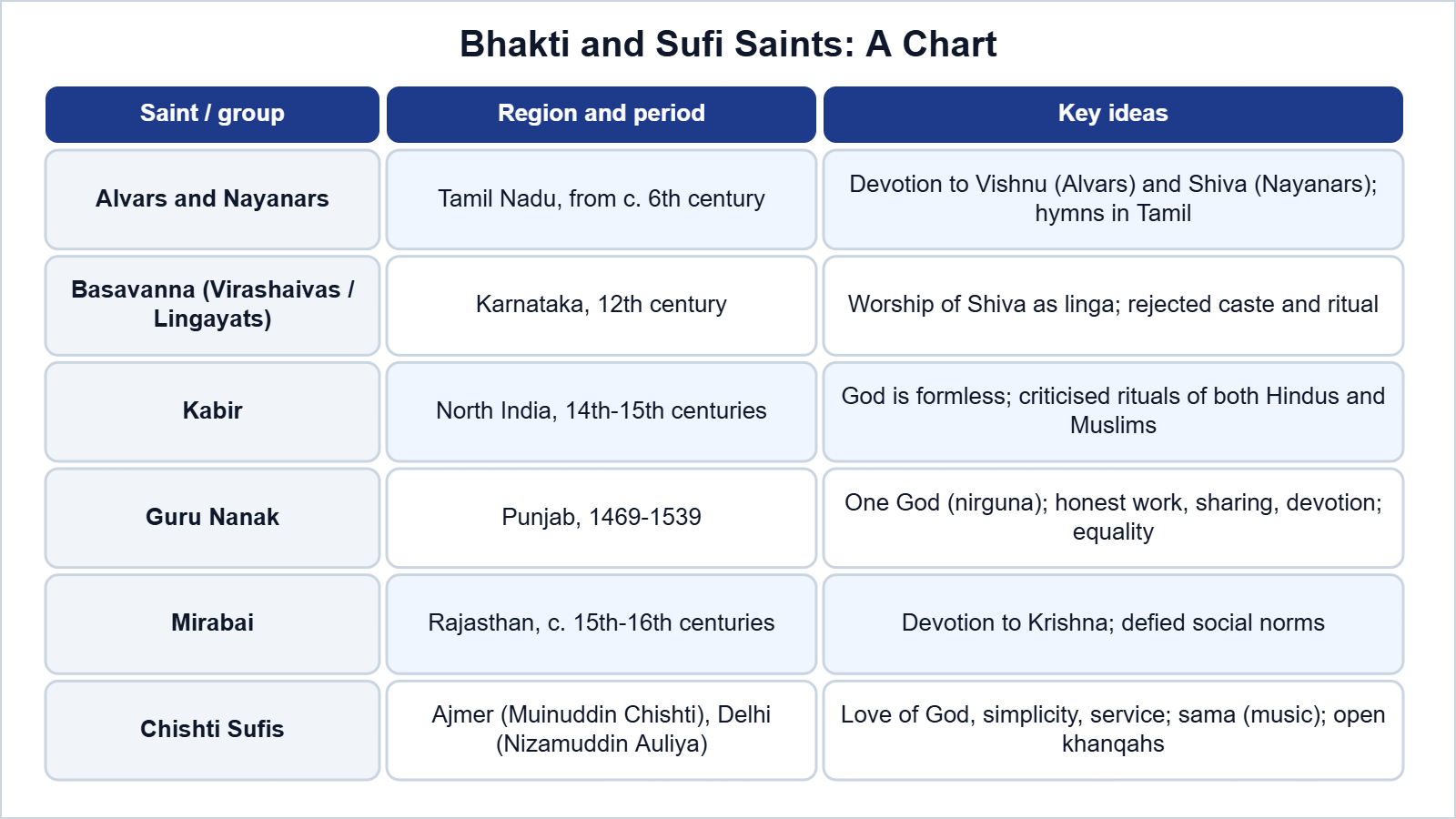
From about the sixth century, the Alvars (devotees of Vishnu) and Nayanars (devotees of Shiva) travelled from place to place singing hymns in Tamil. They came from many castes, including those considered “untouchable”, and some were women, like Andal (an Alvar) and Karaikkal Ammaiyar (a Nayanar). The Alvars’ hymns were compiled in the Nalayira Divyaprabandham and the Nayanars’ hymns in the Tevaram. Chola rulers supported these traditions and built temples.
4. The Virashaiva Tradition in Karnataka
In the twelfth century, Basavanna, a minister at the Chalukya court, started the Virashaiva (Lingayat) movement. Lingayats worship Shiva in the form of a linga, worn on the body. They challenged the caste system, questioned rebirth, and did not practise funeral rites like cremation. Their compositions in Kannada are called vachanas.
5. Islamic Traditions and the Sufis
With the coming of Islam, rulers sometimes followed Islamic law (sharia), but they also had to rule over large non-Muslim populations, who were treated as zimmis (protected people) paying jizya. Sufis were Muslim mystics who sought union with God through love, devotion and following the master.
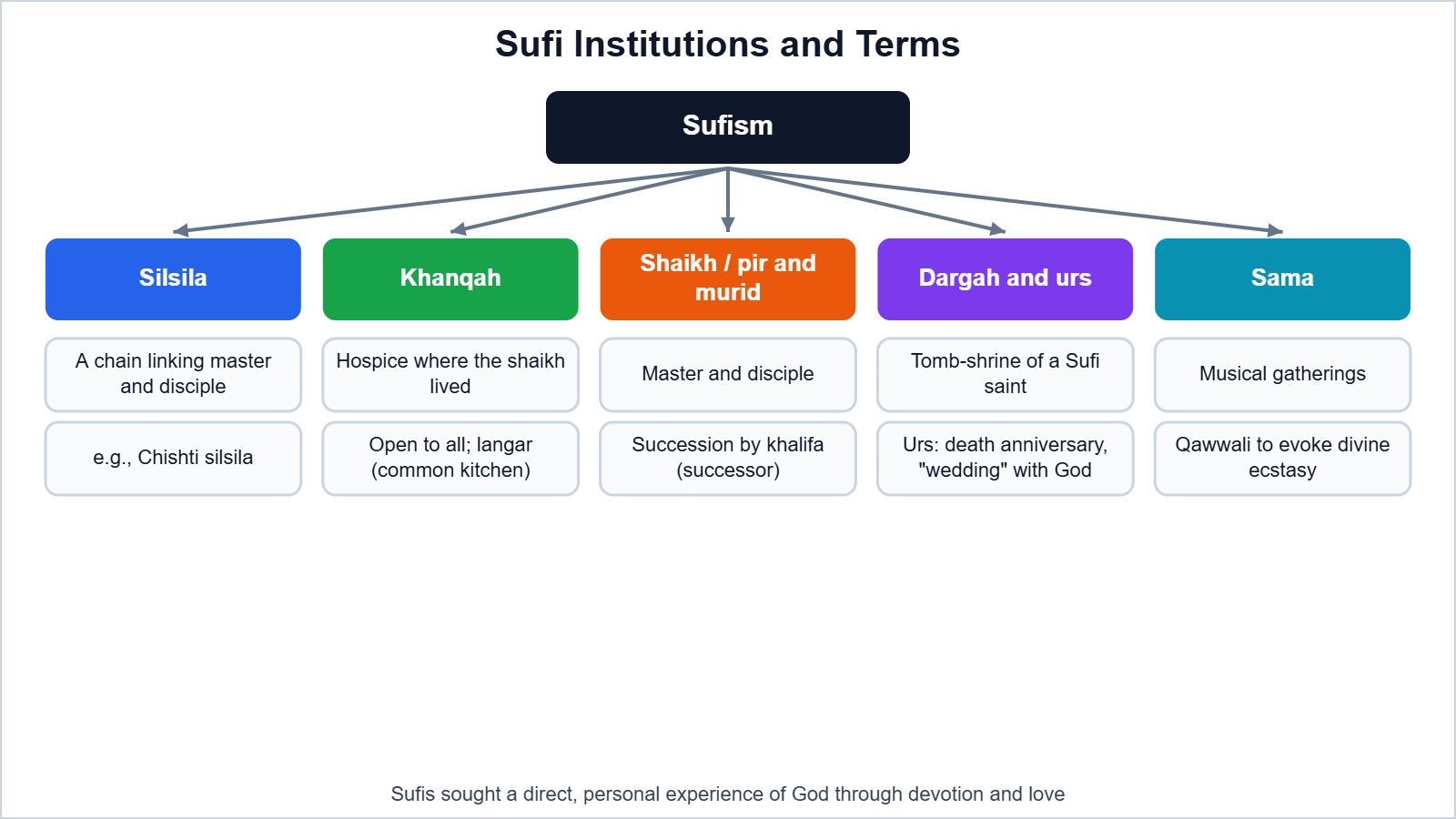
The Chishtis in India: the most influential order in India. Khwaja Muinuddin Chishti settled at Ajmer (died 1235); Shaikh Nizamuddin Auliya lived in Delhi (died 1325). Chishti khanqahs were open to all, fed visitors through langars and practised sama (music). Mughal emperor Akbar visited the Ajmer dargah fourteen times. Amir Khusrau, a poet-musician and disciple of Nizamuddin, contributed to qawwali.
6. New Strands of Devotion in North India
Kabir (c. 14th-15th centuries) described the ultimate reality as formless and used many terms – Allah, Rama, Hari – for God. He criticised the rituals of both Hindus and Muslims. His verses survive in the Bijak (preserved by the Kabirpanth in Varanasi), the Kabir Granthavali (preserved by the Dadupanth in Rajasthan) and in the Adi Granth Sahib.
Guru Nanak (1469-1539), born at Talwandi (now Nankana Sahib in Pakistan), taught devotion to one formless God, honest work, sharing and equality, and rejected rituals and caste distinctions. His hymns, along with those of later Gurus and saints, were compiled in the Adi Granth by Guru Arjan in 1604. Guru Gobind Singh founded the Khalsa in 1699.
Mirabai, a Rajput princess from Merta, married into the Sisodia clan of Mewar. She was devoted to Krishna, rejected her husband’s family’s demands and, according to traditions, took up a life of devotion. Her songs remain popular.
7. Present State of Research
Historians now emphasise that bhakti and Sufi traditions were diverse and constantly interacting. Rather than seeing them as reforms of existing religions, historians study how saints challenged caste and ritual, how their followers organised communities, and how their compositions were preserved and changed through oral and written traditions.
8. How Historians Acquired This Knowledge
The teachings of most saints survive through compositions sung and memorised by followers, which were written down later, sometimes centuries afterwards. Hagiographies, collections like the Adi Granth, and records of Sufi conversations (malfuzat) and letters (maktubat) are key sources. Historians compare versions, note additions by later followers and study inscriptions and court records that mention saints.
9. Primary Source and How Historians Use It
Verses of Kabir (paraphrased). Kabir asks how one God can be divided into two names; he says that some call God Allah and others Rama, but they are only names, and he mocks those who argue over them. In other verses he says that God is not found in temples or mosques but within one’s own heart.
How historians use them: Kabir’s verses show the criticism of ritual and religious division in popular religion. Since the verses were preserved by different communities and in different collections, historians compare versions and are careful in deciding which verses go back to Kabir himself and which were added later. The verses also show how saints used everyday language and images to communicate with ordinary people.
10. Timeline
Date / Period | Event |
|---|---|
c. 6th century onwards | Alvars and Nayanars in Tamil Nadu |
12th century | Basavanna and the Virashaiva movement |
c. 1235 | Death of Khwaja Muinuddin Chishti at Ajmer |
1325 | Death of Shaikh Nizamuddin Auliya at Delhi |
c. 14th-15th centuries | Kabir |
1469-1539 | Guru Nanak |
1604 | Guru Arjan compiles the Adi Granth |
1699 | Guru Gobind Singh founds the Khalsa |
11. Important Terms
Term | Meaning |
|---|---|
Bhakti | Devotion to a personal god |
Sufism | Islamic mysticism seeking direct experience of God |
Silsila | A chain linking Sufi master and disciples |
Khanqah | A Sufi hospice |
Dargah | The tomb-shrine of a Sufi saint |
Vachanas | Kannada compositions of the Virashaivas |
Nirguna / saguna | Worship of God without attributes / with attributes |
Hagiography | A biography of a saint |
12. Short Answer Questions
Q1. Who were the Alvars and Nayanars?
Ans. Tamil devotees of Vishnu (Alvars) and Shiva (Nayanars) from about the 6th century.
Q2. Name the collections of hymns of the Alvars and Nayanars.
Ans. Nalayira Divyaprabandham (Alvars) and Tevaram (Nayanars).
Q3. Who founded the Virashaiva movement?
Ans. Basavanna, in the 12th century in Karnataka.
Q4. What is a khanqah?
Ans. A Sufi hospice where the shaikh lived and met disciples and visitors.
Q5. Where are the dargahs of Muinuddin Chishti and Nizamuddin Auliya?
Ans. Ajmer and Delhi.
Q6. Where are Kabir’s verses preserved?
Ans. In the Bijak, the Kabir Granthavali and the Adi Granth Sahib.
Q7. Who compiled the Adi Granth and when?
Ans. Guru Arjan, in 1604.
Q8. Who was Mirabai?
Ans. A Rajput princess and devotee of Krishna who defied social norms.
13. Long Answer Questions
Q1. Explain the main features of the bhakti movement.
Ans. Bhakti saints emphasised personal devotion to God over rituals and sacrifices. They composed in regional languages and travelled widely, reaching ordinary people. Many came from different castes and some were women. Some, like the Alvars and Nayanars, worshipped Vishnu or Shiva in personal (saguna) forms; others, like Kabir and Guru Nanak, worshipped a formless (nirguna) God and criticised caste and ritual.
Q2. Describe the main features of the Chishti silsila.
Ans. The Chishtis lived in khanqahs open to all, served langars, and practised simplicity and service. The silsila linked master (shaikh) and disciples (murids), and successors (khalifas) continued the order. Sama (music) was used to evoke devotion. Dargahs of saints like Muinuddin Chishti at Ajmer became places of pilgrimage for people of all faiths; even Akbar visited Ajmer fourteen times.
14. Source-based Questions
Q1. (Source) A poet-saint says God is known by many names, such as Allah and Rama, and mocks people who quarrel over these names. (a) Identify the saint. (b) What does the verse show?
Ans. (a) Kabir. (b) His rejection of religious division and his idea of one formless God.
Q2. (Source) A princess refuses to follow the customs of her husband’s royal family and devotes her life to Krishna. (a) Who is she? (b) What does her story show?
Ans. (a) Mirabai. (b) Defiance of social and gender norms through devotion.
Easy Memory Trick: “A-N-B-K-N-M” = Alvars, Nayanars, Basavanna, Kabir, Nanak, Mira; Sufi: “S-K-D-S” = Silsila, Khanqah, Dargah, Sama.
Conclusion: Bhakti and Sufi traditions brought religion closer to ordinary people through love and devotion. Their saints challenged ritual and caste, and their compositions remain a living part of India’s culture.