Kings, Farmers and Towns (Early States and Economies) – History Class 12 Notes
Part-I | Chapter – 2
Kings, Farmers and Towns
(Early States and Economies (c. 600 BCE – 600 CE))
1. Introduction: Prinsep and Piyadassi
In 1838 James Prinsep, an officer of the East India Company’s mint, deciphered the Brahmi and Kharosthi scripts. Most early inscriptions mention a king called Piyadassi (“pleasant to behold”); some refer to him as Devanampiya (“beloved of the gods”). He was identified as Ashoka. This opened up the study of early Indian political history.
2. The Sixteen Mahajanapadas
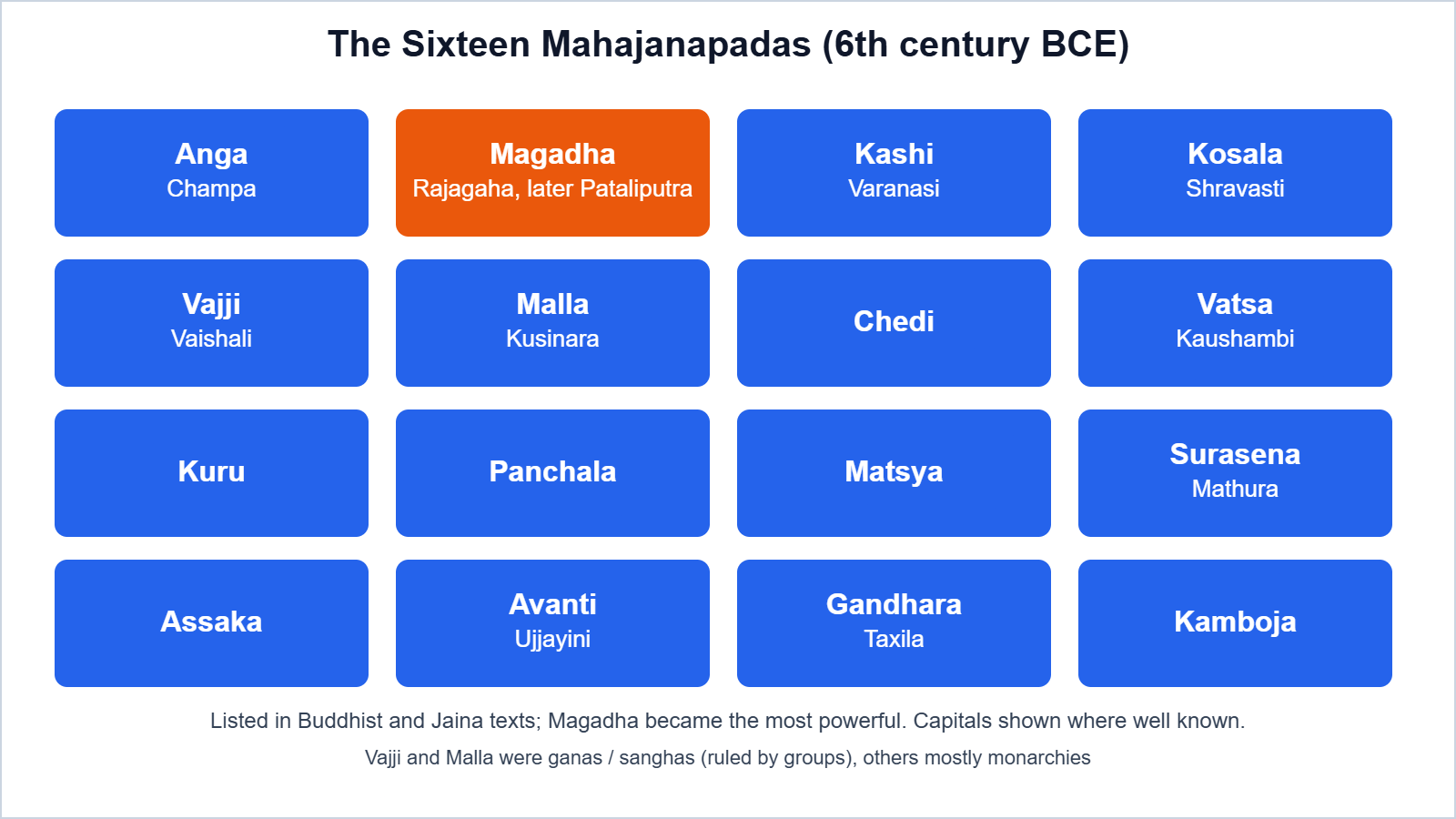
The sixth century BCE was a turning point: early states, cities, the use of iron, coins and new religious ideas (Buddhism and Jainism) developed. Buddhist and Jaina texts list sixteen mahajanapadas. Most were ruled by kings; some, called ganas or sanghas (such as the Vajji and Malla), were ruled by groups. Each had a capital, often fortified. Rulers collected taxes and tribute and maintained armies. Brahmanas composed the Dharmasutras, which laid down norms for rulers and social categories.
3. The First Empire: Magadha and the Mauryas
Between the sixth and fourth centuries BCE, Magadha (in present-day Bihar) became the most powerful mahajanapada. Reasons: fertile land, iron mines (in present-day Jharkhand), elephants from forests for the army, rivers (Ganga and tributaries) for communication, and ambitious rulers such as Bimbisara, Ajatasattu and Mahapadma Nanda. Its capital moved from Rajagaha to Pataliputra.
Chandragupta Maurya founded the Mauryan empire around 321 BCE. His grandson Ashoka is the best-known Mauryan ruler. Sources include Megasthenes’ account (Indica, preserved in later Greek writers), the Arthashastra (ascribed to Kautilya/Chanakya), Buddhist and Jaina texts, Puranas, and Ashoka’s inscriptions on rocks and pillars.
Ashoka’s dhamma: after the Kalinga war, Ashoka tried to hold his empire together by propagating dhamma: respect for elders, kindness to slaves and servants, generosity to brahmanas and monks, respect for other religions. Special officers called dhamma mahamattas spread the message.
4. New Notions of Kingship
In the south, chiefs and kings such as the Cholas, Cheras and Pandyas emerged; Tamil Sangam texts describe them. In the north-west, the Kushanas (c. 1st century BCE – 1st century CE onwards) ruled a vast area; their coins and statues suggest that they claimed divine status, with titles like devaputra (“son of god”). The Guptas (from c. 4th century CE) are known from literature, coins and inscriptions, including prashastis (praise poems).
5. Changes in Rural Society and Agriculture
To meet growing demands for taxes, new strategies increased production: the use of the iron ploughshare in fertile alluvial regions, the transplantation of paddy, and irrigation through wells, tanks and canals. Rural society was differentiated: large landowners, smallholders and landless labourers. In Pali texts, gahapati refers to the owner and head of a household; in Tamil texts, landowners were called vellalar, ploughmen uzhavar and slaves adimai.
Land grants: from the early centuries CE, rulers granted land, recorded in inscriptions on copper plates, often to religious institutions or brahmanas. Example: Prabhavati Gupta, daughter of Chandragupta II, granted land. Grants show the spread of agriculture and of the state’s control into new areas.
6. Towns and Trade
Many cities grew at river banks or along trade routes (e.g., Pataliputra, Ujjayini, Puhar). Urban populations included elites and craftspeople; guilds (shrenis) organised crafts. Trade routes crossed land and sea; Roman coins found in south India show trade with the Roman Empire.
Coins: punch-marked coins of silver and copper were among the earliest (from about the sixth century BCE). Indo-Greek coins carried rulers’ names and images; the Kushanas issued the first gold coins on a large scale; the Guptas issued spectacular gold coins. The tribal republic of the Yaudheyas issued copper coins.
7. Present State of Research
Historians no longer see early states only through the lives of kings. They study inscriptions, coins, archaeology and texts together to understand agriculture, trade, towns and ordinary people. They also note that the Mauryan empire was not uniform: areas near Pataliputra and the provincial centres were well controlled, while forests and distant regions were more loosely held.
8. How Historians Acquired This Knowledge
Inscriptions were deciphered by James Prinsep (1838). Epigraphy (the study of inscriptions) and numismatics (the study of coins) are key methods. Limitations of inscriptions: letters may be faintly engraved or damaged; the meaning of words may be uncertain; not all inscriptions have survived; and they record what rulers wanted to say, not always what ordinary people thought.
9. Primary Source and How Historians Use It
The Prayag Prashasti (Allahabad Pillar Inscription). Composed in Sanskrit by Harishena, a court poet, in praise of Samudragupta, it was engraved on an earlier Ashokan pillar at Allahabad (Prayagraj). In simple words, it praises Samudragupta as a great warrior who conquered many kings, a generous ruler, and a talented poet and musician, comparing him to the gods.
How historians use it: it is a valuable source for the extent of Samudragupta’s campaigns and for the Gupta idea of kingship. But since it is a prashasti (praise poem), historians read it critically, comparing it with coins and other inscriptions, because it naturally exaggerates the king’s achievements.
10. Timeline
Date / Period | Event |
|---|---|
c. 600 BCE | Mahajanapadas; use of iron; beginnings of coinage |
c. 500 BCE | Rise of Magadha |
c. 321 BCE | Chandragupta Maurya founds the Mauryan empire |
3rd century BCE | Ashoka; Kalinga war; inscriptions on rocks and pillars |
c. 1st century CE | Kushanas in the north-west; Roman trade; Sangam texts in the south |
c. 4th century CE | Rise of the Guptas; Prayag Prashasti of Samudragupta |
1838 | James Prinsep deciphers Brahmi and Kharosthi |
11. Important Terms
Term | Meaning |
|---|---|
Mahajanapada | A large early state of the sixth century BCE |
Gana / sangha | A state ruled by a group of people, not a single king |
Dhamma | Ashoka’s ethical principles for social harmony |
Prashasti | An inscription composed in praise of a ruler |
Epigraphy | The study of inscriptions |
Numismatics | The study of coins |
Gahapati | Owner and head of a household in Pali texts |
Shreni | A guild of craftspeople or merchants |
12. Short Answer Questions
Q1. Who deciphered the Brahmi script and when?
Ans. James Prinsep, in 1838.
Q2. Name any four mahajanapadas.
Ans. Magadha, Kosala, Vatsa and Avanti (any four).
Q3. Give three reasons for the rise of Magadha.
Ans. Fertile land, iron mines and elephants (also rivers and ambitious rulers).
Q4. Name the five major political centres of the Mauryan empire.
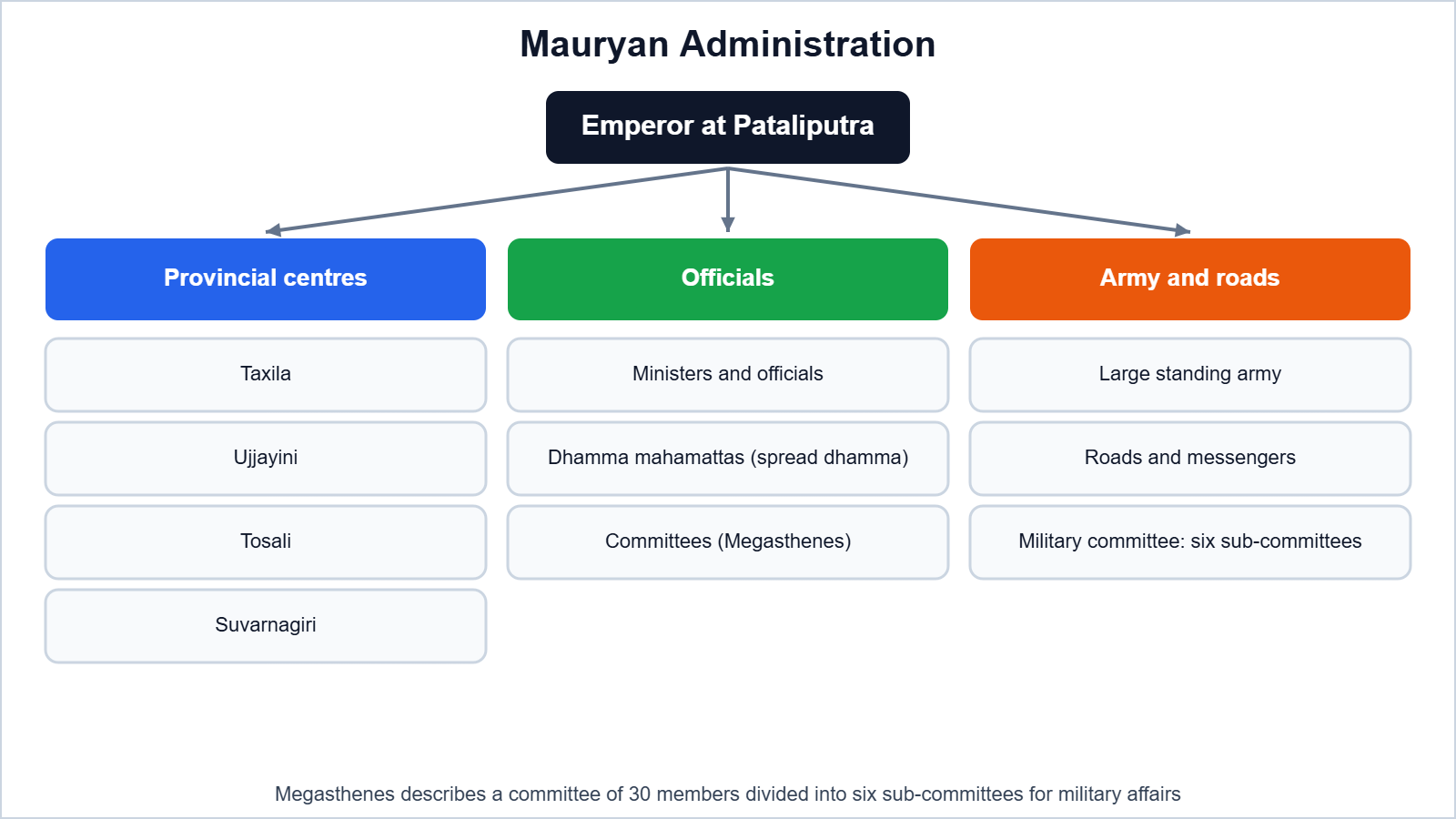
Ans. Pataliputra (capital), Taxila, Ujjayini, Tosali and Suvarnagiri.
Q5. What was Ashoka’s dhamma?
Ans. A set of ethical principles such as respect for elders, kindness and tolerance of all religions.
Q6. Who issued the first large-scale gold coins in India?
Ans. The Kushanas.
Q7. What is a prashasti? Give an example.
Ans. A praise inscription; the Prayag Prashasti of Samudragupta.
Q8. What were the limitations of inscriptions as sources?
Ans. Damage, uncertain meanings, loss of inscriptions and bias towards rulers’ views.
13. Long Answer Questions
Q1. Describe the administration of the Mauryan empire.
Ans. The emperor ruled from Pataliputra; Taxila, Ujjayini, Tosali and Suvarnagiri were provincial centres. Control was strongest near the capital and provincial centres. Megasthenes describes a committee of thirty members divided into six sub-committees for military affairs, looking after the navy, transport, foot soldiers, horses, chariots and elephants. Roads and communication were vital. Ashoka appointed dhamma mahamattas to spread dhamma. Sources include Megasthenes, the Arthashastra and Ashoka’s inscriptions.
Q2. Explain the strategies used to increase agricultural production during this period.
Ans. Rulers needed more taxes, so production was increased by using iron ploughshares in fertile river valleys, transplanting paddy, and building irrigation works such as wells, tanks and canals. Land grants extended agriculture into new areas. These changes increased production but also widened differences between large landowners, small peasants and landless labourers.
14. Source-based Questions
Q1. (Source) A court poet’s inscription on an old pillar praises a king as a mighty conqueror, a generous giver and a poet and musician equal to the gods. (a) Identify the inscription and the king. (b) Why should historians treat it carefully?
Ans. (a) The Prayag Prashasti of Samudragupta, composed by Harishena. (b) Because a prashasti is a praise poem and tends to exaggerate.
Q2. (Source) Many early inscriptions mention a king called Piyadassi who preached tolerance and kindness. (a) Who was he? (b) What did he call his message?
Ans. (a) Ashoka. (b) Dhamma.
Easy Memory Trick: Mauryan provinces: “T-U-T-S” around Pataliputra = Taxila, Ujjayini, Tosali, Suvarnagiri.
Conclusion: Between about 600 BCE and 600 CE, early states, empires, new farming methods, towns, trade and coins transformed India. Inscriptions and coins, read critically, help historians reconstruct these changes.