Thinkers, Beliefs and Buildings (Cultural Developments) – History Class 12 Notes
Part-I | Chapter – 4
Thinkers, Beliefs and Buildings
(Cultural Developments (c. 600 BCE – 600 CE))
1. Introduction
The period from about 600 BCE to 600 CE saw the rise of new philosophical ideas and religious traditions – Buddhism, Jainism and later Puranic Hinduism – and the building of stupas, monasteries and temples. Sources include Buddhist, Jaina and brahmanical texts, and above all the remains of buildings and sculptures, such as those at Sanchi in Madhya Pradesh.
2. The Background: Sacrifices and Debates
Early Vedic traditions included sacrifices (yajnas) such as the rajasuya and ashvamedha performed by chiefs and kings. The sixth century BCE is often seen as a turning point when thinkers questioned the meaning of life, rebirth and karma. The Upanishads discussed the nature of the self (atman) and the universe. Many teachers – Buddhist, Jaina and others – debated these ideas, often in a kutagarashala (a hut with a pointed roof) or groves where travelling mendicants halted.
3. Mahavira and the Jaina Tradition
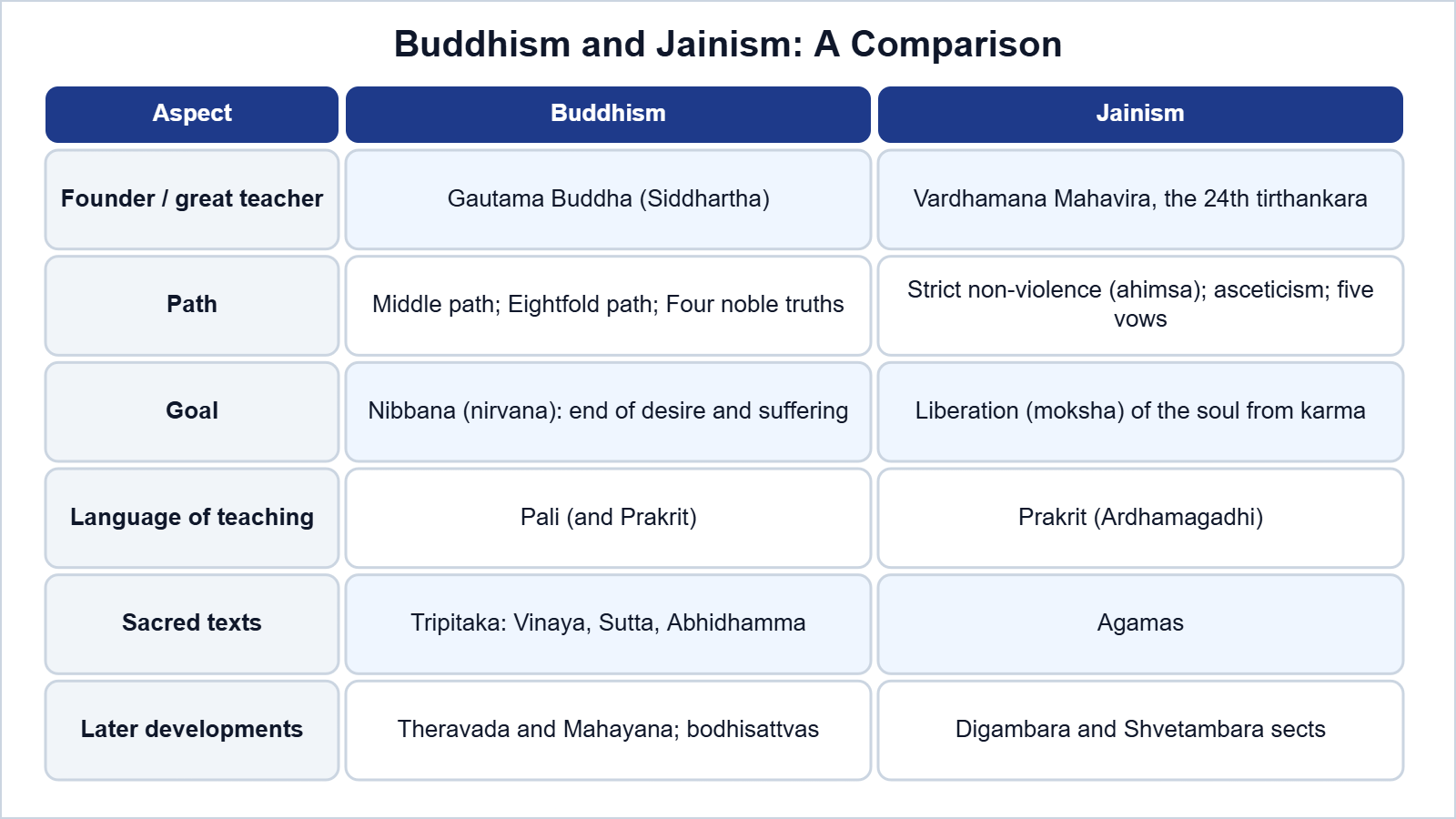
Jainism had a tradition of teachers called tirthankaras; Vardhamana Mahavira was the twenty-fourth. Central Jaina ideas: the entire world is animated (even stones and water have life); ahimsa (non-injury) to all beings; the cycle of birth and rebirth is shaped by karma, and liberation requires asceticism and penance. Jaina monks and nuns took five vows: not to kill, steal, lie, own property, or have sexual relations (the fifth, celibacy, is said to have been added by Mahavira himself).
4. The Buddha and the Quest for Enlightenment
Siddhartha, a prince of the Shakya clan, left home after seeing old age, illness and death, and after long meditation attained enlightenment, becoming the Buddha (the Awakened One). He taught that the world is impermanent and that sorrow arises from desire; following a middle path between luxury and extreme austerity leads to nibbana (the extinguishing of desire). He set up the sangha, an organisation of monks (bhikkhus) and later nuns (bhikkhunis); his foster-mother Mahapajapati Gotami was the first woman ordained.
5. Stupas: Buildings for Relics
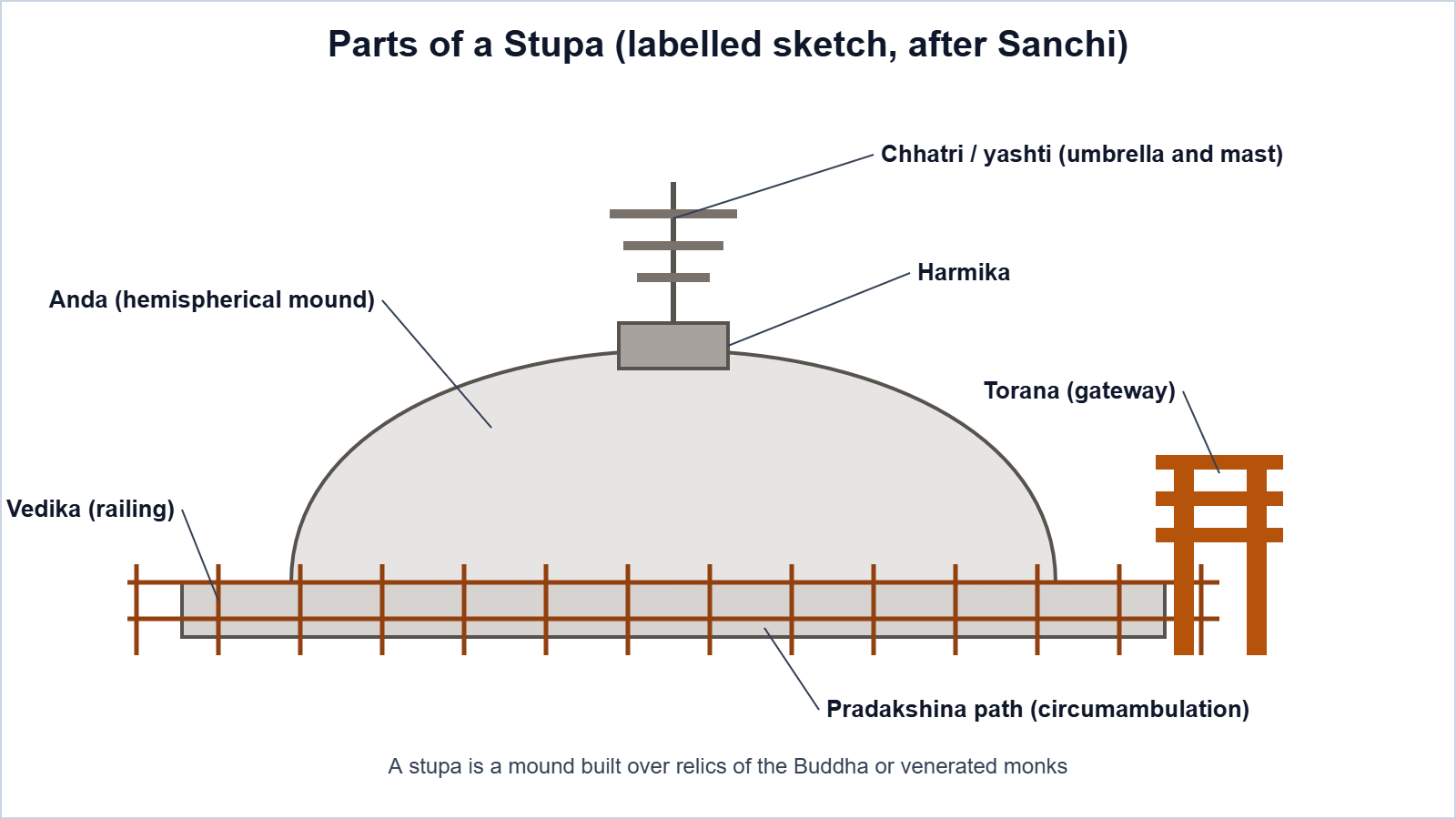
Stupas were mounds built over relics (bodily remains or objects used) of the Buddha or revered monks. Donations from kings, merchants, guilds, monks and nuns built and decorated them, as inscriptions on railings and pillars show.
Sanchi and Amaravati: the Sanchi stupa was preserved partly because of the support of the Begums of Bhopal (Shahjehan Begum and her successor Sultan Jehan Begum), who funded its preservation; it was declared a protected monument and later restored. The stupa at Amaravati (Andhra Pradesh), on the other hand, was dismantled in the nineteenth century and its sculptures were taken to Calcutta, Madras and London.
6. New Religious Traditions: Mahayana and Puranic Hinduism
Mahayana Buddhism (“great vehicle”) developed the idea of the bodhisattva, a compassionate being who helps others attain enlightenment; images of the Buddha and bodhisattvas were worshipped. Followers of the older tradition called it Hinayana (“lesser vehicle”), but it is better called Theravada.
Puranic Hinduism included Vaishnavism (worship of Vishnu and his avatars) and Shaivism (worship of Shiva). Stories in the Puranas made these traditions popular. Temples developed from a small square room (garbhagriha) with one door to tall structures with a shikhara; examples include the Dashavatara temple at Deogarh (Uttar Pradesh) and the Kailashnatha temple at Ellora (Maharashtra), carved out of a single rock.
7. Present State of Research
Historians now see the religious history of this period as a set of interacting traditions rather than separate compartments. They study patronage (who donated and why), the role of women and ordinary people, and the regional spread of ideas. Art historians have shown that sculptures combined Buddhist ideas with popular traditions.
8. How Historians Acquired This Knowledge
European scholars in the nineteenth century often understood Indian sculpture by comparing it with Greek art and found some images strange. Historians now interpret sculptures by studying the texts that describe the stories shown, inscriptions on the monuments, and local traditions. Archaeologists recorded and restored monuments; for example, John Marshall documented Sanchi, and detailed studies of donors’ inscriptions revealed the social background of patrons.
9. Primary Source and How Historians Use It
Sculptures on the gateways of Sanchi. The gateways show scenes from the Buddha’s life and earlier lives (Jataka stories), but in the early sculptures the Buddha is not shown in human form. Instead, symbols represent him: an empty seat (his meditation), the wheel (his first sermon at Sarnath), the stupa (his mahaparinibbana), and a tree (enlightenment). There are also images of a woman swinging from the edge of a gateway (a shalabhanjika, a symbol of good fortune), animals such as elephants, and other scenes from everyday life.
How historians use it: by reading symbols with the help of Buddhist texts, historians understand how the Buddha was remembered and worshipped. The shalabhanjika and animal figures show that Buddhism absorbed popular beliefs and folk traditions. Such sculptures thus reveal the religious ideas and wider culture of their patrons.
10. Timeline
Date / Period | Event |
|---|---|
c. 6th-5th centuries BCE | Mahavira and the Buddha; rise of new ideas |
c. 3rd century BCE | Ashoka supports Buddhism; early stupas |
c. 2nd century BCE – 1st century CE | Gateways and railings of Sanchi decorated |
c. 1st century CE onwards | Mahayana Buddhism; images of the Buddha |
c. 5th century CE | Early temples such as Deogarh |
8th century CE | Kailashnatha temple at Ellora |
1818 | Sanchi stupa “discovered” by Europeans |
19th century | Amaravati stupa dismantled; Sanchi preserved with help from the Begums of Bhopal |
11. Important Terms
Term | Meaning |
|---|---|
Tirthankara | A Jaina teacher; literally “ford-maker” who guides people across the river of existence |
Nibbana | Extinguishing of desire; the goal of Buddhism |
Sangha | The community of Buddhist monks and nuns |
Stupa | A mound containing relics |
Bodhisattva | A compassionate being who delays own liberation to help others |
Garbhagriha | The innermost shrine room of a temple |
Shikhara | The tower over the shrine of a temple |
Jataka | Stories of the previous lives of the Buddha |
12. Short Answer Questions
Q1. Who was the 24th tirthankara?
Ans. Vardhamana Mahavira.
Q2. What is the middle path?
Ans. A path between luxury and extreme austerity taught by the Buddha.
Q3. Who was the first woman to be ordained as a nun?
Ans. Mahapajapati Gotami, the Buddha’s foster-mother.
Q4. Name the main parts of a stupa.
Ans. Anda, harmika, chhatri/yashti, vedika and torana.
Q5. Why was Sanchi preserved while Amaravati was not?
Ans. The Begums of Bhopal funded its preservation and it was protected, whereas Amaravati was dismantled.
Q6. What is a bodhisattva?
Ans. A compassionate being who helps others attain enlightenment.
Q7. What symbols represent the Buddha in early sculptures?
Ans. The empty seat, the wheel, the stupa and the tree.
Q8. Name two types of Puranic Hinduism.
Ans. Vaishnavism and Shaivism.
13. Long Answer Questions
Q1. Compare the teachings of Mahavira and the Buddha.
Ans. Both rejected the authority of Vedic sacrifices and believed in karma and rebirth. Mahavira stressed strict ahimsa, asceticism and five vows to free the soul from karma. The Buddha taught a middle path, the impermanence of the world and the end of desire to reach nibbana. Buddhism spread through the sangha and royal patronage; Jainism emphasised discipline and was supported by traders.
Q2. How do historians interpret the sculptures of Sanchi?
Ans. They read early symbols – the empty seat, wheel, stupa and tree – as representing events in the Buddha’s life, using Buddhist texts as a guide. Images like the shalabhanjika and animals are linked to popular traditions. Inscriptions record donors such as monks, nuns, merchants and guilds. Thus the sculptures reveal religious ideas, patronage and the culture of the time.
14. Source-based Questions
Q1. (Source) A gateway panel shows an empty seat under a tree, with worshippers around it. (a) What does the empty seat represent? (b) Why was the Buddha not shown in human form?
Ans. (a) The Buddha’s meditation/enlightenment. (b) Early Buddhist art used symbols instead of human images of the Buddha.
Q2. (Source) A sculpture shows a woman holding a branch and swinging from the edge of a gateway. (a) What is she called? (b) What does she show about Buddhism?
Ans. (a) A shalabhanjika. (b) That Buddhism absorbed popular beliefs and symbols of good fortune.
Easy Memory Trick: Stupa parts from top: “C-H-A-V-T” = Chhatri, Harmika, Anda, Vedika, Torana.
Conclusion: The period from 600 BCE to 600 CE was rich in thought and art. Jainism, Buddhism and Puranic Hinduism, along with stupas and temples, show how ideas and beliefs were expressed and shared by people of all classes.